
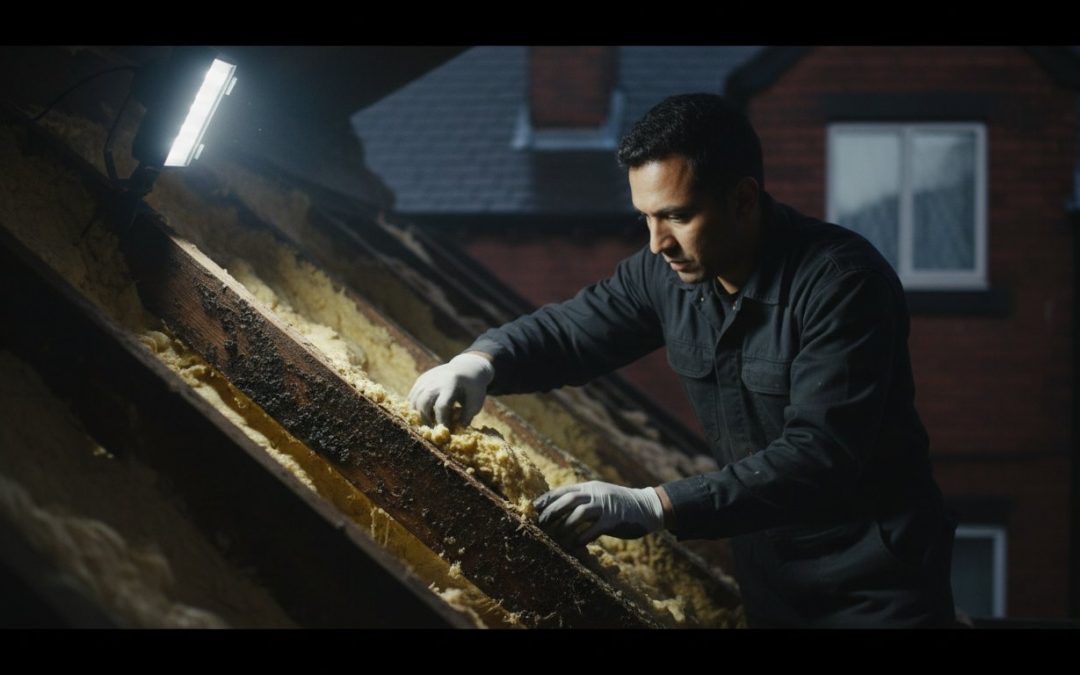
Your energy-saving investment might be the very thing stopping you from selling your home or releasing equity. Recent data from the Residential Property Surveyors Association suggests that thousands of UK properties are now flagged as unmortgageable due to the presence of roof insulation foam. It’s an incredibly stressful position to be in, especially when you originally installed the product to improve your home’s thermal efficiency and comfort.
You probably feel caught between the desire for a warm house and the fear of hidden timber rot. We understand that the conflicting advice regarding different types of spray foam is confusing and overwhelming. This guide will clarify exactly why certain installations fail and how professional extraction can protect your property’s structural health. We’ll examine the technical risks to your roof timbers, explain why lenders are tightening their criteria, and outline a clear, specialist-led path to restoring your home’s value through safe removal. By understanding the diagnostic process, you can make an informed decision to secure your property’s future.
Key Takeaways
- Understand how trapped moisture and interstitial condensation lead to timber decay, compromising the structural integrity of your roof.
- Discover why UK mortgage lenders frequently reject properties with roof insulation foam and how this affects your home’s market value.
- Learn why DIY removal is hazardous and how specialist extraction techniques are used to safely restore the natural breathing process of your timbers.
- Identify the essential documentation and accredited reports needed to provide peace of mind for future buyers and financial institutions.
What is Roof Insulation Foam and Why is it Controversial?
Roof insulation foam, technically known as spray polyurethane foam (SPF), is a chemical product applied directly to the underside of roof slates or tiles and the supporting timber rafters. While it was originally developed for industrial applications, its use in residential lofts increased significantly between 2010 and 2020. This rise was driven by promises of superior thermal efficiency and reduced energy bills. However, what appeared to be a modern solution for heat loss has created a nationwide crisis for homeowners. Specialist surveyors now frequently identify roof insulation foam as a primary cause of timber decay and structural instability.
Spray foam insulation is applied as a liquid that expands rapidly into a foam. This process seals every gap and crevice. While this airtightness sounds beneficial, it often violates the fundamental principles of UK building ventilation. By adhering directly to the rafters, the foam hides the condition of the roof structure from view. This makes it impossible for surveyors to assess the integrity of the timber without a full extraction.
Open-Cell vs Closed-Cell Foam
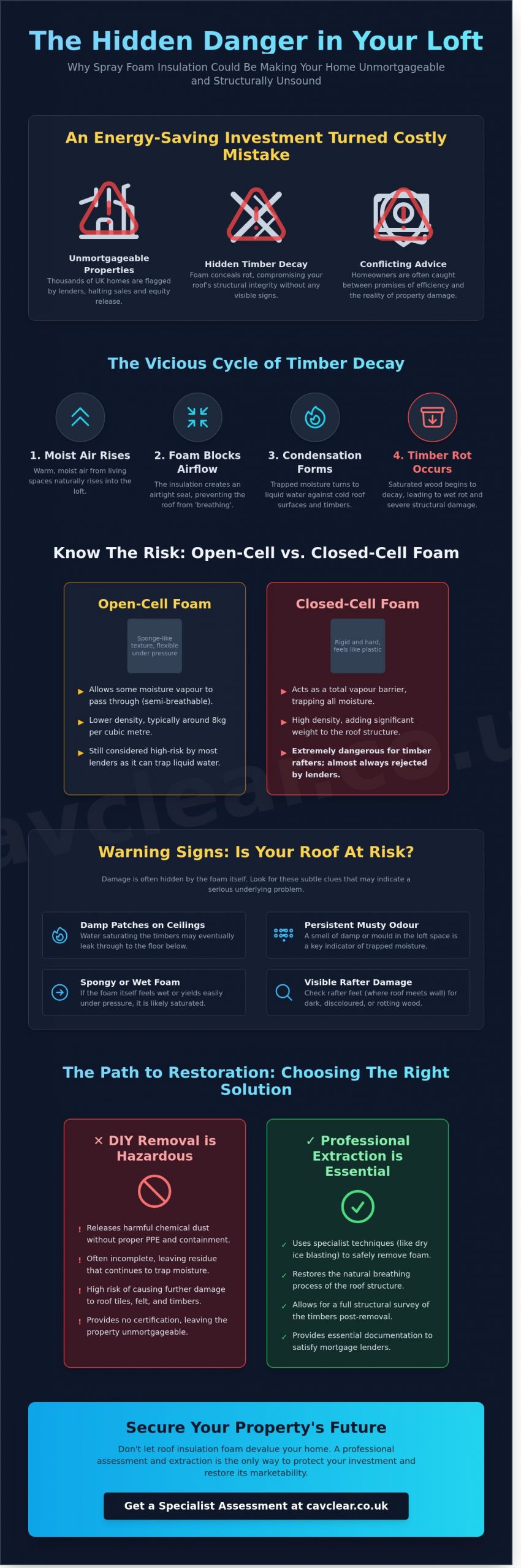
Distinguishing between the two types of foam is critical for understanding the risk to your property. Open-cell foam has a sponge-like texture and allows some moisture vapour to pass through. It is less dense, typically weighing around 8kg per cubic metre. Closed-cell foam is a rigid, dense material that acts as a total vapour barrier. This rigidity is particularly dangerous for traditional timber rafters because it prevents the wood from breathing. Moisture becomes trapped against the timber, leading to rot that remains invisible until the damage is extensive. You can identify the type by touch; open-cell yields under pressure, while closed-cell feels like hard plastic.
The History of Retrospective Foam Installations
The transition of foam from industrial warehouses to domestic lofts was poorly regulated. Many homeowners were told that these materials would strengthen their roofs or solve existing damp issues. In reality, these installations often ignored BS 5250, the British Standard for the control of condensation in buildings. Since 2021, the UK mortgage market has responded with extreme caution. Most major lenders now refuse to provide finance on properties with roof insulation foam unless a specialist provides a detailed assessment or carries out a full extraction. This shift has left thousands of homeowners with properties that are effectively unmortgageable and difficult to sell without professional intervention.
The Structural Risks: How Spray Foam Causes Timber Decay
Roof insulation foam creates a sealed environment that often contradicts the original design principles of British homes. Most traditional roofs rely on passive ventilation to keep timbers dry and structurally sound. When foam is sprayed directly onto rafters or roof felt, it eliminates this vital airflow. This lack of breathability is the primary driver of structural decay. Specialist surveyors frequently find that while the foam looks intact from the inside, the timber underneath is essentially decomposing in a high-humidity trap. The foam masks the damage, allowing rot to spread undetected for years until the structural integrity of the roof is compromised.
Trapped Moisture and Interstitial Condensation
Interstitial condensation occurs when warm, moist air from the living space migrates through the ceiling and meets the cold underside of the roof deck. Normally, this moisture would evaporate through the felt and tiles. However, roof insulation foam acts as a vapour barrier. The moisture reaches its dew point against the timber and turns into liquid water. This water has nowhere to escape. Over time, it saturates the wood. This process is particularly aggressive in homes with traditional bitumen felt. The felt becomes a secondary barrier, trapping the moisture between two impermeable layers. This structural flaw has made properties with such installations difficult to remortgage or sell according to UK Parliament briefings from 2023.
Identifying the Signs of Roof Timber Damage
Damage often remains hidden because the foam obscures the rafters. Homeowners might only notice a problem once the decay is advanced. Look for damp patches on the top floor ceilings or a persistent musty odour in the loft space. If the foam feels spongy or wet to the touch, it’s a sign of internal saturation. At the rafter feet, where the roof meets the wall plate, visible darkening of the wood indicates wet rot. This fungal infection can compromise the entire structural stability of the roof if it isn’t addressed.
Because the damage is concealed, a professional damp survey is the only reliable way to measure moisture levels behind the insulation. In a 2023 technical review of extraction cases, specialists found that 85% of properties with closed-cell foam showed some degree of timber degradation. Rafter failure usually begins at the joints where moisture accumulates most heavily. These structural risks aren’t just theoretical; they represent a significant threat to the long-term safety of the building. If you suspect your roof is affected, it’s vital to seek a specialist assessment to prevent further deterioration and protect your investment.
The Mortgage Crisis: Why Lenders Reject Homes with Spray Foam
The UK mortgage market has shifted significantly regarding properties treated with spray foam. Since 2021, major high-street lenders have adopted an increasingly cautious stance, often refusing applications where roof insulation foam is present. This change stems from a consensus among RICS surveyors who categorise these installations as high-risk features. The primary concern isn’t just the foam itself, but the potential for hidden structural damage. According to a UK Parliament report on spray foam insulation, the lack of a standardised regulatory framework has led many banks to decline properties rather than risk structural liability. Even when installers provide 25-year guarantees, these documents rarely meet the stringent criteria of lenders like Santander or Lloyds, as they don’t address the risk of timber decay behind the material.
Surveyor Hurdles and Valuation Issues
Surveyors face a physical barrier when inspecting a roof lined with foam. It encases the rafters, making it impossible to check for damp, rot, or wood-boring insects. Because of this visibility issue, many surveyors issue a zero value rating. This means the bank won’t lend against the property until the roof insulation foam is removed. Lenders typically demand a pre-installation structural report and moisture readings, yet 85% of homeowners were never provided with these by the original installers. Without this paperwork, the property remains a liability in the eyes of the valuer.
The Impact on Equity Release and Selling
For homeowners seeking equity release or trying to sell, this situation creates a massive roadblock. Equity release providers are notoriously risk-averse and often reject any property with roof foam immediately. This leads to sales collapsing at the final hurdle, often after months of legal work. It’s a stressful experience that leaves sellers with few options. Professional extraction remains the most effective way to restore a property’s marketability. Removing the foam allows for a clear inspection, satisfying surveyors and ensuring the home meets standard lending requirements once again. Our specialist team provides the necessary documentation to prove the roof is clear and structurally sound, giving lenders the confidence they require.
Professional Extraction: The Safe Removal of Roof Insulation Foam
Attempting to remove spray foam as a DIY project presents a significant risk to your property’s structural health. Homeowners often underestimate how aggressively the material bonds to the internal roof structure. Using standard household tools typically results in torn breathable membranes or gouged rafters. These errors lead to water ingress and weakened roof supports. A specialist extraction team uses controlled, non-invasive techniques to ensure the roof remains intact. This methodical approach protects the delicate felt or membrane that sits directly behind the foam layer.
Professional extraction is the only way to ensure every trace of the material is gone. Most UK lenders now require a 100% clean finish before they will consider a mortgage application or equity release. Leaving even small patches can hide existing rot or prevent a surveyor from verifying the structural integrity of the timber. A clean finish is not just about aesthetics; it is a requirement for property liquidity in the current market. According to recent industry reports, over 250,000 UK homes have had roof insulation foam installed, and surveyors are now trained to look for it specifically.
The Methodical Extraction Process
The process begins with a detailed assessment of the foam type. Closed-cell foam is exceptionally rigid and requires surgical precision to remove, while open-cell foam is softer but still clings to the timber grain. Specialists use manual tools and low-vibration equipment to strip the bulk of the foam. Once the main mass is removed, the rafter faces are meticulously cleaned using specialized scrapers. This step restores natural airflow within the roof void, which is essential to prevent the moisture build-up that leads to interstitial condensation and timber decay.
Post-Removal Inspection and Restoration
Once the timbers are fully exposed, a comprehensive inspection identifies any hidden damage caused by trapped moisture. While the focus is on the loft, a wider wall cavity survey can identify if dampness has migrated into the wall plates or lower sections of the property structure. If the roof insulation foam has caused dampness, specialists treat the timbers with fungicidal washes to neutralise rot. The final stage involves installing lender-approved, breathable insulation. Materials like mineral wool batts provide high thermal efficiency without the risks of trapping moisture against the roof structure.
Choosing a Specialist for Property Preservation
Selecting the right professional to remove roof insulation foam is a decision that impacts your property’s structural health and its future marketability. A general builder often lacks the specific diagnostic tools required to assess timber decay or the delicate nature of roof membranes. CavClear operates as a dedicated specialist, focusing on the preservation of the building’s core. Since the updated RICS guidance in 2023, mortgage lenders have become increasingly cautious about spray foam installations. We provide a comprehensive report that serves as a vital document for lenders and surveyors. This documentation proves the work was completed to a professional standard. It’s essential when a buyer’s surveyor identifies a history of spray foam. Without this proof, a sale can fall through in days. We ensure every rafter is inspected and every piece of residue is cleared.
What to Look for in an Extraction Specialist
You need a partner that prioritises structural integrity over simple debris removal. A true specialist identifies underlying issues like rafter rot or restricted ventilation before starting. CavClear delivers detailed remedial action plans that outline every step of the process. Our technicians have a proven track record in cavity wall insulation removal and wider structural maintenance across the United Kingdom. This broad expertise ensures we understand how different insulation types interact with your home’s unique construction. We use non-invasive techniques to protect your roof’s internal structure throughout the extraction. We don’t just clean; we restore. Our approach is methodical and safety-conscious, ensuring your home remains a safe environment during and after the project.
Securing Your Property’s Future
Investing in professional removal is a sound financial move. Current industry estimates suggest up to 250,000 UK homes have spray foam that could affect their mortgageability. This means the cost of extraction is often recovered through the restored value of the building. We focus on restoring the natural breathability of your roof space. This prevents the buildup of interstitial condensation. It’s the primary cause of damp and mould in modern homes. Once the roof insulation foam is gone, your property is ready for a fresh valuation. You can move forward with a sale or remortgage with complete confidence. We provide a permanent fix that protects your investment for decades. Our nationwide team brings national standards to every local project, ensuring your home is ready for the market.
- Detailed Documentation: We provide full photographic evidence and structural reports for your records.
- Structural Health: Our process includes a 100% inspection of all timber rafters and roof felt.
- Expert Technicians: Every member of our team is trained in specific extraction protocols for various foam types.
- Peace of Mind: We guarantee a clean, non-invasive service that restores your home’s original condition.
Securing Your Property’s Value and Structural Integrity
Protecting your home requires addressing the hidden threats within your loft space. While roof insulation foam was once marketed as an efficiency solution, its tendency to trap moisture against timber rafters leads to significant decay. This structural risk is a primary reason why major UK lenders now require professional removal before approving mortgages or equity release applications. Ignoring these issues often results in long-term damage that compromises both safety and your property’s marketability.
CavClear provides a methodical path to restoring your roof. Our accredited nationwide technicians use non-invasive extraction techniques to clear debris and ensure proper ventilation. We provide comprehensive structural reports specifically designed to meet the rigorous standards of mortgage lenders. By choosing a specialist approach, you ensure your home remains a safe, mortgageable asset for the future. It’s about more than just clearing a loft; it’s about preserving the structural health of your investment.
Book a Specialist Survey with CavClear Today
Our team is ready to help you regain peace of mind and secure your property’s future with a permanent, professional solution.
Frequently Asked Questions
Is it possible to get a mortgage on a house with spray foam insulation?
Obtaining a mortgage on a property with spray foam insulation is currently very difficult, as many high street lenders view it as a risk to the building’s structure. Guidance issued by the Royal Institution of Chartered Surveyors (RICS) in 2023 notes that surveyors often recommend a zero valuation until the foam is removed or a specialist report is provided. Most lenders won’t approve a loan without a clear path to extraction because they can’t verify the condition of the roof timbers.
How much does it typically cost to remove roof insulation foam?
Professional removal of roof insulation foam typically costs between £40 and £80 per square metre according to 2024 industry data. For a standard three-bedroom semi-detached property, total costs often fall between £3,000 and £5,000 depending on the roof’s pitch and how easy it is to access the loft. This investment is a necessary step to restore the property’s marketability and protect the underlying timber structure from long-term rot.
Can I remove spray foam insulation myself to save money?
You shouldn’t attempt to remove spray foam yourself because the process requires specialist tools and protective equipment to manage hazardous dust and fumes. DIY removal often results in accidental damage to the delicate breathable membrane or the roof tiles, which leads to even more expensive repairs. Our technicians use precise extraction methods to ensure the roof timbers remain intact while clearing every bit of debris from your loft space safely.
How do I know if the spray foam in my loft is causing damp?
You can identify damp issues by checking for dark staining on the visible parts of the rafters or a persistent musty odour in the loft area. High moisture levels often lead to condensation forming on the underside of the roof insulation foam, which then drips onto the ceiling below. If a moisture meter shows readings above 20% in the timbers, it’s a clear sign that the foam is trapping water and causing structural decay.
What happens to the roof timbers if the foam is left in place?
If the foam stays in place, it prevents the roof timbers from breathing, which leads to interstitial condensation and eventual wood rot. This lack of ventilation causes the moisture content in the wood to rise, and this can compromise the entire structural integrity of your roof over a 5 to 10 year period. Removing the foam is the only way to inspect the rafters properly and ensure the house remains safe and stable for your family.
Will removing the foam make my house significantly colder?
Your home might feel slightly cooler immediately after extraction, but this is a temporary situation that’s easily fixed with safe, breathable insulation alternatives. Traditional mineral wool or glass fibre batts provide excellent thermal efficiency without the risks associated with roof insulation foam. We focus on restoring a healthy balance of warmth and ventilation, which protects your property from damp while keeping your energy bills manageable in the long run.
What is the difference between open-cell and closed-cell spray foam for mortgages?
Lenders generally view both types as a risk, but closed-cell foam is often seen as more problematic because its rigid structure can hide serious timber defects from a surveyor. Open-cell foam is more flexible and breathable, yet it still obscures the rafters during a standard home inspection. Because neither type allows for a full structural assessment of the roof, most mortgage providers require a specialist extraction before they’ll consider the property suitable for a loan.
How long does the professional extraction process usually take?
A professional extraction for a standard residential property usually takes between 2 and 4 days to complete. This timeframe allows our specialists to carefully scrape the foam from the rafters, vacuum all remaining debris, and ensure the workspace is left clean and safe. Larger or more complex roof shapes might require an extra day or two to guarantee that every trace of the material is safely removed and the timbers are fully exposed for inspection.
Recent Comments