
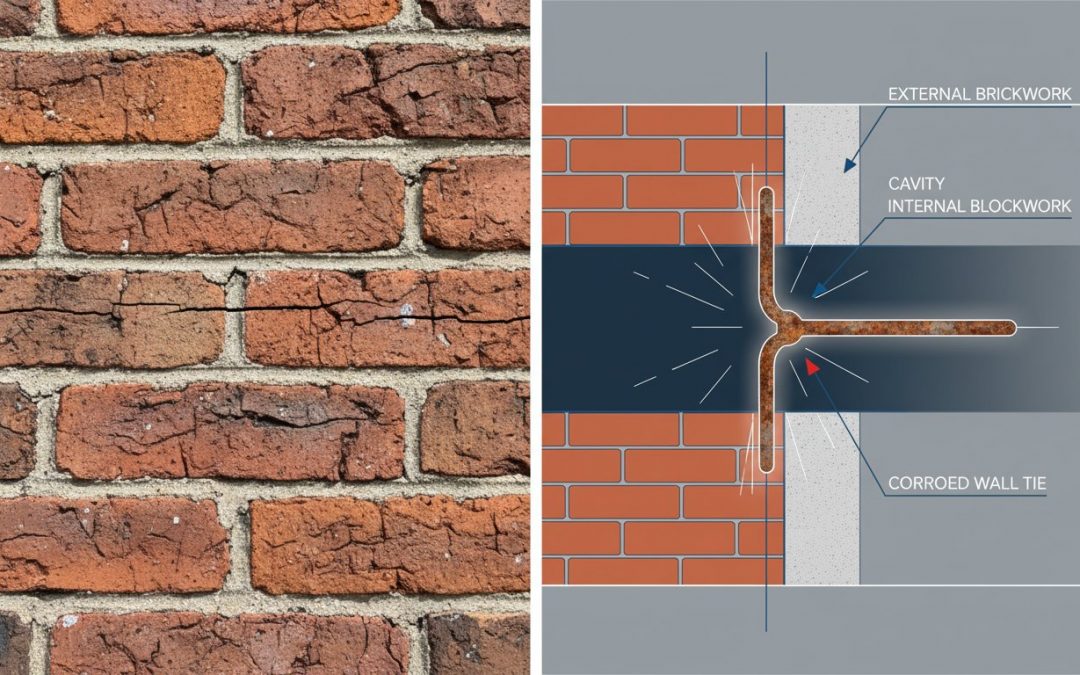
The horizontal fractures appearing in your mortar joints are more than just aesthetic flaws; they’re the visible symptoms of a progressive chemical reaction that can compromise your home’s entire structural integrity. It’s common for property owners to feel a sense of anxiety when they spot new gaps in their masonry, particularly when it’s difficult to distinguish between harmless settling and a serious technical fault. Understanding the specific geometry of wall tie failure cracks in brickwork is the first step toward preventing avoidable structural damage and restoring your peace of mind.
This guide provides the technical clarity you need to identify these issues accurately, helping you move from uncertainty to a defined plan for professional restoration. As a nationwide specialist, we’ll examine the underlying causes of tie corrosion, the latest 2026 standards for masonry structures such as PD 6697:2019, and the non-disruptive methodology required to secure your property’s long-term health. By following a methodical diagnostic process, you can ensure your home remains a safe, stable investment for decades to come.
Key Takeaways
- Learn to identify wall tie failure cracks in brickwork by recognizing horizontal fractures in mortar joints that appear at regular, repeating intervals.
- Understand the chemical mechanics of corrosion and how the expansion force of rusting ties can physically lift and destabilize your property’s masonry.
- Differentiate between wall tie corrosion and other structural issues like subsidence or thermal expansion to ensure the correct remedial path is taken.
- Discover why a specialist survey using a high-definition borescope is the only definitive way to assess tie density and the condition of the cavity.
- Explore the professional methodology for isolating original ties and installing permanent, non-disruptive replacements to restore your home’s structural integrity.
Identifying Wall Tie Failure Through Brickwork Cracking
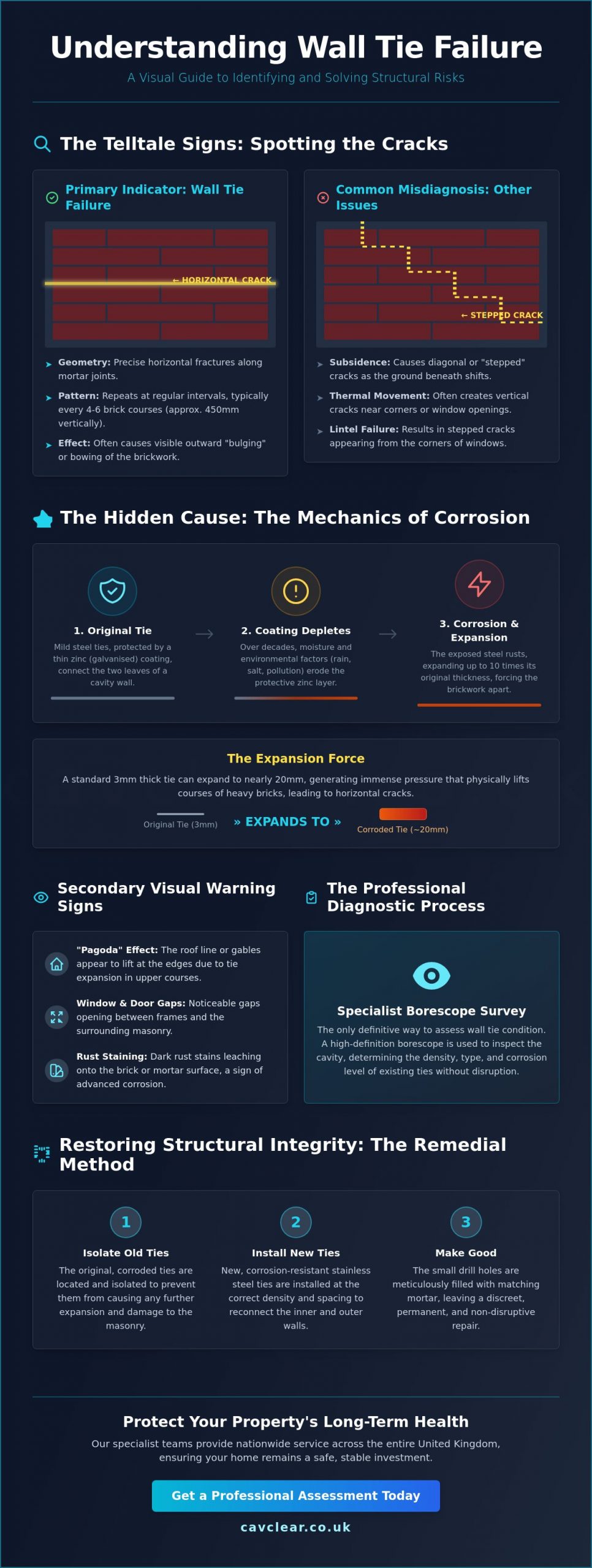
The most recognizable indicator of structural instability in cavity walls is the emergence of horizontal fractures within the mortar joints. Unlike ground movement which usually causes diagonal or “stepped” cracking, wall tie failure cracks in brickwork follow the horizontal bed joints with mathematical precision. These cracks typically manifest at regular intervals, often every fourth to sixth course of bricks. This pattern directly correlates with the vertical spacing of the original metal ties installed during construction, which are typically placed every 450mm vertically.
When the protective zinc coating on older mild steel ties degrades, the resulting iron oxide occupies a significantly larger volume than the original metal. This expansion creates an irresistible upward force that physically lifts the masonry courses above it. As the external leaf of the wall moves independently from the internal leaf, you’ll often notice a visible “bulge” or bowing in the brickwork. This distortion isn’t just an aesthetic concern; it’s a clear signal that the structural bond between the two layers of your wall has been compromised.
Internal symptoms often accompany these external warning signs. You may observe cracks in the internal plasterwork or, in more severe cases, the separation of floor joists from the wall. This happens because Cavity wall ties are essential for transferring lateral loads between the two leaves. When they fail, the stability of the entire building envelope is at risk. You’ll also likely see sagging lintels or cracks appearing around window reveals as the masonry shifts and loses its primary support system.
The Geometry of a Wall Tie Crack
The primary distinction of a wall tie crack is its horizontal orientation. While subsidence forces masonry to pull apart in a stepped fashion, the expansion of corroding ties pushes the bricks apart vertically. If you notice a crack that maintains a consistent width across the entire elevation of your property, it’s a strong indicator of active expansion. Distinguishing between this active movement and historic settling is vital for determining the urgency of a professional survey. Our specialist teams look for these specific geometric markers to differentiate between harmless aging and critical faults.
Secondary Visual Warning Signs
Beyond the brickwork itself, other architectural features provide clues. A “pagoda” effect, where the roof line or gables appear to lift at the edges, suggests significant tie expansion in the upper courses. You should also check for gaps opening between window frames and the surrounding masonry. While rare, you might occasionally see dark rust staining leaching onto the mortar surface; this is a critical sign of advanced corrosion that requires immediate technical intervention to prevent further masonry damage.
The Mechanics of Corrosion: Why Cavity Wall Ties Fail
The degradation of a property’s structural skeleton begins with a silent chemical transition. Most homes built between 1920 and 1981 utilized mild steel ties protected by a thin layer of sacrificial zinc. Over time, this galvanised coating depletes, leaving the raw steel vulnerable to oxygen and moisture. Once the protective layer is gone, the steel reacts to form ferrous oxide, commonly known as rust. This isn’t just a surface-level change; the metal physically expands as it oxidizes. A standard 3mm thick tie can grow to nearly 20mm in thickness. This massive expansion generates enough upward pressure to lift heavy masonry courses, resulting in the characteristic wall tie failure cracks in brickwork that compromise your home’s stability.
The “fishtail” tie, a flat-bar design common in mid-20th-century construction, is particularly prone to causing significant damage. Because these ties have a larger surface area than modern wire alternatives, the volume of rust they produce is substantially greater. This leads to more pronounced horizontal cracking and a higher risk of the outer leaf separating from the main structure. Environmental factors act as catalysts in this process. Properties across the United Kingdom, especially those in coastal regions, face constant exposure to salt spray which acts as an electrolyte to speed up corrosion. Industrial pollution and consistent driving rain also penetrate the masonry, ensuring the metal remains in a permanently damp state. A professional investigation of wall tie failure often reveals that these conditions can reduce the lifespan of original ties to just 15 to 20 years.
The Role of Cavity Wall Insulation
Retrospective cavity wall insulation is a frequent but often overlooked accelerator of tie corrosion. When these materials are injected into a cavity, they can trap moisture against the metal ties rather than allowing the space to breathe. This creates a saturated environment that triggers rapid oxidation. Because the insulation holds water like a sponge, the chemical reaction between the wet material and older galvanised steel is relentless. If your property shows signs of distress, cavity wall insulation removal is often a necessary prerequisite for successful remedial work. Extracting the damp material allows the wall to dry and prevents further accelerated damage to your new structural components.
Material Science: Galvanisation vs. Stainless Steel
Early 20th-century zinc-coating standards were simply not designed for century-long durability. While wire ties might snap and lead to wall bowing, the thicker fishtail ties are almost certain to cause horizontal fractures. Modern remedial solutions bypass these issues by using 304 or 316 grade stainless steel. These alloys contain chromium, which creates a self-healing oxide layer that resists corrosion even in high-moisture or coastal environments. Choosing the correct material ensures a permanent fix and protects your property’s long-term asset health. If you’ve spotted fractures in your mortar, arranging a specialist wall tie inspection is a proactive step toward securing your home’s future.
Assessing the Risk: Horizontal Cracks vs Other Structural Issues
Identifying the specific nature of masonry damage is essential for a correct technical remedy. Many homeowners mistake wall tie failure cracks in brickwork for subsidence, yet the two issues have distinct physical profiles. Subsidence typically results in diagonal or vertical cracks that are wider at the top than the bottom, indicating ground movement. In contrast, wall tie corrosion creates horizontal fractures that maintain a consistent width across the elevation of the property. This distinction is vital because the structural solutions for ground movement and tie failure are entirely different.
Thermal expansion and sulphate attack also present symptoms that can confuse an untrained eye. Thermal movement usually concentrates at corners or rooflines where the masonry is most exposed to temperature fluctuations. Sulphate attack is a specific chemical breakdown often found in older chimneys or walls where combustion gases or moisture react with the mortar. Misdiagnosing these as simple maintenance issues leads many to attempt repointing. This is merely a temporary bandage. Because the underlying corrosion remains active, the expanding metal will eventually shatter the new mortar, leading to more extensive and costly masonry damage over time.
Diagnostic Comparison Table
To help you differentiate between these common structural faults, use the following comparison framework based on standard diagnostic observations.
| Structural Issue | Primary Crack Pattern | Nature of Movement |
|---|---|---|
| Wall Tie Failure | Horizontal, regular intervals (4th-6th course) | Progressive expansion and bowing |
| Subsidence | Vertical or Diagonal, tapering width | Ground-dependent and downward |
| Settlement | Random, hairline fractures | Generally non-progressive after initial years |
The ‘Tipping Point’ of Structural Integrity
A crack moves from a maintenance concern to a structural emergency when bowing or “bulging” becomes visible to the naked eye. If the external leaf loses its connection to the internal leaf, it becomes vulnerable to wind suction. During high winds, this lack of lateral restraint can lead to the sudden collapse of the outer masonry wall. Our nationwide teams frequently encounter properties where these issues have been ignored, resulting in preventable structural failure that endangers residents and the public.
Beyond safety, wall tie failure cracks in brickwork significantly impact the mortgageability and sale of a property. Surveyors often flag these patterns as structural defects, which can prevent a sale or lead to substantial devaluations. Lenders typically require a specialist Wall Tie Survey to be completed before approving funds. Addressing the problem early through professional intervention ensures your home remains a secure asset and prevents the escalation of repair costs. Restoration of structural stability is a vital investment in the property’s future health and market value.
The Professional Wall Tie Survey and Diagnostic Process
While identifying wall tie failure cracks in brickwork is a critical first step, a definitive assessment requires a methodical technical investigation. We utilize high-definition borescopes to perform intrusive inspections without compromising the aesthetic or structural integrity of your masonry. This technology allows our specialists to view the internal condition of the cavity directly, providing clear evidence of corrosion that isn’t visible from the street. A formal technical report is the final output of this process, serving as a vital document for property buyers, insurers, and mortgage lenders who require proof of structural stability.
The diagnostic process begins with non-destructive metal detection to locate the exact positions of existing ties. We map the property to determine if the tie density meets the required safety standards, as insufficient ties can lead to wall bowing even without advanced corrosion. Our technicians look for patterns of placement that might suggest poor original workmanship. By identifying the specific location of every metal component, we can plan a remedial strategy that targets the areas of highest risk while maintaining the property’s overall health.
What Happens During a Specialist Survey?
Our technicians drill discrete pilot holes at strategic points across the building’s elevation. These entry points allow for the insertion of a borescope to inspect the cavity for mortar “snots,” debris, or failing insulation material that may be trapping moisture. This level of detail is essential, as trapped moisture is a primary driver of metal degradation. The process mirrors the rigorous standards described in our professional damp survey guide, ensuring that environmental factors are fully accounted for. We also measure the embedment depth of existing ties to verify they’re still providing the necessary lateral restraint between the internal and external leaves.
Interpreting the Condition Grades
The findings are categorized using a standardized scale ranging from ‘Sound’ to ‘Severe Corrosion’. It’s a common mistake to only inspect walls where wall tie failure cracks in brickwork are already present. We survey all elevations because environmental exposure varies, and corrosion often progresses at different rates across the property. Our specialist then recommends a bespoke remedial action plan based on these grades, ensuring that repairs are proportionate to the actual risk. If you’ve noticed fractures in your mortar, arranging a professional Wall Tie Survey is the most reliable way to secure a permanent resolution.
Specialist Remedial Solutions and Wall Tie Replacement
Resolving the structural instability indicated by wall tie failure cracks in brickwork requires a dual-stage technical approach. Simply installing new ties alongside corroded ones is a frequent mistake that leads to ongoing masonry damage. The original ties continue to expand as they rust, meaning the internal pressure within the mortar joints remains active. To achieve a permanent fix, our specialist methodology focuses on isolating the original ties. This process ensures that the iron oxide expansion is neutralized, preventing the recurrence of horizontal fractures and protecting the long-term health of your property’s facade.
We utilize three primary types of remedial ties depending on the specific masonry type and mortar condition identified during the survey. Mechanical expansion ties provide a reliable fix in hard masonry, while resin-bonded ties are used when the internal leaf is constructed of softer materials like lightweight blockwork. Helical ties, made from high-grade stainless steel, are driven into small pilot holes to provide a non-disruptive, high-strength connection. These modern solutions are designed to last for the remaining life of the building, framing the repair as a vital investment in your property’s structural future.
The Isolation and Replacement Methodology
Our technicians prioritize a clean and non-disruptive environment. We use specialist tools to isolate old ties, often employing foam sleeves or physical removal techniques to stop them from lifting the brickwork further. Precision drilling ensures that the structural integrity of the bricks is maintained throughout the process. Once the new stainless steel ties are installed, we perform meticulous colour-matching of the mortar. This attention to detail results in discrete, nearly invisible repairs that restore the original aesthetic of your home. For a deeper look at this process, you can read our wall tie replacement guide.
Why Professional Installation is Vital
Achieving the correct tie density is fundamental to building safety. Industry standards typically require a minimum of 2.5 ties per square metre, with increased density around window and door openings. If the resin bonding is applied incorrectly in weak or sandy mortar, the tie will fail to provide the necessary lateral restraint. Our nationwide teams perform rigorous tension and pull-out tests to verify the load-bearing capacity of the new installation. This data-driven approach allows us to provide the structural certification required by lenders and insurers. If you have concerns about the stability of your masonry, contact CavClear to arrange a professional wall tie survey across the United Kingdom.
Securing Your Property’s Structural Future
Wall tie failure cracks in brickwork represent a significant technical fault that compromises the safety of your building envelope. Acknowledging the stress these fractures cause is the first step toward a permanent resolution. The transition from rusting mild steel to expanding ferrous oxide creates an irresistible force that only professional intervention can neutralize. By addressing these symptoms early, you prevent the risk of external leaf collapse and avoid the escalating costs associated with major masonry failure.
Our accredited nationwide technicians use a clean, non-disruptive remedial methodology to restore stability without impacting your property’s aesthetic. We provide detailed technical reporting that serves as essential documentation for insurers and mortgage lenders, protecting your asset’s market value. Investing in specialist repairs today ensures your home remains a safe and comfortable environment for decades to come. Secure your property’s future with a specialist Wall Tie Survey from CavClear. Taking this proactive step provides the lasting assurance that your property’s structural integrity is in expert hands.
Frequently Asked Questions
Can I ignore horizontal cracks in my brickwork if they aren’t getting bigger?
No, you shouldn’t ignore these fractures because corrosion is a progressive chemical process that doesn’t stop once it starts. Even if the visible gaps appear stable, the metal ties inside the cavity continue to expand as they rust. This internal pressure eventually reaches a tipping point where the structural bond fails, potentially leading to the sudden and dangerous collapse of the external masonry leaf.
How much does it cost to replace failing wall ties in a standard UK home?
The total investment for remedial work depends on several technical factors including property size, the number of ties required, and scaffolding requirements. While industry data suggests broad ranges for labor and materials, every building presents unique access challenges and masonry conditions. You should arrange a specialist technical assessment to receive a bespoke plan that addresses your property’s specific structural needs rather than relying on generic estimates.
Will wall tie failure show up on a standard RICS homebuyer’s report?
A general surveyor will often identify the visual symptoms of wall tie failure cracks in brickwork, such as horizontal fractures or masonry bowing. However, these reports are usually non-intrusive and cannot confirm the internal condition of the ties. If symptoms are spotted, the surveyor will typically recommend a further specialist inspection using a borescope to determine the severity of the corrosion and the necessary remedial action.
Can failing cavity wall insulation cause my wall ties to rust faster?
Yes, wet or degraded cavity wall insulation frequently accelerates the oxidation of metal ties by trapping moisture within the wall. This creates a permanently damp environment that strips the protective zinc coating from older ties much faster than a dry cavity would. In these scenarios, we often perform cavity wall insulation extraction to ensure the wall can dry out properly before we install new stainless steel replacements.
How long does the wall tie replacement process take to complete?
A typical remedial project for a semi-detached property usually takes between two and four days to finish. This timeframe includes the precision drilling of new tie positions, the isolation of original corroded components, and the final making good of the mortar joints. Larger detached homes or properties with complex architectural features will naturally require a longer schedule to ensure all structural standards and safety protocols are met.
Is wall tie replacement a messy or disruptive process for the homeowner?
Modern remedial methodology is designed to be exceptionally clean and has minimal impact on your daily routine. All work is performed from the exterior of the building, so there’s no requirement for technicians to enter your home. We use dust-extraction systems during the drilling phase and ensure all mortar repairs are colour-matched to the existing facade, leaving your property’s appearance restored and the site tidy.
What is the difference between a mechanical tie and a resin-bonded tie?
Mechanical ties use an expansion sleeve to grip the masonry, which makes them highly effective for solid brick or hard stone walls. Resin-bonded ties use a chemical adhesive to secure the tie in place, providing a reliable solution for softer materials like thermal blocks or aerated concrete. A specialist survey determines which fix is technically appropriate by testing the pull-out strength of your specific masonry type.
Do I need to replace all the ties in my house if only one wall is cracking?
While it’s possible to treat a single elevation, we strongly recommend a full property inspection to ensure total structural stability. If one wall exhibits wall tie failure cracks in brickwork, the ties in the other elevations were likely manufactured and installed at the same time and are subject to the same environmental aging. Replacing all ties provides a permanent, uniform fix that protects the long-term health and value of the entire asset.
Recent Comments