

Your home’s biggest threat isn’t the weather outside; it’s the wet, degraded material trapped inside your walls. When cavity insulation fails, it stops being a barrier and starts acting as a bridge for moisture. This leads to the persistent black mould and cold spots you’ve been battling. It’s exhausting to deal with rising heating costs when your property should be protected. Research indicates that saturated masonry can lose up to 50% more heat than dry brickwork, making professional extraction a necessity for your comfort. Achieving true peace of mind after removing bad insulation requires a methodical, specialist approach that addresses the root cause rather than just the symptoms.
We understand that the health of your property is a priority, especially when dampness threatens its long-term value. This article explains how a professional extraction process restores your home’s thermal efficiency and protects its structural integrity. You’ll discover how we ensure your wall cavity is 100% clear of debris, preventing future damp issues and securing your investment. We’ll examine the technical steps required to return your home to a dry, safe, and mould-expert environment.
Key Takeaways
- Understand how removing defective materials like saturated mineral wool restores the cavity’s natural ability to prevent moisture transfer and protect your internal walls.
- Learn why specialist extraction is a precise, non-invasive procedure that ensures a complete clearance of debris, avoiding the structural risks of non-expert attempts.
- Gain true peace of mind after removing bad insulation by following a managed drying timeline that eliminates persistent damp and restores a healthy living environment.
- Discover the critical link between wet insulation and wall tie corrosion, and how a professional survey during extraction protects your home’s long-term structural integrity.
- Identify the immediate benefits of a clear cavity, from improved indoor air quality and reduced humidity to the long-term preservation of your property’s value.
The Burden of Defective Cavity Wall Insulation
Many UK properties suffer from insulation materials that were never fit for purpose or were installed without regard for the building’s location. “Bad” insulation typically refers to saturated mineral wool, failing urea-formaldehyde foam that has degraded into toxic dust, or loose-fill beads that have settled unevenly. These materials transform from thermal barriers into moisture reservoirs. For families across the country, the psychological toll is heavy. Living with persistent black mould and the constant scent of damp creates a stressful home environment that feels impossible to escape. True peace of mind after removing bad insulation comes from knowing your home’s structural health is finally being restored.
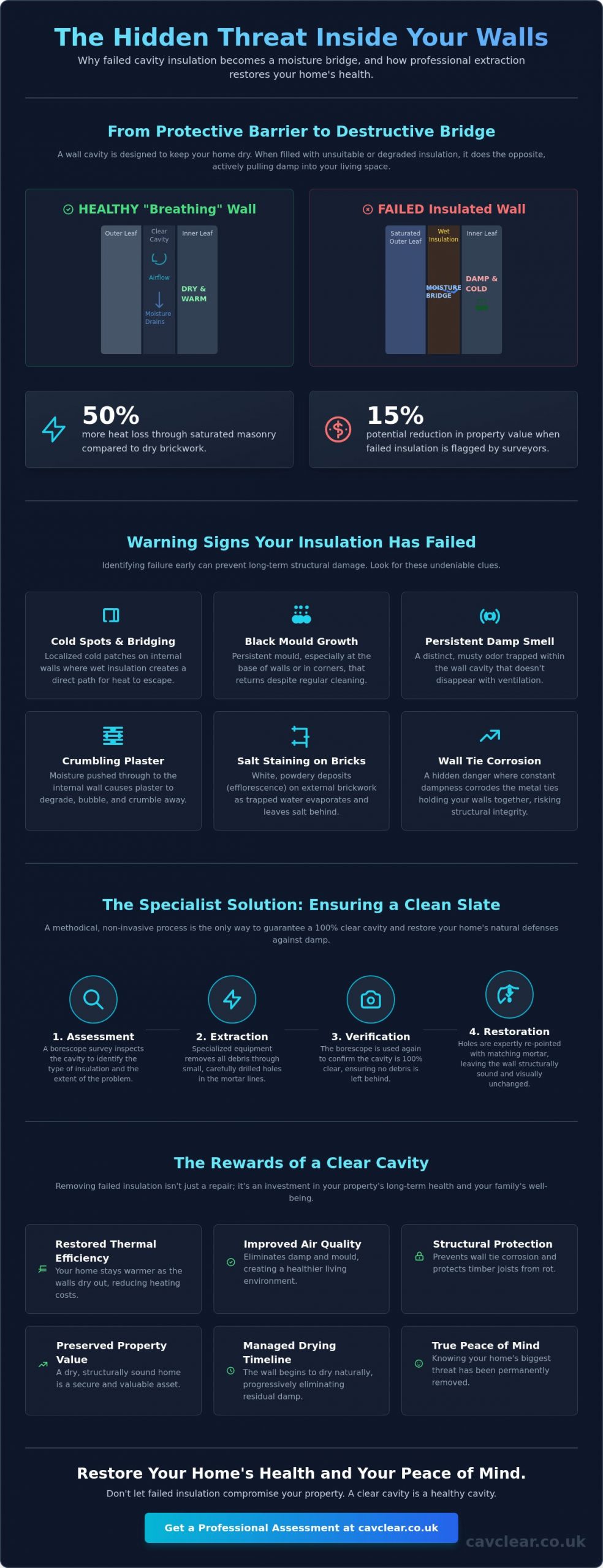
Retrospective insulation often fails because it ignores the fundamental design of a Cavity Wall, which is intended to provide a clear path for moisture to drain away. In regions exposed to high levels of wind-driven rain, such as the Western coast where annual rainfall often exceeds 1,000mm, filling this gap is a recipe for disaster. The hidden cost of inaction is significant. Beyond health risks, wet insulation accelerates the corrosion of wall ties and can reduce a property’s market value by up to 15% when flagged by surveyors during a sale.
Common Signs Your Insulation Has Failed
Identifying a failure early can prevent long-term structural damage. Look for “cold bridging,” which occurs when wet insulation creates a direct thermal path between the external and internal walls, resulting in localized cold spots. You might also notice a distinct, heavy smell of damp trapped within the wall cavity that doesn’t disappear with ventilation. Visual cues are often undeniable: crumbling plaster, white salt staining on brickwork, and black mould that returns despite regular cleaning. These symptoms indicate that the cavity is no longer breathing.
Why ‘no-obligation’ Insulation Often Becomes an Expensive Problem
The legacy of mass-scale installation schemes has left thousands of UK homeowners with unsuitable cavity fills. Many contractors ignored property suitability, installing materials in homes with porous brickwork or in high-exposure zones. Once these materials become moisture-saturated, they act as a bridge, allowing water to track directly from the outer leaf to your internal decor. Interstitial condensation occurs when warm, moist air from inside the home penetrates the wall and reaches its dew point within the cavity, turning into liquid water that saturates the insulation. This process ensures the wall stays wet year-round, making professional extraction the only viable solution for long-term peace of mind after removing bad insulation.
The Science of the Breathing Wall: Why Clear Cavities Matter
UK architecture adopted the cavity wall in the early 20th century as a direct response to our driving rain and high humidity levels. The primary function of this 50mm to 100mm gap is to act as a physical barrier. It breaks the path of moisture, preventing rain that saturates the external brickwork from reaching the internal leaf through capillary action. When this space is filled with unsuitable or degraded materials, that protective barrier vanishes. Instead of a shield, the insulation becomes a bridge, actively pulling water into your living space.
The building science of moisture management dictates that a wall must be able to dry out. In a damp-prone climate like the UK, a clear cavity allows for the natural evaporation of moisture that inevitably enters the structure. Removing failed materials restores this essential function, providing homeowners with genuine peace of mind after removing bad insulation because the house can finally breathe again. A clear cavity isn’t a defect; it’s a functional design feature that protects the structural integrity of your home.
Managing Moisture Transfer and Airflow
Air circulation is the property’s natural defense against rot. Within a clear cavity, air moves steadily, preventing the build-up of stagnant, humid pockets. This airflow is vital for the health of structural timbers, such as floor joists and wall plates, which can suffer from fungal decay if moisture levels exceed 20%. You can learn more about what is a cavity wall to understand how these components interact. Stagnant moisture doesn’t just damage wood; it creates an environment where mold spores thrive, compromising the air quality inside your home. Our extraction process ensures these pathways are completely clear of debris.
Thermal Performance vs. Structural Health
There’s a common misconception that an empty cavity means an inefficient home. However, the thermal performance of a wall depends heavily on it being dry. Saturated brickwork has a significantly lower R-value than dry masonry. When insulation becomes damp, it loses its ability to trap heat and instead acts as a thermal bridge, conducting cold directly into the house.
- Dry Masonry: Acts as a natural insulator, keeping the inner leaf warm.
- Wet Insulation: Increases heat loss by up to 30% compared to a dry, clear cavity.
- Structural Integrity: A clear cavity prevents wall tie corrosion caused by constant moisture contact.
A clear, dry cavity maintains the integrity of the thermal envelope. It ensures that the inner leaf stays warm and dry, which is far more efficient than a wet, insulated wall that promotes heat loss through evaporation. Restoring this balance is a key step in protecting your property’s long-term value. If you are concerned about damp patches or cold spots, our specialists can provide a professional cavity assessment to determine the state of your wall’s health.
The Specialist Extraction Process: Ensuring a Clean Slate
Extraction isn’t a simple cleaning task; it’s a precision surgical procedure. When homeowners attempt DIY removal or hire non-specialists, they often face catastrophic results. Standard vacuum equipment lacks the power to clear heavy, damp-saturated material. This leads to blockages and pockets of debris that continue to bridge the cavity, allowing moisture to travel from the outer leaf to the inner wall. Proper extraction requires a methodical approach that addresses every square inch of the void to prevent future damp issues.
CavClear utilizes a non-invasive technique designed to protect the structural integrity of your home. Technicians work from the outside, drilling small, strategically placed holes in the mortar joints. This avoids damaging the brickwork. Our industrial-grade vacuum systems provide the suction necessary for 100% material removal, even when the insulation has turned into a wet, heavy sludge. Achieving total clearance is the only way to ensure peace of mind after removing bad insulation.
Borescope Inspections: Seeing the Unseen
Visual verification is the foundation of a successful extraction. Technicians insert high-definition borescope cameras into the cavity to inspect the progress. These cameras identify hidden debris, “mortar snots” from the original construction, and “bridging” points where insulation has snagged on wall ties. Without this technology, it’s impossible to confirm the cavity is clear. Providing homeowners with post-extraction video evidence is vital for peace of mind after removing bad insulation because it offers undeniable proof that the root cause of damp has been eliminated.
Accredited Technicians and Professional Standards
Property preservation requires expertise that general builders often lack. A specialist contractor understands the physics of airflow within a cavity and how it impacts thermal efficiency. When choosing a provider, always demand a comprehensive technical property inspection report. This document should outline the condition of the wall ties and confirm the absence of any remaining obstructions. For a detailed breakdown of what this process involves, consult our cavity wall insulation removal guide. Our nationwide team operates across the United Kingdom, ensuring that every home we service meets the highest standards of structural health and safety.
The Recovery Phase: What Happens After Removal?
Extracting failed insulation is the first step toward a healthy home. You’ll notice a change in the atmosphere almost immediately. The heavy, damp scent often associated with saturated mineral wool begins to dissipate as the cavity finally receives airflow. This shift provides the initial peace of mind after removing bad insulation, knowing the source of the decay is gone. However, the structure requires a dedicated recovery period to return to its optimal state. This restoration process is essential for achieving true peace of mind after removing bad insulation, as it ensures the structural integrity of your property is maintained.
The Drying Out Process Explained
Patience is vital during the drying phase. A saturated brick wall doesn’t dry instantly. Industry standards suggest that masonry dries at a rate of approximately 25mm per month. For a standard UK cavity wall, this means full recovery can take between 4 to 9 months depending on the previous level of water ingress. Several factors dictate this timeline:
- Wall Thickness: Thicker masonry retains moisture for longer periods.
- Weather Conditions: High humidity in UK winters slows evaporation compared to breezy spring days.
- Ventilation: Natural airflow is essential, though industrial dehumidifiers can reduce drying times by 35% in severe cases.
A specialist uses a calibrated moisture meter to confirm when the substrate is bone dry. You shouldn’t rely on surface appearances alone, as internal moisture can remain high even when the wallpaper feels dry to the touch.
Addressing Residual Mould and Damp Issues
Removing the insulation stops the moisture supply, but existing spores require professional attention. You should clean internal surfaces with specialist fungicidal washes to prevent regrowth. For deep-seated problems, review these black mould solutions to ensure your living space is safe. This is also the time to monitor for secondary issues.
In roughly 12% of extractions, the failed insulation may have masked other structural faults. If damp patches persist after the 6-month drying period, it’s possible the property has a compromised damp proof course or damaged wall ties. A professional survey identifies if secondary remedial work is necessary to protect the building’s long-term thermal performance. It’s best to wait until moisture levels drop below 15% before you repaint or replaster. Decorating too early traps residual moisture, which often leads to salt staining or blown plasterwork.
If you’re concerned about the state of your walls, book a professional cavity assessment with our specialist team to ensure a complete recovery.
Restoring Structural Integrity and Future-Proofing
Extraction provides a rare opportunity to inspect the internal skeleton of your property. Wet insulation often hides a silent threat: wall tie corrosion. When moisture remains trapped within a cavity, it accelerates the rusting of the metal ties that hold your inner and outer walls together. This oxidation causes the metal to expand up to seven times its original thickness; this exerts immense pressure on the mortar joints. Conducting a structural wall tie survey during the extraction process is the most efficient way to catch these issues before they lead to expensive repairs. It allows us to view the condition of the ties clearly while the cavity is accessible and empty.
Wall Tie Replacement: The Final Piece of the Puzzle
Homeowners should watch for horizontal cracking along mortar lines or visible bulging in the brickwork. These are clear indicators that the structural integrity of the wall is compromised. Our specialists use the extraction phase to conduct a thorough assessment. If damage is detected, we install remedial stainless steel ties. These mechanical or resin-fixed components restore the bond between the inner and outer leaves without requiring a full rebuild. For detailed technical advice, consult our wall tie replacement guide to understand how we secure your home’s stability for the long term.
The Investment Value of a Specialist Certificate
Achieving true peace of mind after removing bad insulation requires more than just a dry wall; it requires professional documentation. RICS surveyors and mortgage lenders are increasingly cautious about properties with a history of damp or failed cavity fill. A specialist extraction certificate serves as a formal record that the cavity is entirely clear of debris and structurally sound. This document acts as a powerful asset during a home sale, as it proves the problem has been professionally resolved to high industry standards. It effectively transforms a potential liability into a verified asset.
Once the cavity is clear and the ties are secure, the fix is permanent. You won’t need to worry about hidden damp or structural movement again. This proactive approach ensures your home remains a safe, warm, and mortgageable investment for decades to come. Ultimately, the peace of mind after removing bad insulation comes from knowing your property is protected by a long-term guarantee and professional accreditation from a nationwide specialist.
Securing Your Home’s Future Health
Restoring a property’s structural health begins with the total removal of defective materials that compromise its integrity. By clearing the cavity, you reinstate the essential 50mm air gap that allows your walls to breathe, effectively stopping the cycle of damp and interstitial condensation. Our accredited specialist technicians provide nationwide UK coverage, ensuring that homeowners across the country can access professional remediation. We don’t just extract the material; we provide comprehensive post-extraction borescopic verification to confirm the cavity is entirely clear of debris. This rigorous approach is the only way to guarantee the long-term safety of your masonry and wall ties. Achieving peace of mind after removing bad insulation comes from knowing the job was done to exact technical standards. You’ll see the difference in your home’s atmosphere and its thermal performance immediately. Take the first step toward a dry, healthy living environment today.
Book your specialist property survey with CavClear today
Your home deserves a permanent solution and a return to lasting comfort.
Frequently Asked Questions
How long does it take for walls to dry out after insulation is removed?
Drying times typically range from 4 to 6 months depending on the level of moisture saturation within the masonry. Once the wet material is removed, the cavity allows for natural airflow to resume, which is essential for structural health. Factors like the UK’s seasonal weather and the thickness of the brickwork influence the exact duration of this natural evaporation process.
Will my energy bills go up significantly after removing the insulation?
You won’t see a massive spike in heating costs because failing or wet insulation often acts as a thermal bridge, drawing heat out of the property. According to industry data, wet insulation can be up to 40% less effective than dry material. Removing it restores the cavity’s original function, which helps stabilize internal temperatures and provides peace of mind after removing bad insulation.
Is the insulation removal process messy for my home and garden?
The extraction process is remarkably clean because we use high-powered industrial vacuum units to pull debris directly from the cavity into sealed bags. We remove individual bricks at the base of the walls to create access points, which we then replace or point with matching mortar. Our specialists ensure all external areas are swept and cleared of dust before leaving the site.
Can I stay in the house while the insulation is being extracted?
You can remain in your home throughout the entire procedure as all work is performed from the exterior of the property. The extraction equipment stays outside, and there’s no need for our technicians to enter your living spaces. This ensures your daily routine remains undisturbed while we focus on restoring your home’s structural integrity and long term health.
Do I need to replaster my internal walls after the extraction?
Replastering isn’t required as a direct result of the extraction because the work is non-invasive to your interior. However, if the failing insulation caused damp that damaged 15% or more of your internal plaster, those specific areas may need attention once the walls have fully dried. Our specialist survey identifies these moisture levels before we begin any work on the exterior.
How do I know if all the ‘bad’ insulation has actually been removed?
We verify the completion of the work using a high-definition borescope camera to inspect the empty cavity thoroughly. This allows us to see into every corner and ensure that 100% of the debris and saturated material is gone. Providing this visual evidence is a key part of our service, ensuring you have total peace of mind after removing bad insulation.
What happens if I leave failing insulation in my walls?
Leaving failing insulation leads to progressive structural damage, including wall tie corrosion and internal black mold growth. Saturated material bridges the gap between your external and internal walls, allowing moisture to travel inward. Over 70% of damp issues in cavity-walled homes are linked to compromised insulation that prevents the cavity from draining or breathing properly.
Is a specialist survey required before the extraction begins?
A specialist survey is mandatory to assess the condition of the material and the cavity itself before any extraction starts. We use thermal imaging and borescope inspections to map out saturation points and identify any hidden blockages. This diagnostic approach ensures the extraction plan is tailored to your property’s specific needs and follows the highest UK industry standards for property maintenance.
Recent Comments