
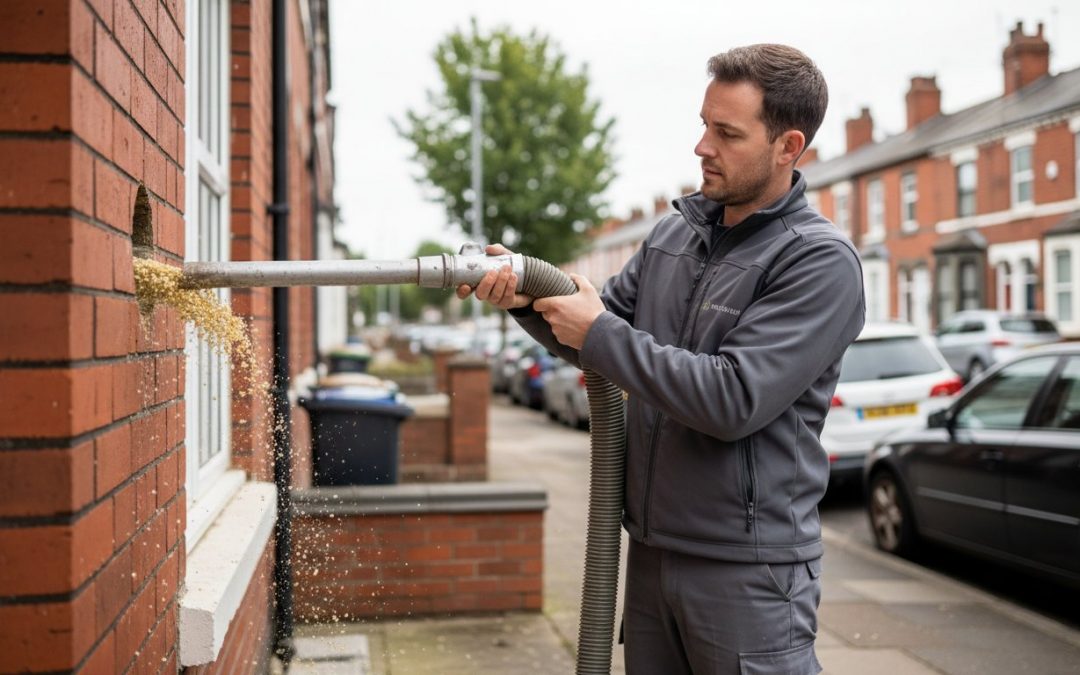
Your home’s insulation should be a protective thermal envelope, but for thousands of UK properties, it has become a hidden reservoir for moisture. Industry reports from late 2024 indicate that a significant number of installations fail when the adhesive binder breaks down, leading to the common problems with bead insulation in cavity walls that homeowners face today. You likely expected lower energy bills and a warmer environment, yet you’re now dealing with persistent black mould and cold spots that won’t go away. It is stressful to watch your property’s value and comfort diminish while your heating system works harder than ever.
We understand that you want a permanent solution that restores your peace of mind and structural health. This 2026 specialist guide explains the technical reasons behind insulation failure, from bead slump to blocked ventilation, and provides a clear path toward professional extraction. You’ll learn how our non-invasive techniques remove saturated debris to eliminate damp at the source. We will walk you through the diagnostic process used by our nationwide specialists to identify compromised cavities and restore your home to its peak thermal efficiency.
Key Takeaways
- Learn how common problems with bead insulation in cavity walls arise when bonded EPS spheres create moisture bridges that compromise your home’s thermal efficiency.
- Discover the structural risks associated with wet insulation, including accelerated wall tie corrosion and the “thermal bypass” effect that renders insulation ineffective.
- Identify the warning signs of failing insulation by looking for leaking beads in air bricks or persistent damp and cold spots inside your property.
- Understand the specialist extraction process using industrial vacuum systems to restore structural integrity and ensure a clean, clear cavity.
- Gain peace of mind by learning how professional removal protects your property’s long-term health and prevents the recurring cycle of damp and mould.
Understanding Bonded Bead Cavity Wall Insulation and Common Failures
Bonded bead insulation consists of small expanded polystyrene (EPS) spheres injected into a property’s wall space alongside a liquid adhesive. This bonding agent is meant to glue the beads together into a stable, porous mass. The original design intended to provide thermal resistance while theoretically allowing the building to breathe. However, Understanding Bonded Bead Cavity Wall Insulation requires recognizing that these systems often fail to maintain their structural integrity over time. When the adhesive degrades, it creates significant problems with bead insulation in cavity walls, primarily because the material stops behaving as a solid block and begins to settle.
A fundamental rule of UK construction is that a property’s air gap must remain unobstructed to function correctly. To understand why this space is vital, homeowners should first understand what is a cavity wall and how its primary purpose is to prevent moisture transfer. When insulation is added retrospectively, it creates a physical bridge. This bridge allows water to travel from the external brickwork to the internal skin, leading to dampness and timber decay.
The Difference Between Loose and Bonded Beads
Older insulation systems used loose beads without any adhesive. These are notorious for escaping through any small gap in the brickwork, such as around pipework, air bricks, or during window replacements. Modern bonded systems were designed to solve this issue; however, they rely entirely on the correct ratio of glue to beads during the installation process. If the technician used an incorrect mix or the injection equipment wasn’t calibrated, the bond fails within a few years. This leads to “slumping,” where the insulation settles at the bottom of the wall, leaving the upper sections of the room uninsulated. If you’re noticing cold spots or damp patches near the ceiling, these are classic problems with bead insulation in cavity walls that suggest the material is no longer stable. It’s impossible to verify the quality of this bond through a simple visual check. A specialist survey using borescope cameras is the only way to confirm if the material has become unstable or debris-ridden.
Why 2026 Standards Question Retrospective Installation
By 2026, industry data has shown that retrospective cavity filling carries inherent risks, especially in the UK’s more exposed regions. Properties in areas with high levels of driving rain often suffer from saturated external leaves. When the cavity is full of beads, moisture cannot drain away or evaporate naturally. This trapped water eventually causes damp patches and accelerates wall tie corrosion, which can compromise the building’s stability. CavClear maintains a firm stance against retrospective filling because the long-term structural risks far outweigh any temporary energy savings. We’ve seen that once a cavity is compromised, the only way to restore the property’s health is through a professional extraction. Our nationwide specialist teams focus on removing these failing materials to restore the home’s natural ventilation and protect its structural integrity for the future.
Why Bead Insulation Leads to Damp and Mould Issues
Cavity walls serve a specific structural purpose: they provide a clear air gap that prevents moisture from transferring from the exterior of a building to the interior. When this gap is filled with EPS (expanded polystyrene) beads, the fundamental physics of the wall change. Homeowners often encounter problems with bead insulation in cavity walls because the material creates what specialists call a “moisture bridge.” Under normal conditions, rainwater that penetrates the porous outer brickwork should run down the internal face of the external leaf and exit through weep holes. When beads are present, they provide a physical path for this liquid water to travel directly across the cavity to the internal masonry.
Effective ventilation is essential for maintaining a dry property. Beads block the natural air circulation required to evaporate residual moisture within the cavity. This problem is frequently worsened by debris accumulation. During the original construction process, mortar droppings and brick ties often collect waste at the bottom of the cavity. When beads are injected into these spaces, they trap the construction waste against the inner leaf. This creates localized “cold spots” where the wall temperature drops significantly. These cold areas are prime locations for condensation, which eventually leads to the development of black mould on internal surfaces.
Interstitial Condensation Explained
This phenomenon occurs when warm, moist air from the living space moves through the internal wall and meets the colder temperatures within the cavity. Because the beads restrict airflow, the water vapour cannot escape and reaches its dew point, turning into liquid water inside the insulation layer. This moisture becomes trapped against the inner leaf, eventually soaking through the masonry to create visible damp patches on your interior plaster or wallpaper. Interstitial condensation is the primary hidden cause of internal wall decay.
The Impact of Driving Rain on Bead Systems
The UK climate presents a significant challenge for bead systems, as approximately 60% of the country is classified as a high-exposure zone for wind-driven rain. During the winter months, prolonged rainfall saturates porous brickwork. While many installers highlight the “breathability” of beads, these claims often fail in high-exposure geographic zones where the wall never has the opportunity to dry out. Gravity causes moisture to migrate downward, meaning beads in the lower sections of a wall often become waterlogged first. This saturation transforms the insulation into a wet blanket that draws heat out of the home rather than retaining it.
If you’ve noticed persistent dampness or a musty smell in your rooms, a specialist cavity wall survey can determine if your insulation has become a liability to your property’s health.
Structural Risks: Wall Tie Corrosion and Thermal Bypass
Installing beads was once marketed as a permanent solution for home efficiency. However, specialist inspections in 2026 reveal that problems with bead insulation in cavity walls often lead to severe structural degradation. The most pressing concern involves the integrity of the wall ties that hold your home together. These metal components are designed to sit in a clear, ventilated air space. When that space is filled with beads that have become saturated by wind-driven rain, the structural health of the property is compromised.
How Wet Insulation Attacks Wall Ties
Wet insulation acts as a reservoir, holding moisture directly against the metal wall ties for months at a time. This creates a persistent damp environment that accelerates the oxidation process. As the steel ties rust, they undergo a process called laminating expansion. The rust can grow to seven times the thickness of the original steel. This expansion is powerful enough to lift mortar joints, causing horizontal cracking and visible bulging of the outer brickwork. If left unaddressed, the outer leaf can become unstable or even collapse during high winds. A combined survey is essential to assess both the condition of the insulation and the ties. If our specialists detect significant corrosion, a professional wall tie replacement is required to restore the building’s stability.
The Problem of Voids and Settling
Bead insulation is prone to slumping over time. Gravity, combined with the natural vibration of the property from nearby traffic, causes the beads to settle toward the bottom of the cavity. This movement creates large voids at the top of the wall, often leaving the upper 300mm to 500mm of a room completely uninsulated. These gaps facilitate a phenomenon known as thermal bypass. Cold air enters the cavity and moves expertly around the remaining insulation, effectively neutralizing its thermal benefits. You’ll often find that problems with bead insulation in cavity walls manifest as dark patches of mould near the ceiling where these cold bridges occur. We don’t recommend “topping up” the beads. Adding more material into a failing system only packs the damp beads tighter against the wall ties and fails to address the moisture trapped within the structure.
- Horizontal cracking in mortar joints is a primary sign of tie expansion.
- Cold spots at the top of walls indicate significant insulation slumping.
- Rusting ties lose their structural capacity, risking outer leaf detachment.
- Extraction is the only way to stop the cycle of corrosion and thermal bypass.
Identifying Problems: Specialist Surveys and Borescope Inspections
Identifying problems with bead insulation in cavity walls starts with a methodical visual assessment of the property’s exterior. You should look for small grey or white polystyrene spheres escaping from air bricks or gaps in the brickwork. Cracks in the mortar joints often indicate where moisture has entered, which can lead to the insulation material becoming saturated. These external markers serve as early warnings that the structural integrity of your insulation system has failed.
Inside the home, the symptoms are often more distressing and immediate. You’ll likely notice persistent musty odors, peeling paintwork, or localized cold spots on your walls. These issues typically arise when the beads have clumped together or shifted, creating “cold bridges” that allow moisture to migrate from the outer leaf to the inner leaf of the building. A specialist damp survey is the most effective way to diagnose these underlying causes accurately. While thermal imaging cameras identify temperature variations, they can’t distinguish between a lack of insulation and a cavity filled with wet debris, making them insufficient for a full structural diagnosis on their own.
The Borescope Inspection Process
Our technicians use a precise, non-invasive method to see exactly what’s happening inside your walls. We drill small holes, usually 10mm to 12mm in diameter, into the mortar joints at strategic points across the elevation. A high-definition camera is then inserted into these voids to inspect the cavity’s condition. We look for specific indicators like bead slumping, mortar “snots” on wall ties, and clear signs of water ingress. A borescope provides the only definitive visual proof of cavity conditions.
Professional Reporting Standards
A reliable structural report must provide more than just a verbal summary of the findings. It should include clear photographic evidence from the borescope and accurate moisture readings taken from the internal masonry. You need an independent assessment to ensure the recommendations are based on structural requirements rather than sales targets. We advise homeowners to be cautious of companies offering “expert” inspections, as these are frequently used as lead-generation tools to sell more insulation products. Our nationwide team focuses on the long-term health of your property, providing the data needed to make an informed decision about extraction.
To ensure your home is protected and structurally sound, book a specialist survey with our nationwide team today.
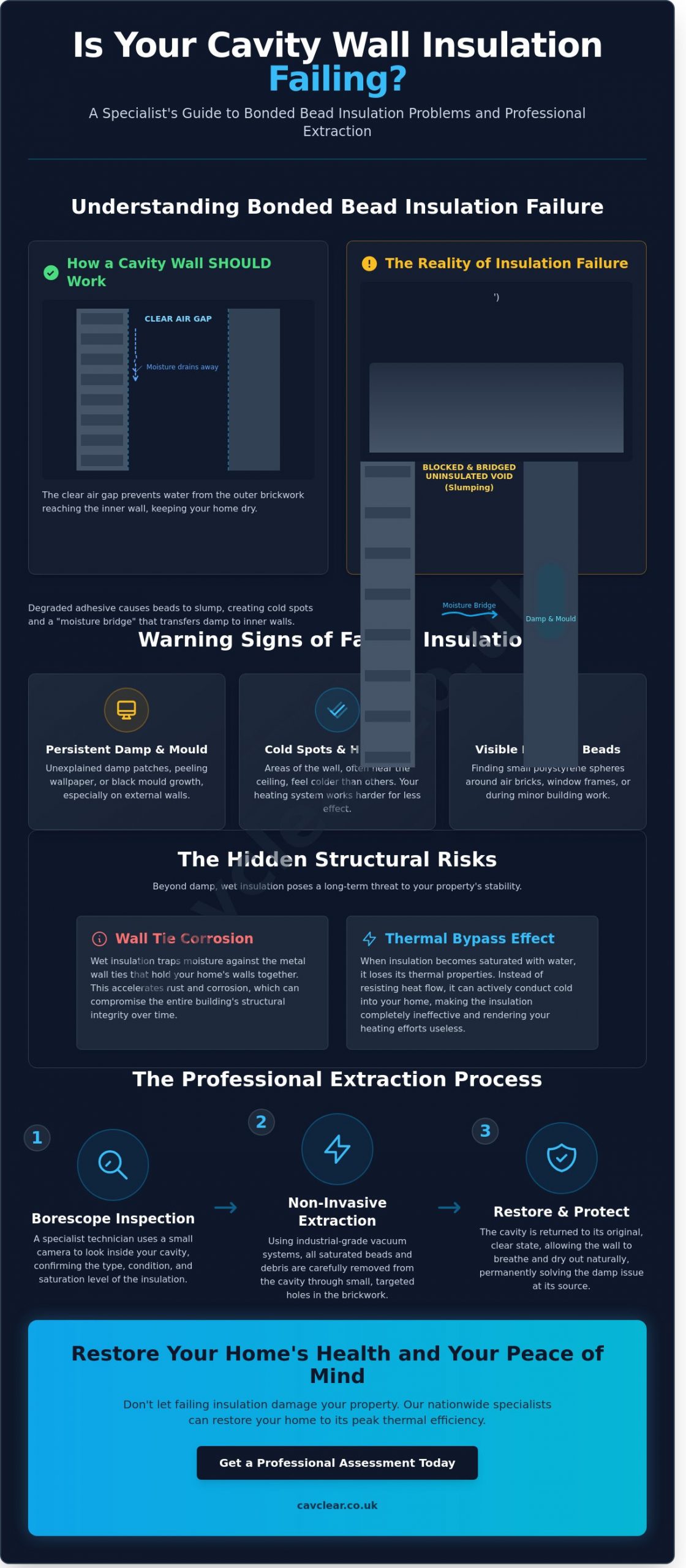
The Specialist Extraction Process: Restoring Your Home’s Structural Integrity
Addressing the problems with bead insulation in cavity walls requires a methodical, technical approach. We use industrial-grade vacuum systems to perform a complete cavity wall insulation removal. Our technicians remove specific bricks at the lowest point of the wall, typically just above the damp proof course. This allows gravity and high-powered suction to work in tandem. We extract the beads from the bottom to ensure the entire vertical space is emptied thoroughly.
A critical stage involves “clearing the bridge.” Over years, beads and mortar debris settle at the base of the cavity, creating a solid mass that transfers moisture. This bridge is a primary cause of penetrating damp. Our specialists focus on these areas to break down the blockage. The process is non-invasive. We only drill small, 22mm holes in the mortar joints, which we carefully make good afterward to match your existing masonry. This ensures your home’s aesthetic remains unchanged while its structural health is restored.
Ensuring a Clean Extraction
We use high-pressure compressed air to dislodge beads that have stuck to wall ties or the inner leaf. This is vital because problems with bead insulation in cavity walls often stem from partial blockages that trap moisture. Technicians use bore-scope cameras to inspect hard-to-reach corners and ensure no pockets of material remain. Our industrial HEPA-filtered vacuum units contain all extracted material. This prevents lightweight beads from escaping into your garden or the local environment during the procedure.
Post-Extraction Property Care
Once the cavity is clear, your home needs time to recover. We typically recommend a drying-out period of 4 to 12 weeks, depending on how much moisture the previous insulation held. Restoring the original air gap allows the building to breathe. This natural ventilation regulates temperature and stops the stagnant conditions that lead to mold growth. It’s a permanent solution for long-term property health. Our nationwide team provides the expertise needed to return your home to its original design specifications. Contact CavClear for a specialist cavity survey and extraction quote to begin the restoration of your home.
Protect Your Property’s Future with Professional Extraction
Ignoring the problems with bead insulation in cavity walls leads to more than just high energy bills; it risks the long-term health of your masonry. When beads settle or bonding agents degrade, they trap moisture against the inner leaf, which often results in wall tie corrosion and persistent damp. Industry data from 2025 shows that saturated insulation can increase heat loss by 30%, turning a supposed energy-saving measure into a structural liability. Restoring your home requires a precise, technical approach to ensure the cavity is completely clear of debris and failing materials.
CavClear operates as a dedicated specialist with nationwide service coverage across the United Kingdom. Our accredited technicians use specialist extraction equipment to safely remove compromised insulation without damaging your home. We provide a detailed technical report for every property we visit, giving you a clear record of the work performed and the current state of your wall ties. It’s time to stop the cycle of damp and protect your investment with a permanent solution.
Book a Specialist Cavity Survey with CavClear Today
We’re ready to help you reclaim a dry, safe, and comfortable home environment.
Frequently Asked Questions
Is bead insulation better than glass wool or foam?
Every material has specific technical drawbacks when retrospectively installed into a property. While beads allow for some drainage, they often settle over time, leaving 15% to 20% of the upper wall unprotected. Glass wool tends to sag and hold moisture like a sponge, whereas foam can become brittle or trap water against the inner leaf. Specialists find that all three materials frequently lead to problems with bead insulation in cavity walls by bridging the gap meant to keep moisture out.
Can bead insulation cause damp in a house that was previously dry?
Bead insulation can create damp issues in properties that were historically dry by bridging the 50mm cavity gap. When wind-driven rain saturates the outer brickwork, the beads provide a physical pathway for moisture to travel to the internal walls. This process, known as interstitial condensation or capillary action, often results in visible mold growth on the 10% of wall surfaces nearest to the floor or ceiling.
How do I know if the beads in my cavity have slumped?
You can identify slumped beads by checking for cold spots at the top of your walls using a thermal imaging camera. If the insulation has settled, the top 30cm to 60cm of the wall will often show a temperature difference of 3 to 5 degrees Celsius compared to the rest of the room. A specialist surveyor can confirm this by performing a borescope inspection, which involves inserting a small camera into the cavity to view the fill levels and identify any problems with bead insulation in cavity walls.
What happens if I leave wet bead insulation in my walls?
Leaving wet insulation inside your walls leads to long-term structural decay and persistent health risks. Damp beads accelerate the corrosion of metal wall ties, which can lose their structural integrity within 10 to 15 years of exposure. This moisture also creates an environment for black mold spores to thrive, which reduces the air quality and can trigger respiratory issues for the occupants of the home.
Is the extraction of bead insulation a messy process?
Extraction is a clean and non-invasive process when performed by a specialist using high-powered vacuum machinery. We remove bricks at the base of the wall to create a collection point, ensuring that 99% of the beads and debris are sucked directly into a sealed container. This method prevents dust and loose material from entering your living space, maintaining the cleanliness of your property’s exterior throughout the 1 to 2 days of work.
Will removing the insulation make my house much colder?
Removing wet or slumped insulation often improves the actual thermal comfort of a home by eliminating damp-induced cold bridges. While the theoretical U-value might change, dry air in an empty cavity acts as a natural insulator, whereas wet beads actually pull heat away from the building. Homeowners frequently report that their rooms feel warmer and more consistent once the moisture-laden material is gone and the walls are allowed to breathe.
How long does it take to extract bead insulation from a standard semi-detached house?
A standard three-bedroom semi-detached house typically takes between 1 and 2 working days to clear completely. Our teams work systematically around the perimeter, ensuring every section of the cavity is inspected and cleared of obstructions. This timeframe includes the final borescope check to guarantee that 100% of the problematic material has been removed from the structure.
Can I remove the bead insulation myself?
You shouldn’t attempt to remove bead insulation yourself because it requires specialist industrial vacuums and compressed air tools to ensure a complete extraction. DIY attempts often leave behind 20% to 30% of the material, which can trap moisture in localized pockets and cause even more concentrated damp problems. Professional extraction ensures the cavity is entirely clear of debris, protecting the long-term health of your property and its structural components.
Recent Comments