
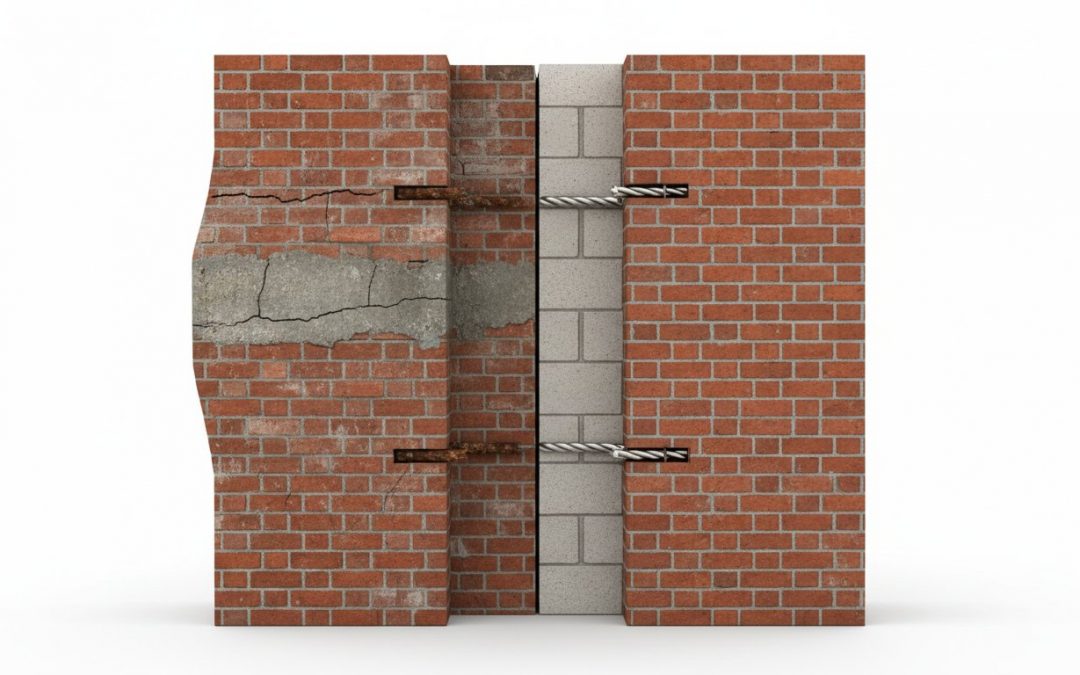
Did you know that for houses constructed before the 1980s, the metal ties securing your external masonry have a design life of only 15 to 20 years? It’s a sobering fact that means thousands of UK properties are currently standing with internal supports that have long since exceeded their structural expiration date. You might’ve noticed horizontal cracks in your mortar or a slight bulge in your brickwork and wondered if it’s just natural settling. Identifying the specific signs of wall tie failure is critical because these issues often stem from moisture trapped by defective cavity insulation, which accelerates corrosion and compromises your home’s stability.
We understand the anxiety that comes with spotting structural defects and the fear that a minor crack could signal a major collapse. This guide provides the clarity you need to distinguish between harmless movement and serious structural faults. You’ll learn how to identify the subtle red flags of failing wall ties and understand why maintaining a dry cavity is essential for long-term safety. We’ll walk through a professional checklist of symptoms and explain how a non-disruptive specialist survey can restore your confidence in your property’s integrity.
Key Takeaways
- Identify the primary signs of wall tie failure, such as horizontal mortar cracks and bulging masonry, to prevent minor faults from escalating into structural risks.
- Understand the critical link between trapped moisture within the cavity and the accelerated corrosion of metal ties, especially in properties built before the 1980s.
- Learn how a professional wall tie survey utilizes non-destructive metal detection and borescope inspections to accurately assess the “structural skeleton” of your home.
- Discover why modern stainless steel replacements provide a permanent, corrosion-resistant solution that far exceeds the limited lifespan of original galvanised steel components.
- Recognize the importance of a dual-action remediation approach that isolates failing ties and restores structural integrity to ensure long-term property safety.
Understanding the Role and Lifecycle of Cavity Wall Ties
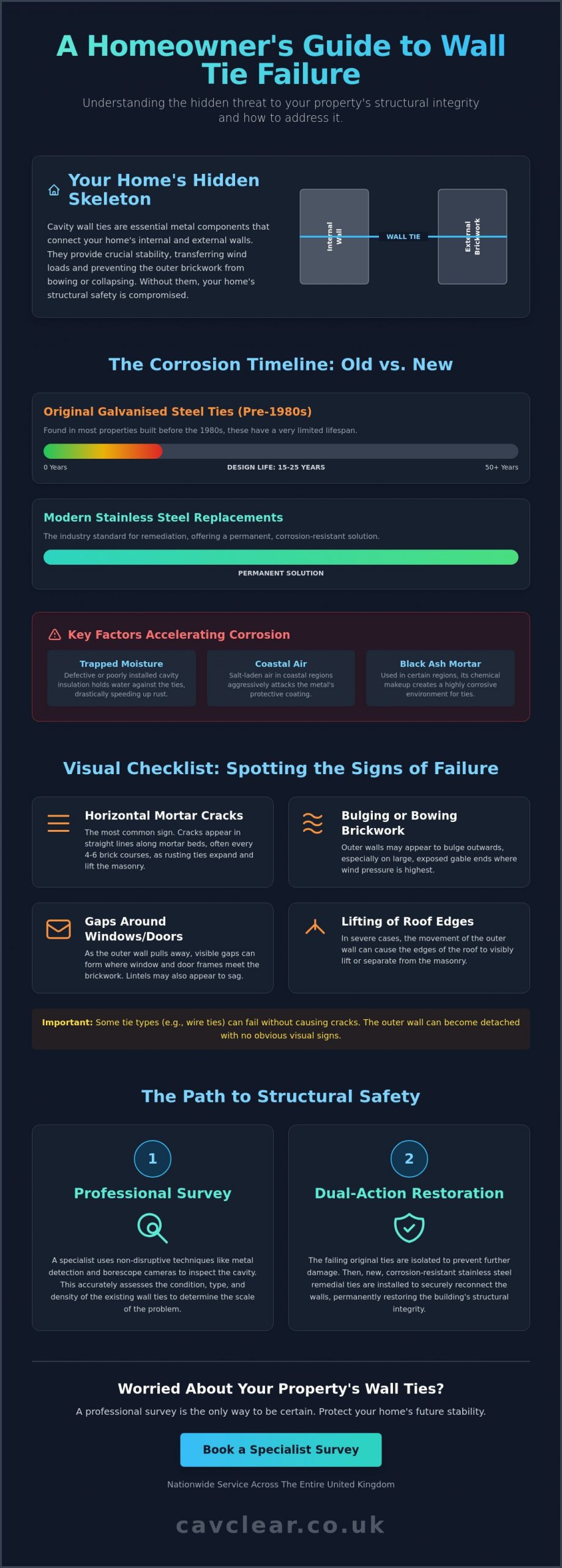
Cavity wall ties function as the hidden structural skeleton of a modern property. These components connect the internal load-bearing leaf to the external masonry veneer. Their primary mechanical purpose is to transfer lateral wind loads to the main structure while preventing the outer leaf from bowing or collapsing. Without these essential connectors, the two walls act independently. This significantly compromises the building’s stability and safety. While they remain invisible to the naked eye, their role in maintaining structural integrity is absolute.
The evolution of construction materials has seen a shift from basic galvanised mild steel to modern, high-grade stainless steel. Properties built between 1930 and 1980 remain at the highest risk because they rely on older galvanisation techniques that offer limited protection. Once the protective zinc layer fails, moisture within the cavity triggers the oxidation process. This causes the metal to expand, which is one of the most common precursors to the signs of wall tie failure. Today, we use stainless steel as the industry standard because it provides a permanent fix, ensuring the property’s long-term asset health for decades.
The Different Types of Wall Ties Found in UK Homes
Traditional fishtail ties are heavy, flat strips of steel commonly found in older masonry. Their substantial mass means that when they corrode, the resulting expansion is powerful enough to lift entire rows of brickwork, causing horizontal cracking. Butterfly and wire ties are thinner and fail differently. Instead of expanding and cracking the mortar, they often thin out and snap. This type of failure is particularly dangerous because the wall can remain visually perfect while the outer leaf is actually detached from the house. Identifying these reliable signs of wall tie failure requires a professional eye. Modern remedial ties are the specialist solution for restoration. These mechanical or resin-fixed ties provide a clean and non-disruptive way to secure the building.
How Long Should Wall Ties Last?
The expected lifespan of original galvanised ties is typically between 15 and 25 years. However, several environmental factors can shorten this window. Properties in coastal areas across the United Kingdom face salt-laden air that aggressively attacks metal components. Similarly, the use of “black ash” mortar in certain regions creates a chemical environment that destroys zinc coatings rapidly. Because these components are buried within the wall, homeowners must avoid the “out of sight, out of mind” mentality. Regular Cavity Wall Tie Inspections are a necessary part of property maintenance to catch decay before it requires extensive structural intervention. Proactive monitoring isn’t just about repair; it’s an investment in your home’s future stability.
Identifying the Primary Signs of Wall Tie Failure in UK Properties
Recognising the physical signs of wall tie failure is the first step in protecting your property’s long-term asset health. Most homeowners first notice horizontal cracking in the mortar joints. These cracks typically appear at regular intervals, often every four to six courses of brickwork. This pattern occurs because the metal ties are embedded in the mortar beds. As they rust, they expand and physically lift the masonry above them. Beyond cracking, you might observe a distinct bulging or bowing of the external walls. This is particularly common on large, exposed areas like gable ends where wind pressure is highest.
Other indicators include the lifting of roof edges or sagging window lintels. When the outer leaf of a cavity wall moves, it pulls away from the internal structure. This often results in visible gaps where window frames meet the masonry. In severe cases, you may even find internal cracks in your plasterwork that mirror the faults on the exterior. These symptoms suggest that the structural skeleton of your home is no longer providing the necessary lateral support. If you notice these changes, booking a professional Wall Tie Survey is the most reliable way to confirm the condition of your masonry.
The Significance of Horizontal Mortar Cracking
When mild steel or galvanised ties corrode, the oxidation process causes the metal to grow up to seven times its original thickness. This massive expansion exerts immense upward pressure on the mortar joints. You can distinguish this from standard settlement cracks because settlement usually follows a diagonal, zig-zag path through both bricks and mortar. Wall tie expansion remains strictly horizontal, following the bed joints where the ties sit. These cracks aren’t just aesthetic issues; they’re an active warning that the metal components are forcing your home’s walls apart.
The “Invisible” Danger: When Ties Fail Without Cracking
Not all failing ties leave obvious marks on your brickwork. Thinner wire ties, common in mid-century construction, often suffer from point corrosion where they enter the mortar. Instead of expanding and cracking the joints, these ties simply snap or waste away until they offer zero structural support. This creates a dangerous situation where the outer leaf is completely detached, yet looks perfectly sound. High winds can then cause a sudden collapse of the masonry leaf. A visual inspection alone cannot detect these snapped ties. We use specialised metal detectors and borescopes during our Cavity Wall Tie Inspections to verify the condition of the metal hidden beneath the surface.
The Science of Corrosion: Why Metal Ties Fail Over Time
Corrosion is a chemical reaction. When the protective zinc coating on a galvanised tie is exposed to moisture and oxygen, it begins to oxidise. This process turns the solid steel into iron oxide, commonly known as rust. As rust forms, it occupies significantly more volume than the original metal. This volumetric expansion is the root cause of the most visible signs of wall tie failure, such as horizontal mortar splitting. While all metal components eventually age, certain factors can turn a slow natural process into a rapid structural threat.
Aggressive mortars play a significant role in this decay. In many parts of the United Kingdom, particularly in industrial heritage areas, builders used “black ash” mortar. This material contains high levels of sulphates that react with moisture to create an acidic environment. This acidity eats through galvanised coatings at an accelerated rate. Additionally, metal ties act as thermal bridges. Because metal conducts heat better than the surrounding masonry, the ties often stay cooler than the rest of the wall. This temperature difference causes localized condensation to form directly on the tie, providing the moisture needed for corrosion to continue even in seemingly dry conditions.
The Link Between Defective Insulation and Wall Tie Failure
One of the most overlooked factors in structural decay is the presence of saturated cavity wall insulation. When insulation becomes wet due to brickwork faults or driving rain, it creates a “poultice effect.” The wet material holds moisture directly against the wall ties for months at a time, preventing the metal from ever drying out. This constant dampness strips away protective coatings far faster than natural weathering. Removing compromised material through Cavity Wall Insulation Extraction is frequently the first step in preserving the building’s structural integrity. Without addressing the damp environment, new ties would eventually face the same corrosive risks.
Environmental Factors and Property Orientation
Property orientation often dictates where the first signs of wall tie failure will appear. In the UK, south-west facing walls bear the brunt of driving rain. These elevations absorb more water, which then migrates into the cavity. Coastal properties face even higher risks. Salt-laden air is highly corrosive and can penetrate masonry, attacking metal ties with clinical efficiency. Localised failure is also common around chimney stacks or beneath overflowing gutters. These areas of persistent water ingress create “hotspots” of corrosion. Maintaining your property’s external envelope is a vital investment in its long-term health, as preventing water ingress directly slows the degradation of your home’s structural skeleton.
Professional Wall Tie Surveys: What to Expect During an Inspection
While identifying the external signs of wall tie failure is a vital first step, a definitive diagnosis requires an independent structural assessment. We utilize specialized, non-destructive techniques to look deep within the wall cavity without causing unnecessary damage to your masonry. Our specialists begin by using high-frequency metal detectors to map the exact locations of existing ties. This allows us to determine if the original builders installed ties at the correct density. For standard cavity walls, the requirement is a minimum of 2.5 ties per square metre. We also analyze the mortar condition to check for chemical instability or the presence of debris that could bridge the cavity and lead to dampness.
A central part of our diagnostic process involves borescope inspections. By drilling a small, discreet pilot hole, we insert a high-definition camera to view the ties directly. This allows us to see the actual state of the metal rather than relying on external guesswork. We look for specific indicators like “rust crusting” or thinning of the wire. This level of detail is essential for creating a precise remedial strategy that addresses the root cause of the structural movement. If you’ve noticed cracks or bulging, booking a comprehensive Wall Tie Survey provides the technical evidence needed to secure your property’s future.
The Survey Process: Step-by-Step
Our methodology follows a logical, methodical flow to ensure no defect is missed. We start with a thorough external visual inspection, mapping out crack patterns and movement zones. Once we’ve identified the areas of concern, we drill pilot holes to facilitate borescope entry. We gather photographic evidence and grade the corrosion on a standard scale from 1 to 4. Level 1 indicates light surface rust, while Level 4 represents total structural failure where the tie has snapped or expanded significantly. This data culminates in a detailed remedial action plan, providing you with a clear path toward restoration.
Why DIY Inspections Are Insufficient
Structural Restoration: The Process of Wall Tie Replacement
Restoration of a property’s structural integrity requires a methodical, dual-action approach. Simply installing new ties is insufficient if the original, corroded components remain active within the masonry. As established in previous sections, the expansion of rusting steel is the primary driver behind the visible signs of wall tie failure. If these old ties aren’t neutralized, they’ll continue to expand and lift the masonry, eventually compromising the new repairs. Our process ensures the building is stabilized while preventing any further “jacking” of the mortar joints, providing a permanent fix rather than a temporary patch.
Selecting the correct replacement tie is essential for long-term asset health. We match the new tie to the specific masonry type and cavity width of your home. Whether your property uses traditional brick, timber frame, or thin-joint blocks, the replacement must facilitate the natural movement of the building while providing rigid lateral support. This precision ensures that the structural skeleton is restored to modern standards, utilizing materials that are immune to the oxidation issues of the past.
Isolating the Corroded Ties
Isolation is the most critical step in structural preservation. We use specialized equipment to either remove the expanding ends of the old ties or “sleeve” them. Sleeving involves fitting a protective buffer around the tie end, which allows the metal to continue its oxidation process without exerting physical pressure on the surrounding brickwork. By neutralizing the force that caused the initial cracking, we stop the lifting of the masonry leaf. This ensures the wall remains stable throughout the transition to the new structural system and prevents recurring cracks in your fresh mortar.
Installing Remedial Wall Ties
Once we’ve isolated the failing components, we begin the precision wall tie replacement process. We primarily use stainless steel helical ties because they provide a secure, non-disruptive mechanical fix. These ties are driven into small pilot holes and grip both the inner and outer leaves through a high-performance screw-like action. In softer masonry or specific stone types, we may use resin-fixed ties to ensure a more tailored bond. To guarantee long-term safety, we perform pull-out strength tests as standard. This confirms that the new ties meet the required load-bearing standards for your specific property.
Completing the Repair
The final stage of restoration focuses on restoring the property’s aesthetic and environmental health. We use professional mortar tinting to match the original joints, ensuring the repair points are virtually invisible to the naked eye. However, structural repair is only half the battle. We also address any underlying moisture issues, such as saturated insulation or pointing defects, to ensure the new cavity environment remains dry. This holistic approach transforms a technical repair into a vital investment in your home’s future. We conclude each project with a formal sign-off, providing homeowners with the structural assurances they need for complete peace of mind.
Securing Your Home’s Structural Future
Wall tie integrity is not a static feature of your home; it is a lifecycle that requires proactive management and expert oversight. We have explored how identifying the early signs of wall tie failure can prevent the escalation of minor mortar cracks into significant structural instability. By addressing the underlying causes of corrosion, specifically the moisture trapped by defective cavity insulation, you protect your property’s long-term asset health and market value. Ignoring these subtle red flags only leads to more complex and costly repairs in the future.
Our accredited specialist technicians provide a comprehensive nationwide service across the entire United Kingdom. We deliver detailed technical reporting and precise remedial plans that restore the structural skeleton of your property with minimal disruption. Choosing a professional assessment provides the clarity needed to transition from uncertainty to a permanent, safety-conscious solution. You can restore the comfort and security of your property by partnering with experts who prioritize structural rigor and technical excellence. Book a Professional Wall Tie Survey with CavClear Today and take the first step toward a permanently stable home.
Frequently Asked Questions
Is wall tie failure dangerous?
Yes, wall tie failure represents a significant structural safety risk. When the ties fail, the external masonry leaf is no longer secured to the internal load-bearing structure. This can lead to bowing, bulging, or even the complete collapse of the outer wall during periods of high winds. It’s a serious issue that compromises the safety of both the building’s occupants and those in the surrounding area.
Can I see wall tie failure from inside my house?
While most indicators appear on the exterior, internal signs are certainly possible. You might notice cracks in the plasterwork that mirror the horizontal mortar cracks on the outside of the building. In some cases, internal dampness occurs because failing ties allow moisture to bridge the cavity. However, these internal symptoms usually suggest that the structural movement has already reached an advanced stage.
Does home insurance cover wall tie replacement?
Standard home insurance policies typically don’t cover wall tie replacement. Insurers generally view the corrosion of metal ties as a maintenance issue or natural wear and tear rather than sudden, accidental damage. You should check your specific policy wording for exclusions; however, most structural maintenance tasks are the responsibility of the homeowner. Proactive repairs are a vital investment in your property’s future stability.
How much does a wall tie survey cost?
The cost of a professional survey varies depending on the size and location of the property. A specialist assessment involves using borescope cameras and metal detectors to identify the signs of wall tie failure without damaging the brickwork. Professional reporting provides the technical evidence required for structural assurances. We recommend contacting a specialist for a quote tailored to your property’s specific structural requirements.
How long does it take to replace wall ties?
A standard semi-detached property usually takes between one and two days to complete. The process involves drilling, installing remedial ties, and isolating the old ones. Detached houses or those with complex masonry may take longer. Our technicians work methodically to ensure the process is clean and non-disruptive to your daily routine while restoring full structural integrity and long-term asset health.
What happens if I ignore the signs of wall tie failure?
Ignoring the signs of wall tie failure allows corrosion to worsen, which increases the risk of a sudden structural collapse. Over time, the expanding rust will cause wider mortar cracks and more severe bulging in the masonry. This not only makes the eventual repair more expensive but also compromises the resale value of your property. Addressing the issue early prevents minor faults from becoming major repairs.
Can I replace wall ties myself?
Wall tie replacement is not a suitable DIY task. It requires specialist structural knowledge and precision equipment like borescope cameras and high-performance helical drivers. Incorrect installation can weaken the masonry further or fail to provide the necessary lateral support. Professional intervention ensures the work complies with UK Building Regulations and structural standards, protecting your home’s long-term asset health and safety.
Why do wall ties fail in newer properties?
Failure in newer homes is rarely due to age but often results from poor workmanship or extreme environmental exposure. If ties were spaced too far apart during construction or if the property is located in a high-exposure coastal area, the ties may degrade faster than expected. Using the wrong type of tie for the specific masonry can also lead to premature structural issues and instability.
Recent Comments