
The stability of your home’s outer walls depends on a series of hidden metal components that you’ll likely never see. When a mortgage survey highlights potential corrosion, it’s natural to feel a sense of dread about the structural integrity of your property. You might worry that finding out what does a wall tie survey involve means preparing for an invasive, messy, and expensive ordeal. However, a professional inspection is a surgical and non-disruptive diagnostic process that prioritizes the safety of your home without causing unnecessary damage.
We understand that technical jargon can be confusing, especially when the safety of your investment is at stake. This guide will clarify the precise methodology our specialists use to assess properties across the United Kingdom. You’ll learn about the use of high-resolution endoscopic boroscopes to view inside the cavity and how we grade tie condition according to industry standards like BRE Digest 401. We will outline the professional reporting process and the exact steps needed to preserve your property’s structural health for the long term.
Key Takeaways
- Understand the non-disruptive nature of advanced diagnostics, which use high-resolution boroscopes to inspect cavity walls without removing masonry.
- Learn exactly what does a wall tie survey involve, from the initial external appraisal to the drilling of discreet 8-10mm pilot holes for internal access.
- Gain confidence in interpreting professional reports that use standardized corrosion grading scales to determine the urgency of remedial action.
- Discover why specialist expertise is essential for providing the validated documentation required by mortgage lenders and insurance providers.
- Identify how a proactive structural inspection protects your property’s long-term value by identifying hidden metal fatigue before it leads to wall failure.
What is a Wall Tie Survey and Why is it Essential?
A specialist wall tie survey is a precision structural diagnostic procedure. It evaluates the condition of the metal components that bridge the gap between your property’s internal structure and its external masonry leaf. Understanding what is a wall tie is the first step in recognizing why these components are vital. They act as the primary structural link that prevents the outer wall from bowing, leaning, or collapsing under wind loads and environmental pressure. Because these ties are embedded within the brickwork, they’re invisible to the naked eye. This makes a professional inspection the only reliable way to confirm they’re still performing their role.
Property owners often ask what does a wall tie survey involve when they notice fine horizontal cracks in their mortar joints. Unlike a standard visual check, this survey uses technical tools to see inside the wall. The longevity of these ties is directly linked to the environment within the wall itself. You can learn more about the structure of these spaces in our guide on what is a wall cavity. If moisture enters this space, it reacts with older galvanized steel ties, leading to oxide expansion and eventual structural failure.
The Primary Drivers for a Specialist Inspection
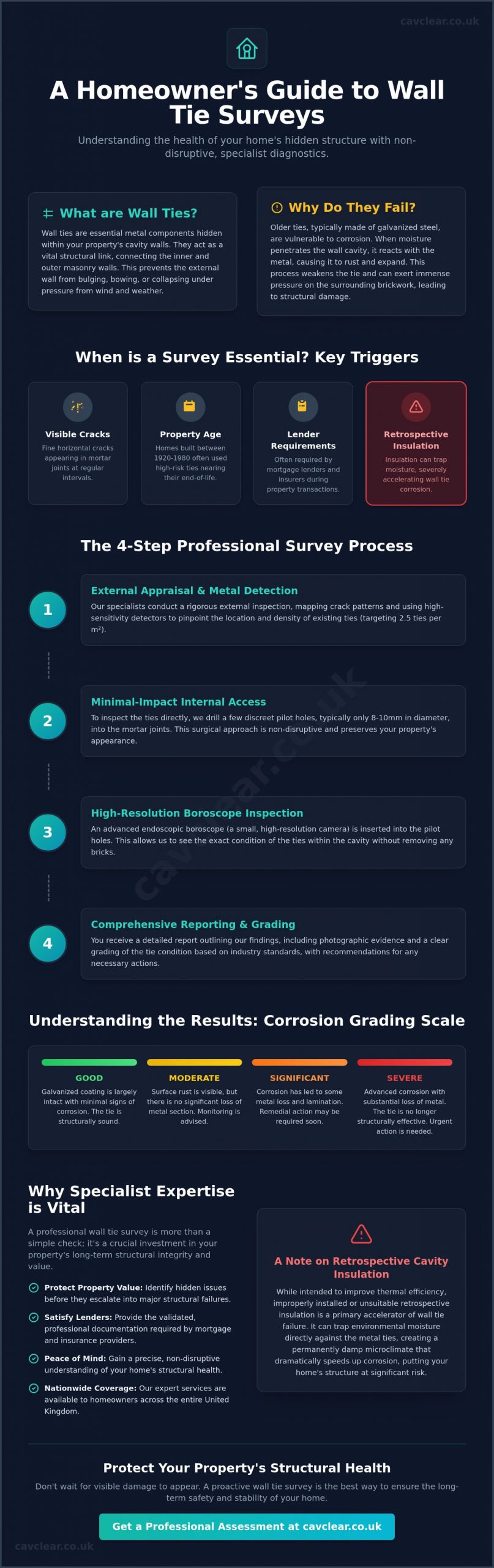
Several factors trigger the need for a professional assessment. Structural red flags are the most common indicators; these include horizontal cracking at regular intervals, bulging brickwork, or roof edges that appear to be lifting. Beyond visible damage, mortgage lenders and insurance providers across the UK frequently require these surveys during property transactions to manage risk. We recommend pre-emptive checks for any property built between 1920 and 1980. Homes from this era often contain high-corrosion-risk ties that may have reached the end of their functional lifespan, even if the walls look stable from the street.
The Impact of Retrospective Cavity Wall Insulation
The presence of retrospective cavity wall insulation significantly changes the risk profile of a building. These materials can trap moisture against the metallic ties, creating a damp microclimate that accelerates the rate of corrosion. In an empty cavity, air circulation helps keep ties dry. In an insulated cavity, wet material can hold water against the metal for years. This leads to much faster degradation than you would find in an uninsulated wall. If you suspect your property has defective or wet insulation, a survey is vital to ensure your wall ties haven’t been compromised by the resulting dampness.
The Technical Steps of a Professional Wall Tie Inspection
A professional inspection is a systematic investigation. It isn’t a surface-level glance. When property owners ask what does a wall tie survey involve, they’re often relieved to learn it’s a non-disruptive procedure designed to protect the building’s aesthetics. Our technicians begin by mapping out the property’s construction type and identifying existing defects across every elevation. This comprehensive approach ensures that no hidden localized failures are missed. We treat every property with the respect it deserves, using specialized equipment to gather data without the need for immediate, invasive brick removal. Our service coverage extends nationwide, ensuring that homeowners across the United Kingdom receive the same high-level diagnostic rigor.
Step 1: Precision Metal Detection
The first technical phase involves locating the existing ties within the mortar joints. We use high-sensitivity metal detectors to pinpoint the exact position of every tie in a sample area. This allows us to map the vertical and horizontal spacing against current building regulation standards. For standard masonry walls, we expect a density of 2.5 ties per square metre. This step is crucial for identifying “missing” or incorrectly installed ties from the original construction phase. It provides a baseline for the structural integrity of the wall before we even look inside the cavity. If the density is insufficient, the wall is already at risk regardless of the ties’ physical condition.
Step 2: External Masonry Appraisal
Following the metal detection, we conduct a rigorous external appraisal of the masonry. We document specific crack patterns, such as horizontal cracks every few courses, which often indicate the expansion of rusting ties. This oxide expansion can exert enough force to lift the entire external leaf of a building. We also check for lateral movement or “bowing”, which suggests the ties have already failed or snapped. Part of this process involves inspecting the mortar beds for signs of chemical attack or degradation. Understanding the causes of wall tie failure helps us interpret these external symptoms accurately. If you’ve noticed these signs on your property, booking a professional wall tie survey is the most effective way to prevent further structural decline.
By examining every elevation, we ensure the final report reflects the true state of the entire building. This methodical sequence moves from observation to data collection, providing a clear picture of whether the wall ties are still fit for purpose. It’s a proactive investment in the long-term health of your property that avoids the guesswork of general builders.
Advanced Diagnostics: Boroscope Imaging and Internal Access
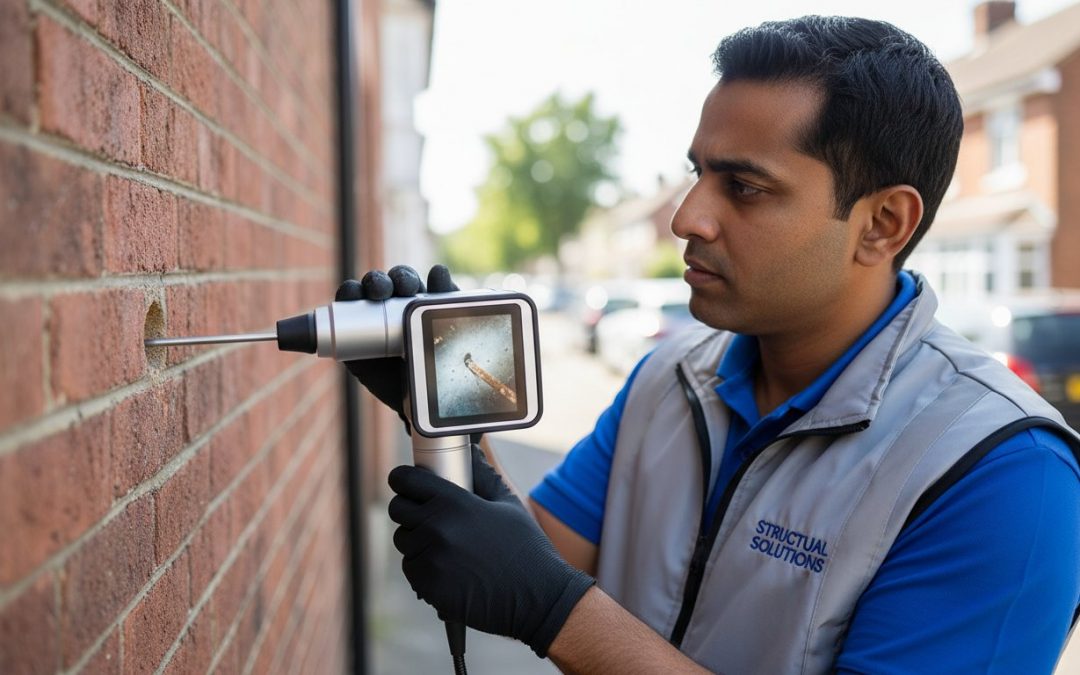
External observations provide the initial clues, but the internal diagnostic phase reveals the true condition of your property’s structure. This is where the most critical data is gathered. Understanding what does a wall tie survey involve at this stage helps property owners appreciate why these small pilot holes are a necessary part of a thorough inspection. We use high-resolution boroscope technology to provide a direct visual link into the hidden cavity, removing any guesswork from the diagnostic process. This allows us to see exactly how the metal is reacting to its environment.
To gain access, our technicians drill small, discreet pilot holes, typically between 8mm and 10mm in diameter, directly into the mortar joints. These holes are strategically placed to minimize any impact on the building’s appearance and are easily made good with matching mortar once the survey is complete. By inserting a slender optical probe, we can capture clear photographic evidence of the ties in their current state. This methodical approach ensures that the findings in your final report are based on physical proof rather than assumptions.
Visualising the Cavity Environment
Inside the cavity, our specialists look for more than just surface rust. We identify the specific type of tie installed, such as a traditional fishtail, a wire tie, or a butterfly design, as each has a different failure profile. We also assess the condition of the protective coating, looking for signs that the zinc or bitumen layer has begun to flake or bubble. A critical part of this check is identifying “debris bridges.” These are piles of mortar or rubble that have fallen during the original construction, creating a path for moisture to travel from the outer leaf to the inner wall. These bridges often act as the primary catalyst for localized corrosion.
Evaluating Insulation-Induced Damp
A major component of our diagnostic process is identifying the presence and state of cavity wall insulation. If the cavity is filled with saturated material, the risk to your wall ties increases significantly. Wet insulation often causes “cold bridging,” where moisture is held directly against the metal ties for extended periods. This environment leads to rapid oxidation, even in ties that might have otherwise remained functional for decades. Boroscope evidence is vital here; it provides the visual proof needed to justify remedial action before the corrosion leads to a total structural failure. This level of technical detail is a hallmark of a specialist inspection, ensuring your property’s long-term health is protected.
Interpreting Your Wall Tie Report and Grading
A specialist report is the final output of the diagnostic process. It transforms raw data and boroscope imagery into a structured document that property owners, mortgage lenders, and insurers can rely on. When considering what does a wall tie survey involve, the clarity of this final report is just as important as the physical inspection itself. Our reports provide a precise technical breakdown, including high-resolution photographic evidence of the ties and scale drawings that map out the required remedial works across every elevation. This transparency removes the ambiguity often found in general homebuyer surveys.
The report’s primary function is to determine the urgency of intervention. By distinguishing between pre-emptive maintenance and emergency structural repair, we provide a clear roadmap for your property’s future. For many homeowners, this document is the key to securing a mortgage or satisfying insurance requirements, as it provides a professional validation of the building’s structural integrity. It ensures that any recommended work is based on physical evidence rather than speculation, often supplemented by precision data from 1ESX Roof & Wall Reports for a complete digital overview of the structure.
The Corrosion Grading System Explained
We categorize the condition of each tie according to a recognized four-grade scale. Grade 1 indicates a bright or slightly dull coating with no remedial action needed. Grade 2 signifies the presence of white oxide formation, which suggests the protective coating is sacrificial and requires monitoring or medium-term planning. Grade 3 is more serious, showing red rust and significant pitting of the metal; at this stage, replacement is required to prevent wall movement. Grade 4 represents total failure or significant oxide expansion. This grade demands immediate structural intervention to prevent the outer leaf from becoming unstable or collapsing.
The Professional Remedial Action Plan
The remedial action plan is the concluding section of the report. It specifies the exact type of stainless steel remedial ties required for your specific masonry type. It also details the methodology for isolating or removing the original failing ties to stop ongoing expansion damage. This document serves as a fixed-price specification for wall tie replacement, ensuring there are no hidden costs during the repair phase. If your property shows signs of distress, contact our team to arrange a specialist survey and receive a definitive structural assessment.
Why Specialist Expertise is Vital for Structural Integrity
A general homebuyer’s survey provides a broad overview of a property’s condition, but it lacks the technical depth required to diagnose hidden structural decay. General surveyors often flag potential issues with a caveat, recommending further investigation by a specialist. This happens because they don’t carry the high-resolution boroscopes or precision metal detectors necessary for a conclusive assessment. A specialist structural inspection removes the guesswork, providing a definitive statement on the health of the building’s hidden components. It’s the difference between a visual guess and a data-driven diagnosis that protects your investment; you can learn more about the value of professional property evaluations and how they safeguard homeowners from unforeseen structural complications.
When property owners ask what does a wall tie survey involve, they’re often seeking professional accountability. Mortgage lenders and insurance providers across the United Kingdom require validated documentation from specialist technicians before they’ll approve loans or provide coverage. A specialist report provides this validation, offering a clear and transparent record of the property’s structural state. This level of detail is essential for maintaining the asset’s market value and ensuring that any remedial work is targeted and necessary. It protects the buyer, the seller, and the lender by providing a factual basis for the transaction.
Ensuring Nationwide Standards and Accuracy
Consistency is vital when you’re dealing with structural safety. By using a nationwide specialist, property owners benefit from a standardized methodology that applies the same high-level technical rigor to every property from Cornwall to Scotland. This consistency provides peace of mind for both owners and lenders, as the findings are based on a proven diagnostic framework. Our surveyors act as calm, expert solution-providers who prioritize safety without becoming alarmist. They focus on providing a clear path toward resolution, ensuring you understand the condition of your home’s structure and the steps required to preserve it for the future.
The CavClear Commitment to Property Health
We take pride in our clean and non-disruptive methodology. Every survey is conducted with the goal of gathering maximum data with minimum impact on the property’s aesthetics. Our expertise isn’t limited to a single structural element; we understand the complex relationship between the cavity environment and the longevity of the ties. In many cases, wall tie corrosion is accelerated by the presence of wet or defective insulation. Because we specialize in both cavity wall insulation removal and wall tie surveys, we can provide a holistic solution that addresses the root cause of the problem.
Proactive structural preservation is a vital investment in your property’s future. By identifying and rectifying faults early, you avoid the risk of sudden structural failure and the associated costs of emergency repairs. Our commitment to precision diagnostics ensures your home remains safe, secure, and structurally sound for the long term. This methodical approach doesn’t just fix a fault; it restores the structural integrity of your asset. We focus on providing a permanent fix that secures your home’s health and maintains its value for decades to come.
Securing Your Property’s Structural Future
Gaining a clear understanding of what does a wall tie survey involve is the first step toward restoring your peace of mind. A specialist inspection replaces uncertainty with definitive data, using non-disruptive boroscope technology and precision metal detection to look deep within your masonry. You now understand how our technicians use a clear grading system to assess corrosion levels and provide the validated reporting required by UK mortgage lenders and insurers. This process isn’t just about identifying faults; it’s about making a vital investment in the long-term health and stability of your asset.
We provide nationwide coverage by accredited technicians who specialize in structural integrity and damp prevention. Our comprehensive photographic reporting ensures you have a transparent record of your home’s condition and a clear remedial path if action is needed. Don’t let structural concerns linger. Book your professional wall tie survey with CavClear today to protect your property with expert diagnostics. Taking proactive steps now ensures your home remains a safe and secure environment for years to come.
Frequently Asked Questions
How long does a wall tie survey usually take to complete?
A professional wall tie survey typically takes between 2 and 4 hours to complete. This timeframe depends on the size of the property and the ease of access to all elevations. Our technicians work methodically to ensure a thorough inspection of the cavity walls without causing unnecessary disruption to your daily schedule. Larger detached homes or complex structures may require more time for a complete diagnostic appraisal.
Is a wall tie survey messy or will it damage my brickwork?
The survey is a non-disruptive process designed to preserve your property’s aesthetics. We drill small, discreet pilot holes, usually 8mm to 10mm in diameter, into the mortar joints rather than the bricks themselves. These holes allow for boroscope access and are professionally filled with matching mortar once the inspection is finished. This ensures your brickwork remains intact and the visual appearance of your home is unchanged.
What are the most common signs that I need a wall tie survey?
The most frequent indicators of failure include horizontal cracking in the mortar joints, bulging brickwork, or roof edges that appear to be lifting. You might also notice sagging window lintels or internal dampness caused by debris bridges in the cavity. If your property was built between 1920 and 1980, these visible red flags often point to underlying metallic corrosion that requires a specialist structural assessment.
Can I still get a survey if my cavity is already filled with insulation?
Yes, we can perform a comprehensive inspection even if your cavity is filled with insulation. Understanding what does a wall tie survey involve in these instances is important, as our technicians use specialized boroscopes to see through the material. We specifically check for saturated or slumped insulation, as trapped moisture significantly accelerates the oxidation of metal ties and compromises the structural integrity of the wall.
Do mortgage lenders always require a specialist wall tie report?
Mortgage lenders frequently request a specialist report if a general homebuyer’s survey identifies potential structural movement or signs of corrosion. Because standard surveys are visual only, lenders require the technical validation provided by a specialist to manage their investment risk. Our reports provide the photographic evidence and professional grading necessary to satisfy mortgage requirements and ensure a smooth property transaction.
How much does a professional wall tie survey cost in the UK?
The cost of a specialist survey varies depending on the property type, size, and the number of elevations that require inspection. While pricing is not standardized across the industry, investing in a professional diagnostic is a vital step in maintaining your property’s long-term value. We provide a clear, technical breakdown of our findings and a fixed-price specification for any remedial structural works that may be required.
What happens if the survey finds that my wall ties have failed?
If the survey identifies failed or heavily corroded ties, we will provide a detailed remedial action plan. This typically involves the installation of high-grade stainless steel replacement ties and the isolation of original failing components to prevent further masonry expansion. Our priority is to restore the structural stability of your home using industry-standard methodologies that ensure a permanent and reliable fix for the building’s future.
Can I check the condition of my wall ties myself?
It is not possible to accurately assess the condition of wall ties without specialist diagnostic equipment. While you can look for external symptoms like cracking or bowing, a definitive diagnosis requires metal detectors to locate ties and boroscopes to view the internal cavity environment. Professional what does a wall tie survey involve procedures ensure that the internal state of the ties is correctly graded, providing you with a reliable structural roadmap.
Recent Comments