
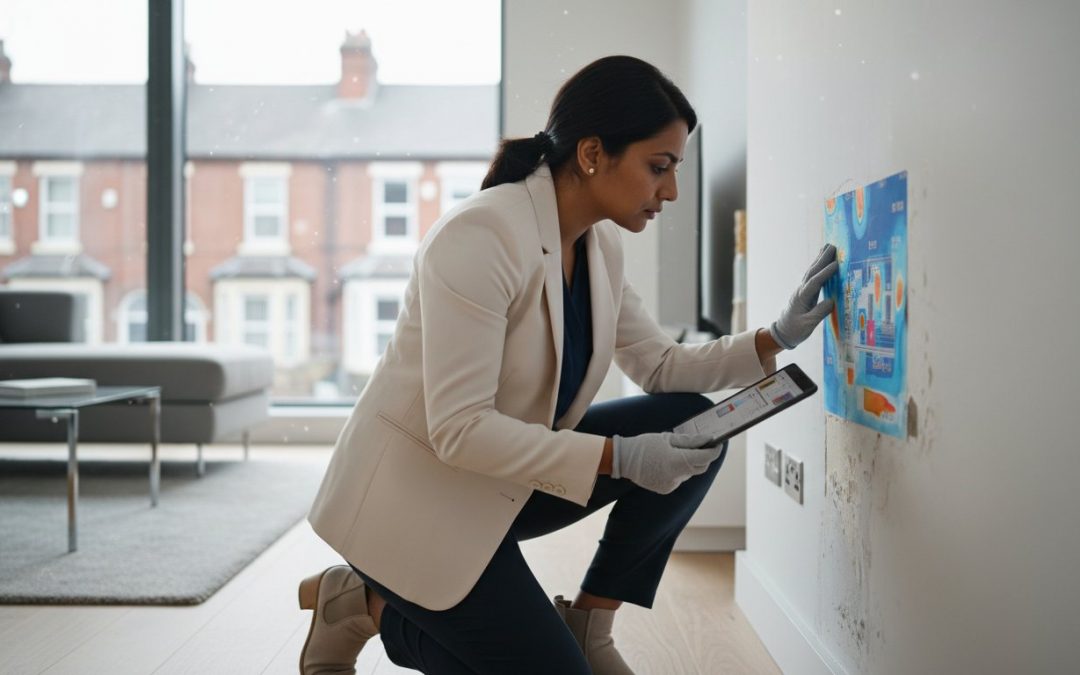
The difference between a rejected notification and a successful property restoration often comes down to a single specialist report rather than the visible damage. It’s a frustrating reality for many homeowners; the fear of being told a problem is just “gradual deterioration” can be as overwhelming as the damp itself. You want a dry, safe home that maintains its structural integrity, and you need professional validation to ensure your property’s value is protected.
Accredited technicians employ advanced tools like electronic hygrometers and thermal imaging cameras to see what the naked eye cannot. To understand how these specialized tools are used to solve complex water ingress, you can learn more about 紅外線熱顯像檢測 from specialists like Modic. These devices identify “bridging” within the cavity, where debris or failed insulation allows moisture to cross from the external wall to the internal leaf. Moisture mapping is a non-invasive diagnostic tool that uses surface and sub-surface readings to create a precise map of water distribution within a structure. This data provides the professional validation needed to prove that the dampness isn’t a result of simple condensation or poor ventilation. It establishes a clear pattern of ingress that aligns with structural faults rather than lifestyle factors.
Understanding how to make a building insurance claim for damp damage in 2026 requires a methodical approach to evidence. With the Financial Ombudsman Service reporting an average uphold rate of only 31% for general insurance complaints in the final quarter of 2025, providing precise technical data is vital. This guide explains how to notify your provider and what specialist evidence you’ll need to secure coverage for essential repairs. We’ll examine the documentation required for successful outcomes, including how the Decent Homes Standard updates from May 1, 2026, emphasize that every property must remain expert from moisture and mold to be considered decent.
Key Takeaways
- Differentiate between sudden insured perils and maintenance issues to understand how to make a building insurance claim for damp damage effectively.
- Discover why an independent specialist report carries significantly more weight than a standard builder’s estimate when validating structural issues.
- Identify the immediate steps required to document visible symptoms and secure your property without compromising essential evidence for your provider.
- Understand why cavity wall insulation extraction is frequently the only permanent method to restore structural integrity and prevent recurring moisture issues.
- Explore how working with a nationwide specialist ensures your repairs are backed by accredited techniques and a long-term guarantee for your home’s future health.
Understanding Damp Damage and Building Insurance Coverage
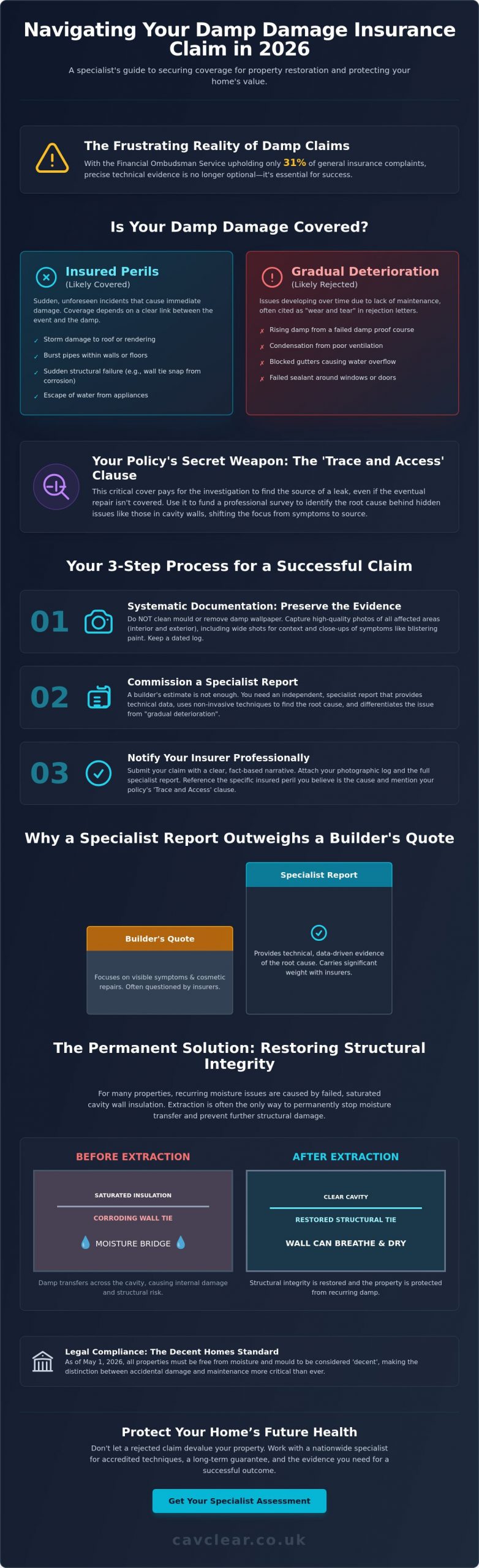
UK building insurance policies generally categorize property damage into two distinct groups: damage resulting from a sudden event and damage caused by neglect. Insurers use the term “insured perils” to describe sudden, unforeseen incidents. This includes events like a storm damaging the roof or a pipe bursting within a wall. Conversely, “gradual deterioration” refers to issues that develop over time due to a lack of maintenance. Understanding these definitions is the first step in learning how to make a building insurance claim for damp damage. Most standard policies won’t cover rising damp or condensation because they consider these preventable through routine upkeep.
The definition of damp damage in the context of UK building insurance is rarely straightforward. Most policies define it as the physical destruction or damage to the structure caused by the escape of water or a sudden external event. It’s not simply the presence of moisture. For coverage to apply, there must be a clear link between a specific incident and the resulting dampness. For instance, if a storm in January 2026 damages your external rendering and allows water to penetrate the cavity, this is typically a covered event. If the dampness is caused by a lack of ventilation over several years, it falls under the owner’s responsibility for property maintenance.
Insured Perils vs. Maintenance Issues
Rejection letters often cite “wear and tear” as the reason for denying coverage. This happens when a homeowner fails to address a small leak or blocked gutters. A sudden structural failure, such as a wall tie snapping due to severe corrosion from saturated insulation, presents a different scenario. It’s essential to identify the root cause before you contact your insurer. A specialist survey can confirm if the damp is a secondary effect of an insured event. Understanding Water Damage categories helps clarify whether the moisture intrusion is “clean” or “black” water, which influences the remediation strategy. By May 2026, the Decent Homes Standard requires all properties to be expert from these hazards, making the distinction between accidental damage and maintenance even more critical for property owners.
The ‘Trace and Access’ Clause Explained
This is the most critical part of a policy for damp issues. Most people don’t realize their insurance might pay for the investigation itself. Trace and Access cover pays for the costs involved in finding the source of a leak. This is vital for cavity wall investigations where the problem is hidden behind brickwork. Homeowners can use this clause to fund professional surveys that utilize non-invasive techniques to locate moisture. Knowing how to make a building insurance claim for damp damage effectively involves highlighting this clause to your provider. It shifts the focus from the symptoms to the source, which is exactly what a specialist needs to see. Identifying the fault correctly prevents the misdiagnosis of issues, ensuring that the structural integrity of the building is restored through the right technical solution.
How to Make a Building Insurance Claim for Damp Damage
The success of your property restoration depends heavily on the accuracy of your initial notification. When you first notice damp patches or peeling wallpaper, your immediate reaction might be to clean the area or attempt a DIY fix. However, preserving the site is essential for a successful outcome. Insurers require a clear chain of evidence that links the damage to a specific event. By following a structured process, you ensure that your submission remains professional and fact-based, reducing the risk of a summary rejection based on maintenance exclusions.
Step 1: Systematic Documentation
Start by capturing high-quality photography of all affected areas. This should include wide-angle shots to show the location within the room and close-up images of specific symptoms like blistering paint or salt deposits. Don’t overlook the exterior of your property. Look for cracks in the masonry, failed pointing, or signs of wall tie failure. It’s helpful to maintain a log of when these issues first appeared. A specific date often helps align the damage with local weather events or known plumbing issues. Avoid cleaning mould or removing damp wallpaper before the insurer’s representative arrives. Removing this evidence makes it difficult for a surveyor to assess the severity of the moisture intrusion. If you need a professional assessment of the internal wall conditions, a damp survey provides the technical data required to support your case.
Step 2: Professional Notification
Before you make the call, review your policy documents for specific terms. Look for “Trace and Access” cover and identify any exclusion keywords like “gradual seepage.” When speaking with the provider, state the facts clearly. Avoid speculating on the cause. Instead of saying “I think the insulation is wet,” describe the observation: “There is significant dampness on the internal leaf of the north-facing wall.” This factual approach prevents you from inadvertently admitting to a maintenance fault you aren’t qualified to diagnose. Request that the insurer sends a specialist who understands structural dampness rather than a general loss adjuster. A loss adjuster’s role is to minimize the insurer’s liability, whereas a specialist focuses on the technical root cause. This distinction is vital when learning how to make a building insurance claim for damp damage that actually results in a dry, safe home.
Once your notification is logged, the insurer typically appoints a representative within 48 to 72 hours. During this period, take reasonable steps to prevent further damage, such as placing buckets under active leaks or moving furniture away from damp walls. Do not commence any permanent repairs. A nationwide specialist can often provide the necessary technical reports that bridge the gap between a homeowner’s observation and the insurer’s requirement for accredited evidence. For those dealing with severe water ingress, understanding the removal process for saturated insulation is a vital step in restoring the thermal efficiency and structural health of your property.
The Vital Role of a Specialist Damp and Structural Survey
A general builder’s estimate often focuses on cosmetic repair costs rather than technical causation. This is a common pitfall when learning how to make a building insurance claim for damp damage. Insurers require a remedial report that uses empirical data to link the moisture to an insured event. An independent damp survey provides this evidence by utilizing specialized diagnostic equipment. These reports carry significant weight because they’re objective and accredited, whereas a builder’s quote might be viewed as subjective or purely commercial. Providing this level of detail ensures your notification is handled with the professional seriousness it deserves.
Beyond the Visible: Technical Moisture Mapping
Accredited technicians employ advanced tools like electronic hygrometers and thermal imaging cameras to see what the naked eye cannot. These devices identify “bridging” within the cavity, where debris or failed insulation allows moisture to cross from the external wall to the internal leaf. Moisture mapping is a non-invasive diagnostic tool that uses surface and sub-surface readings to create a precise map of water distribution within a structure. This data provides the professional validation needed to prove that the dampness isn’t a result of simple condensation or poor ventilation. It establishes a clear pattern of ingress that aligns with structural faults rather than lifestyle factors.
Validating Structural Integrity
Saturated insulation often leads to hidden structural failures, most notably the corrosion of wall ties. When these steel components rust, they expand and can cause horizontal cracking in the masonry or even the instability of the outer leaf. A specialist report will detail whether a wall tie replacement is necessary to restore the building’s safety. This technical link is crucial for a successful notification. If an insurer initially rejects a request by citing gradual deterioration, a detailed structural survey can counter this by proving the damage was accelerated by a specific failure, such as a compromised cavity wall system. It’s about presenting facts that meet the rigorous standards required by UK insurers in 2026.
Specialist reports are often the only way to overturn a denied submission. By providing clear photographic evidence of debris within the cavity or thermal profiles showing cold spots, you provide the insurer with facts that are difficult to ignore. This methodical approach transforms a vague complaint into a technical case for restoration. It’s the most effective way to ensure your property’s structural integrity is protected while securing the coverage you need for essential repairs. Using a nationwide specialist ensures that your report is recognized for its professional rigor across the entire United Kingdom.
Remedial Actions: Extraction and Structural Repairs
Surface treatments often fail because they ignore the moisture reservoir hidden within the property walls. When learning how to make a building insurance claim for damp damage, it’s vital to recognize that saturated insulation is frequently the primary driver of persistent dampness. Leaving defective material inside the cavity allows moisture to transition continuously from the outer leaf to the inner leaf. This process compromises the thermal efficiency of the building and leads to long-term structural decay. Professional extraction is the only permanent solution to ensure the cavity functions as an empty, protective air gap.
The Process of Insulation Extraction
Specialists use a non-invasive technique to remove debris and wet material through small, strategically placed openings in the external masonry. High-pressure compressed air and industrial-grade vacuums clear the entire cavity, ensuring no obstructions remain. This allows the building to “breathe” again, which is essential for natural drying. A clear cavity prevents the conditions that lead to black mould growth, which by May 2026 is a key health hazard identified under the updated Decent Homes Standard. Once the extraction is complete, the technicians verify the cavity is empty using specialized camera equipment, providing the documented proof required for your records.
Structural Restoration and Wall Tie Integrity
Damp environments accelerate the corrosion of wall ties, the essential components that hold your property’s leaves together. If a survey identifies snapped or expanded ties, replacement is mandatory to maintain structural safety. Our specialists never recommend the installation of retrospective cavity wall insulation because it creates a bridge for moisture and hides these critical structural issues. After the cavity wall insulation removal is finished, the property requires a period of natural ventilation before internal redecoration begins. This ensures the masonry is fully dry and won’t trap residual moisture behind new paint or plaster.
Restoring your home’s integrity requires a specialist who understands the interplay between insulation and masonry. If you’re currently navigating how to make a building insurance claim for damp damage, securing an accredited technical report is your first step toward a permanent fix. Our nationwide team provides the expertise needed to identify and rectify these hidden faults. To protect your property’s future and restore its comfort, contact a CavClear specialist today for a comprehensive structural assessment.
Protecting Your Home’s Future with CavClear Specialists
Restoring a property after moisture intrusion requires more than just a temporary patch. It demands a specialist approach that addresses the fundamental structural causes of the issue. As a nationwide provider, CavClear delivers consistent, high-level standards across the entire United Kingdom. We focus on returning your home to its original design intent: a dry, thermally efficient structure with a clear, functional cavity. By choosing an accredited specialist, you ensure that the remedial work doesn’t just fix the current symptom but protects the property’s long-term health and market value.
Nationwide Expertise, Local Standards
Our technicians operate across every region of the UK, ensuring that homeowners have access to expert structural investigations regardless of their location. This nationwide reach allows us to maintain a rigorous standard of quality that local general builders often cannot match. Every extraction and wall tie replacement we perform adheres to modern building regulations and safety standards. Providing professional remedial documentation is essential for maintaining your property’s value, especially with the 2026 updates to the Building Safety Act and the Decent Homes Standard. These records prove that the property is managed correctly and that risks like dampness have been professionally mitigated.
Your Path to a Damp-no-obligation Home
The journey from discovering moisture to achieving a dry home involves several technical steps. You’ve learned about documenting damage, notifying your provider, and the necessity of specialist surveys. Understanding how to make a building insurance claim for damp damage is the first stage in this process. However, the resolution only comes through precise extraction and structural repair. Acting quickly is vital; moisture left within a cavity can lead to significant wall tie corrosion and internal decay within months. By May 2026, regulatory scrutiny on property health is higher than ever, making a permanent fix a necessity rather than an option.
Moving from a property with failed insulation to a certified, dry home provides essential peace of mind. Our techniques are clean, non-invasive, and designed to restore the structural integrity of your walls. We provide a guarantee for our extraction services, ensuring that the moisture source is permanently removed. The next step in your property’s recovery is a professional assessment. Book your specialist survey today to begin the diagnostic process and secure your home’s future. Our team is ready to provide the technical expertise and reliability required to resolve your damp issues for good.
Secure Your Property’s Structural Future
Successfully addressing dampness requires a transition from observing symptoms to documenting technical causes. You’ve seen that success depends on distinguishing between gradual wear and sudden insured perils. Providing an insurer with a specialist report that maps moisture and structural integrity is the most effective way to validate your case. With the Financial Ombudsman Service noting a 31% uphold rate for general insurance complaints in late 2025, your evidence must be beyond reproach. This level of detail is exactly what’s needed to move from a notification to a full restoration.
Understanding how to make a building insurance claim for damp damage ensures you approach your provider with professional authority. Our nationwide UK coverage and accredited specialist technicians provide the comprehensive technical reporting required to support your notification. We focus on permanent solutions like cavity extraction to restore your home’s thermal efficiency and structural health. Don’t let hidden moisture compromise your property’s value or your family’s comfort. By taking decisive action now, you protect your investment and ensure your home meets the Decent Homes Standards effective from May 1, 2026. Book a Specialist Damp Survey with CavClear Today to begin your journey toward a dry, safe home.
Frequently Asked Questions
Does building insurance cover rising damp in the UK?
Standard building insurance policies in the UK typically exclude rising damp because it’s considered a maintenance issue. Insurers classify this as gradual deterioration rather than a sudden, accidental event. However, if the moisture ingress is caused by a specific insured peril like storm damage or a burst pipe, coverage may apply. A professional survey is necessary to identify the specific source and provide the technical evidence required for a successful notification.
What should I do if my insurer rejects my damp-related submission?
You should request a formal review and submit an independent specialist report to challenge the decision. Statistics from the Financial Ombudsman Service show a 31% uphold rate for general insurance complaints in late 2025, which highlights the need for robust evidence. A detailed remedial report from an accredited technician can often prove that the damage resulted from an insured peril rather than neglect. This technical validation is a key part of how to make a building insurance claim for damp damage successfully.
Is mould damage covered under a standard building insurance policy?
Mould damage is generally only covered if it’s a direct consequence of a covered event, such as a sudden leak or flood. If the mould results from condensation or poor ventilation, insurers usually reject the request. Under the Decent Homes Standard updated on May 1, 2026, properties must be expert from these hazards to be considered safe. Providing a specialist report that links the mould to a structural fault is the most effective way to secure restoration coverage.
What is the ‘Trace and Access’ clause, and how does it help with damp?
The ‘Trace and Access’ clause covers the costs involved in locating the source of a leak or water ingress. This is a vital tool for homeowners because it can fund the specialist equipment needed to inspect hidden areas like wall cavities. Using this clause allows for the identification of debris or failed insulation that is bridging moisture across the leaves. It shifts the financial burden of the investigation from the homeowner to the insurer, ensuring a professional diagnosis is performed.
Do I need to get a specialist survey before notifying my insurer?
While not mandatory, obtaining an independent specialist survey before notifying your insurer provides a significant advantage. This report establishes a technical baseline and identifies the root cause of the moisture before the insurer’s representative arrives. Having this data ready helps you navigate how to make a building insurance claim for damp damage by preventing the provider from defaulting to a wear and tear exclusion. It ensures the conversation focuses on structural facts rather than speculation.
Will my insurance pay for cavity wall insulation removal?
Insurance providers often cover cavity wall insulation removal if the material has been saturated by an insured event, such as a storm or plumbing failure. Saturated insulation loses its thermal efficiency and becomes a bridge for moisture, leading to internal damage. If a specialist report proves the insulation is defective or contaminated due to a covered peril, the extraction cost is typically included in the restoration. This process is essential for returning the property to a dry, safe condition.
How long does the average damp investigation and repair process take?
A typical investigation and repair timeline usually spans four to eight weeks from the initial notification. The specialist survey is generally completed within the first seven days, followed by the insurer’s review process which can take up to 21 days. Once the work is approved, a professional cavity extraction often takes only one or two days to complete. This methodical approach ensures that all debris is removed and the structural integrity of the building is fully restored.
Can damp damage affect the structural integrity of my home?
Persistent dampness significantly threatens the structural integrity of a building by accelerating wall tie corrosion and timber decay. When steel wall ties rust, they expand and can cause horizontal cracking or instability in the outer masonry leaf. Our nationwide surveys frequently identify these hidden issues in properties with failed insulation. Addressing these structural faults immediately is vital for maintaining the property’s safety and long-term value, as required by the 2026 Building Safety Act standards.
Recent Comments