
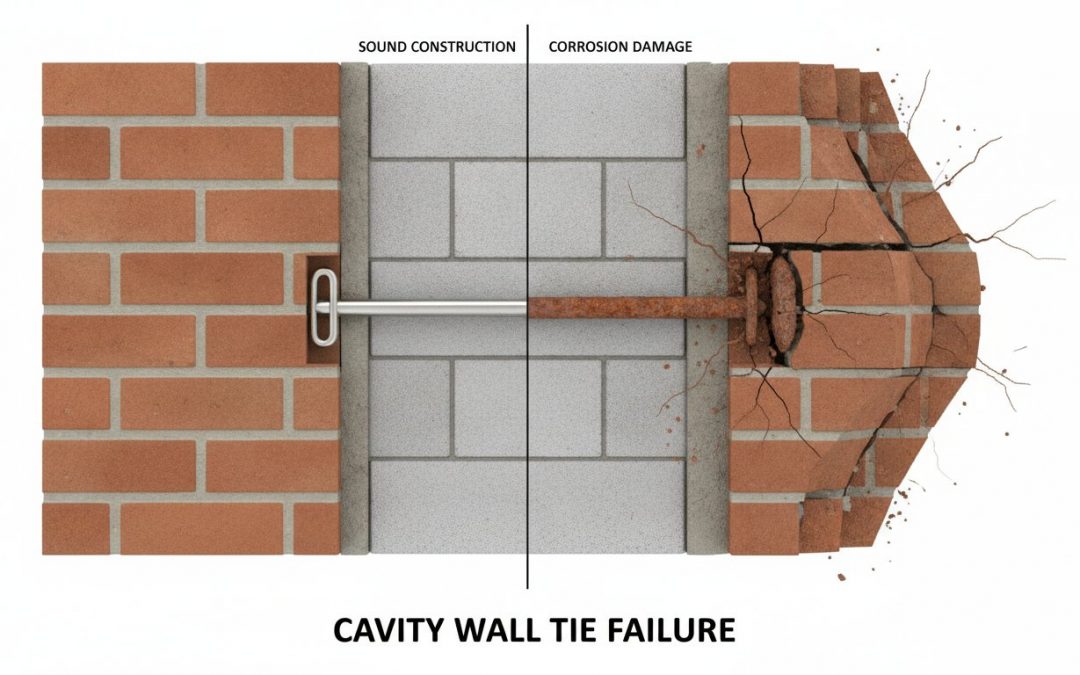
Did you know that an estimated 10 million homes across the United Kingdom are currently at risk of structural instability due to a component you’ll likely never see? It’s natural to feel a sense of unease when you notice horizontal cracks in your masonry or hear technical warnings about cavity failure. You want to protect your property’s long-term value and ensure the safety of those inside. You’re likely asking how serious is wall tie corrosion and whether your home requires immediate professional intervention.
We understand that structural issues feel overwhelming, but wall tie failure is a manageable problem when it’s identified early. This guide provides a clear look at the hidden dangers of metal expansion within your walls. You’ll learn how to spot the early warning signs of distress and understand why certain types of ties fail without any visible symptoms at all. We also outline the precise methodology for professional inspection and replacement, giving you a reliable roadmap to restore your home’s structural integrity and your own peace of mind.
Key Takeaways
- Understand how rusting ties can expand up to seven times their original thickness, exerting enough mechanical force to lift brickwork and compromise structural stability.
- Determine how serious is wall tie corrosion in your property by identifying visual warning signs, ranging from horizontal hairline cracks to noticeable masonry bulging.
- Learn why retrospective cavity wall insulation often accelerates metal decay by trapping moisture and creating a bridge that facilitates rapid corrosion.
- Discover the non-disruptive methodology for professional wall tie replacement, which utilizes borescopes and metal detectors to ensure a precise and permanent fix.
- Gain a clear roadmap for restoring your home’s structural integrity through specialist surveys that assess hidden risks before they lead to catastrophic failure.
Defining the Severity: Why Wall Tie Corrosion is a Critical Structural Issue
Wall tie corrosion is a high-severity structural issue that directly compromises the stability of a building. In the UK, most homes built since the early 20th century utilize cavity wall construction. This design relies on two separate layers of masonry, known as leaves, which are held together by metal ties. When these ties begin to degrade through chemical oxidation, the mechanical bond between the inner and outer walls vanishes. This leaves the exterior leaf standing as an independent, unsupported structure. Property owners frequently ask how serious is wall tie corrosion, and the reality is that it can lead to total wall collapse if left unaddressed.
The Role of Wall Ties in Property Stability
The primary function of cavity wall ties is to transfer lateral loads between the internal and external leaves of a building. This ensures that wind pressure and the weight of the structure are distributed safely across both layers of masonry. Without these ties, the outer leaf becomes vulnerable to external forces. It may begin to bow outward or lean away from the property because it no longer has the internal wall for support. Modern standards, such as PD 6697:2019, now mandate the use of stainless steel to prevent these issues, but millions of older properties still rely on vulnerable materials. Ensuring these ties remain functional is vital for long-term asset health and the safety of the occupants.
Why Mild Steel is the Primary Culprit
Homes constructed between the 1920s and 1981 are at the highest risk of failure. During this period, builders commonly used mild steel ties with a thin protective coating of zinc. We now know that this protection is temporary. Once moisture penetrates the cavity, the galvanization fails and the underlying steel begins to rust. The Building Research Establishment estimates that the service life for wire ties installed between 1964 and 1981 can be as short as 13 to 26 years. In coastal areas, salt-laden air accelerates this chemical breakdown, often cutting the expected lifespan in half. This makes professional wall tie replacement a necessary investment for many UK homeowners. Understanding how serious is wall tie corrosion involves recognizing that these components have a finite lifespan and will eventually require expert intervention to maintain structural safety.
The Physics of Failure: How Rust Expansion Destroys Brickwork
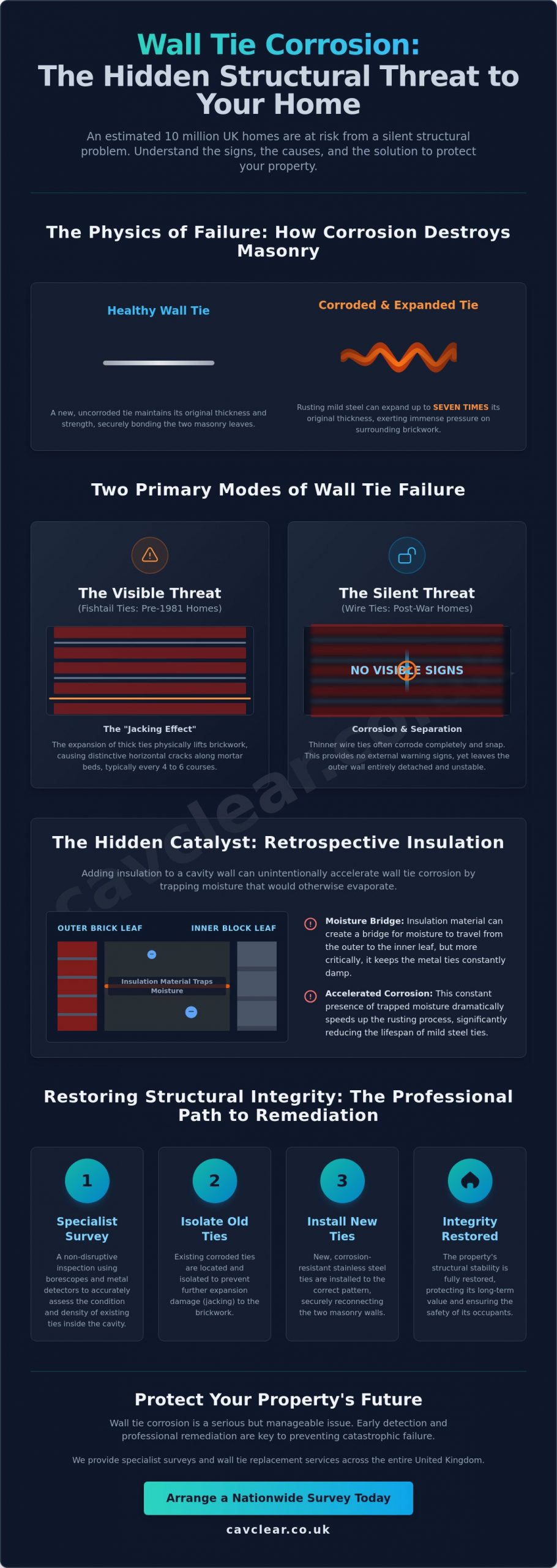
Corrosion is more than just the weakening of a metal component. It is a progressive mechanical process that generates immense internal pressure within a building’s envelope. When mild steel reacts with oxygen and moisture, it transforms into ferric oxide, or rust. This new substance occupies significantly more volume than the original raw steel. In many cases, a corroding tie can expand to seven times its original thickness. This physical growth creates a powerful force that works against the structural integrity of the masonry. Homeowners often ask how serious is wall tie corrosion, and the answer lies in the sheer physics of this expansion.
The Jacking Effect and Horizontal Cracking
The expansion of thick, traditional “fishtail” ties produces what structural engineers call the “jacking” effect. As the metal grows, it physically lifts the layers of brickwork above it. Because mortar is less dense and more brittle than brick, the stress manifests as horizontal cracks along the bedding joints. You will typically see these cracks appearing every four to six brick courses, which corresponds to the vertical spacing of the ties. Rust expansion is a mechanical force that overcomes the weight of the masonry. This process doesn’t just damage the aesthetics of your home; it actively destabilizes the outer leaf by widening the joints and allowing even more moisture to enter the cavity.
Wire Tie Failure: The Silent Threat
While thick ties provide visible warnings through cracking, thinner “wire” or “butterfly” ties behave differently. These ties, common in post-war housing, often fail without any external expansion or brickwork distress. Instead of lifting the masonry, the thin wire simply corrodes until it snaps. This is a silent threat because a wall can appear perfectly healthy while the two leaves are entirely detached. A lack of visible cracks does not necessarily mean the wall is safe from collapse. This ambiguity highlights how serious is wall tie corrosion even when symptoms aren’t obvious. To protect your property’s long-term health, we recommend a professional wall tie survey to verify the internal condition of your cavity. Identifying these hidden faults early is a vital investment in your property’s future stability.
Assessing the Damage: Symptoms and Severity Stages
Identifying structural defects early is the most effective way to prevent costly remediation. While the mechanical expansion of rust occurs deep within the cavity, the resulting pressure eventually forces visible changes on the property’s exterior. Property owners often struggle to distinguish between minor settling and structural failure. Understanding the progression of these symptoms helps you determine how serious is wall tie corrosion in your specific property. By the time signs appear on the outer leaf, the internal degradation is usually well-advanced.
Visual Checklist for Property Owners
We recommend a methodical walk-around of your home to look for specific indicators of masonry distress. Because wall tie failure is a progressive issue, these symptoms often appear gradually before accelerating. Look for the following signs:
- Horizontal cracking: These cracks typically appear in the mortar joints every four to six courses. They are often most prominent on the upper storeys or on elevations most exposed to the wind and rain.
- Outward bulging: If a wall appears to “pillow” or bow outward, it suggests the outer leaf has detached from the inner structure. This is a clear sign that the ties are no longer providing lateral support.
- Roof and fascia distress: When expanding ties lift the masonry, they can push the fascia boards out of alignment or create visible gaps where the roof meets the wall.
- Distorted frames: Movement in the masonry often puts pressure on window and door openings. If your windows are suddenly sticking or you notice new gaps around the frames, the wall may be shifting.
- Stepped cracking in gables: Diagonal or “stepped” cracks in the triangular gable ends are particularly concerning. These indicate that the top of the wall is losing its bond with the rest of the building.
The Four Stages of Wall Tie Corrosion
To help homeowners understand the urgency of the situation, we categorize the degradation into four distinct stages. This scale reflects the increasing risk to the building’s structural integrity. It’s important to remember that homes across the United Kingdom face different environmental pressures, but the chemical progression remains the same.
- Stage 1: Incipient Corrosion. The protective zinc or galvanised coating on the mild steel ties has failed. There are no external symptoms, but the ties are now vulnerable to moisture. Only an intrusive survey can detect this stage.
- Stage 2: Active Oxidation. The steel is actively rusting and beginning to expand. You may notice horizontal hairline cracks in the mortar joints. At this stage, how serious is wall tie corrosion becomes a question of preventing future damage rather than fixing a collapse.
- Stage 3: Structural Movement. The expansion force is now significant enough to physically move the masonry. Cracks are wider, and you may see early signs of bulging. The stability of the outer leaf is now officially compromised.
- Stage 4: Imminent Failure. The outer leaf has significantly detached from the inner leaf. Large gaps may be visible at the corners of the property or at the roofline. There is a high risk of the wall collapsing, especially during periods of high winds or storms.
Recognizing these stages allows you to act before a manageable repair turns into an emergency. Our nationwide team provides the expert assessment needed to pinpoint exactly where your property sits on this scale, ensuring the long-term health of your asset.
The Hidden Catalyst: How Retrospective Insulation Accelerates Corrosion
We maintain a firm professional stance against the installation of retrospective cavity wall insulation in older properties. While often marketed as a simple energy-saving measure, these materials frequently act as a hidden catalyst for rapid structural decay. Understanding the relationship between these materials and metal degradation is essential when determining how serious is wall tie corrosion in your home. When insulation is added to a cavity that was never designed for it, the risk of accelerated oxidation increases significantly.
Moisture Bridging and the Cavity Environment
The original design of a wall cavity serves as a vital moisture barrier. It provides an air gap that prevents wind-driven rain from crossing from the outer leaf to the inner leaf. When this space is filled with retrospective materials like mineral wool or foam, that barrier is removed. These materials can become saturated, acting as a physical bridge that carries water directly to the mild steel ties. This creates a damp micro-climate where the ties are permanently exposed to oxygen and moisture. In an empty cavity, ties have the opportunity to dry out between rain spells. In an insulated cavity, they stay wet for months at a time. Retrospective insulation can turn a 20-year corrosion process into a 5-year structural crisis. Because the insulation obstructs visual checks, the damage often remains hidden until the masonry begins to fail. For this reason, properties with failing ties and damp material often require professional cavity wall insulation removal as a primary step in the remediation process.
The Risk to Property Value and Insurance
The presence of compromised wall ties and wet insulation poses a significant threat to your property’s marketability. Most building insurers will not cover the costs of repair because they classify rust as gradual deterioration rather than an accidental event. This leaves the homeowner responsible for the full cost of structural restoration. From a financial perspective, lenders frequently refuse mortgages on properties where structural movement or damp insulation is detected during a survey. A building with these issues can quickly become unmortgageable, forcing a significant devaluation. Maintaining asset health requires a professional report that confirms the cavity is clear and the ties are secure. If you suspect your insulation is compromising your home, you should arrange a professional cavity wall tie inspection to assess the internal conditions before the damage escalates.
Restoring Structural Integrity: The Professional Path to Remediation
While the discovery of structural faults is naturally stressful, modern engineering provides a reliable and methodical path to restoration. Remediation is a non-disruptive process that preserves the aesthetic of your home while reinforcing its core stability. Understanding how serious is wall tie corrosion allows you to appreciate why a simple patch repair isn’t sufficient for long-term safety. We utilize high-grade stainless steel components that offer a permanent solution, far outlasting the original mild steel installations common in older UK properties. Our approach focuses on the restoration of comfort and the protection of your property’s future value.
What Happens During a Specialist Survey?
A professional assessment begins with a non-invasive diagnostic phase to determine the exact state of the cavity. We use high-sensitivity metal detectors to locate the precise positions of existing ties across the masonry. Once mapped, we insert endoscopes into the cavity through small, discreet inspection holes to visually inspect the degree of oxidation. We don’t just look at the surface; our specialists perform “pull-out” tests to measure the remaining mechanical grip of the ties. We also map the density of the ties across every elevation. This ensures the property meets current building regulations, providing a data-driven roadmap for the necessary repairs.
The Remediation Process Step-by-Step
The actual wall tie replacement is a clean and efficient procedure. We follow a specific methodology to ensure the fix is both permanent and visually subtle.
- Precision Drilling: Our team drills small entry points into the mortar joints. We avoid drilling into the bricks themselves to maintain the visual integrity of your masonry.
- Installation: we install high-grade stainless steel mechanical or resin ties. These materials are impervious to the moisture issues that destroyed the original mild steel components.
- Isolation: This is a critical step that many general builders overlook. We must isolate the old, corroded ties. Even if they’re no longer providing support, they’ll continue to expand and cause “jacking” if left active. We use foam sleeves or physical removal to stop this mechanical force.
- Finishing: We point the entry holes using mortar that matches your existing finish. The result is a structurally sound wall with almost no visible evidence of the intervention.
This proactive approach transforms a significant structural risk into a long-term asset. By following the correct methodology, we don’t just repair a fault; we provide a vital investment in the property’s future. Our nationwide team ensures that every homeowner in the United Kingdom has access to this level of professional rigor and technical expertise. Understanding how serious is wall tie corrosion is the first step toward a permanent, professionally guaranteed resolution.
Securing Your Property’s Structural Future
Wall tie failure isn’t just a surface issue; it’s a progressive mechanical breakdown that threatens the very stability of your home. We’ve explored the physics of rust expansion and the specific risks posed by moisture-trapping insulation. You now understand how serious is wall tie corrosion when left to progress from hairline cracks to full structural bulging. Identifying these faults early is the most effective way to prevent catastrophic masonry failure and protect your long-term asset health.
Our nationwide team provides the expertise needed to diagnose hidden cavity issues and implement permanent, non-disruptive solutions. We use precision technology to ensure every replacement meets current building standards, providing you with comprehensive technical reports for your peace of mind. To take the first step toward a secure and stable home, Book a Professional Wall Tie Survey with CavClear Today. Our accredited technicians are ready to restore your property’s integrity with professional rigor and high-level standards. Structural safety is a vital investment, and we’re here to provide the expert resolution you deserve.
Frequently Asked Questions
How urgent is wall tie replacement if I see cracks?
Replacement is urgent once visible cracking appears because the mechanical expansion has already overcome the weight of the masonry. These cracks represent advanced structural movement that compromises the bond between your walls. Delaying repairs allows further moisture ingress, which accelerates the decay and increases the risk of the outer leaf becoming entirely detached from the property.
Can wall tie corrosion cause the whole house to collapse?
Corrosion typically leads to the collapse of the external masonry leaf rather than the entire building structure. While the inner load-bearing wall may remain standing, the loss of the outer leaf leaves the home vulnerable to the elements and further instability. This is why understanding how serious is wall tie corrosion is vital; it’s a specific threat to the building’s protective envelope and safety.
Does home insurance cover the cost of wall tie replacement?
Standard home insurance policies generally exclude wall tie replacement because it’s classified as wear and tear or gradual deterioration. Insurers rarely cover damage that occurs over a long period, such as the slow oxidation of metal. Homeowners are typically responsible for these structural maintenance costs. We recommend checking your specific policy wording, but most providers find these costs are not covered.
How long do remedial stainless steel wall ties last?
Modern remedial ties manufactured from high-grade stainless steel are designed to last for the remaining lifetime of the building. Unlike the original galvanised mild steel ties used in older homes, stainless steel is highly resistant to oxidation even in damp cavity environments. This makes professional replacement a permanent fix and a vital investment in the property’s long-term asset health.
Is it possible to check for wall tie corrosion without drilling holes?
A metal detector can locate the presence and density of ties without drilling, but it cannot assess their physical condition. A specialist must use an endoscope to view the level of rust, which requires a small, discreet inspection hole in the mortar joint. Without this visual confirmation, it’s impossible to determine the true severity of the corrosion or the safety of the wall.
Will wall tie corrosion affect the sale of my house?
Failing wall ties can significantly complicate or even block a property sale in the United Kingdom. Surveyors often flag horizontal cracking or bulging as a high-risk defect, which can lead mortgage lenders to refuse a loan entirely until the issue is rectified. Addressing how serious is wall tie corrosion before listing your home ensures a smoother transaction and protects the asset’s market value.
What happens if I ignore the horizontal cracks in my brickwork?
Ignoring horizontal cracks allows the jacking effect to continue, leading to wider gaps and potential bulging of the brickwork. Over time, the outer leaf will lose all structural connection to the inner leaf. This progression increases the likelihood of a sudden collapse during a storm or period of high winds, turning a manageable repair into a structural emergency.
Can I replace wall ties myself as a DIY project?
Wall tie replacement is not a suitable DIY project because it requires technical load testing and specialist drilling equipment. A professional must ensure the new ties are spaced correctly to meet building regulations and that the old, corroding ties are properly isolated. Incorrect installation can lead to further masonry damage or fail to provide the necessary lateral support required for safety.
Recent Comments