

What if the material installed to protect your home is actually the catalyst for its structural decline? Many homeowners across the UK currently face the reality that wet or degraded insulation traps moisture against internal walls, leading to persistent damp and mould. It’s a frustrating situation when your energy bills rise despite your efforts to insulate, but these symptoms indicate that your property’s cavity is no longer functioning correctly.
This guide clarifies the latest 2026 eligibility criteria for government grants for insulation removal UK, focusing on active support schemes like ECO4 that help fund professional extraction. We’ll explain why removing failed material is a vital investment in your property’s structural health and how our nationwide specialists restore thermal efficiency. You’ll discover the technical steps involved in a clean, non-invasive extraction and how a guaranteed fix provides the peace of mind your home deserves.
Key Takeaways
- Understand the critical timelines for active energy support schemes, including the transition of the Great British Insulation Scheme toward its March 2026 deadline.
- Identify how to navigate the current eligibility criteria for homeowners and tenants seeking government grants for insulation removal UK to address failing materials.
- Learn why professional extraction is a structural necessity to prevent damp and protect your property from the risks of accelerated wall tie corrosion.
- Discover the specialized technical process required to ensure all debris is removed, restoring the thermal efficiency and safety of your home’s cavity.
- Gain insight into how a specialist remedial extraction serves as a vital investment in your property’s long-term health and structural integrity.
The Landscape of Energy Support and Extraction Funding in 2026
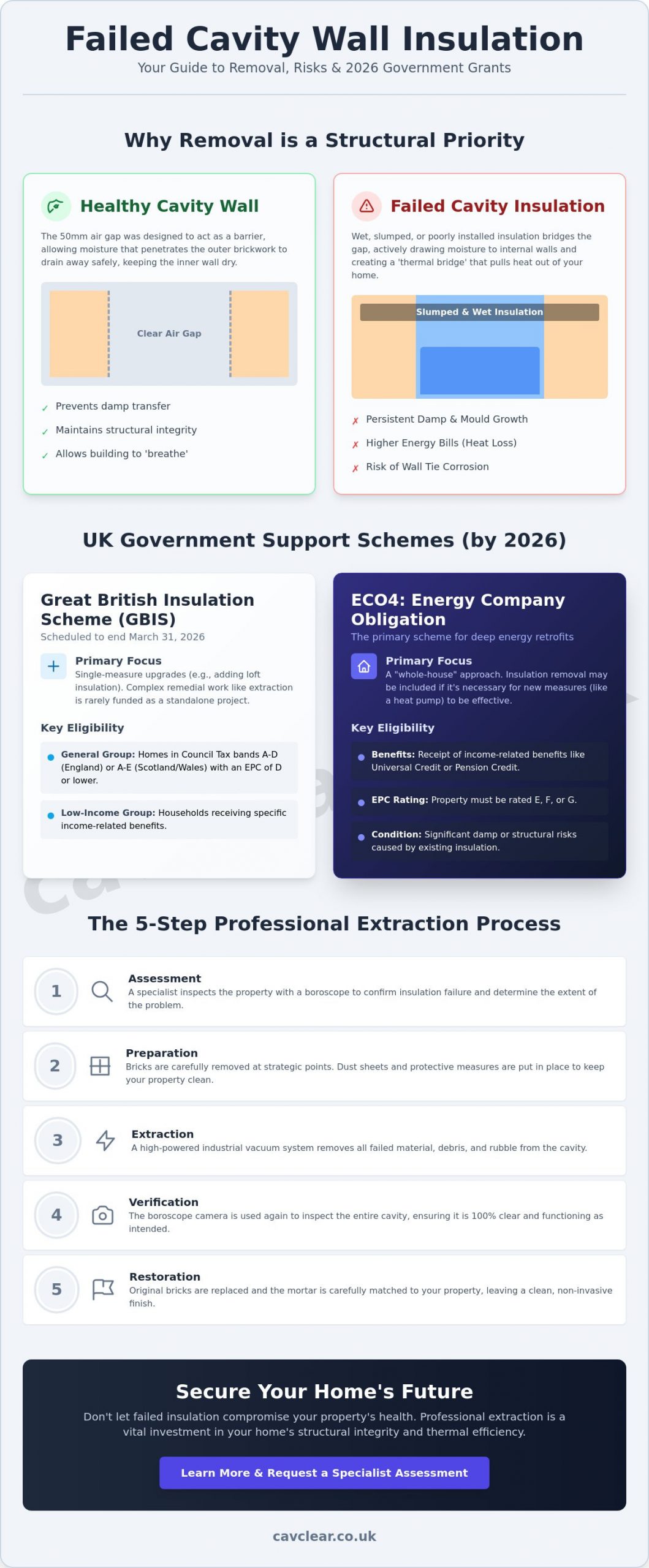
The UK domestic energy sector in 2026 prioritizes the remediation of failed installations. For decades, thousands of properties were fitted with materials that didn’t suit the specific local climate or property type. By 2026, the emphasis of national support has moved toward correcting these errors to protect structural integrity. While many homeowners seek government grants for insulation removal UK, the availability of these funds depends on specific criteria and the scheme’s primary objectives. Understanding Cavity Walls is essential because it highlights how these gaps were intended to function as a moisture barrier before being filled with unsuitable or poorly installed materials.
National funding has shifted from simple installation to complex remedial works for several reasons. Wet or slumped insulation creates a thermal bridge, which actively pulls heat out of the home and encourages mold growth. This makes extraction a vital piece of structural maintenance rather than a simple cosmetic fix. Our nationwide specialist teams focus on the restoration of your home’s natural ventilation. We ensure the cavity is clear of all debris, which is the only way to guarantee the long-term health of the building and prevent wall tie corrosion.
The Status of the Great British Insulation Scheme (GBIS)
The Great British Insulation Scheme (GBIS) reaches its scheduled conclusion on March 31, 2026. This scheme targets a broad range of households through two distinct pathways. The “general group” includes homes in Council Tax bands A to D in England, or A to E in Scotland and Wales, with an EPC rating of D or lower. The “low-income group” focuses on households receiving specific income-related benefits. It’s important to note that GBIS primarily funds the addition of new measures. Specialist extraction is rarely a standalone feature of this specific programme, as the scheme’s design favors single-measure upgrades rather than complex remedial projects.
ECO4: The Energy Company Obligation in 2026
ECO4 remains the primary mechanism for deep retrofits in 2026. Unlike previous iterations, it mandates a whole-house approach to energy efficiency. This means energy suppliers don’t just look at one measure; they assess the entire property’s thermal performance. If existing wet or slumped material hinders the efficiency of new measures, such as heat pumps, suppliers may include remedial work as part of the package. Eligibility is strictly tied to:
- Receipt of income-related benefits like Universal Credit or Pension Credit.
- Property Energy Performance Certificates (EPC) rated E, F, or G.
- The presence of significant damp or structural risks caused by the original material.
The role of the energy supplier is to conduct a thorough assessment. They determine if the existing insulation is fit for purpose. If it’s found to be failing, the extraction process becomes a necessary step in the property’s journey toward the 2050 net-zero targets.
Understanding Why Defective Insulation Removal is a Structural Priority
UK cavity walls were designed to act as a barrier against the driving rain common across the British Isles. The 50mm gap between the external and internal brickwork provides a vital drainage plane that keeps the interior of the home dry. When this cavity is retrofitted with insulation, that essential air space is lost. Many homeowners find that older installations from the 1990s or early 2000s have failed, leading them to investigate government grants for insulation removal UK to rectify the damage before it affects the building’s stability.
Failure typically occurs due to poor installation techniques, existing debris at the bottom of the cavity, or the use of materials unsuitable for the local exposure zone. In many cases, the material becomes a bridge for external moisture, allowing liquid water to travel directly to the internal walls. This compromise isn’t just a matter of reduced thermal efficiency; it’s a fundamental threat to the property’s structural health. Maintaining a clear cavity is technically necessary to allow the building to breathe and to ensure that any moisture penetrating the outer leaf can drain away safely.
The Impact of Wet and Slumped Insulation
Saturated insulation is worse than no insulation at all. When mineral wool or cellulose becomes damp, it slumps toward the bottom of the wall, leaving the top sections cold and the bottom sections perpetually wet. These wet pockets create thermal bridges that pull heat out of the room, resulting in cold spots where condensation thrives. This environment is the perfect breeding ground for black mould, which can spread rapidly across wallpaper and plaster surfaces. Interstitial condensation is a primary result of blocked cavities, occurring when warm, moist air from inside the home hits the cold, saturated material within the wall structure and turns into liquid.
Wall Tie Corrosion and Structural Integrity
Wall ties are essential steel components that lock the two leaves of a cavity wall together. They’re designed to live in a dry environment. When insulation holds moisture against these ties, it triggers a chemical reaction called oxidation. Over time, the metal rusts and expands to several times its original thickness. This expansion exerts immense pressure on the surrounding mortar, often leading to visible horizontal cracks or a bulging appearance in the external brickwork. If you’ve noticed these signs, you can learn more about the technical process and costs involved in Wall Tie Replacement to understand why extraction is the first step in protecting your home.
Ignoring these signs can lead to severe instability and expensive repairs. Accessing government grants for insulation removal UK can help homeowners manage the cost of these essential structural interventions. A professional extraction from a specialist ensures the cavity is clear, dry, and functioning as intended. You can contact our specialist team to discuss a property survey and restore your home’s integrity.
Navigating ECO4 and Residential Energy Efficiency Support Schemes
Accessing government grants for insulation removal UK remains a complex process in 2026. Most financial assistance is delivered through the ECO4 scheme, which focuses on a whole-house approach to energy efficiency. This means that support isn’t typically awarded for standalone extraction. Instead, it’s integrated into larger renovation projects designed to lift a property’s thermal performance. Before you apply, it’s vital to secure an independent property assessment. A specialist surveyor can identify if your current insulation is wet, slumped, or incorrectly installed, providing the technical evidence required to justify any funding application.
The House of Commons Library briefing on cavity wall insulation details the widespread nature of installation failures across the country. This document serves as a critical reference for understanding why so many properties now require remedial intervention. While national schemes aim to reduce fuel poverty, they often struggle to address the specific structural damage caused by saturated debris within a cavity. For many homeowners, the challenge lies in proving that the existing material is a detriment to the building’s integrity rather than an asset.
Eligibility Requirements for 2026 Support
To qualify for assistance under the current “Help to Heat” framework, your household must meet strict criteria. Eligibility is largely determined by your property’s Energy Performance Certificate (EPC) rating and your financial circumstances. Properties with a rating of D, E, F, or G are prioritized. You must also be a homeowner or a private tenant with the landlord’s permission, and receive one of the following qualifying benefits:
- Pension Credit (Guarantee or Savings Credit)
- Universal Credit
- Income-based Jobseeker’s Allowance
- Child Benefit, subject to 2026 income thresholds (e.g., £22,700 for a single claimant with one child)
If you don’t meet these national requirements, the Local Authority Flexible Eligibility (LA Flex) route offers an alternative. Councils can nominate households that are either on a low income (typically under £31,000 per year) or contain residents vulnerable to the effects of a cold, damp home. This localized approach expands access to government grants for insulation removal UK for those who fall outside the standard benefit net.
The Limitations of Current Funding Models
A significant “funding gap” exists for many UK residents. Current models often only fund extraction if it’s a technical prerequisite for a new, approved measure, such as solid wall insulation. This leaves many homeowners in a difficult position if their property has a higher EPC rating but still suffers from severe damp caused by failing cavity fill. If your home doesn’t qualify for a full retrofit package, the cost of extraction often falls to the property owner.
Waiting for funding that may never arrive can be a costly mistake. Damp and mold spread rapidly, compromising wall ties and internal finishes. We’ve seen cases where delaying a necessary extraction for 12 months led to a 40% increase in total repair costs due to secondary structural damage. If your property shows signs of water ingress, moving forward with private remedial works is often the most responsible choice. Investing in professional extraction ensures the long-term health of your home and restores the thermal efficiency of your walls without the risks associated with defective materials.
Technical Standards and Planning for Professional Insulation Extraction
Removing failed material from a property is a technical undertaking that prioritizes the structural health of the building. It’s a precise engineering process rather than a simple cleaning task. When insulation becomes saturated or slumps, it creates bridges that allow moisture to travel from the outer leaf of masonry to the inner skin. Professional extraction stops this process by restoring the clear air space that your home needs to breathe. While many homeowners investigate government grants for insulation removal UK to help fund these essential repairs, the focus should always remain on the technical rigour of the contractor performing the work.
Choosing an Accredited Specialist
Selecting a nationwide specialist is vital for ensuring the long-term safety of your masonry. General builders often lack the industrial-grade machinery required to clear a cavity completely. You should look for contractors who hold comprehensive liability insurance and can demonstrate a track record of successful extractions across diverse property types. Before any physical work begins, a professional will always insist on a detailed Damp Survey to map the extent of the moisture ingress. This diagnostic step ensures the extraction plan addresses the specific failure points of your property’s original installation. Using a specialist ensures that the work adheres to 2026 building safety standards, providing you with the necessary certification for future property valuations.
The Extraction Process Explained
The process begins with the strategic removal of individual bricks at the base of the walls. These openings serve as extraction points where debris is collected. Technicians use high-pressure compressed air, typically delivered at 100 to 120 psi, to agitate and break down the insulation material inside the wall. Simultaneously, industrial-strength vacuum units draw the loosened material out of the cavity. This dual-action method ensures that no pockets of damp material remain trapped behind wall ties or internal obstructions.
Verification is the most critical stage of the project. Specialists use high-definition borescope inspections to view the internal cavity through small pilot holes. This allows the team to confirm that 100% of the debris is gone before the bricks are replaced and repointed with matching mortar. A clean cavity allows for natural ventilation, which is the only way to permanently dry out the masonry. If you are currently exploring government grants for insulation removal UK, ensure your chosen provider follows these strict technical protocols to guarantee a permanent fix.
Protect your home from further damp damage by choosing a team that understands structural integrity. Contact our specialist team today for a professional assessment of your cavity walls.
Securing Your Home’s Future with Specialist Remedial Extraction
Restoring a clear cavity is the only way to ensure the long-term structural safety of your home. When insulation fails, it stops acting as a thermal barrier and starts acting as a bridge for moisture. This leads to internal damp and cold spots that compromise your living environment. Removing this debris restores the original design intent of your property. It allows the structure to breathe and prevents the degradation of wall ties. Saturated material sitting against metal for years leads to corrosion and eventual structural failure. While many homeowners search for government grants for insulation removal UK in 2026 to offset these costs, the primary focus should remain on the quality of the extraction itself. A poorly executed removal can leave behind pockets of material that continue to cause moisture issues.
The CavClear National Standard
CavClear maintains a rigorous technical standard to ensure every property we service is returned to its optimal state. We use high-suction, non-invasive vacuum technology to extract failed material through small, existing mortar joints. This process minimizes disruption to your daily life and leaves no visible trace on your brickwork. Our specialist reports provide a clear roadmap for structural restoration, documenting the condition of the cavity before and after the work. Our nationwide team operates across the UK to rectify poor workmanship, ensuring every homeowner has access to specialist remedial services regardless of their location. We focus on property cleanliness, ensuring all debris is removed from the site responsibly and the area is left in a pristine condition.
Investing in Property Longevity
Property owners often face a choice between the one-time cost of extraction and the recurring expense of damp treatments. Industry data indicates that persistent damp and mold can reduce a property’s value by up to 15% and create serious respiratory health risks for residents. Maintaining a clear wall cavity is the most effective protection against the driving rain common in the UK climate. It’s a proactive investment that stops the cycle of damage. Because government grants for insulation removal UK are subject to specific eligibility criteria and shifting regulations, securing a professional guarantee for the work is vital for long-term peace of mind. Every extraction we perform comes with this guarantee, providing the certainty that the issue won’t return. The first step toward a dry, efficient home is a technical survey. Contact our team today to book a professional property health check and secure your home’s future.
Securing Your Home’s Structural Integrity for 2026
Removing defective cavity wall insulation is a vital necessity for maintaining property health and preventing wall tie failure. Saturated material creates a bridge for moisture that leads to damp and structural decay. Homeowners should focus on professional extraction to restore the natural ventilation of the cavity. Navigating the current landscape of government grants for insulation removal UK requires a clear understanding of the latest ECO4 standards and eligibility criteria. Our team focuses on rectifying poor workmanship to ensure your property meets modern energy efficiency benchmarks without the risk of moisture ingress.
CavClear operates a nationwide service across the UK, using specialist technicians and non-invasive extraction technology to clear debris safely. We provide comprehensive structural reports and remedial guarantees to confirm your home is protected against future issues. It’s important to address these faults early to avoid more expensive repairs later. Our methodical approach ensures a clean extraction process that prioritizes your home’s long-term durability. Book a specialist survey with CavClear to assess your insulation today and take the first step toward a drier, healthier home.
Frequently Asked Questions
Is there a specific government-backed scheme for insulation removal in 2026?
The ECO4 scheme and the Great British Insulation Scheme are the primary frameworks providing support for energy efficiency through March 2026. While direct government grants for insulation removal UK aren’t typically standalone, funding is frequently available when extraction is a necessary technical requirement before installing new, compliant measures. Specialists must often clear the cavity to ensure the property meets current PAS 2035 standards for structural safety and thermal performance.
Can I get financial support for extraction if I am not on benefits?
You can access support through the Great British Insulation Scheme’s general group or the Local Authority Flexibility (LA Flex) programme. LA Flex allows local councils to extend eligibility to residents with a household income under £31,000 or those with health conditions made worse by a cold home. These pathways ensure that homeowners who don’t receive traditional benefits can still receive assistance to rectify failing cavity insulation and protect their property.
Does the ECO4 scheme cover the cost of removing wet cavity wall insulation?
ECO4 provides funding for the extraction of wet or slumped material when it’s part of a whole-house retrofit plan. Since saturated insulation acts as a thermal bridge and causes significant heat loss, its removal is essential to improve the property’s EPC rating. The scheme prioritizes the restoration of the cavity’s integrity to prevent further damp penetration and ensure the effectiveness of any subsequent energy-saving measures.
How do I know if my insulation was installed under a previous scheme?
You can identify the installation history by checking the national EPC register or contacting your local building control office for records of work. Many properties received insulation between 2008 and 2018 under the Carbon Emissions Reduction Target (CERT) or the Community Energy Saving Programme (CESP). If you have a technical certificate from an accreditation body, it’ll list the installer and the specific scheme used during that period.
What happens if my energy supplier refuses to fund the removal of failing insulation?
If a supplier refuses to fund the extraction, you should submit a formal written complaint and then escalate the matter to the Energy Ombudsman. The Ombudsman is an independent body that handles disputes regarding energy company services and installations. They’ve the authority to order a supplier to fix poor workmanship or provide financial redress if the original installation didn’t follow the required technical standards.
Can I get help with damp and mould caused by insulation installed through a scheme?
Professional extraction specialists provide dedicated services to remove debris and saturated material that leads to damp and mould growth. We focus on clearing the cavity entirely to restore natural ventilation and allow the internal walls to dry. This process is a vital investment in your home’s future, as it stops moisture transfer and protects the structural wall ties from corrosion caused by prolonged dampness.
Are there any deadlines for applying for insulation-related support in 2026?
The current phase of the ECO4 scheme is scheduled to end on March 31, 2026. It’s best to start your application at least 90 days before this date to ensure there’s enough time for a technical survey and the extraction process. Funding cycles often change after these legislative deadlines, so acting early ensures you benefit from the current 2026 budget allocations for home improvements.
How much does professional insulation extraction typically cost without funding?
Professional extraction prices usually range from £20 to £40 per square metre based on 2024 industry data from property maintenance trackers. For a typical three-bedroom semi-detached house, the total cost often sits between £1,600 and £2,500 depending on the material type and property height. This investment covers the use of specialized industrial vacuums and the compressed air tools required to clear the cavity without damaging the brickwork.
Recent Comments