

A large communal damp repair bill isn’t automatically justified just because work was carried out. If the charge arrives with little explanation, it’s reasonable to ask what was repaired, why it was necessary and how your share was calculated. Understanding how to challenge an inflated service charge for communal damp repairs starts with checking the evidence and repair scope, not simply disputing the total.
You’ll learn which lease terms and records to review, what details to request from the landlord or managing agent, and how to compare the described work with the damp problem in the building. Clear invoices, inspection reports, photographs and a breakdown of costs can help show whether the charge has been properly explained. If the cause or extent of damp is unclear, a specialist survey may provide technical evidence. It can inform your understanding of the property, but it can’t determine whether a service charge is reasonable or provide legal advice.
This guide also explains how to raise concerns in writing and why the appropriate dispute route and deadlines depend on whether the property is in England, Wales, Scotland or Northern Ireland. You’ll have a practical starting point for asking informed questions before deciding what to do next.
Key Takeaways
- Learn how to challenge an inflated service charge for communal damp repairs by checking the lease, demand and repair records before disputing the amount.
- Find out which documents to request, including an itemised breakdown, contractor scope and records of the damp inspection and completed work.
- Separate concerns about whether repairs were necessary or carried out properly from questions about how costs were divided between leaseholders.
- Use a clear, dated written process to explain what remains unclear and decide whether to escalate the dispute.
- Understand how technical survey evidence can clarify damp causes, while recognising that dispute routes depend on where in the UK the property is located.
Why a communal damp repair service charge may seem inflated
A large demand for communal damp repairs can be unsettling, especially when it arrives without a clear breakdown of what happened or why the work was needed. You’re entitled to seek an explanation, but the amount alone doesn’t establish that a charge is unreasonable or invalid. Start by understanding what the charge relates to and how it has been calculated.
A service charge is generally a lease-based contribution towards the costs of maintaining or managing shared parts of a building. The lease sets out which costs may be included and how they’re apportioned. The precise rules and terminology vary across the UK, so check the documents and guidance relevant to the property’s jurisdiction rather than assuming one process applies everywhere.
Keep three questions separate: Was the repair necessary? Was the work completed to a reasonable standard? Does the demand explain how the costs were calculated and allocated? Evidence for one question doesn’t automatically answer the others.
What communal damp repair charges may cover
Depending on the lease and the work involved, a demand might include investigating a shared wall, arranging access to communal areas, carrying out repairs and preparing professional reports or completion records. Costs may also relate to work on shared roofs, gutters or external walls. That doesn’t mean every item is automatically recoverable: compare each entry with the lease and the supporting demand documents.
Communal work is different from repairs confined to an individual flat. For example, investigating moisture affecting a shared stairwell may concern a common area, while repairing a damaged internal finish in one home may be a separate issue. The location and cause matter, so look for a scope that identifies the affected areas and describes the work carried out.
Why damp repair demands can be difficult to assess
A stain on a wall shows that a surface has been affected, but it doesn’t identify the moisture source or prove which repair is needed. Damp can have different causes, and the appropriate work depends on investigation. A technical inspection and report may help clarify the cause and extent of the problem, but it can’t decide whether a service charge is reasonable.
It’s harder to check a demand when the work description is vague, several visits appear without explanation, or inspection and completion records are missing. Those gaps justify specific questions; they don’t, on their own, prove misconduct or defective workmanship. For leaseholders in England, the First-tier Tribunal (Property Chamber) is a route for certain service charge disputes. The correct route depends on where the property is located, so verify the applicable process before escalating.
To understand how to challenge an inflated service charge for communal damp repairs, first establish what was repaired, whether the evidence supports that scope and how the lease relates to the costs listed. That gives you a clearer basis for reviewing the demand without treating a high total as proof either way.
Check the lease, demand and damp repair evidence before disputing the charge
Before you question the amount, assemble the documents that explain what the lease permits, what work was authorised and what the demand covers. Compare the relevant lease clauses with the service charge demand, budget information and correspondence about the damp repairs. Check the dates and descriptions carefully. A budget estimate, for example, may describe planned work, while the final demand should be read alongside records showing what was actually done.
A sound review starts with the lease and supporting records, not the headline total.
Which records should a leaseholder request?
Ask the landlord or managing agent for the records needed to follow the work from investigation through to completion. The GOV.UK guidance on service charges and other expenses is a useful starting point for understanding leaseholder information and service charge rules in England. Check which guidance and procedures apply where your property is located, as they can differ across the UK.
- The demand, the relevant lease wording and an itemised breakdown showing how your share was calculated.
- Available invoices, the contractor’s work specification and any explanation of changes to the agreed scope.
- Damp inspection findings, recommendations, completion records and relevant correspondence about access or follow-up visits.
Keep your requests, replies and documents together in one evidence file. Add the date each item was received, and save photographs with the date and location noted. This makes it easier to identify missing information and ask focused follow-up questions rather than relying on memory.
How to assess whether the repair scope makes sense
Read the inspection findings alongside the work specification. Does the report identify a likely moisture source, or does it only record visible marks? Does the proposed work appear to address the suspected cause, and do the completion records describe the same work? If the scope changed, or repeat visits are listed without explanation, ask what prompted the change and what each visit involved.
Photographs can help document the condition of shared areas before and after work, but they cannot diagnose a structural or environmental cause on their own. Note visible differences and dates, then request clarification or suitable technical evidence. If the damp source remains unclear, a specialist survey may help explain the moisture issue. It won’t determine whether the service charge is reasonable.
For technical context, CavClear’s damp and mould survey information may help you understand what an inspection can examine. Keep that evidence separate from the lease and accounting records: both may inform your review, but they answer different questions.
Separate a questionable repair from an unreasonable service charge
A repair concern and a service charge concern can overlap, but they are not the same question. A damp patch returning after work may raise questions about the diagnosis or workmanship. A demand that doesn’t explain the cost allocation raises a separate question about the charge. Identify which issue you’re raising, then gather evidence that addresses it.
Necessity: Was there evidence of a damp problem, and did the inspection identify a likely cause? Look for findings that explain why the work was recommended.
Workmanship: Does the damp persist or return? Record where and when it appears, and compare the observed result with the contractor’s completion records and any stated limitations.
Allocation: Does the lease explain how shared costs are divided, and does the demand show how that method was applied? Don’t assume your experience alone establishes how every leaseholder’s share should be calculated.
Supporting records: Do the available reports, specifications and invoices describe the work and costs clearly enough to follow? Note missing or inconsistent details and ask for an explanation.
When the work itself or its result is in dispute
Make a dated record of the affected location, visible condition and any recurrence after the repair. Photographs can document what you observed, but they can’t establish the moisture source or prove why a repair failed. Check whether the contractor’s records match the completed scope and mention any limitations. If the cause or suitable remedy remains unclear, consider an appropriately qualified technical opinion.
A technical survey can explain damp causes and assess physical conditions, but it cannot decide legal liability or whether a service charge is reasonable. That decision depends on the relevant lease terms, evidence and applicable rules.
When the amount, allocation or process is in dispute
Focus on the accounting and lease documents. Check the apportionment wording, compare it with the calculation in the demand, and identify entries you can’t reconcile. Ask the landlord or managing agent in writing to explain those entries and provide available supporting records. Keep each question specific, such as asking how a listed visit relates to the stated repair scope.
The lease and legal tests may differ across England, Wales, Scotland and Northern Ireland. Verify the current rules and dispute route for the property’s jurisdiction before taking formal steps. This distinction helps you decide how to challenge an inflated service charge for communal damp repairs without treating a technical concern as proof that the cost allocation is wrong, or an unclear bill as proof that the repair was defective.
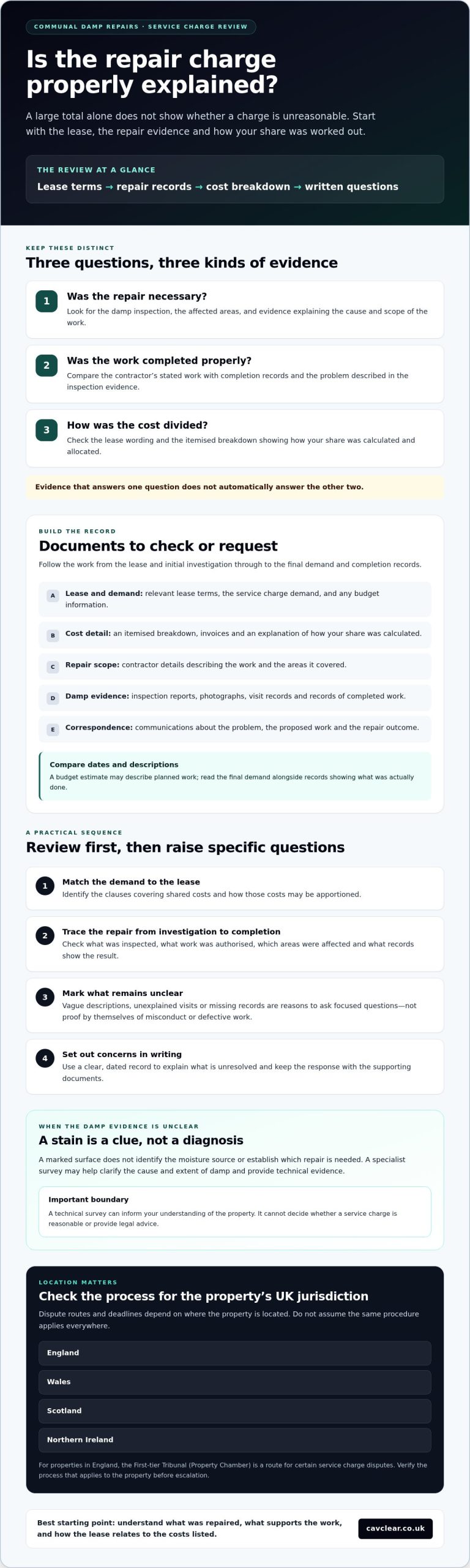
How to challenge an inflated communal damp repair charge step by step
A measured, evidence-led process makes it easier to identify what needs explaining. Work through the documents first, then raise specific questions with the landlord or managing agent. Keep the repair evidence separate from concerns about the amount or apportionment, so each issue is clear.
- Check the lease and demand. Find the clauses covering shared repairs and cost allocation. Compare them with the demand, budget information and any correspondence about the work.
- Request supporting records. Ask for an itemised breakdown, available invoices, the contractor’s scope, damp inspection findings and completion records. If a cost or visit is unclear, identify it specifically.
- Document your concerns. Note dates, affected communal areas, visible conditions and any differences between the proposed and completed work. Keep copies of photographs and correspondence.
- Review the response. Compare the explanation and records with your questions. If important points remain unanswered, consider the appropriate next step for your jurisdiction.
Write a clear, evidence-led request for an explanation
Identify the demand by its date or reference, then name the particular entry you’re querying. For example, ask what a listed follow-up visit involved if the work records don’t explain it. Request the documents or clarification needed to understand the repair scope and how your share was calculated. Keep the tone factual, retain your message and the reply, and record when each was received. Avoid unsupported accusations; precise questions are easier to answer.
Set out any technical concern separately from an accounting question. A recurring damp mark may call for an explanation of the inspection and remedial work, while an unclear apportionment calls for reference to the lease and calculation. One issue doesn’t automatically prove the other.
Escalate carefully if the explanation does not resolve the issue
Before taking formal action, verify the current procedures, deadlines and advice routes for the part of the UK where the property is located. Tribunal names, powers and processes aren’t uniform across England, Wales, Scotland and Northern Ireland. Check jurisdiction-specific official guidance and consider independent legal or leasehold advice about your circumstances, especially if a deadline may apply.
Understanding how to challenge an inflated service charge for communal damp repairs can help you ask focused questions, but no process guarantees that a charge will be reduced, suspended or cancelled. A technical survey can investigate moisture causes and provide property findings; it cannot decide whether the charge is reasonable or determine legal liability. If the damp cause remains unclear, you can arrange a damp and mould survey with CavClear to obtain technical information about the property.
Resolve the damp evidence gap and decide your next step
Once you’ve reviewed the demand and raised specific questions, decide what information is still missing. If the accounting records remain unclear, follow up with the landlord or managing agent. If the physical cause or extent of damp is uncertain, technical evidence may help. Then verify the appropriate advice or dispute route for the property’s jurisdiction before taking formal action.
When a specialist damp survey may help
A specialist inspection may be useful if the records describe staining but don’t explain the likely moisture source, if damp has returned, or if the suitable remedial approach remains uncertain. CavClear provides damp and mould surveys nationwide across the UK, with property inspections, reports and remedial recommendations. These findings can clarify the property condition and inform further questions about the repair.
A survey is technical evidence, not legal advice. It cannot decide whether a service charge is reasonable, determine who is legally responsible for a cost or guarantee a particular billing or legal outcome. If the inspection points to a specific building issue, use the findings to ask focused questions and seek advice appropriate to your circumstances. Where a report raises concerns about wall ties, a wall tie inspection may be relevant; the correct next step depends on the evidence.
If the damp source is still unclear, you could speak with CavClear about whether a specialist damp and mould survey may help. The aim is to understand the property issue, not to replace independent advice about a service charge dispute. A damp survey guide or wall tie replacement guide may also help you understand the technical terms in a report, where relevant.
A practical checklist before taking further action
- Check the lease, service charge demand, supporting records and any written explanation you’ve received.
- Organise photographs, inspection reports and correspondence by date and location. Note any unanswered questions or differences between the proposed and completed work.
- Separate technical concerns about damp or workmanship from questions about cost allocation and lease terms.
- Verify current legal procedures, deadlines and advice routes for England, Wales, Scotland or Northern Ireland, as applicable.
This gives you a clearer basis for deciding how to challenge an inflated service charge for communal damp repairs. Follow the evidence in order: clarify the records, assess whether technical information is missing, then choose a verified next step. A careful review can help you ask better questions, though it cannot predict the outcome of a formal dispute.
Take your next step with clearer evidence
A large communal repair demand deserves a careful review, not an assumption that the work or charge is automatically wrong. Check the lease and supporting records, keep repair concerns separate from questions about cost allocation, and verify the relevant advice route and deadlines for your part of the UK. These steps give you a clearer basis for deciding how to challenge an inflated service charge for communal damp repairs.
If the damp source or extent remains uncertain, a specialist inspection can provide technical context. CavClear’s accredited technicians carry out property inspections nationwide across the UK and provide reports with remedial recommendations. This evidence can help explain the building condition, but it isn’t legal advice and doesn’t determine whether a service charge is reasonable.
If you need a clearer understanding of the damp issue, arrange a specialist damp survey with CavClear. With better information about both the property and the paperwork, you can approach the next step calmly and make a more informed decision.
Frequently Asked Questions
Can I challenge a communal damp repair service charge if I think it is too high?
Yes, you can question a demand you believe is unclear or incorrect, but the relevant test and process depend on your lease and where the property is in the UK. To understand how to challenge an inflated service charge for communal damp repairs, first ask the landlord or managing agent for an explanation and supporting records. Pinpoint whether your concern relates to the need for the work, its quality, cost allocation or calculation, then get jurisdiction-specific advice before formal action.
What evidence should I ask for when disputing communal damp repairs?
Request the relevant lease clauses, an itemised demand, available invoices, the contractor’s work specification and records of the damp investigation and completed work. Ask for clarification if the documents don’t show how the repair addressed the suspected moisture source or how your share was calculated. Keep dated photographs, correspondence and reports together. If a record is unavailable, ask the landlord or managing agent to confirm that and explain what information supports the disputed entry.
Can I withhold a service charge while disputing damp repair costs?
Don’t assume it’s safe to withhold payment because you’ve raised a dispute. The consequences can depend on your lease, the circumstances and the law applying to the property. Before deciding, obtain independent legal or leasehold advice about your position and any relevant deadlines. Keep communicating in writing, retain copies of demands and responses, and ask the adviser what steps are appropriate in your situation. General guidance cannot determine the consequences for an individual leaseholder.
How do I know whether communal damp repairs were necessary?
Look for an inspection report that identifies a likely moisture source, explains why work to a shared area was recommended and describes what was completed. Visible staining or mould alone doesn’t establish the cause or the right remedy. If the technical explanation is incomplete, a suitably qualified surveyor may assess the building condition and provide findings. That technical opinion can inform your questions, but it cannot decide whether the service charge is legally reasonable.
Can one leaseholder challenge a charge for repairs to shared areas?
You can raise questions about a service charge that affects you, but your rights and any formal route depend on the lease and the property’s jurisdiction. Check the lease wording on shared costs and compare it with the calculation in your demand. Other residents may have useful observations or records, such as dated photographs of a communal area, but their experience doesn’t establish how your share must be apportioned. Seek advice about your own lease and circumstances.
Which tribunal handles a service charge dispute in the UK?
There isn’t one tribunal route that applies uniformly across the UK. The relevant body, its role, the procedure and any time limits depend on whether the property is in England, Wales, Scotland or Northern Ireland, as well as the issue in dispute. Check current official guidance for the property’s jurisdiction before submitting an application. Independent leasehold or legal advice can help you understand which process applies and what information you may need.
Can a damp survey prove that a service charge is unreasonable?
No. A damp survey can provide technical evidence about moisture, building condition and possible remedial work, but it cannot decide whether a charge is recoverable, fairly apportioned or reasonable under the applicable rules. Review any survey findings alongside the lease, demand and supporting records. If you need a view on your rights or the dispute process, seek separate legal or leasehold advice. Technical evidence and legal assessment answer different questions.
Recent Comments