
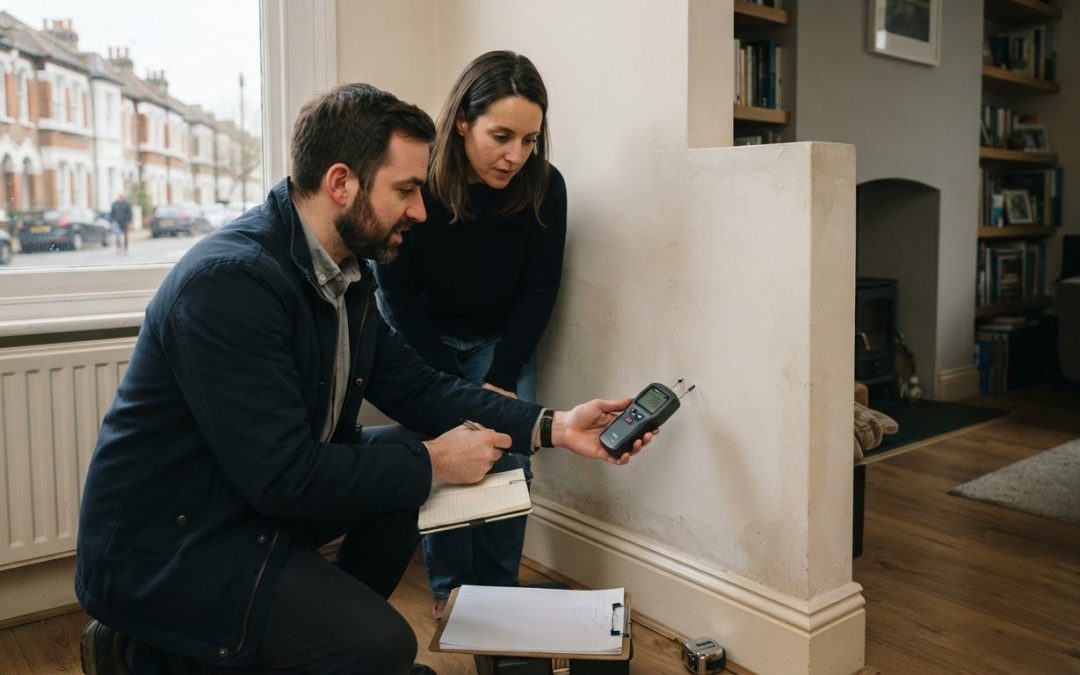
What if the recommended damp treatment seems reasonable, but the report doesn’t show enough evidence to explain why it’s needed? If technical terms are left unexplained or extensive work doesn’t appear to match the symptoms, getting a second opinion on a damp report may help you understand what the first assessment establishes and what remains uncertain.
It’s understandable to want clear answers before agreeing to remedial work. A useful second opinion should examine the evidence and reasoning, not simply offer a different treatment. It should explain what was inspected, how the surveyor reached their conclusions and whether the proposed work addresses the likely cause.
This article explains when another assessment may be worthwhile and how to compare findings such as moisture readings, photographs and observations inside and outside the property. It also covers what information to share and what to ask about possible cavity-wall defects, including insulation and wall ties. If the report raises cavity-wall concerns, a specialist survey may help clarify those findings alongside, rather than replace, a broader damp assessment.
Key Takeaways
- Getting a second opinion on a damp report means seeking a fresh assessment of the evidence, not automatically dismissing the original findings.
- Check which rooms, elevations and building elements each surveyor inspected before comparing their conclusions or recommendations.
- Use a simple comparison table to separate observed symptoms, supporting evidence, possible causes, recommended work and areas of uncertainty.
- Prepare the original report, photographs, property history and access details, then agree the scope of the new assessment before it begins.
- If a report raises specific questions about cavity-wall insulation or wall ties, a cavity-wall specialist may help assess those concerns alongside a broader damp investigation.
Why get a second opinion on a damp report?
A second opinion is a fresh assessment of the available evidence, not an automatic rejection of the first report. It gives you another opportunity to understand how the surveyor connected their observations with the likely cause and recommended work. If those parts don’t seem to align, ask for a clearer explanation before deciding what to do next.
Damp describes a symptom, not a confirmed cause. Moisture may be associated with condensation, water entering from outside or moisture rising from the ground, among other possibilities. The Structural dampness overview introduces these different causes, but a property needs to be inspected to assess which may apply. In some cases, questions about cracking, wall ties or cavity wall insulation may also need specialist investigation.
When might another damp assessment be useful?
Consider another assessment if the report states a cause without explaining the observations that support it, or recommends extensive work without linking each step to a finding. You may also want clarification if symptoms continue or relevant rooms, external elevations or building elements weren’t inspected. These are reasons to ask questions, not proof that the first surveyor was wrong.
Before arranging another visit, note the points you can’t reconcile. For example, does the report describe moisture in one area but recommend work across several walls? Does it explain whether external conditions or cavity-wall concerns were considered? Focus on the gap between the evidence and the proposed action.
What a second opinion can and cannot establish
Another professional can interpret the areas inspected and evidence available, explain their reasoning, and identify questions the original report left open. Their findings may support the first report, differ from it or indicate that more investigation is needed. Getting a second opinion on a damp report is about testing the reasoning, not commissioning someone to confirm a preferred outcome.
A second assessment can’t confirm a hidden defect if the inspection didn’t investigate it. If the suspected cause involves a cavity, ask whether the proposed inspection can assess that area and what its limits are. A different recommendation alone doesn’t show that either assessment is incorrect. Compare what each surveyor inspected, the evidence they recorded and how clearly they connected that evidence to their conclusions.
What should a thorough second opinion on a damp report examine?
A useful review should connect four things: the visible symptoms, what the surveyor inspected, the possible cause and the proposed action. Check whether the report covers the affected rooms, relevant external elevations and building elements, rather than drawing conclusions from one isolated area. If a wall is damp internally, for example, the assessment should explain what was checked inside and outside before recommending work.
A diagnosis is an evidence-based explanation of a building’s symptoms, not simply a label applied to a damp patch. Moisture meter readings can help record conditions at particular locations, but a reading alone doesn’t establish why moisture is present. Its meaning depends on the material, the test location and the wider inspection findings. A report should distinguish measurements from the surveyor’s interpretation and explain how the evidence supports the conclusion.
Check the report’s observations and evidence
Look for dated notes, clearly identified locations and photographs that show the conditions described. The report should explain how tests were carried out and identify any areas the surveyor couldn’t access. Check whether it separates direct observations, such as visible staining or a recorded meter reading, from interpretations about their cause. The Joint Position Statement on damp also highlights the value of investigating moisture in context, rather than relying on meter readings alone.
Check that the recommendations follow from the evidence. If the report proposes work in areas where it records no relevant findings, ask what links those recommendations to the inspection results. A clear explanation should help you understand both the proposed action and any remaining uncertainty.
Check whether cavity-wall issues were considered appropriately
If the report raises a cavity-wall concern, check whether it treats cavity wall insulation or wall ties as a possibility to investigate or as a confirmed finding. Damp, mould or cracking alone doesn’t prove a cavity defect. The report should explain why a defect is suspected and whether the inspection method could assess it.
A borescope inspection, which uses a small camera to view inside a cavity, or a more intrusive opening-up investigation may be considered if the circumstances justify it. Ask what each method could establish and what it might not show. If the report identifies a specific cavity-wall question, CavClear provides cavity-wall surveys and inspections. Confirm the proposed survey’s scope before arranging it. This can add specialist evidence about cavity-wall concerns without replacing a broader damp assessment where one is needed. Explore cavity wall surveys as a possible next step.
How to compare two damp reports without guessing at the cause
Compare the scope and evidence in each report before weighing the conclusions. One surveyor may have inspected only the affected room, while another checked the external wall, nearby rooms and relevant building details. Different findings can reflect differences in access, inspection methods or available evidence. They don’t automatically mean one surveyor is wrong.
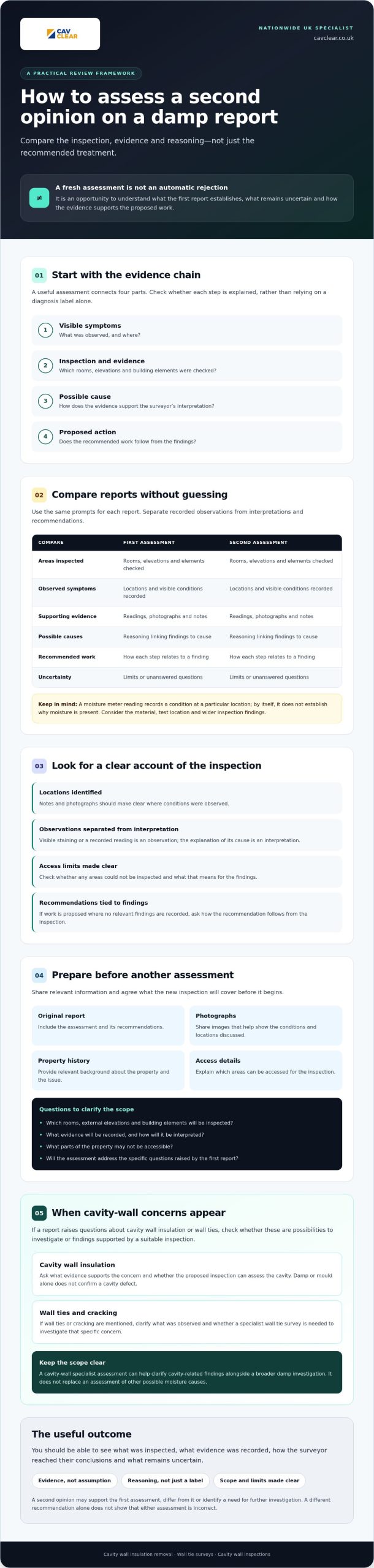
A simple comparison table can help keep observations separate from interpretations. Use the same headings for both reports:
- Observation: What condition was recorded, and where?
- Evidence: What supports it, such as a photograph, test result or inspection note?
- Proposed cause: Is this confirmed by the inspection or presented as a possibility?
- Recommendation: What action is proposed, and which finding is it meant to address?
- Uncertainty: What wasn’t inspected or still needs clarification?
This format makes it easier to see whether the reports genuinely disagree or simply cover different ground. If one report discusses an internal damp patch and another also considers the external wall, compare their inspection areas and methods before comparing their conclusions.
Separate symptoms, possible causes, and confirmed findings
Record symptoms such as damp patches, mould or cracking as observations, without assigning a cause prematurely. Then note whether each report treats a possible explanation as a possibility or supports it with inspection evidence. Check whether the surveyor considered other plausible sources of moisture, rather than moving directly from a visible symptom to one diagnosis. Cracking or damp on its own doesn’t confirm a cavity-wall defect.
Assess whether the recommendations follow from the evidence
For each proposed action, ask which recorded finding it addresses and how the work is expected to respond to that finding. If the link isn’t clear, ask the surveyor to explain it. Where a key point remains uncertain, ask what further inspection could resolve it and what that investigation would cover. This helps distinguish necessary next steps from recommendations that need more supporting detail.
Don’t choose a report simply because it recommends fewer treatments, or assume a longer list is more thorough. Assess the reasoning and evidence behind each recommendation. If you’re getting a second opinion on a damp report, the goal is to understand what the inspections establish, where they differ and what question should be answered next.
What to prepare and ask before commissioning another opinion
A clear brief helps the surveyor focus on the questions the first report left unanswered. Before booking, gather the documents, list your unresolved points, agree what the assessment will cover, then review the findings against that scope. Confirm whether the survey includes a site visit, which areas will be inspected and which concerns the surveyor can reasonably assess.
Documents and details to share
Send the complete original report, including photographs, appendices and any stated limitations. Add your own relevant photographs and a short property history. Note when symptoms first appeared, whether they have changed, and any previous work that may affect the areas being assessed. Include practical access details, such as rooms or external areas that may be difficult to reach.
Prepare specific questions rather than asking only for confirmation of the first report. For example, ask why a particular cause was proposed, whether a certain elevation was inspected, or what evidence supports the recommended work. This gives the surveyor a defined starting point without directing them towards a predetermined answer.
Questions to ask the surveyor
Before commissioning the assessment, clarify its scope and how the findings will be reported. Useful questions include:
- Will you visit the property, and which rooms, elevations and building elements will you inspect?
- What evidence supports each proposed cause, and what remains uncertain?
- Does the report raise a specific question about cavity-wall insulation or wall ties that merits specialist investigation?
- What further inspection, if any, could resolve an uncertainty, and what findings might change the recommended next step?
- Will the written report separate observations, interpretation, inspection limitations and recommendations?
These questions help establish whether the assessment is suited to your concern. A survey focused on internal symptoms may not answer a specific question about a cavity or wall ties, so agree how that issue will be assessed before proceeding. Don’t assume every damp assessment includes specialist cavity-wall checks.
Ask for written findings that explain what the surveyor observed, how they interpreted it and what action they recommend. The report should also make clear where access or inspection limits leave questions unresolved. This makes it easier to compare the new findings with the original report and decide on proportionate next steps.
If a second opinion raises a specific cavity-wall concern, you can arrange a cavity wall inspection with CavClear. Confirm the survey scope first to ensure it addresses the question you need answered.
When a cavity-wall specialist may help clarify a damp report
A cavity-wall specialist may be useful when a damp report raises a specific question about the cavity, such as whether insulation or wall ties need closer inspection. This doesn’t mean the cavity is necessarily defective or that it explains the damp. It means the question may need an inspection suited to that part of the building.
CavClear provides Cavity Wall Insulation Surveys, Wall Tie Surveys and Cavity Wall Tie Inspections, as well as damp and mould surveys where cavity-wall problems are relevant. Its work focuses on assessing cavity-wall concerns, not replacing every type of damp assessment. CavClear operates nationwide across the UK, and inspection findings can help determine whether further investigation or remedial work is appropriate.
When cavity-wall insulation or wall ties warrant closer review
If the report mentions cavity wall insulation, treat its condition as a question for inspection, not an assumed cause of moisture. A survey may help assess whether there is evidence of a problem and whether cavity wall insulation removal should be considered. Insulation in a property does not, by itself, prove that it is defective or needs removal.
Wall ties are a separate consideration. These metal components connect the two masonry leaves of a cavity wall, and a wall tie survey assesses their condition, particularly where the report raises concerns about cracking or possible movement. That investigation addresses a different potential cavity-wall issue from moisture symptoms. For background, read about cavity wall insulation removal and wall tie replacement, ensuring any further inspection matches the concern identified in your report.
Choose a relevant specialist and agree the scope
Before arranging an inspection, check that the provider’s stated services match the question you need answered. Ask what the survey will cover, which parts of the property will be inspected, and what the resulting report can establish. CavClear is a member of the Wall Tie Installers Federation and is TrustMark registered for cavity wall insulation removal. These credentials relate to specific areas of work and don’t, on their own, determine the cause of damp in a property.
When getting a second opinion on a damp report, share the original findings and identify the precise cavity-wall concern. Agree the scope before proceeding, then use the inspection results to decide on proportionate next steps. If the report points to a cavity-wall question, discuss a cavity-wall concern with CavClear and confirm whether its inspection services fit your needs.
Make your next step evidence-led
Getting a second opinion on a damp report can help you understand how the inspection findings support the proposed cause and remedial work. Compare what each surveyor examined, what evidence they recorded and what remains uncertain. A different recommendation isn’t proof that either report is wrong; the key is whether the reasoning is clear and the next step fits the findings.
If the report raises a specific concern about cavity-wall insulation or wall ties, check whether a cavity-wall inspection or survey could address it. CavClear works nationwide across the UK and provides specialist inspections relevant to cavity-wall concerns. The company is a member of the Wall Tie Installers Federation and is TrustMark registered for cavity wall insulation removal.
Before arranging an assessment, explain the issue and confirm the survey’s scope. Discuss a cavity-wall concern with CavClear if you’d like to explore whether its inspection services are relevant. Clear evidence and proportionate next steps can help you make a more informed decision for your property.
Frequently Asked Questions
Is it worth getting a second opinion on a damp report?
It can be worthwhile if the report doesn’t explain how its evidence supports the diagnosis, recommends work that seems broader than the findings, or leaves relevant areas uninspected. Another assessment offers a fresh interpretation, but it doesn’t automatically mean the first report is wrong. Share your concerns and ask the surveyor to explain the inspection scope, evidence, limitations and reasoning behind any recommended next steps.
Can two damp surveyors reach different conclusions?
Yes. Surveyors may inspect different rooms, external elevations or building elements, use different methods, or have access to different evidence. Their conclusions can also differ if one identifies unanswered questions that the other didn’t investigate. Compare the scope and supporting observations before treating different recommendations as a disagreement. Ask each surveyor to explain how their findings support their interpretation and what remains uncertain.
What should I ask when getting a second opinion on a damp report?
Ask what areas the surveyor will inspect and whether the assessment includes a site visit. Find out what evidence supports each proposed cause, what the inspection can’t establish, and whether cavity-wall insulation or wall ties merit specialist investigation. Ask how each recommendation relates to a recorded finding and what further evidence could change the next step. Request written findings that separate observations, interpretation, limitations and recommendations.
How do I compare two damp reports?
First compare the areas inspected and methods used, then assess the conclusions. For each report, note the symptom and location, supporting evidence, proposed cause, recommended action and any uncertainty. Check whether photographs, readings or observations are clearly explained. Ask how each proposed treatment addresses the findings. Don’t assume the report with fewer recommendations is better, or that different conclusions alone prove one assessment is incorrect.
Can damp be caused by cavity wall insulation?
Defective or incorrectly installed cavity wall insulation can contribute to damp or moisture problems in some properties, but insulation isn’t automatically the cause. A visible damp patch, mould or cracking doesn’t confirm a cavity defect. Inspection is needed to assess the insulation and consider other possible sources of moisture. If evidence indicates a problem, a specialist may discuss whether cavity wall insulation removal is an appropriate next step.
Should I arrange a second inspection if a damp report mentions wall ties?
Consider a specialist wall tie survey if the report raises a specific concern about their condition, particularly if it notes cracking or possible movement. Ask whether wall ties were inspected or simply mentioned as a potential issue, and what evidence supports further investigation. A wall tie survey assesses this cavity-wall component, but it doesn’t replace a broader damp assessment or establish the cause of moisture by itself.
What documents should I give a second damp surveyor?
Provide the complete original report, including photographs, appendices and any stated limitations. Add relevant pictures of the affected areas, a brief property history, when symptoms began, how they’ve changed, and details of previous work. Include access information for rooms or external areas. Prepare specific questions about unclear findings or recommendations. These details help the surveyor understand the background, define the inspection scope and identify points that still need investigation.
Recent Comments