
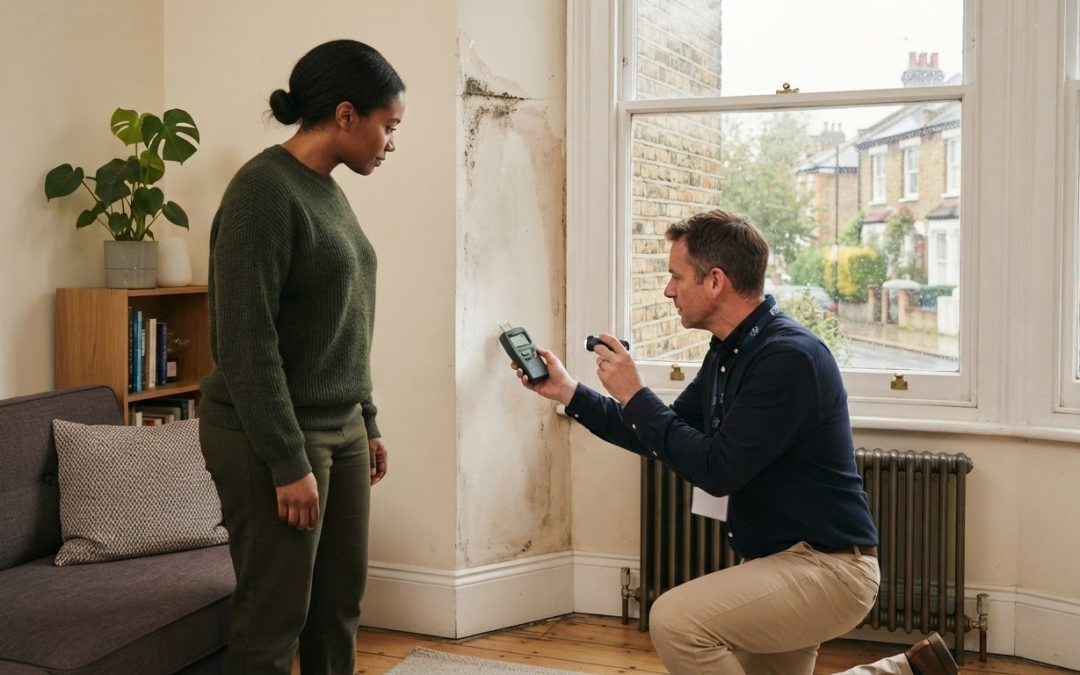
A small patch of mould doesn’t automatically mean a landlord has broken the law, but ignoring its underlying cause can put both the property and a tenant’s health at risk. The landlord obligations for mould under Fitness for Human Habitation Act depend on the condition of the home, what is causing the moisture and whether the property is unfit to live in.
It’s understandable to feel unsure about who is responsible, especially when mould could relate to a leak, a building defect, ventilation or everyday moisture. The legal framework also differs across the UK: the Homes (Fitness for Human Habitation) Act applies in England, while other nations have their own housing rules.
This guide explains what the law expects of landlords, where its limits lie and why responsibility depends on the cause. You’ll also learn what to include when reporting mould, which records to keep and when a professional investigation may help identify a building-related source. A specialist survey can support diagnosis, but it doesn’t replace legal advice or a landlord’s responsibilities.
Key Takeaways
- Visible mould alone doesn’t establish who is responsible. The home’s condition and the source of moisture both matter.
- Landlord obligations for mould under Fitness for Human Habitation Act relate to whether the property is fit to live in. The rules also vary across the UK.
- Record where mould appears, when it began and whether it changes, then report it clearly and keep copies of communications.
- Consider possible causes such as leaks, building defects, ventilation and everyday moisture, but don’t assume the source before it’s assessed.
- A specialist survey may help identify building-related moisture and inform maintenance decisions, but it doesn’t determine legal responsibility.
When can mould make a rented home unfit for human habitation?
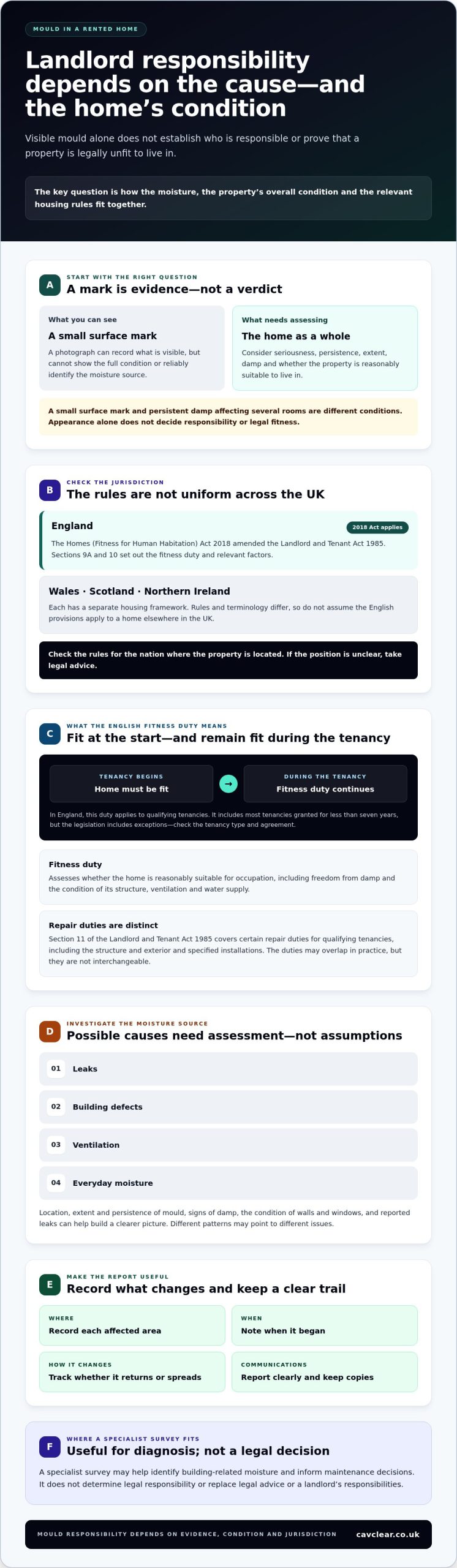
Visible mould does not, by itself, establish who is responsible or prove that a rented home is legally unfit. A small surface mark and persistent damp affecting several rooms are different conditions. The legal question concerns the home as a whole, including the seriousness of the problem and its effect on whether the property is suitable to live in.
What does fitness for human habitation mean in a mould case?
Fitness for human habitation means that a home is reasonably suitable for occupation, assessed against the relevant legal standards and the property’s overall condition. In England, sections 9A and 10 of the Landlord and Tenant Act 1985, inserted by the Homes (Fitness for Human Habitation) Act 2018, set out the fitness duty and factors relevant to that assessment. These include expertdom from damp and the condition of the property’s structure, ventilation and water supply.
Mould may therefore matter as part of a wider housing condition, particularly if it is extensive, keeps returning or is linked to damp or another defect. A mark alone doesn’t establish the cause or determine the legal outcome. A photograph can help record what’s visible, but it can’t show the full condition of the property or reliably identify where moisture is coming from.
Does the same Act apply throughout the UK?
No. The phrase landlord obligations for mould under Fitness for Human Habitation Act needs a jurisdiction check: the 2018 Act’s fitness provisions apply in England, not uniformly across the UK. In England, section 9A of the 1985 Act requires a landlord under a qualifying tenancy to ensure the home is fit at the start of the tenancy and remains fit during it. The 1985 Act provides the wider statutory context. You can read an overview of the Landlord and Tenant Act 1985.
Wales, Scotland and Northern Ireland have separate housing frameworks. Their rules and terminology differ, so don’t assume the English provisions apply to a property elsewhere in the UK. Check the current rules for the nation where the home is located, and take legal advice if the position is unclear.
In practice, deciding whether mould makes a home unfit requires more than spotting discolouration. The property’s overall condition and the nature of the damp need careful assessment. This shifts the discussion from appearance alone to the evidence needed to understand the problem.
What does the Fitness for Human Habitation Act require of a landlord?
In England, the Homes (Fitness for Human Habitation) Act 2018 amended the Landlord and Tenant Act 1985 to require landlords with qualifying tenancies to ensure the home is fit for human habitation when the tenancy begins and remains fit throughout it. The duty concerns the condition of the property, not simply whether mould is visible.
This is the central point behind landlord obligations for mould under Fitness for Human Habitation Act: damp and mould must be considered in context, alongside the property’s condition and the circumstances of the tenancy. The Act applies in England. Wales, Scotland and Northern Ireland have different housing frameworks, so check the rules for the nation where the property is located.
When does the landlord’s responsibility apply?
The fitness duty applies to qualifying tenancies in England, including most tenancies granted for less than seven years. The legislation includes exceptions, so landlords and tenants should check the tenancy type and agreement rather than assume every letting is covered. Where it applies, the duty starts at the beginning of the tenancy and continues during it.
The fitness duty is distinct from repair obligations. Section 11 of the Landlord and Tenant Act 1985 sets out certain repair duties for qualifying tenancies, including duties relating to the structure and exterior and specified installations. A tenancy agreement may also set out responsibilities. These duties can overlap in practice, but they aren’t interchangeable. A repair issue may need attention even if the wider fitness assessment is unclear, and the relevant terms and statutory coverage matter.
How should damp and mould factor into the assessment?
Assess the evidence, not just the appearance. The location, extent and persistence of mould, signs of damp, the condition of walls and windows, and any reported leaks can help build a clearer picture. A recurring patch near a defective gutter, for example, may point to a different issue from condensation appearing around a cold window during periods of high indoor moisture.
Moisture can come from building-related problems, such as leaks or structural defects, or from everyday activities such as cooking and bathing. Neither possibility proves fault by itself. Ventilation and heating conditions may also be relevant, but no single observation settles whether the legal duty has been breached. A proper assessment considers the property and available evidence together.
Where the cause is unclear, a specialist damp and mould survey may help identify building-related moisture or structural issues and inform maintenance decisions. CavClear’s survey findings can support diagnosis, but don’t replace legal advice or a landlord’s responsibilities.
Is mould always the tenant’s responsibility, or must the landlord act?
Neither conclusion follows from mould alone. Its presence doesn’t automatically make a tenant responsible, and it doesn’t by itself prove a landlord has breached a duty. The right response is to establish what’s happening in the property before deciding what action is appropriate. That means considering building conditions as well as how moisture is produced and managed during everyday use.
What property conditions may contribute to mould?
Leaks, water entering through the building, ventilation problems and cold surfaces can all contribute to damp or mould. Moisture from ordinary activities such as cooking, bathing and drying clothes indoors can also contribute. Several factors may combine. For example, everyday moisture may build up more readily in a room with limited ventilation or a cold external wall.
These are possibilities, not diagnoses. Mould near a ceiling might warrant checking for water penetration, while recurring damp on a wall could justify a closer look at the building fabric. Cavity-related moisture or structural concerns should be investigated where observations support that possibility, not assumed from a mould patch alone.
| Observed condition | Possible cause | Information still needed |
|---|---|---|
| Mould around a window | Condensation on a cold surface, or another moisture source | Does it recur, and are there signs of water entry or ventilation issues? |
| A damp patch below a ceiling | A leak or water penetration may need checking | When did it appear, and does it change after rainfall or plumbing use? |
| Mould returning on an external wall | Condensation, a cold surface or a building-related moisture issue | Where exactly is it, how extensive is it, and what else is visible nearby? |
How should landlords and tenants communicate about the cause?
Tenants should report the issue promptly and factually. Include the affected room and surface, when the mould first appeared, how far it has spread and whether it has changed. Dated photographs and notes can help show how the condition develops. Landlords should acknowledge the report, assess what has been described and investigate potential property-related causes rather than relying on assumptions about a tenant’s behaviour.
Keep communication clear and retain records of inspections or action taken. Avoid concealing the affected area or treating visible mould as a permanent fix before the source has been considered. The official government guidance for tenants explains the Act’s purpose and scope in England. For more background, consult a guide to black mould. A specialist property survey may also help investigate possible building-related moisture. Landlord obligations for mould under Fitness for Human Habitation Act depend on the applicable law and the evidence about the home, not on appearance alone.
What should tenants and landlords do when mould is reported?
A clear record helps everyone move from uncertainty to assessment. Tenants can describe what they see and report it through the agreed contact route. Landlords can acknowledge the information, check the affected areas and arrange further investigation if the cause isn’t clear. The landlord obligations for mould under Fitness for Human Habitation Act depend on the applicable law and the property’s condition, so practical steps should focus first on evidence and the source of moisture.
What information should a mould report include?
Make the report specific and keep a copy. Include the affected rooms, approximate size and location of the area, when it was first noticed, whether it has returned, and dated photographs showing how it changes. Note related signs such as water staining, a leak, cold surfaces or concerns about ventilation. These details help guide an inspection without assuming what caused the problem.
A practical sequence for responding
- Document the condition. Record dates, locations, visible changes and related observations. Keep photographs and notes together.
- Notify the appropriate person. Tenants should use the landlord, letting agent or reporting process set out for the tenancy. Landlords should confirm receipt and clarify any missing details.
- Assess the affected area. Review the report and inspect the property as appropriate. Consider whether there are signs of a leak, water penetration, ventilation issues or cold surfaces.
- Investigate the likely source. If the cause remains uncertain, arrange suitable professional input rather than relying on assumptions about the building or the occupants.
- Record action and follow-up. Keep a written note of inspections, findings, maintenance carried out and whether the condition changes afterwards.
If there’s an urgent safety concern, such as active water entering the property or a suspected hazard affecting electrical equipment, seek prompt attention from an appropriate professional. Don’t wait for routine monitoring where immediate safety may be at risk.
When may a professional damp survey help?
A survey can be useful when mould persists, returns after surface cleaning or appears alongside signs of a building-related moisture problem. An inspection may help assess possible causes, including defects or cavity-related concerns where the evidence supports further investigation. A written report with remedial recommendations can inform property maintenance decisions, but it can’t guarantee a particular result, determine legal responsibility or replace legal advice.
If the moisture source is unclear, consider a professional damp and mould survey to help assess the property. Any recommended work should follow the findings rather than treating visible mould as the whole problem.
How can a specialist survey help resolve a mould problem?
Repeated mould or unexplained damp can leave tenants and landlords unsure what to address first. A specialist survey can shift the focus from the visible mark to possible sources of moisture in the property. Understanding the likely cause may inform maintenance decisions and reduce the risk of treating a symptom while an underlying building issue remains. Where structural movement or damp ingress is involved, remedial specialists such as Foundation ResQ illustrate how structural stabilization and mold remediation work together to resolve root causes permanently.
A survey supports property diagnosis; it does not decide who is legally responsible. The landlord obligations for mould under Fitness for Human Habitation Act depend on the relevant law, tenancy and property condition. Survey findings can provide technical information, but they don’t replace legal advice or a landlord’s duties.
What can a damp and mould survey examine?
An inspection can assess visible damp symptoms and consider potential property-related causes, such as signs of water ingress, leaks, ventilation concerns or cold surfaces. The appropriate checks depend on the property and the observations available. A survey shouldn’t assume that every mould patch has the same cause, or that a particular remedy will be suitable before the evidence is assessed.
Findings and recommended remedial work will depend on the inspection. A report may clarify what was observed and what further action may be appropriate. For background on the process, readers can consult a guide to damp surveys.
What should readers expect from CavClear?
CavClear provides damp and mould surveys across the UK, with inspections conducted by accredited technicians. Survey services can include a report and professional remedial recommendations based on the property assessment. This information may help landlords, tenants or property owners understand whether a building-related moisture issue warrants further attention.
If inspection findings indicate a relevant cavity issue, CavClear also provides cavity wall surveys and cavity wall insulation removal. Wall tie surveys, inspections and replacement may be relevant where structural observations support that next step. These services aren’t automatic parts of every damp survey; their suitability depends on the findings.
A specialist survey is a diagnostic option, not a legal assessment or guaranteed solution. If damp or mould remains unexplained, you can discuss the property concerns and whether a damp and mould survey may be suitable with CavClear. Nationwide coverage is available across the United Kingdom.
Take the next step towards a clearer diagnosis
Mould doesn’t automatically establish who is responsible. The home’s overall condition, the likely moisture source and the housing law that applies all matter. The landlord obligations for mould under Fitness for Human Habitation Act depend on the relevant tenancy and jurisdiction, so avoid drawing legal conclusions from a visible mark alone.
Clear records help: note where the mould appears, when it started, whether it returns and any related signs such as staining or leaks. If the cause remains uncertain, a professional inspection may help identify property-related moisture or structural concerns and inform maintenance. A survey can support diagnosis, but it doesn’t determine legal responsibility or replace a landlord’s duties.
CavClear provides damp and mould surveys nationwide across the UK. Accredited technicians carry out inspections and can provide reports with professional remedial recommendations based on their findings. To discuss whether an inspection may help with your property, discuss a professional damp and mould survey.
Frequently Asked Questions
Does the Fitness for Human Habitation Act cover mould?
Yes, damp and mould can be relevant to a home’s fitness under the Homes (Fitness for Human Habitation) Act 2018 in England. The Act amended the Landlord and Tenant Act 1985, which includes expertdom from damp among the factors considered when assessing a home. Mould’s presence alone doesn’t prove that a property is unfit or that a landlord has breached a duty. The tenancy type and the property’s overall condition matter.
Is a landlord responsible for mould in a rented property?
Responsibility depends on the cause, the property’s condition, the tenancy and the law that applies where the home is located. Leaks, water penetration, defective building elements or ventilation problems may point to issues requiring the landlord’s attention. Everyday moisture can also contribute, but that doesn’t settle responsibility by itself. A landlord should assess reported mould and investigate possible property-related causes rather than assume who is at fault.
Can a landlord blame a tenant for mould?
A landlord shouldn’t attribute mould to a tenant’s behaviour without considering the evidence and possible building conditions. Cooking, bathing and drying clothes indoors can add moisture, but leaks, cold surfaces or ventilation problems may also contribute, sometimes together. Tenants can help by reporting the location, timing and any changes, while landlords can inspect and investigate. Neither a photograph nor a single observation usually establishes the cause or responsibility.
What should a tenant do if a landlord does not address mould?
Send a clear written report or follow up describing where the mould is, when it appeared and whether it is spreading or recurring. Include dated photographs and keep copies of messages and any inspection notes. Ask for the issue to be assessed and retain a record of the response. If it remains unaddressed, contact the relevant local authority housing or environmental health team, or seek independent housing advice. Rules and routes vary across the UK.
Does the Fitness for Human Habitation Act apply across the UK?
No. The Homes (Fitness for Human Habitation) Act 2018 applies in England, where its provisions amend the Landlord and Tenant Act 1985 for qualifying tenancies. Wales, Scotland and Northern Ireland have separate housing frameworks, so don’t assume the English Act governs a property elsewhere. Check the current rules for the nation where the home is situated, and seek appropriate housing or legal advice if the applicable duty is unclear.
Should a landlord arrange a damp survey for mould?
A damp survey may help if mould keeps returning, the moisture source is unclear or there are signs of a possible building defect. An inspection can consider visible symptoms and potential property-related causes. A report with remedial recommendations may inform maintenance decisions, depending on the findings. A survey doesn’t determine legal responsibility or replace the landlord’s obligations. The appropriate investigation depends on the property and the conditions observed.
Can mould make a rented home unfit for human habitation?
Yes, serious damp and mould can contribute to a home being assessed as unfit, but the visible presence of mould alone doesn’t decide the question. In England, the relevant assessment considers the property’s overall condition and whether the statutory fitness duty applies to the tenancy. The cause, extent and persistence of damp may all be relevant. A proper assessment is needed; a photograph alone can’t establish that a home is legally unfit.
Recent Comments