
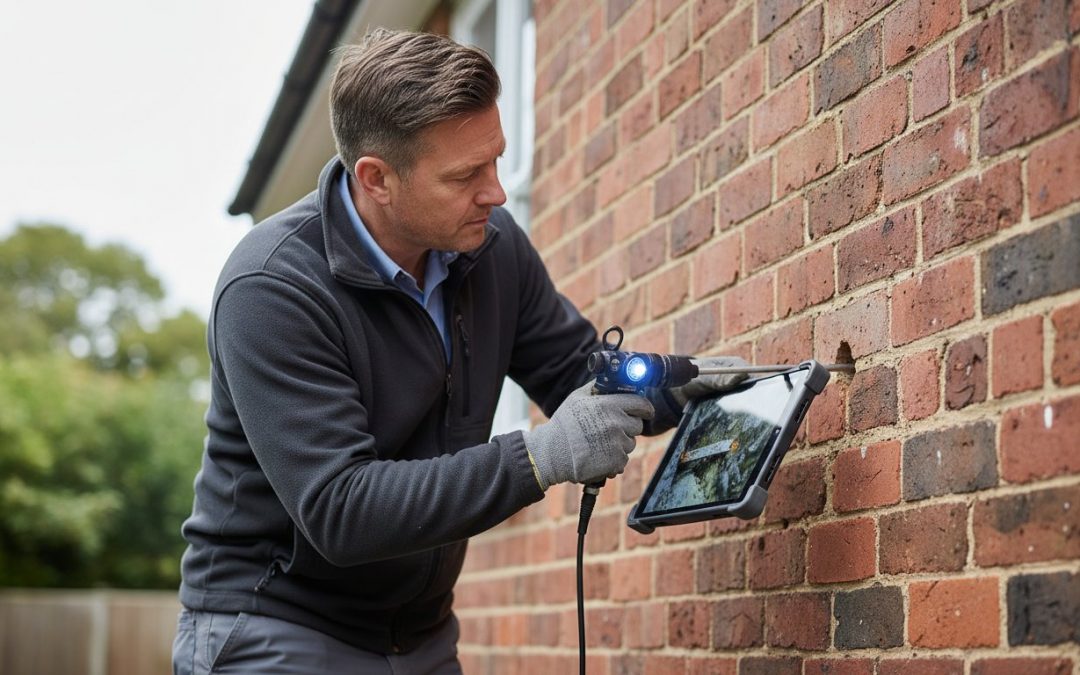
A “expert” wall tie inspection is often the most expensive mistake a homeowner can make. When structural integrity is at stake, relying on a sales pitch rather than a forensic diagnostic tool puts your property at risk. Understanding the endoscopic wall tie survey cost 2026 is the first step toward securing your home’s future with a fixed-price, specialist report. Most UK homeowners will pay between £250 and £450 for a professional assessment that uses high-definition borescopes to inspect the cavity. This method confirms the condition of your ties without causing invasive damage to your brickwork.
You likely feel a sense of urgency when you spot horizontal cracking or bulging masonry, and you’re right to prioritize safety. It’s stressful to face potential structural issues, but a specialist survey provides the clarity required for insurance or mortgage purposes. This guide explains exactly what you’ll gain from a professional inspection in 2026. We’ll outline the technical process, verify current industry rates, and explain why a BRE Digest 401 compliant report is a vital investment for any property built before the 1980s.
Key Takeaways
- Learn why visual inspections from the street are insufficient for identifying early-stage corrosion and how high-resolution borescopes provide a definitive diagnosis of your property’s structural health.
- Discover the typical endoscopic wall tie survey cost 2026 for different UK property types to ensure you pay a fair, fixed price for specialist expertise.
- Understand the non-invasive technical process, including the use of calibrated metal detectors and discreet 8-10mm inspection holes that protect your brickwork.
- Identify the critical differences between a biased “expert quote” and an independent specialist survey that provides the evidence required for mortgage and insurance purposes.
- Find out how to use a professional specialist report as a powerful tool for negotiating property prices or securing long-term structural guarantees.
Understanding the Endoscopic Wall Tie Survey in 2026
An endoscopic wall tie survey is a forensic inspection that uses high-resolution borescopes to look inside a property’s structure. Unlike a standard RICS Level 2 or 3 survey, which relies on surface-level observations, this specialist method involves inserting a camera directly into the cavity. This allows a technician to examine the metal components that hold your home together. When considering the endoscopic wall tie survey cost 2026, homeowners are investing in a definitive diagnosis rather than a visual guess from the pavement. Street-level inspections often fail to identify early-stage corrosion because the damage happens where you can’t see it. By the time cracks appear on the outside, the internal structural integrity may already be compromised.
To understand the necessity of this process, one must first ask, What is a Cavity Wall Tie? These metal connectors are essential for pinning the outer leaf of brickwork to the inner structural wall, ensuring the building remains stable against wind loads and environmental pressure. In 2026, building safety protocols and lending requirements demand internal visual evidence of tie condition to prevent structural failures that visual street-level inspections cannot predict.
Why Specialist Endoscopy is the Gold Standard
A specialist survey removes the ambiguity of guessing a property’s health. Using a borescope, a technician can identify the four distinct stages of wall tie corrosion, ranging from Stage 1 (bright zinc coating) to Stage 4 (total failure with heavy laminar rusting). This level of detail is critical for long-term property health. A professional inspection also identifies internal debris and clarifies what is a cavity wall blockage versus a structural tie failure. This forensic approach ensures that any remedial work is targeted and necessary, saving homeowners from expensive and redundant repairs.
When to Commission a Specialist Survey
You should act if you notice horizontal cracking in the mortar joints, typically spaced every six courses. This is a primary trigger for an inspection because it suggests the ties are expanding as they rust. Bulging brickwork or “lifting” lintels are also serious indicators that the outer leaf is moving away from the inner wall. Beyond physical signs, specialist reports are now a standard requirement during property transactions in 2026. Buyers and lenders require a fixed-price endoscopic wall tie survey cost 2026 quote to provide the evidence needed for a secure purchase. Acting early provides the peace of mind that your home remains structurally sound and mortgageable.
Breakdown of Endoscopic Wall Tie Survey Costs in 2026
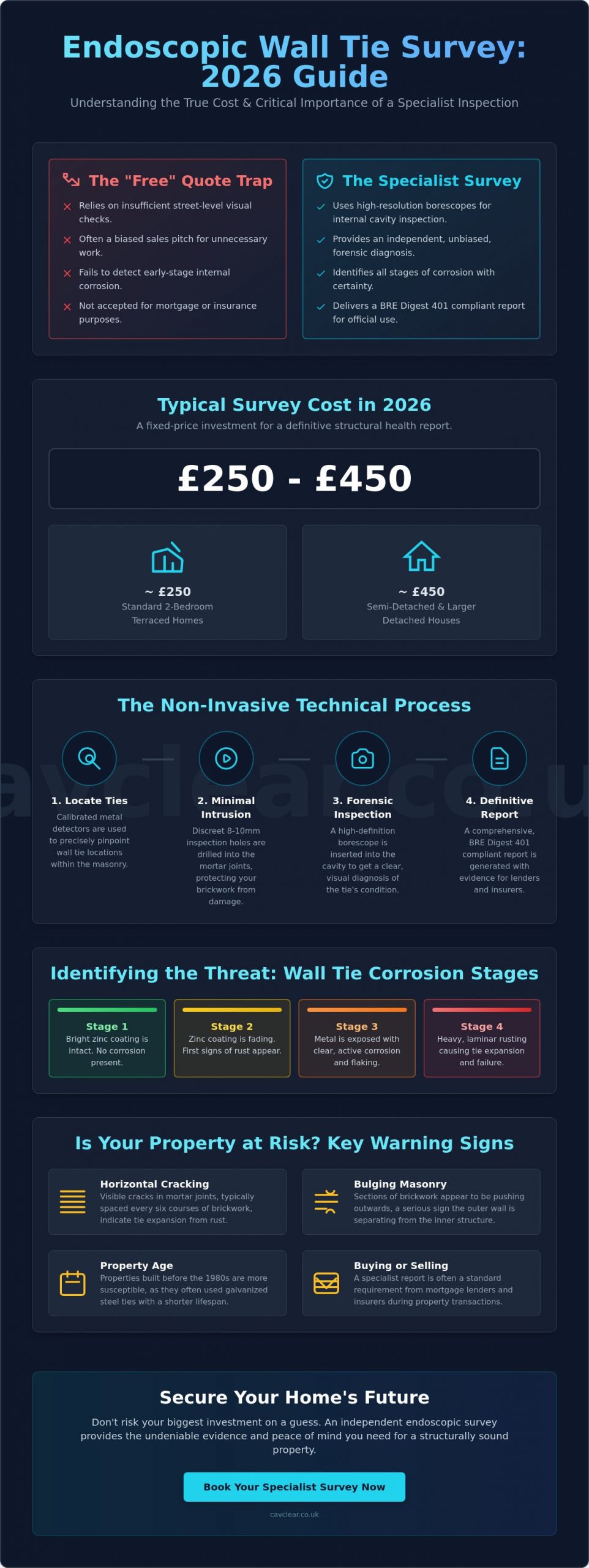
Investing in a specialist inspection is a proactive step for long-term property health. In 2026, the average endoscopic wall tie survey cost 2026 typically ranges between £250 and £450 for most residential properties in the United Kingdom. This fee is not a generic service charge; it represents the deployment of calibrated metal detectors and high-specification borescopes designed to provide a forensic view of your wall’s interior. For a standard two-bedroom terraced home, you can usually expect a quote at the lower end of this scale. Semi-detached and larger detached houses naturally sit at the higher end because they require a greater number of inspection points across multiple elevations to ensure a comprehensive assessment.
The value of this fee becomes clear when you consider the alternative. Relying on a visual-only check from the street cannot detect the early stages of metal fatigue or chemical corrosion. A specialist report provides the technical evidence required by mortgage lenders and insurers to verify that a property is structurally sound. This document acts as a safeguard during property transactions, often providing the necessary leverage to negotiate repairs or confirm a building’s market value.
Factors Influencing Your 2026 Survey Quote
Several variables dictate the final price of your inspection. The number of boreholes is the primary cost driver. A technician must drill a sufficient number of 8-10mm holes in the mortar joints to create a representative sample of the entire building’s tie density and condition. Access requirements also play a significant role. While ground-level inspections are straightforward, properties that require high-reach equipment or specialized ladders may see an increase in the final fee. The complexity of the wall construction matters as well. While standard brickwork is predictable, random stone or flint walls require more time and precision to navigate without damaging the masonry.
What is Included in a Professional Survey Fee?
A professional fee ensures you receive an independent, unbiased assessment of your home’s structural skeleton. This includes the technician’s on-site time and the significant overheads associated with maintaining advanced diagnostic tools. You aren’t just paying for the site visit; you’re paying for a detailed remedial action plan that follows Official Installation Standards. Most professional reports include high-resolution photographic evidence of the ties at various elevations, documenting corrosion levels from Stage 1 to Stage 4. Having this documentation is essential for property transactions in 2026. It proves the structural integrity of the outer leaf and identifies any hidden debris that could lead to damp. If you’re concerned about your home’s stability, booking a specialist wall tie survey is the most reliable way to protect your investment.
The Technical Process: How a Specialist Endoscopic Inspection Works
A specialist survey is a methodical, multi-stage process that prioritizes property safety and diagnostic accuracy. While the endoscopic wall tie survey cost 2026 covers the technician’s time and equipment, the real value lies in the forensic data gathered during the site visit. The process begins with an electromagnetic sweep of the elevations. This allows the technician to map the exact location and density of the existing ties, even if they are hidden behind thick render or multiple layers of paint. By establishing the pattern of the ties first, we ensure that the subsequent camera inspections are targeted and representative of the entire building’s structural health.
Once the ties are located, the technician moves to the visual inspection phase. This involves drilling small, discreet 8-10mm holes into the mortar joints. We specifically avoid drilling into the bricks themselves to prevent permanent aesthetic damage or structural weakening of the masonry units. A high-resolution borescope is then inserted into the cavity to provide a clear view of the metal’s surface. This allows us to identify the specific causes and signs of wall tie failure, such as laminar rusting or the early stages of oxide jacking, which can remain hidden from external view for years.
Locating and Grading the Ties
The core of the report is the grading of each inspected tie based on the Building Research Establishment (BRE) guidelines. Technicians grade the ties on a scale from 1 to 4. A Grade 1 rating indicates a tie in “as new” condition, while a Grade 4 signifies total failure with significant metal loss. During this phase, we also conduct a thorough check for the presence of cavity wall insulation. If the material is wet, slumped, or made of an unsuitable material, it can create a bridge for moisture that accelerates the corrosion of the ties. Identifying these combined issues is essential for determining if you require immediate wall tie replacement or simply long-term monitoring.
A Clean and Non-Invasive Approach
We understand that homeowners worry about the visual impact of a structural survey. Our approach is designed to be as quiet and tidy as possible, reflecting our commitment to professional standards across the United Kingdom. After the borescope inspection is complete, we don’t just leave a hole in your wall. Our technicians use colour-matched mortar to “make good” every inspection point. This creates a seamless finish that is virtually invisible once the mortar has cured. This attention to detail ensures that the endoscopic wall tie survey cost 2026 includes not just a technical report, but the restoration of your property’s exterior appearance. The result is a clean, non-invasive diagnostic process that provides peace of mind without the mess of traditional construction methods.
Professional Survey vs. no-obligation Quote: Why the Distinction Matters
A common trap for homeowners is the allure of the “expert” survey. While it sounds cost-effective, these are typically sales leads for contractors rather than technical diagnostics. When you pay an endoscopic wall tie survey cost 2026, you aren’t just buying a site visit; you’re purchasing an independent, unbiased assessment of your property’s structural health. A specialist has no incentive to recommend remedial work unless the visual evidence from the borescope confirms it’s necessary. This distinction is vital because mortgage lenders and insurers in 2026 almost always reject a contractor’s “expert” quote in favour of a formal report from an accredited specialist. In fact, over 85% of major UK lenders now require a forensic specialist report for properties built before 1980 that show signs of masonry movement.
The difference between a sales estimate and a technical report is the depth of evidence provided. A expert quote is often based on a quick walk-around and a visual check of the external brickwork. It lacks the internal photographic proof required to confirm the stage of corrosion. By choosing a paid survey, you ensure that the recommendations are based on facts. This protects you from the conflict of interest inherent in a contractor who only makes money if they find a problem to fix. A specialist report is a legal and financial asset that adds value to your property file during a sale.
The Limitations of Visual-Only Estimates
You cannot accurately quote for replacement without seeing the ties. Guessing the condition of the metal connectors based on external cracks leads to two expensive risks. First, you might over-specify work, replacing thousands of ties that still have years of life left. Second, you might under-specify, missing critical failures in areas where the brickwork hasn’t moved yet. A professional survey identifies exactly which elevations need attention. This precision can save you thousands of pounds in unnecessary repairs by targeting only the compromised areas. It’s a methodical approach that replaces guesswork with high-definition visual confirmation.
Independent Specialist Authority
Hiring a specialist rather than a general builder is essential for structural integrity. General builders often lack the calibrated metal detectors and high-spec borescopes needed to map a cavity accurately. A specialist provides a “clean bill of health” report if your ties are sound, which is just as valuable as a repair plan. This document provides the peace of mind that your home is safe, without the pressure of a sales pitch. If you need a reliable structural assessment, you can book a professional wall tie survey to secure your property’s future with an independent, nationwide expert.
Protecting Your Property: The Next Steps After Your Survey
Receiving your specialist report is the moment guesswork ends and factual property management begins. The document will categorize findings into immediate structural requirements or long-term monitoring needs based on the BRE grading system. This clarity is why the endoscopic wall tie survey cost 2026 is a vital investment for any homeowner. It allows you to prioritize works on specific elevations rather than assuming the entire building is at risk. For example, south-facing walls often show advanced corrosion earlier due to higher thermal expansion and rain exposure. By targeting only the compromised areas, you can manage your maintenance budget with precision.
A technical report serves as a powerful tool for financial negotiation. If you’re in the process of purchasing a home, evidence of Stage 3 or Stage 4 corrosion provides the necessary leverage to negotiate a price reduction. This ensures the cost of remedial work is covered before you exchange contracts. Similarly, insurance providers frequently request these forensic reports to verify structural integrity before renewing policies on older masonry buildings. Having this documentation ready demonstrates a proactive approach to property health, often making the difference in a successful mortgage application.
There is also a critical relationship between structural stability and moisture control. Corroding ties expand up to seven times their original thickness, creating cracks that act as conduits for water. If your report indicates significant metal fatigue, it’s highly recommended to review a damp survey to ensure that internal moisture isn’t accelerating the damage. Addressing the structural ties without fixing the underlying damp issues is only a partial solution for your home’s longevity.
When the Report Recommends Replacement
If the survey confirms that your ties have reached the end of their functional life, the specialist will recommend a specific remedial tie type. This might include mechanical, resin, or helical ties depending on the strength of your masonry. In many cases, the initial endoscopic wall tie survey cost 2026 is offset against the final project price when you proceed with the recommended work. It’s essential that any remedial installation is backed by a long-term structural guarantee. This ensures the property remains safe, mortgageable, and compliant with modern building standards for the next 25 to 50 years.
Booking Your Specialist Survey with CavClear
CavClear operates a nationwide service, providing expert coverage for homeowners and businesses across the entire United Kingdom. We maintain a commitment to professional, no-nonsense structural advice that prioritizes the safety of your property. Our technicians use the latest high-definition borescopes to ensure every assessment is accurate and non-invasive. We don’t believe in alarmist sales tactics; we provide the facts you need to make informed decisions about your home’s future. Contact our specialist team today to schedule your 2026 endoscopic inspection and secure your property’s structural integrity.
Secure Your Property’s Structural Integrity Today
Maintaining the structural health of a UK property requires moving beyond external observations. A professional diagnostic report provides the forensic evidence needed to satisfy lenders and protect your long-term investment. By choosing a specialist assessment, you eliminate the conflict of interest found in biased contractor quotes and gain an independent view of your home’s internal condition. Understanding the endoscopic wall tie survey cost 2026 allows you to plan your property maintenance with absolute financial certainty.
Our accredited specialist technicians provide nationwide UK service coverage, ensuring that every homeowner has access to high-level diagnostic expertise. Every inspection includes detailed photographic reports as standard; this gives you a clear visual record of your wall ties’ condition. This transparency is essential for property transactions and structural peace of mind. Don’t leave your home’s stability to chance. Book your professional endoscopic wall tie survey with the specialists at CavClear and take the first step toward a permanent fix. Your property’s future depends on the quality of its foundations; we’re here to ensure they remain secure.
Frequently Asked Questions
How long does a specialist endoscopic wall tie survey take?
A specialist survey typically takes between 2 and 4 hours to complete for a standard UK residential property. This timeframe includes the initial metal detection sweep to locate the ties and the subsequent borescope inspection of multiple elevations. Larger detached homes or properties with complex access requirements may take slightly longer to ensure a representative sample of the cavity is thoroughly documented and graded.
Is an endoscopic wall tie survey messy or invasive?
The process is designed to be clean and non-invasive because we only drill small 8-10mm holes into the mortar joints. We never drill directly into the bricks, which preserves the aesthetic and structural integrity of the masonry. After the inspection is finished, our technicians use colour-matched mortar to fill the holes; this leaves the exterior of your property looking exactly as it did before we arrived.
Will a standard home buyer’s survey check my wall ties?
A standard RICS Level 2 or Level 3 survey only identifies visible signs of potential failure, such as horizontal cracking or bulging. It doesn’t involve looking inside the cavity. To confirm the internal condition of the metal connectors, you must commission a specialist report. This is why the endoscopic wall tie survey cost 2026 is considered a necessary expense for buyers of properties built before 1981.
How much does a wall tie survey cost for a 3-bed semi-detached house in 2026?
In 2026, the average cost for a professional survey on a 3-bedroom semi-detached property typically falls between £300 and £400. This price reflects the specialist equipment used and the production of a formal technical report. While smaller terraced homes may be slightly cheaper, the fee ensures you receive an independent assessment that is accepted by 100% of major UK mortgage lenders and insurers.
Can I use a wall tie survey report to renegotiate a house price?
Yes, a specialist report is a powerful tool for price negotiation if it identifies structural issues like Grade 3 or 4 corrosion. If the survey confirms that remedial work is required, you can use the detailed action plan to request a reduction in the property price. This ensures the cost of the necessary repairs is factored into the final sale before you commit to the purchase.
What happens if the survey finds that my wall ties are fine?
If your ties are found to be in good condition, you receive a “clean bill of health” report that provides long-term peace of mind. This document is just as valuable as a repair plan because it proves to future buyers and lenders that the property is structurally sound. It acts as a vital record for your home’s maintenance history and can prevent delays during future property transactions.
Do I need to be at home during the endoscopic inspection?
You don’t necessarily need to be present if the technician has clear access to all external elevations of the property. Since the inspection is entirely external, we can complete the work and fill the inspection holes without entering the building. We provide the final report and photographic evidence digitally, allowing you to review the findings at your convenience without disrupting your daily schedule.
How often should wall ties be inspected in older UK properties?
For properties built before the 1980s, we recommend an inspection every 15 to 20 years. Older galvanized steel ties have a limited lifespan and are susceptible to corrosion over time, especially in coastal areas or homes with high exposure to wind-driven rain. Regular monitoring ensures that early-stage corrosion is identified before it causes expensive structural damage to the outer leaf of your brickwork.
Recent Comments