
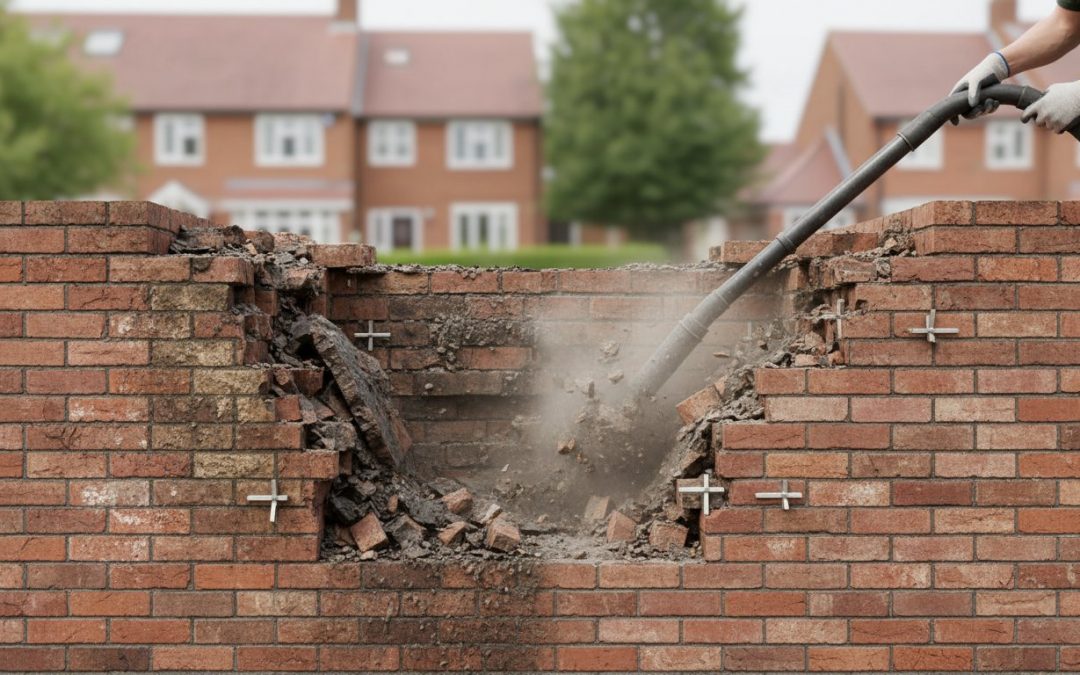
Compliant cavity extraction is a structural necessity governed by moisture-resistance regulations, not just a simple maintenance task. If you’re dealing with damp walls or failing materials, you’re likely concerned about how cavity wall insulation removal regulations UK impact your property’s safety and value. It’s common to feel overwhelmed by the technical complexities of Building Regulations Part C or the health risks associated with dust and mould during the extraction process.
We’ll provide the professional clarity you need to move forward with confidence. This guide breaks down the legal and safety standards for 2026, including the COSHH 2002 requirements for controlling the 5mg/m3 exposure limit and the Waste Regulations 2011 for debris disposal. You’ll learn how a specialist approach ensures your home remains structurally sound while restoring its thermal efficiency. We’ll examine the essential role of wall tie inspections and how to achieve a damp-expert environment that protects your long-term property health.
Key Takeaways
- Understand how Approved Document C and the Building Act 1984 govern moisture resistance and property alterations during the extraction process.
- Identify mandatory COSHH safety standards and the specific PPE required to manage hazardous dust and protect your property’s internal environment.
- Learn how to fulfill your legal Duty of Care for waste disposal as required by cavity wall insulation removal regulations UK for 2026.
- Recognize the critical importance of wall tie integrity and how removing wet insulation prevents structural instability and metal corrosion.
- See why an accredited specialist survey is the only way to ensure your property meets rigorous safety standards and structural requirements.
UK Building Regulations: Compliance Standards for Cavity Extraction
The Building Act 1984 serves as the primary legal foundation for all property alterations in England and Wales. It ensures that any “material alteration” to a building doesn’t negatively impact its safety, structural stability, or weather resistance. When insulation fails, it often becomes a bridge for moisture, which means the property no longer complies with these established standards. Staying informed about cavity wall insulation removal regulations UK is essential for homeowners who want to protect their investment. Compliance isn’t just a recommendation; it’s a legal requirement to ensure the building remains fit for habitation and safe for its occupants.
Approved Document C is the specific regulatory section that focuses on resistance to contaminants and moisture. It mandates that walls must adequately resist the passage of ground moisture and precipitation to the inside of the building. In many cases, extraction is the only viable remedial step to bring a property back into alignment with these modern moisture standards. If a property is suffering from penetrating damp due to failed material, the insulation is legally considered a defect that must be addressed to maintain the health of the building fabric.
Part C Compliance: Moisture and Structural Integrity
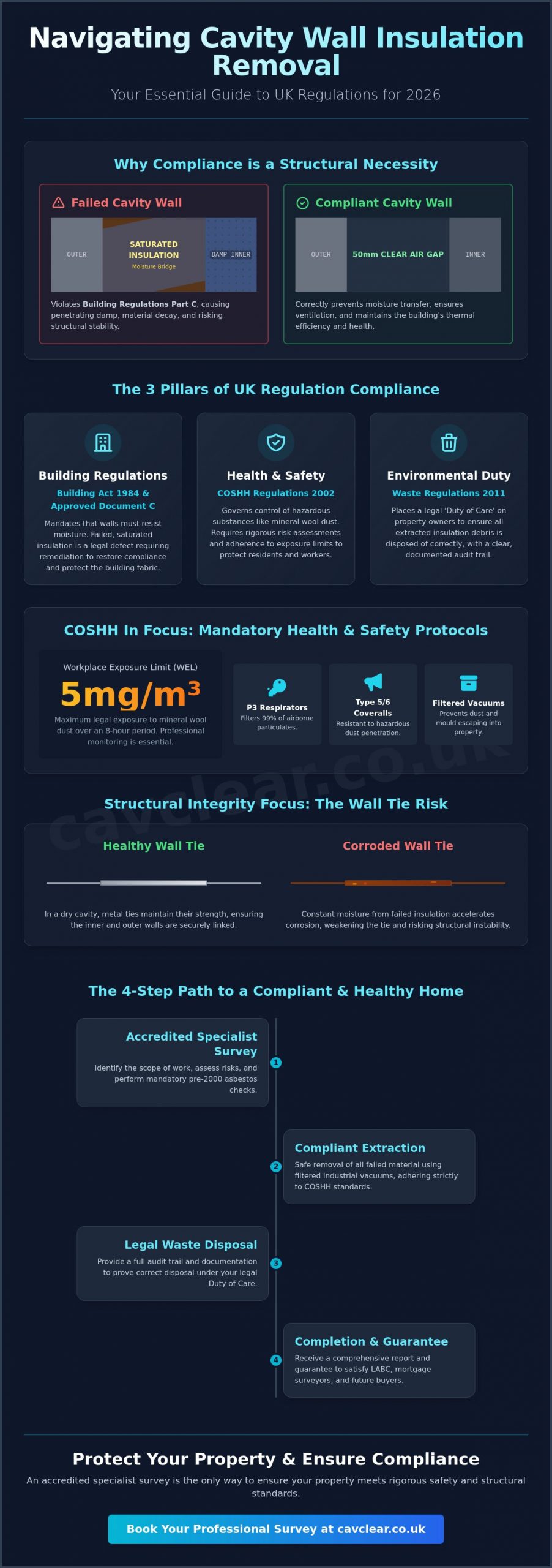
To understand the risks involved with non-compliance, we must look at what is a cavity wall and its intended function. These structures are designed to act as a barrier, preventing external water from reaching the inner leaf of the home. Standard construction guidelines generally require a clear 50mm air gap to allow for adequate ventilation and drainage. When insulation becomes saturated, it creates a capillary bridge. This allows damp to travel directly across the cavity, violating Document C. Detailed historical data on Cavity Wall Construction and Insulation shows that while the intent was thermal efficiency, the reality of failed material is a structural hazard that requires professional intervention.
The Role of Local Authority Building Control (LABC)
Notifying Building Control is a vital step for significant remedial works that affect the structural integrity of a property. While a simple extraction might not always require a full formal application, the moisture implications mean that professional documentation is non-negotiable. Unregulated extractions often leave behind debris that continues to cause damp issues. This lack of compliance creates a massive hurdle during property resale. Mortgage surveyors in 2026 are increasingly strict about identifying defective insulation. Without a clear audit trail from a specialist, including a comprehensive extraction report, you risk devaluing your home. A professional survey provides the technical evidence that the cavity has been cleared to a high standard, satisfying both LABC guidelines and future buyers.
Health, Safety, and COSHH Requirements in 2026
Protecting the health of residents and technicians is a core component of the extraction process. The Control of Substances Hazardous to Health (COSHH) Regulations 2002 require a rigorous risk assessment before any work begins to identify hazardous materials like mineral wool dust or degraded foam. Adhering to cavity wall insulation removal regulations UK ensures that every extraction is conducted without compromising air quality. Technicians must operate within the Workplace Exposure Limit (WEL) for mineral wool, which is currently set at 5mg/m3 based on an eight-hour average. Exceeding these levels poses significant respiratory risks, making professional monitoring and high-grade filtration essential on every site.
Safety standards in 2026 mandate specific Personal Protective Equipment (PPE) for every specialist on site. This includes Type 5/6 disposable coveralls designed to resist hazardous dust and P3 respirators that filter out 99% of airborne particulates. We also prioritize the management of “nuisance dust” to protect neighbouring properties. High-powered vacuum systems with integrated filtration prevent debris from escaping into the local environment during the process. Proper ventilation is equally critical. We use controlled extraction methods to ensure that mould spores or dust particles don’t migrate into the living areas of your home, maintaining a clean and safe workspace throughout the project.
Asbestos Awareness and Pre-Extraction Surveys
Legal requirements dictate that any property built before 2000 must be screened for asbestos-containing materials (ACMs) before invasive work begins. Some older insulation types were occasionally contaminated with asbestos fibres during manufacturing or through contact with other building materials. Our protocol requires an immediate work-stop if technicians discover any suspicious material. We then facilitate specialist testing to confirm the composition of the debris before proceeding. Handling these materials without proper accreditation is illegal and dangerous. If you’re concerned about the history of your property, a specialist accredited cavity wall insulation removal survey is the first step toward a safe and compliant resolution.
Occupant Safety and Internal Air Quality
Maintaining a safe living environment during the extraction is a primary objective. We isolate the worksite by sealing internal vents and entry points where dust might enter the property. Professional standards require the use of HEPA filtration and industrial-grade dust extraction systems to maintain negative pressure within the cavity. This ensures that all debris is pulled outward into our sealed collection units rather than being pushed into the home. Once the extraction is complete, we verify that the living space is expert from contaminants. This methodical approach provides peace of mind and ensures your home remains a healthy environment for your family while we restore its structural integrity.
Environmental Waste Disposal and Legal Duty of Care
Homeowners have a legal responsibility under the Environmental Protection Act 1990 to manage any waste produced on their property. This “Duty of Care” means you’re responsible for the debris from the moment it’s extracted until its final disposal at a licensed facility. It’s a common mistake to assume that local household waste recycling centres will accept this material. Most centres refuse insulation debris because it’s classified as industrial construction waste. Adhering to cavity wall insulation removal regulations UK ensures that your project doesn’t result in legal complications or environmental fines. Every kilogram of material must be tracked and handled by a Registered Waste Carrier to remain compliant with national standards.
Classifying the waste correctly is the first step in a compliant disposal strategy. Mineral wool, fibreglass, and polystyrene beads each have specific handling requirements to prevent environmental contamination. For example, loose-fill beads are highly mobile and can easily escape into local ecosystems if not contained in heavy-duty, sealed bags. Understanding the UK Government Competent Person Scheme provides a framework for identifying specialists who are authorised to self-certify their work and manage these waste streams. Using an uncertified carrier increases the risk of fly-tipping, which leaves the homeowner legally liable for the cleanup costs.
Waste Transfer Notes: Your Legal Protection
A Waste Transfer Note (WTN) is a mandatory document that provides a paper trail for your insulation debris. It must include specific details, such as the European Waste Catalogue (EWC) codes, the volume of waste, and the carrier’s license number. You’re legally required to keep these notes for at least two years. This documentation serves as your ultimate protection against liability. If the waste is ever found illegally dumped, your WTN proves that you handed the material to a legitimate professional. We provide these documents as standard, ensuring you have a complete audit trail for your property records.
Handling Hazardous Materials
Stricter regulations apply when dealing with hazardous substances like degraded Urea Formaldehyde Foam Insulation (UFFI). Over time, these foams can break down into fine powders that require specialist handling under the Hazardous Waste (England and Wales) Regulations. We implement secondary containment strategies to ensure no particles escape during transit. This process involves double-bagging and using sealed transport vehicles to meet the 2026 safety benchmarks. Proper disposal isn’t just a legal hurdle; it’s a vital part of protecting the wider environment and ensuring your property restoration is handled with total integrity.
Structural Preservation: Wall Tie Integrity and Moisture Control
Structural stability is a non-negotiable requirement under Part A of the Building Regulations. When cavity walls are compromised by saturated insulation, the internal steel wall ties are placed at significant risk. These ties are essential for holding the inner and outer leaves of your property together; they provide the lateral strength necessary to prevent wall buckling or collapse. Adhering to cavity wall insulation removal regulations UK is the only way to ensure that these vital structural components are preserved. If moisture remains trapped against the ties for extended periods, the protective galvanised coating fails, leading to iron oxide expansion and eventual structural distress.
Corrosion Risks and Remedial Ties
Saturated mineral wool acts like a wet sponge, maintaining constant contact with metal ties and accelerating the corrosion process. This chemical reaction is particularly aggressive in older properties where ties were manufactured with thinner zinc coatings. During a professional extraction, a borescope inspection is a critical step to assess the condition of these ties before and after the debris is cleared. Many properties across the UK suffer from tie failure specifically because of retrospective insulation installations. Identifying these issues early allows for a seamless transition to wall tie replacement, which restores the structural integrity of the building before permanent damage occurs. Common signs of failure that we look for include:
- Horizontal cracking in the mortar joints of the external leaf.
- Bulging or bowing of the outer wall surface.
- Visible rust staining on the brickwork.
- Internal damp patches that align with tie positions.
Thermal Bridging and Condensation Regulations
Modern thermal performance rules mandate that cavities must be expert of “debris bridges” to function correctly. When material settles at the base of the wall or around window openings, it creates a thermal bridge that allows cold spots to form on internal walls. This temperature variance is a primary cause of localized condensation and mould growth. A completely clear cavity is a requirement for preventing penetrating damp and satisfying current moisture standards. We pay specific attention to the area above the Damp Proof Course (DPC). If debris is allowed to accumulate here, it can bridge the DPC and allow ground moisture to rise into the internal leaf. Ensuring the cavity is cleared to the very bottom is a vital part of maintaining a healthy, compliant home. If you suspect your insulation is damp, booking a professional cavity wall survey is the most effective way to protect your home’s structural future.
Implementing a Compliant Extraction Strategy for Your Property
Executing a successful project requires more than just removing material; it demands a strategy that aligns with cavity wall insulation removal regulations UK for 2026. You shouldn’t entrust this complex task to a general builder who lacks the specific equipment or technical knowledge required for deep-cavity cleaning. Selecting an accredited cavity wall insulation removal specialist is the only way to ensure your property meets the rigorous standards set by modern building controls. A professional survey acts as your primary safeguard, providing the necessary evidence for insurance providers and mortgage lenders that the structural integrity of your home hasn’t been compromised during the process.
The methodology we employ focuses on a “total clear” approach. We use high-velocity compressed air to agitate and break down compacted or saturated material, which is then extracted using industrial-strength vacuum systems. This dual-action process ensures that even the smallest debris particles are removed from the cavity. Once the extraction is complete, we perform a final verification using borescope cameras. This provides visual proof that the cavity is clear and that the 50mm air gap required for moisture management is fully restored. We operate as a nationwide specialist, providing these high standards of care to homeowners across the entire United Kingdom.
Step-by-Step Professional Extraction Process
Our systematic approach follows a four-phase protocol designed for maximum efficiency and minimal disruption to your daily life:
- Phase 1: We conduct a detailed borescope survey to map the cavity and identify areas of high moisture or structural obstruction.
- Phase 2: Technicians remove specific bricks at low levels and around window apertures to create strategic extraction points.
- Phase 3: We use high-velocity air tools to clear the material, paying close attention to removing debris from the wall ties and the base of the cavity.
- Phase 4: We perform a structural repair of all mortar joints, matching the existing finish, followed by a final inspection to confirm compliance with cavity wall insulation removal regulations UK.
Choosing a Specialist Over a General Contractor
General contractors often lack the specialized vacuum technology needed to prevent dust migration into your living spaces. As a dedicated specialist, we provide comprehensive technical reporting that documents the condition of your wall ties and the cleanliness of the cavity post-extraction. This reporting is a vital asset for property preservation and future resale value. We don’t believe in temporary patches; our focus remains on permanent structural fixes that restore your home’s health. Every extraction we perform comes with a robust guarantee, giving you the peace of mind that your damp issues are resolved for the long term. Our commitment to the “right way” of extraction ensures that your property remains a safe, dry, and structurally sound investment.
Securing Your Home’s Structural Integrity and Compliance
Adhering to cavity wall insulation removal regulations UK is a vital investment in your property’s long-term health. By ensuring your home meets the moisture resistance standards of Approved Document C and the safety benchmarks of COSHH 2002, you effectively eliminate the risks of structural decay and poor internal air quality. A compliant extraction protects your investment and provides the technical documentation needed to satisfy mortgage surveyors and future buyers. It’s the only way to guarantee the restoration of your home’s original design and thermal performance.
Our nationwide team of accredited technicians specializes in remedial property preservation across the United Kingdom. We provide comprehensive structural reports that verify your cavity is clear and your wall ties are secure. Don’t let saturated material continue to damage your home’s fabric or compromise your family’s comfort. We take pride in rectifying poor workmanship and restoring the safety of your living environment with professional rigour.
Book a Professional Cavity Survey with CavClear Today to receive an expert assessment from our trusted specialists. We’re here to provide the permanent fix you need for a safe and damp-expert future.
Frequently Asked Questions
Do I need Building Regulations approval to remove cavity wall insulation?
Building Regulations approval isn’t typically required as a formal application for removal alone, but the work must still satisfy Approved Document C. This ensures the property resists moisture and contaminants after the material is gone. Using a specialist ensures your home remains compliant with Part A structural standards. A professional survey provides the technical evidence that these regulatory requirements have been met without needing a local authority inspector on site.
Is it illegal to remove cavity wall insulation myself in the UK?
It’s not illegal to attempt a DIY removal, but you must comply with the Environmental Protection Act 1990 regarding waste disposal. Homeowners hold a legal Duty of Care for all debris produced on their property. If you fail to use a Registered Waste Carrier or improperly handle hazardous dust, you risk heavy fines. Most homeowners find that the technical requirements for safe extraction make professional intervention the only viable path.
What are the 2026 health and safety requirements for insulation extraction?
The 2026 standards prioritize the Control of Substances Hazardous to Health (COSHH) to manage respiratory risks. Technicians must adhere to a Workplace Exposure Limit of 5mg/m3 for mineral wool dust. This requires the use of P3 rated respirators and Type 5/6 protective suits. Additionally, professional standards now mandate HEPA filtered vacuum systems to prevent any nuisance dust from affecting the air quality of neighbouring properties during the extraction.
How do I prove to a future buyer that my cavity was correctly cleared?
You prove a successful extraction by presenting a formal technical report accompanied by borescope photographic evidence. This documentation is essential for 2026 mortgage valuations and property surveys. It demonstrates that the 50mm cavity air gap is fully restored and that no debris bridges remain. Providing a clear audit trail from an accredited specialist gives future buyers the reassurance they need regarding the home’s long term structural health.
What happens if asbestos is found in my cavity wall insulation?
All work must cease immediately under the Control of Asbestos Regulations 2012 if suspicious material is identified. Properties built before 2000 require an asbestos awareness check before any invasive extraction begins. If testing confirms the presence of asbestos, a licensed removal team must take over. They use specialized containment zones and negative pressure units to ensure no hazardous fibres enter the home or the local environment during the process.
Are there specific regulations for disposing of old foam insulation?
Degraded foam insulation is strictly governed by the Hazardous Waste Regulations due to its chemical composition. It cannot be disposed of at standard recycling centres. Instead, it must be double bagged and transported by a licensed carrier to a facility authorized to handle hazardous construction waste. Following cavity wall insulation removal regulations UK ensures that these materials are tracked via Waste Transfer Notes for full legal compliance and property protection.
How does cavity insulation removal affect my home insurance compliance?
Professional removal ensures your property remains compliant with insurance requirements by addressing underlying damp and structural risks. Many insurers won’t cover damage caused by defective or saturated insulation if it’s left untreated. By using an accredited specialist, you provide proof that the building fabric is being maintained to a high standard. This proactive maintenance protects your policy’s validity and ensures the home remains a low risk structural investment.
Does the UK government regulate the equipment used for extraction?
The government regulates equipment performance through safety and environmental outcomes rather than specific model mandates. Extraction systems must meet industrial filtration standards to comply with COSHH and environmental dust limits. For example, high velocity air tools and industrial vacuums must be capable of clearing 100% of debris without leaking particulates. This ensures the work meets the Competent Person benchmarks for property alterations and structural preservation in the UK.
Recent Comments