
Could the “rising damp” identified in your property survey actually be a misdiagnosis that risks your home’s structural integrity? Many homeowners face the stress of a mortgage retention because a contractor used a simple moisture meter to recommend an expensive, unnecessary damp-proof course. Understanding how to challenge a bad damp report is essential when you’re receiving conflicting opinions or feeling pressured to sign off on invasive treatments just to satisfy a lender. You deserve a solution rooted in building pathology, not a quick-fix sales pitch.
This guide explains the technical steps required to move beyond surface-level readings and secure a forensic, evidence-based structural diagnosis. We’ll show you how to identify the technical flaws in standard reports and why investigating the cavity itself is often the only way to find the true cause of moisture. By following this roadmap, you’ll gain the clarity needed to protect your property’s value and ensure its long-term asset health through correct, professional methodology. This approach moves the conversation from guesswork to certain, structural facts.
Key Takeaways
- Understand the distinction between a sales-led survey and a diagnostic structural inspection to identify why many reports prioritize remedial sales over accuracy.
- Recognize red flags like “one size fits all” damp-proof course recommendations that ignore external factors like high ground levels or defective brickwork.
- Discover how to challenge a bad damp report by requesting raw calibration data and insisting on a forensic investigation of the property’s cavity.
- Learn how technical evidence from borescope inspections and salt analysis can distinguish between simple condensation and genuine structural moisture ingress.
- Shift your focus toward long-term asset health by addressing the true causes of dampness, such as wall tie failure, rather than applying temporary surface fixes.
Why Many Damp Reports Are Technically Flawed
Homeowners often face significant stress when a pre-purchase survey identifies “damp issues” without offering a clear, evidence-based cause. These reports typically rely on a cursory walk-through rather than a forensic investigation. A massive gap exists between a sales-led survey and a true diagnostic structural inspection. While the former focuses on selling a specific product, the latter prioritizes the building’s long-term health. Understanding this distinction is the first step in learning how to challenge a bad damp report that threatens your property sale or mortgage approval.
Flawed reports frequently lead to mortgage retentions. This occurs when lenders withhold funds until “remedial” work is finished. This creates immense pressure on buyers and sellers to agree to invasive treatments, such as chemical damp-proof course (DPC) injections. Often, these recommendations are generic templates. They fail to address the actual source of moisture, such as a blocked cavity or defective wall ties. As a nationwide company with service coverage across the United Kingdom, we see how these inaccuracies compromise structural integrity and cause unnecessary financial strain.
The Misuse of Electronic Moisture Meters
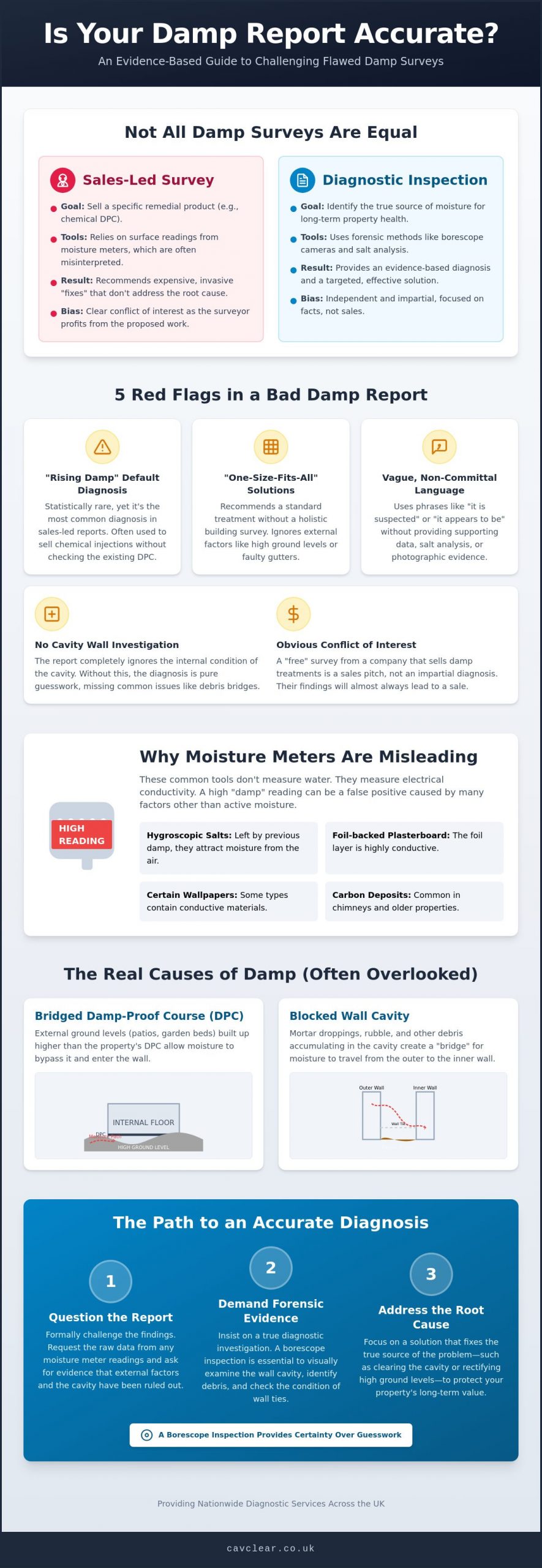
Electronic moisture meters are the most common tool used in damp surveys, yet they are frequently misinterpreted. These devices measure electrical conductivity, not the actual water content of a material. If a wall contains what structural damp is, such as hygroscopic salts left behind by historical moisture, the meter will produce a high “red” reading even if the wall is currently dry. Modern building materials, including foil-backed plasterboard or certain types of wallpaper, also trigger false positives. A high reading doesn’t automatically confirm rising damp. It simply indicates that more rigorous investigation is necessary.
Sales-Driven vs. Independent Surveying
A fundamental conflict of interest exists when the person diagnosing the problem also profits from the solution. Many “expert” surveys are conducted by contractors who specialize in specific remedial treatments. Because their business model depends on selling these services, their reports naturally lean toward recommending them. These reports often use generic, pre-written templates. They ignore property-specific defects like high ground levels, leaking gutters, or debris within the wall cavity. If you suspect that external drainage or plumbing issues are contributing to the moisture, you can check out CH Enviro for professional inspection and maintenance services. Knowing how to challenge a bad damp report involves questioning the independence of the surveyor and demanding data that proves a structural fault rather than a surface-level symptom.
Common Red Flags in an Inaccurate Damp Report
Identifying red flags within a surveyor’s document is the most effective way to understand how to challenge a bad damp report. A professional diagnostic report should provide a definitive cause based on evidence, yet many reports rely on vague, non-committal language. If you see phrases like “it is suspected that” or “it appears to be” without supporting data, the surveyor hasn’t performed a thorough investigation. A reliable report must include technical evidence, such as salt analysis or thermal imaging, to distinguish between structural moisture and simple condensation.
Professional surveyors look at the building as a whole. A report is fundamentally incomplete if it lacks a detailed external inspection of the brickwork, gutters, and ground levels. Many inaccurate reports suggest a chemical damp-proof course (DPC) as a “one size fits all” solution without ever checking if the existing physical DPC is simply bridged by high garden beds or debris. Before committing to expensive remedial work, it’s vital to secure a professional cavity wall survey to see what’s actually happening behind the brickwork.
The “Rising Damp” Default Diagnosis
Rising damp is statistically the least common form of dampness in UK properties, yet it’s the most frequent diagnosis in sales-led reports. Contractors often overlook the physical damp-proof course in favor of high-margin chemical injections. If a report recommends a new DPC without first identifying the location and condition of the original one, it’s likely flawed. True rising damp is rare; most “rising” symptoms are actually caused by external ground levels being higher than the internal floor, which allows moisture to bypass the existing DPC through capillary action.
Ignoring the Cavity Wall
A report that fails to mention the internal condition of the cavity wall is guessing at the cause of the problem. Many “damp” patches are not caused by groundwater at all. Instead, they result from wall tie corrosion or debris collecting on the ties, which creates a physical bridge for moisture to travel from the outer leaf to the inner wall. Similarly, defective or poorly installed cavity wall insulation can become saturated, acting as a permanent conduit for moisture. If your report doesn’t include a borescope inspection to check for these structural faults, you don’t have a complete diagnosis. Understanding these technical gaps is key when learning how to challenge a bad damp report and protecting your property’s long-term asset health.
The Technical Evidence Needed to Challenge a Report
Challenging an inaccurate survey requires more than just a second opinion; it demands empirical evidence that addresses the building’s specific pathology. When you’re learning how to challenge a bad damp report, your goal is to replace assumptions with forensic data. Most standard surveys stop at the surface, but a professional diagnostic approach looks deeper into the structural components that actually control moisture movement. By gathering technical proof, you can demonstrate that “red” meter readings are often symptoms of structural faults rather than rising damp.
Thermal imaging is a vital, non-invasive tool in this process. These cameras identify cold spots and thermal bridging where insulation may have slumped or where hidden pipe leaks are cooling the masonry. This technology highlights anomalies that a simple moisture meter would miss, providing a visual map of moisture patterns. When these findings are combined with a professional wall tie survey, it becomes possible to see if moisture ingress is linked to structural instability. Identifying corroded wall ties early prevents long-term damage and ensures that any remedial work targets the root cause rather than just the symptoms.
Forensic Cavity Inspections
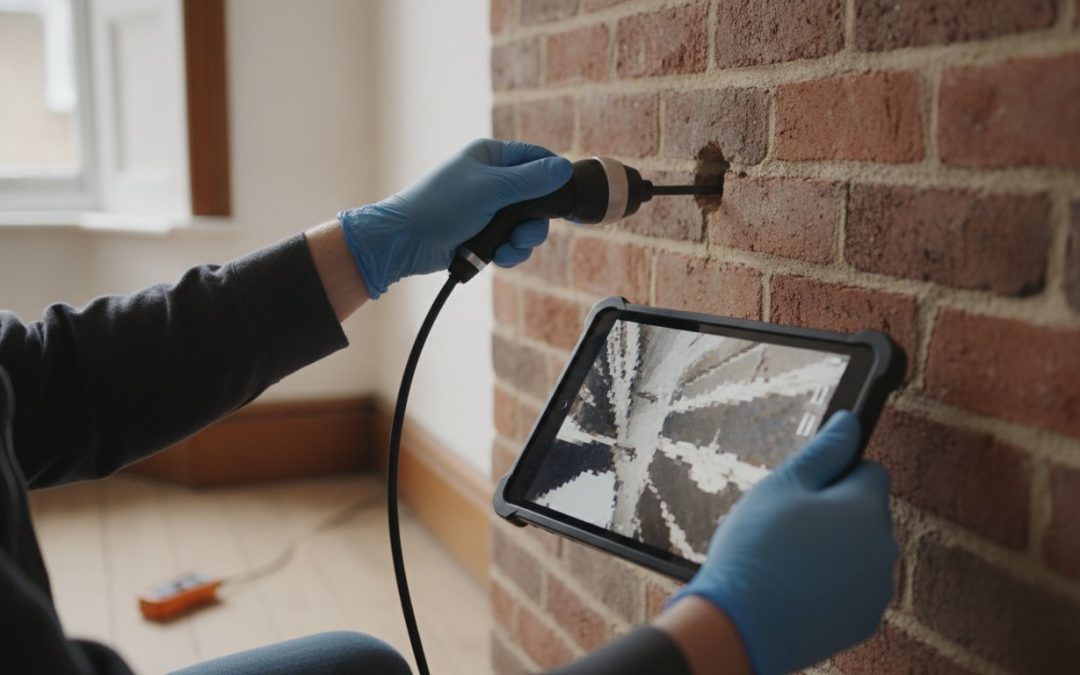
A borescope inspection is a non-disruptive method that allows us to see exactly what is happening inside your walls. By inserting a small camera through a 10mm hole in the mortar joint, we can identify “snots”—mortar droppings that have collected on wall ties during the original construction. These snots create a physical bridge, allowing water to cross from the outer leaf to the inner plaster. A standard damp report will often mislabel this as rising damp, but the camera provides undeniable proof of a structural bridging issue. This inspection also reveals slumped or wet insulation that acts as a permanent conduit for moisture, which is a critical detail in how to challenge a bad damp report effectively.
Hygroscopic Salt and Carbide Testing
Carbide testing provides a level of accuracy that electronic meters cannot match. While a meter measures conductivity, a carbide test involves taking a physical masonry sample from within the wall. This sample is then chemically tested to determine the precise percentage of moisture present. This is the only way to distinguish between surface condensation and deep-seated structural saturation. If a previous report only used a “spike” meter, these results are your strongest tool for refuting their findings. Salt analysis further clarifies the situation by identifying hygroscopic salts, which are often left behind by historical dampness and trigger false positives on electronic devices even if the wall is now dry.
A Step-by-Step Guide to Formally Challenging the Findings
Challenging an inaccurate survey requires a methodical, evidence-based approach rather than just an emotional disagreement. When you understand how to challenge a bad damp report, you can effectively shift the burden of proof back onto the original surveyor. This process involves stripping away vague terminology and demanding technical justifications for any recommended remedial work. If a report lacks structural data, it’s essentially an opinion, not a diagnosis. Just as you would seek professional help to correct physical documentation, Content Removal offers specialized services for those needing to eliminate harmful or inaccurate digital information that could impact their reputation.
To successfully overturn a flawed report, follow these five technical steps:
- Step 1: Request the raw data and calibration records for the equipment used during the survey to ensure the meter readings are valid.
- Step 2: Cross-reference the report’s findings against visible external defects, such as high ground levels or blocked air bricks, which are often overlooked.
- Step 3: Instruct an independent specialist to conduct a diagnostic survey that includes internal cavity inspections.
- Step 4: Formally submit the new forensic evidence to the original surveyor or your mortgage lender.
- Step 5: Seek a “letter of comfort” or a revised report that acknowledges the true cause of the moisture ingress.
Questioning the Original Surveyor
Don’t accept a damp report at face value. You should ask the surveyor specific, technical questions to expose any gaps in their methodology. Ask them directly: “Did you check the internal condition of the cavity?” and “How did you rule out condensation or thermal bridging as the primary cause?” If the report recommends a chemical DPC, demand a justification for why this is the only solution. A professional should be able to provide photographic evidence of the “damp” at the structural level. If they can’t show you what’s happening inside the wall, their recommendation for invasive work is technically unsupported.
Presenting Counter-Evidence
The most effective way to overturn a mortgage retention is to provide a professional damp survey that uses correct diagnostic methodology. Your new evidence must focus on a “remedial action plan” rather than just a sales quote. This plan should detail structural repairs, such as removing debris from the cavity or replacing corroded wall ties. Lenders require certainty; a report that proves the dampness is caused by a specific, fixable structural fault is far more valuable than a generic “suspected rising damp” claim. If you need a definitive diagnosis to satisfy a lender and protect your property’s future, you should book a cavity wall survey with a specialist who covers the entire United Kingdom. This ensures your property preservation strategy is based on facts, not guesswork.
Why Structural Integrity Is the True Answer to Damp
Traditional damp proofing often fails because it treats symptoms rather than structural faults. Learning how to challenge a bad damp report involves shifting the focus toward structural property preservation. If a report suggests chemical injections without assessing the physical condition of the masonry, it ignores the primary defense mechanism of your home. Real solutions come from restoring the building’s original design and ensuring that the structure can manage moisture naturally. This approach protects long-term asset health and prevents the cycle of recurring dampness caused by quick-fix remedies.
A critical element of this process is wall tie replacement. Corroded or incorrectly installed ties don’t just threaten stability; they act as physical bridges for water to travel across the cavity. Similarly, cavity wall insulation removal is frequently the only permanent fix for walls that remain saturated. When insulation becomes wet due to external defects, it holds moisture against the inner leaf, making internal “damp-proof” coatings useless. Addressing these structural failures is the only way to ensure a dry, safe environment.
The Importance of a Clear Cavity
A functioning wall cavity is designed to provide a clear air space that prevents moisture from crossing the outer leaf to the inner wall. When debris, mortar “snots,” or defective insulation fills this space, the building loses its ability to breathe. This blockage creates cold spots and allows penetrating damp to bypass the property’s natural defenses. Extracting failed insulation and clearing the cavity restores the thermal and moisture balance of the home. This methodology is clean, non-disruptive, and addresses the root cause that many standard surveys overlook.
Choosing a Nationwide Specialist
Protecting your property investment requires technical rigor and a specialist who understands the unique structural challenges of UK properties. When you’re determining how to challenge a bad damp report, you need a partner who provides detailed, non-alarmist findings based on forensic evidence. Choosing a nationwide specialist ensures that your property is assessed by technicians who use professional methodology and high-level standards. CavClear provides the diagnostic expertise needed to rectify the poor workmanship of others. Our focus on structural integrity ensures that your home remains a healthy asset, backed by the assurance of a permanent fix rather than a temporary patch.
Securing Your Property’s Structural Future
A flawed damp report doesn’t have to be the final word on your property’s value or safety. By moving beyond surface-level meter readings and demanding forensic evidence, you can identify whether moisture is a simple condensation issue or a deeper structural fault. Understanding how to challenge a bad damp report is the essential first step in protecting your home from invasive, unnecessary treatments that fail to address the root cause. True property preservation relies on maintaining a clear cavity and ensuring the integrity of every wall tie.
Our accredited technicians provide the technical rigor required to overturn inaccurate findings through detailed forensic reporting. We specialize in cavity wall surveys and structural integrity inspections across the entire United Kingdom, offering a clear path toward a permanent resolution. Don’t let a generic survey compromise your property investment or stall your mortgage process. Book a Professional Diagnostic Survey with CavClear today to secure an evidence-based roadmap for your home’s long-term health. You can restore your property’s comfort with confidence when you have the right technical data in hand.
Frequently Asked Questions
Can I ignore a damp report if I think it is wrong?
Ignoring a formal damp report is not recommended, especially during a property transaction. Mortgage lenders act on the written evidence provided; an unaddressed report will likely result in a financial retention. Instead, you should learn how to challenge a bad damp report by commissioning a diagnostic inspection. This replaces a flawed opinion with technical facts and forensic data that a lender or seller can formally accept.
Why do surveyors use moisture meters if they are inaccurate?
Surveyors use electronic moisture meters because they are fast, non-destructive, and effective for identifying “at-risk” areas. However, these devices measure electrical conductivity rather than actual water content. They often produce false positives when they encounter hygroscopic salts or foil-backed building materials. A professional survey uses these meters only as a preliminary screening tool, followed by deeper structural investigation to confirm any findings.
How much does an independent damp survey cost in 2026?
An independent damp survey in the UK typically costs between £200 and £600. For a standard two to three-bedroom house, you should expect to pay between £250 and £400. Complex cases or expert witness reports can exceed £1,000. While “expert” surveys are common, they are usually offered by contractors selling remedial treatments; this often leads to biased results and unnecessary, expensive recommendations.
What is the difference between a damp survey and a structural survey?
A damp survey focuses specifically on moisture ingress and its immediate causes, such as penetrating damp or condensation. A structural survey is a broader assessment of the building’s overall stability, including foundations and load-bearing walls. In many cases, dampness is a symptom of a structural failure, such as corroded wall ties or a bridged cavity. Addressing both ensures the long-term health of the property asset.
Will a bad damp report affect my mortgage offer?
Yes, a report identifying significant damp issues often leads to a mortgage retention. The lender may withhold a portion of the loan until the specified remedial works are completed and certified. This is why knowing how to challenge a bad damp report is vital. Providing a forensic, evidence-based counter-report can prove the issues are misdiagnosed, allowing the lender to release the full funds without unnecessary work.
What happens if a surveyor recommends a DPC but it doesn’t fix the damp?
If a chemical damp-proof course fails to resolve the issue, it is usually because the original diagnosis was incorrect. Many damp problems are actually caused by internal cavity debris, bridged physical damp-proof courses, or poor ventilation. Installing a DPC on a wall suffering from penetrating damp or condensation will not stop the moisture. In these cases, the structural integrity of the cavity must be inspected and restored.
Can I challenge a report after I have already bought the house?
You can challenge a report post-purchase if you discover that the surveyor was negligent or missed obvious structural defects. This involves commissioning a new, diagnostic inspection to document the existing faults that were originally overlooked. While the process is more complex after the sale is finalized, professional evidence of misdiagnosis is essential if you need to rectify poor workmanship or seek a resolution for property damage.
Is condensation often mistaken for rising damp in reports?
Condensation is frequently misdiagnosed as rising damp, especially when surveyors rely solely on surface moisture meters. Surface-level moisture from poor ventilation triggers high meter readings that look identical to rising damp. A professional diagnostic survey uses salt analysis and thermal imaging to distinguish between these two issues. This ensures that homeowners don’t pay for expensive structural injections when improved ventilation or cavity cleaning is the actual solution.
Recent Comments