
Why does the damp return every winter despite your best efforts to scrub it away? If you are tired of persistent musty smells and recurring black mould, you are not alone. Recent data from late 2025 indicates that approximately 28% of the UK population lives in homes affected by damp, mould, or cold issues. It is an incredibly stressful situation that often leads to conflicting advice from general builders who suggest temporary patches rather than addressing the underlying structural fault. This guide focuses on solving damp problems for good by moving beyond surface treatments to identify the technical failures compromising your property’s envelope.
We understand that your home is your most significant asset. Protecting its structural integrity requires a specialist approach that prioritises long-term health over quick fixes. You will discover how to differentiate between simple condensation and serious structural moisture ingress that requires professional remediation. We also outline the methodology for permanent solutions that restore comfort and secure your property resale value. This article provides a clear, expert-led path toward a dry and healthy living environment through precise diagnosis and reliable engineering.
Key Takeaways
- Learn the difference between temporary management techniques and permanent remedial works that address the structural source of moisture.
- Identify how saturated cavity wall insulation creates a bridge for moisture transfer and why its removal is essential for structural health.
- Discover the role of borescope cameras in specialist surveys to accurately diagnose hidden faults within your property’s wall cavity.
- Understand the technical process of solving damp problems for good through professional insulation extraction and the replacement of corroded wall ties.
- Gain insights into why choosing a nationwide specialist with a clean, non-disruptive methodology is a vital investment in your property’s future.
Solving Damp Problems for Good: Management vs. Permanent Remediation
Many property owners find themselves caught in an endless cycle of cleaning, scrubbing, and repainting. This approach is often described as damp management, which focuses on treating the visible symptoms rather than the technical cause. Solving damp problems for good requires a shift in perspective. It involves identifying where the building’s structural integrity has failed and restoring it to its original design. For a comprehensive structural dampness overview, it is helpful to recognize that moisture often penetrates the building envelope through hidden defects that surface treatments simply cannot reach.
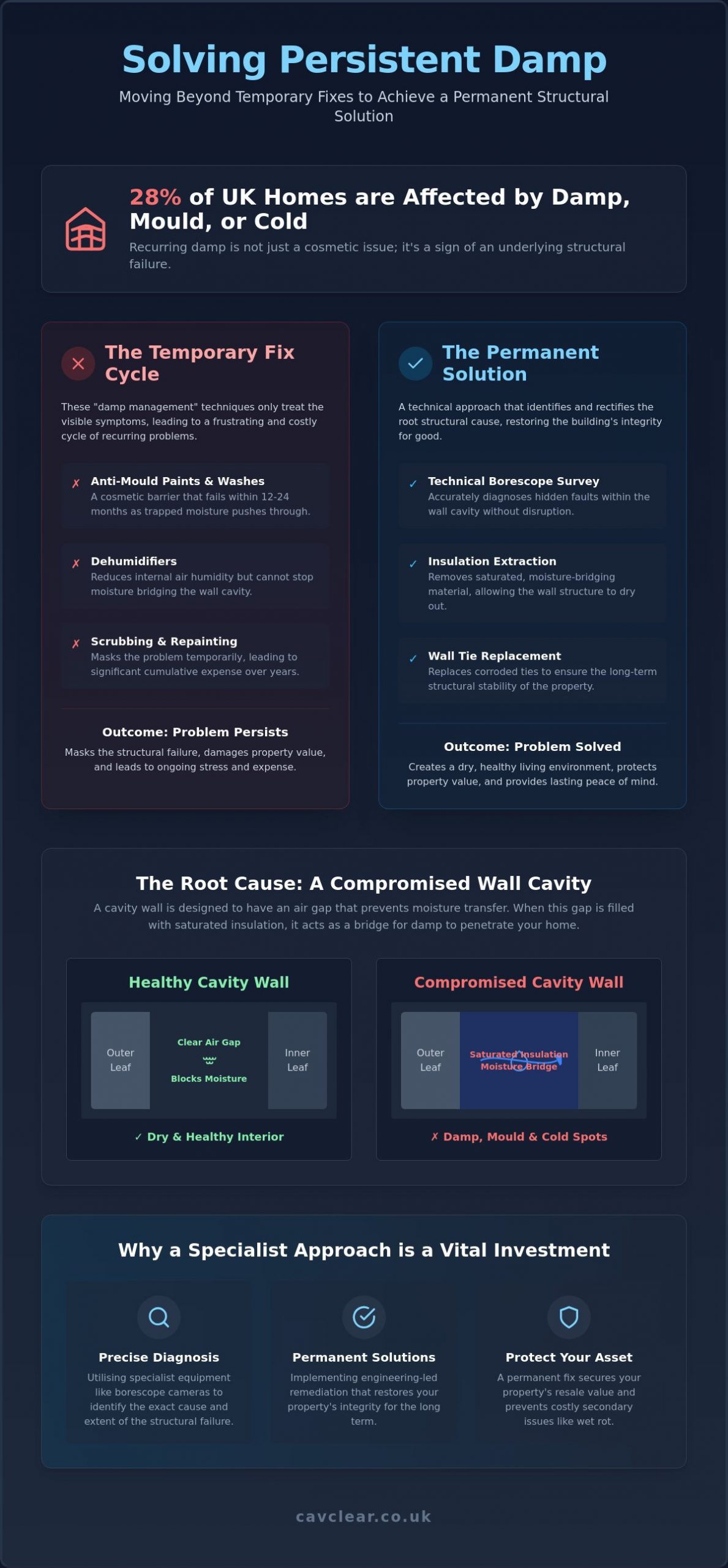
Permanent remediation differs from management because it targets the root cause of moisture ingress. While a dehumidifier might lower internal humidity, it doesn’t stop water from bridging a wall cavity. Most surface treatments, such as damp-proof paints or mould washes, fail within 12 to 24 months. This failure happens because the moisture remains trapped within the wall fabric, eventually pushing through any cosmetic barrier. True resolution involves returning the property to a state of structural equilibrium where the walls can breathe and shed moisture as intended.
The High Cost of Recurring Damp Management
Attempting to manage dampness through temporary fixes leads to significant cumulative expenses. Property owners often spend thousands over several years on specialist paints, new wallpaper, and replacing furniture damaged by spores. Beyond the immediate costs, persistent moisture leads to secondary structural issues like wet rot in floor joists and skirting boards. When it comes time to sell, a standard homebuyer survey will likely flag these issues, which can lead to severe price reductions or even cause a sale to collapse entirely. Investing in a permanent fix protects your property’s long-term asset health.
Why “Quick Fixes” Often Mask Structural Failures
Anti-mould paints are frequently marketed as a solution, but they are limited by the laws of physics. If a wall cavity is compromised by saturated insulation, the internal wall temperature drops, creating a thermal bridge. No amount of paint can prevent condensation from forming on a cold spot caused by a structural fault. Similarly, increasing ventilation via extractor fans or PIV systems is helpful for lifestyle-related moisture, but it cannot dry out a saturated cavity wall. Permanent damp remediation is the removal of moisture-bridging materials. Once these bridges are gone, the structural core can finally dry out, providing a lasting solution that protects the building for decades.
Identifying the Structural Root Causes of Persistent Damp
A cavity wall is a precision-engineered gap designed to act as a physical break between the external masonry and your internal living space. This air space prevents rainwater from migrating through the brickwork to the inner leaf. Solving damp problems for good is impossible if this gap is bridged by debris or saturated materials. When the cavity is compromised, moisture moves expertly through the structure, resulting in the dark patches and peeling wallpaper that indicate a failure in the building’s protective envelope.
Thermal bridging is a common secondary effect of structural failure. When insulation slumps or becomes wet, it creates cold spots on the inner leaf of the wall. These cold spots attract condensation, which property owners often mistake for a simple ventilation issue. In reality, the wall’s thermal performance has failed because the insulation is no longer functioning as a dry barrier. While our focus remains on the vertical building envelope, technical resources regarding basement moisture causes and solutions highlight how groundwater and masonry defects interact similarly across different parts of a building’s foundation and walls.
The Problem with Defective Cavity Wall Insulation
Many insulation materials, particularly older mineral wool or foam products, can become saturated over time due to driving rain or leaking gutters. Once wet, these materials lose their thermal properties and act like a sponge, holding moisture against the inner wall. This constant presence of water significantly increases internal humidity and provides the perfect environment for mould growth. For a detailed breakdown of how to address these issues, consult the UK guide to cavity wall insulation removal. Identifying these faults requires specialized equipment, and scheduling a cavity wall survey is the first step in diagnosing why your home isn’t staying dry.
Wall Tie Corrosion and Moisture Ingress
Wall ties are essential steel components that hold the two leaves of a cavity wall together. In older properties, these ties are often made of mild steel that corrodes when exposed to moisture. As the steel rusts, it expands to several times its original thickness, which exerts immense pressure on the mortar joints. This expansion creates horizontal cracks in the external masonry, providing a direct path for rainwater to enter the cavity. Replacing these failing components is a critical part of wall tie replacement, which restores structural stability and prevents further moisture ingress. Without addressing these cracks, any internal damp treatment will inevitably fail as water continues to penetrate the structural core.
The Necessity of a Technical Property Survey
A standard homebuyer survey is designed to provide a broad overview of a property’s condition, but it often stops at the surface when identifying moisture issues. For property owners committed to solving damp problems for good, a specialist technical survey is the essential next step. Unlike general assessments, a specialist investigation uses diagnostic equipment to look behind the plaster and brickwork. This process moves beyond a simple moisture meter reading to uncover the specific structural failures discussed in previous sections. Our nationwide team provides coverage across the UK, ensuring consistent standards of diagnostic excellence regardless of your location.
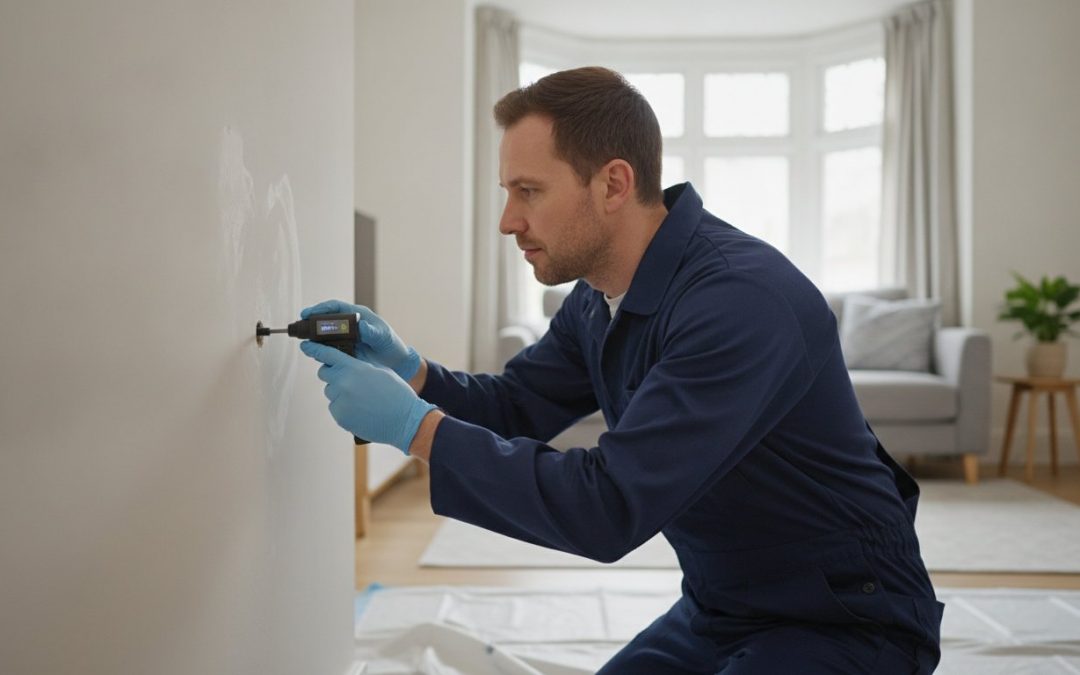
Accredited technicians utilize borescope cameras to perform internal cavity inspections. By inserting a small lens through a discreet hole in the mortar joint, we can visually confirm if insulation is saturated or if debris is bridging the gap. Moisture mapping is another vital tool. It involves taking readings across a grid to visualize how water moves through the structure. Tracing the path of ingress back to its source, whether it’s a failing window seal or a high ground level bridging the damp proof course, eliminates guesswork. This scientific approach ensures that the resulting recommendations are based on physical evidence rather than assumptions.
What to Expect from a Professional Damp Investigation
Our methodology focuses on non-invasive diagnostic techniques that provide maximum clarity without disrupting your daily life. Property owners should be cautious of “expert” surveys, as these are often used as sales funnels for specific products rather than objective diagnostic tools. A professional assessment provides an unbiased remedial action plan based on technical evidence. For more information on the methodology and reporting standards, view our professional damp survey guide. A formal report gives you the transparency needed to make informed decisions about your property’s future.
Interpreting Survey Results for Long-Term Planning
An expert report will clearly distinguish whether you are facing rising damp, penetrating damp, or complex condensation issues. The surveyor must also examine external factors, such as high ground levels or blocked guttering, which often exacerbate internal moisture. To ensure your home’s exterior water management is functioning correctly, you can find out more about Drainage Maintenance and Repair Services as part of your broader maintenance strategy. A formal survey is the only way to guarantee a targeted, permanent fix. By following a documented remedial action plan, you ensure that every penny spent contributes to the long-term health and value of your home. This document serves as a record of professional due diligence, which is invaluable for maintaining property resale value and solving damp problems for good.
Implementing Permanent Solutions: Extraction and Repair
Solving damp problems for good requires moving from technical observation to physical action. Once a specialist survey confirms that the building envelope is compromised, the focus shifts to restoring the cavity to its original, clear state. This process isn’t a cosmetic repair. It’s a structural intervention designed to eliminate the bridges that allow moisture to bypass your property’s natural defences. Because our methodology is refined through years of nationwide service across the UK, we ensure that every remedial step adheres to the highest technical standards of property maintenance.
A critical but often overlooked phase of remediation is the dry-out period. Even after the source of moisture is removed, the masonry remains saturated. It takes time for the structural core to reach equilibrium. This drying process is facilitated by ensuring that the cavity tray and weep holes are entirely clear of debris. These components are designed to direct any incidental moisture back outside. If they are blocked by slumped insulation or mortar droppings, moisture will continue to pool at the base of the wall, leading to persistent damp at the ground floor level.
The Cavity Wall Insulation Extraction Process
The removal of defective material is a clean and non-disruptive procedure because the work is performed entirely from the property’s exterior. Technicians remove individual bricks at strategic points to create access for high-powered vacuums and compressed air tools. This equipment effectively breaks down and removes saturated insulation without damaging the internal decor or structural leaf. Clearing the air gap is a fundamental requirement for solving black mould problems. Once the cavity is empty, air can circulate expertly, which naturally lowers the moisture content of the inner wall and prevents the cold spots that trigger mould growth.
Structural Integrity and Wall Tie Remediation
If the survey identified corroded wall ties, they must be addressed alongside insulation removal. We install modern stainless steel remedial ties that are resistant to the chemical reactions that cause mild steel to rust and expand. Technicians use precision drilling to insert these ties, ensuring the inner and outer leaves are safely bonded without compromising the masonry’s integrity. This is a vital investment in your property’s future stability. Unlike temporary patches, stainless steel ties provide a permanent fix that won’t require further intervention. If you’re ready to restore your home’s structural health, you can book a professional cavity wall insulation extraction to begin the remediation process.
Choosing a Nationwide Specialist for Structural Remediation
Selecting the right partner for structural remediation is the final step in a successful diagnostic journey. Solving damp problems for good requires more than just technical skill; it demands a specialist who views your property as a long-term asset. A nationwide provider offers a level of consistency and professional rigor that general builders often cannot match. By choosing a company with coverage across the entire United Kingdom, you ensure that the remedial works are performed according to standardized technical protocols. This approach provides the peace of mind that comes from knowing your home’s structural health is being managed by experts who understand the complexities of the British building stock.
Comprehensive reports serve as a vital record of the work performed. These documents are not merely receipts; they are technical validations of your property’s condition. When the time comes to sell your home, having a professional remedial recommendation and proof of its implementation can protect your resale value. It demonstrates to surveyors and potential buyers that you have addressed the root cause of moisture ingress rather than masking it with cosmetic treatments. This transparency is a hallmark of a professional service and a necessary component of solving damp problems for good.
The CavClear Approach to Permanent Dryness
At CavClear, we prioritise a clean and non-disruptive methodology that respects the integrity of your home. Our technicians focus on the restoration of structural equilibrium by removing the materials that cause moisture bridging. We maintain a firm stance against the installation of retrospective cavity wall insulation. Our experience shows that these installations frequently lead to significant dampness and accelerated wall tie corrosion. Instead, we focus on extraction and repair to ensure your walls remain clear and breathable. This commitment to technical standards allows us to restore comfort and safety to properties across the UK.
Next Steps for Homeowners
Taking action before structural damage worsens is the most effective way to protect your investment. The first step is to book a comprehensive property inspection that includes a detailed assessment of your wall cavities and ties. This diagnostic process provides the clarity needed to move forward with confidence. A formal report will outline exactly what is required to secure your property’s future. It is a vital investment. To begin your journey toward a dry, healthy home, Contact CavClear for a professional damp and wall tie survey today. Our team is ready to provide the specialist expertise required for permanent remediation.
Securing Your Property’s Structural Future
Achieving a dry home requires a shift from managing symptoms to addressing structural faults. As we have discussed, solving damp problems for good is only possible when you identify the specific bridges, such as saturated insulation or corroded wall ties, that compromise your building’s envelope. By prioritising technical remediation over cosmetic fixes, you ensure the long-term health of your asset and the comfort of your living space.
Our accredited technicians provide nationwide UK coverage, delivering specialist expertise in non-disruptive insulation extraction and structural repair. It’s a process built on professional rigor. We provide detailed technical reports with professional remedial recommendations, giving you a clear, evidence-based path to resolution. This diagnostic approach eliminates the uncertainty often associated with property maintenance. You can take the first step toward a permanent fix by accessing our specialist diagnostic services.
Book a Professional Damp and Wall Tie Survey Today
Restoring your property to its original structural integrity is a vital investment. With the right specialist support, you can look forward to a healthy, damp-expert environment for years to come.
Frequently Asked Questions
Can damp be fixed permanently in an older UK property?
Yes, damp can be permanently resolved in older properties by addressing the structural root cause. Most issues arise from bridging within the wall cavity or the failure of original building components. By removing saturated materials and restoring the intended air gap, you return the building to its original design. This specialist approach effectively eliminates moisture ingress and protects the property for the future.
Why does my damp keep returning after I have cleaned the mould?
Cleaning mould only addresses the aesthetic symptom, not the structural cause. If the wall cavity is bridged by wet insulation or debris, the internal wall remains cold and damp, creating a constant environment for spores to regrow. Solving damp problems for good requires extracting these moisture-bridging materials to ensure the wall fabric can dry out completely. This structural remediation stops the moisture cycle at its source.
Is cavity wall insulation removal a messy or disruptive process?
No, the extraction process is performed entirely from the exterior and is designed to be non-disruptive. Technicians remove small sections of brickwork to access the cavity using high-powered vacuums and compressed air. This methodology ensures that your internal living space remains clean and unaffected while the structural issues are addressed. It is a precise engineering task that maintains the comfort of your home.
How long does it take for a wall to dry out after insulation extraction?
A typical dry-out period can take several months, depending on the severity of the initial saturation and the external weather conditions. Once the moisture source is removed, the masonry must release its stored water through evaporation. Ensuring that weep holes and cavity trays are clear facilitates this process by allowing air to circulate expertly within the restored gap. Patience is required as the structural core reaches equilibrium.
Will my home insurance cover the cost of solving damp problems for good?
Home insurance policies typically focus on sudden and accidental events rather than long-term maintenance issues. Structural dampness resulting from failing insulation or corroding wall ties is usually categorized as a maintenance requirement. You should review your specific policy documents or speak with your provider to understand their stance on remedial structural works. We provide the technical documentation required to support any necessary property health assessments.
What is the difference between a damp survey and a general building survey?
A general building survey provides a broad overview of a property’s condition, whereas a specialist damp survey uses diagnostic equipment like borescope cameras to inspect hidden areas. Our technical surveys focus specifically on identifying moisture ingress patterns and structural failures within the wall cavity. This level of detail is necessary to provide a formal remedial action plan. It offers a targeted solution that a standard visual inspection cannot provide.
Can failing wall ties cause dampness inside my house?
Yes, corroding wall ties expand and create horizontal cracks in the external masonry. These cracks act as a direct path for rainwater to enter the cavity and reach the inner leaf of the wall. Replacing these ties with stainless steel alternatives is a critical step in solving damp problems for good and restoring the structural integrity of the property. This prevents further water penetration and stabilizes the building envelope.
Why should I avoid installing new cavity wall insulation if I have damp issues?
Installing new insulation into a damp cavity will trap moisture and exacerbate existing structural problems. Retrospective insulation often acts as a bridge for water transfer and can accelerate the corrosion of wall ties. We never recommend this practice because it compromises the building’s ability to shed moisture. Instead, the focus should be on extraction and repair to ensure the wall fabric remains clear and functional.
Recent Comments