
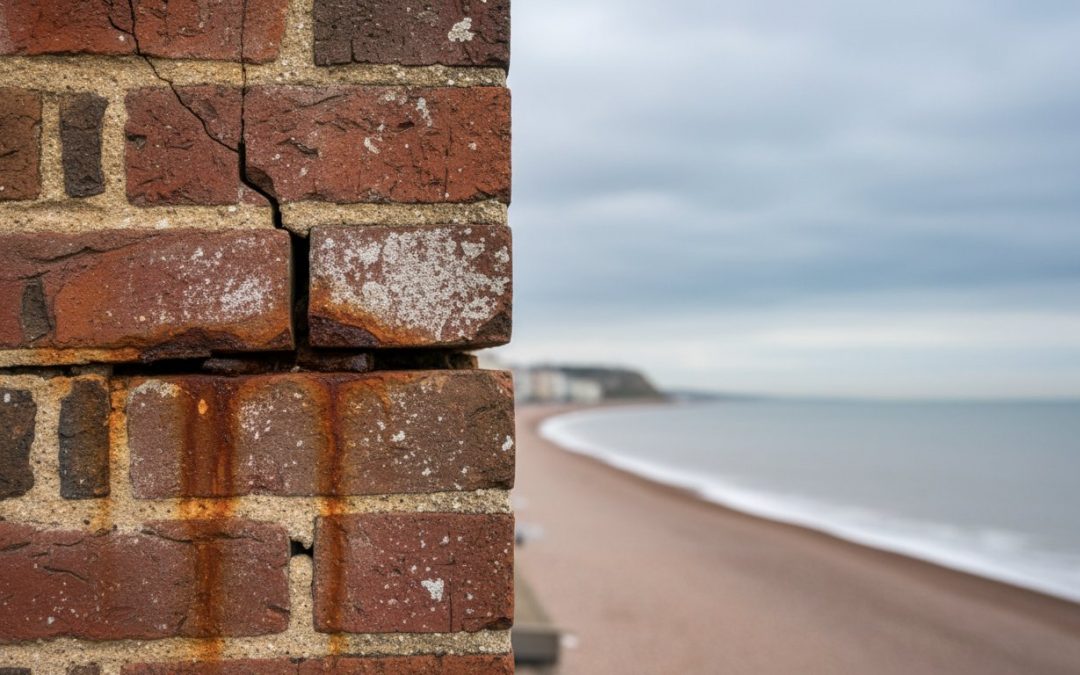
Did you know that over 65% of property lender downgrades and insurance complications in coastal cities like Brighton are now linked to wall tie failure and damp? Living by the sea offers an enviable lifestyle, but the salt-laden air acts as a relentless catalyst for structural decay. If you’ve noticed horizontal cracks in your mortar or persistent damp patches that won’t clear, you’re likely facing the reality of wall tie failure in coastal properties. These metal components, hidden within your cavity walls, are the only things holding your home’s outer leaf to its inner structure. When salt penetrates the masonry, it accelerates the corrosion of older galvanized steel ties; this leads to expansion, cracking, and eventual structural instability.
We understand that the prospect of structural repairs is stressful, especially when maintenance costs for seaside homes continue to rise. This guide will show you exactly why coastal environments are so aggressive toward masonry and how you can protect your investment from long-term damage. You’ll discover the specific technical standards required for maritime environments and the professional methodology used to restore your home’s integrity. We’ll walk through the diagnostic process, from specialist wall tie surveys to the installation of corrosion-resistant replacements, ensuring your property remains safe and dry for decades to come.
Key Takeaways
- Learn why properties within five miles of the coastline require a specialized maintenance timeline to address the accelerated corrosion caused by salt-laden air.
- Understand the “expansion effect,” where rusting steel can grow to seven times its original thickness and cause dangerous leaf separation in high-wind zones.
- Identify the subtle external indicators of wall tie failure in coastal properties before invisible structural damage becomes a critical safety risk.
- Discover why marine-grade (316) stainless steel is the non-negotiable standard for permanent structural restoration in maritime environments.
- Find out how a professional wall tie survey serves as the essential first step in diagnosing hidden faults and preserving your home’s long-term asset value.
Understanding Wall Tie Failure in UK Coastal Environments
Walls in modern UK homes aren’t solid blocks of masonry; they’re built in two separate layers. To understand the structural risk facing seaside homes, we first need to define the components involved. What is a Cavity Wall Tie? These hidden metal components act as essential structural anchors, pinning the outer brick leaf to the inner load-bearing wall. While they’re invisible from the street, they’re the only thing preventing the external facade from bowing, cracking, or collapsing. In most inland areas, these ties can last many decades. However, for properties within five miles of the sea, the maintenance timeline shifts dramatically.
Coastal environments introduce a specific chemical threat that standard building materials weren’t always designed to handle. The primary driver of wall tie failure in coastal properties is the aggressive reaction between metal and airborne chlorides. Unlike inland homes, seaside masonry is under constant attack from salt-laden moisture. This accelerates oxidation, causing mild steel or poorly galvanized ties to corrode much faster than expected. In some cases, structural integrity can be compromised within just 20 years of construction, far sooner than the typical lifespan of inland structures.
The Role of Salt Air and Chlorides
Sea spray doesn’t just sit on the surface of your home. Standard bricks are porous, meaning they absorb moisture like a sponge. Onshore winds create a pressure effect, forcing salt-laden air deep into the brickwork and into the cavity itself. Salt is naturally hygroscopic, which means it attracts and retains water from the atmosphere. This keeps the wall ties in a state of perpetual dampness, creating a perfect environment for rapid electrochemical corrosion. Once the protective zinc coating on a galvanized tie is breached, the underlying steel begins to rust and expand.
Vulnerable Property Eras in Coastal Zones
Properties built between the 1920s and the early 1980s are at the highest risk. During this period, it was standard practice to use mild steel ties with a thin layer of galvanization. While these were deemed sufficient at the time, they’ve proven inadequate for the harsh conditions of the British coastline. It wasn’t until 2004 that an amendment to Approved Document A of the Building Regulations mandated stainless steel for all new houses regardless of location. Most post-war coastal homes were constructed without these marine-grade protections, leaving a legacy of vulnerable structures that now require professional intervention to remain safe.
The Destructive Cycle: How Moisture and Insulation Accelerate Failure
When iron or steel oxidizes, it undergoes a massive volumetric change that many homeowners don’t expect. In the context of wall tie failure in coastal properties, this isn’t just a surface issue. Rust can grow to seven times the thickness of the original steel. This expansion creates an immense internal force that pushes against the masonry from the inside out. As the tie thickens, it physically lifts the mortar joints, creating the horizontal cracks often seen on seaside facades. This physical expansion is the first stage in a cycle that compromises the entire building envelope.
Rust Expansion and Structural Stability
As the corrosion progresses, the bond between the inner and outer leaves of the property weakens. This leads to a dangerous condition known as leaf separation. In high-wind coastal areas, this is particularly critical. The outer masonry leaf relies on the ties to resist the suction and pressure of gale-force winds. If the ties are blown or the mortar is lifted, the wall loses its lateral stability. Following BRE guidance on replacing wall ties is essential to restore this lost integrity. Without intervention, the risks are significant:
- Vertical lifting of mortar joints as rust expands, weakening the masonry bond.
- Loss of lateral stability against extreme coastal wind loads.
- Increased risk of total outer leaf collapse during severe storm events.
Why Retrospective Insulation is a Coastal Risk
Many seaside property owners unknowingly accelerate structural decay by installing retrospective cavity wall insulation. In maritime environments, this material often acts as a massive sponge. It absorbs salt-laden moisture that penetrates the porous outer brickwork and holds it directly against the metal ties. This prevents the cavity from “breathing” or drying out during the limited hours of sunshine. The result is a state of permanent saturation that leads to rapid wall tie failure in coastal properties.
Wet insulation also creates a bridge for moisture to travel from the outer leaf to the inner leaf, causing persistent internal damp issues. However, the structural risk is the primary concern. You can’t effectively treat or replace ties if the cavity is packed with wet, salt-saturated material. In many cases, removing defective insulation is the mandatory first step in a structural recovery plan. It allows the masonry to dry and stops the cycle of galvanic corrosion. If you’ve noticed damp patches or cracking, booking a specialist wall tie survey is the most reliable way to assess the hidden condition of your home’s anchors.
Identifying the Warning Signs in Seaside Properties
Wall tie failure is a progressive structural defect that often remains hidden within the cavity for years. Because these anchors are buried behind the external masonry, many homeowners don’t realize their property’s integrity is compromised until the damage becomes visible on the surface. In maritime environments, the signs of wall tie failure in coastal properties are frequently misinterpreted as general weathering or standard damp issues. Identifying these markers early is essential to prevent the need for more extensive, costly structural stabilization later.
External Indicators of Wall Tie Corrosion
The most common sign of advanced corrosion is horizontal cracking in the mortar joints. These cracks typically appear at regular intervals, often every six to seven courses of brickwork, where the expanding rust on the ties physically forces the masonry apart. This occurs because the iron oxide occupies significantly more space than the original steel. On coastal elevations, particularly those facing the prevailing sea winds, you may also observe:
- Bowing or Bulging: The external leaf may visibly curve outward as it detaches from the inner structure.
- Separation of Openings: Gaps often form around window and door frames as the masonry leaf shifts.
- Roofline Distortion: The expansion of ties can lift the upper courses of bricks, causing the roof edge or soffits to appear misaligned.
White, powdery salt marks on the external bricks are a significant red flag. They indicate that salt-laden moisture is moving through the wall, providing the exact chemical catalyst needed for rapid metal decay. This salt ingress is the primary precursor to structural instability.
Internal Signs and Secondary Damp Issues
Structural failure often manifests internally as confusing damp patterns. When a wall tie corrodes, it can create a bridge for moisture to travel from the wet outer leaf to the dry inner leaf. This results in damp patches that appear in a grid-like pattern, corresponding precisely with the location of the ties. Additionally, the presence of corroded metal within the cavity creates a cold bridge. This causes the internal wall temperature to drop at specific points, leading to localized condensation and black mold growth that refuses to clear with standard ventilation. If you see salt crystals forming on your internal plasterwork, it’s a sign that the structural anchors are likely failing and transferring sea salts directly into your living space. These symptoms suggest the protective environment of your cavity has been compromised and requires a professional inspection.
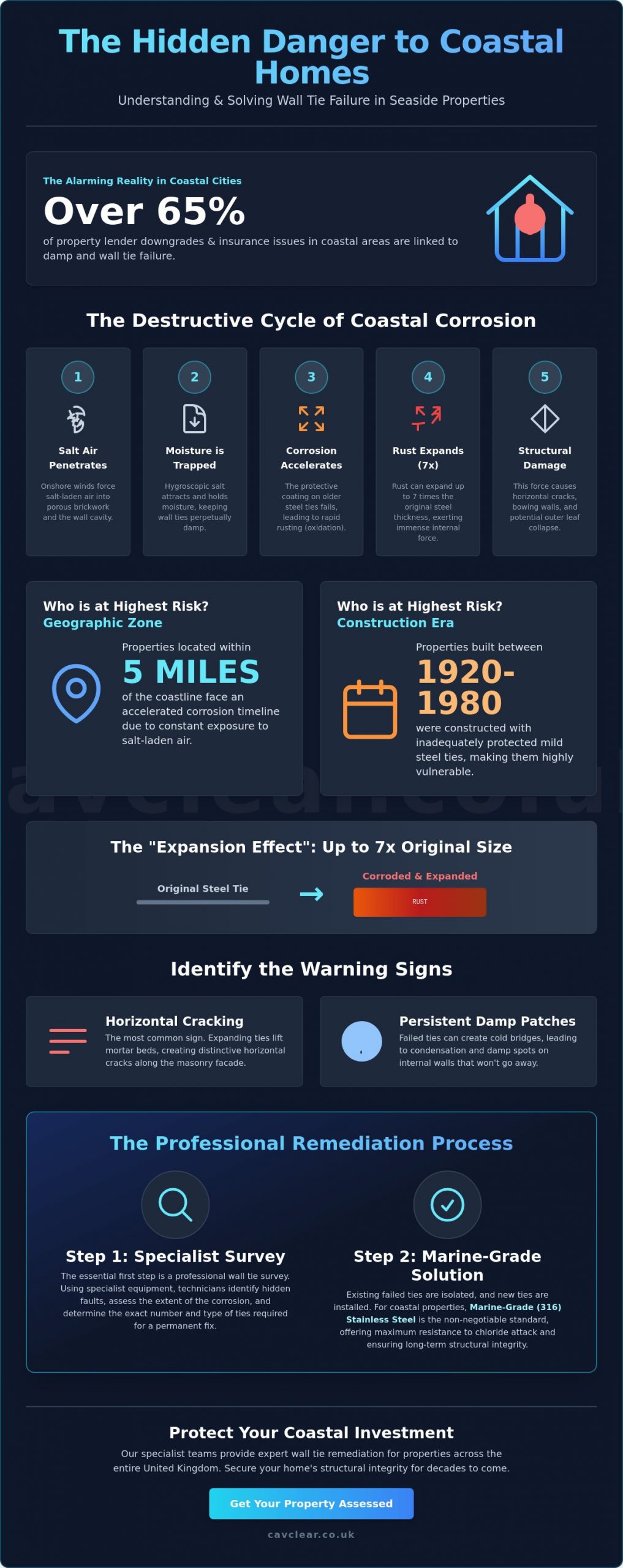
The Remedial Process: Surveys and Marine-Grade Solutions
Addressing structural decay in a maritime environment requires a methodical, evidence-based approach rather than guesswork. Because the damage is hidden within the cavity, we utilize specific diagnostic tools to determine the exact state of your home’s anchors. Effective remediation begins with a professional wall tie survey to map the extent of the corrosion and identify the correct specification for replacement. This process is designed to be clean and non-disruptive, ensuring your property’s daily routine isn’t interrupted while we secure its future.
Technical Assessment Methodology
Our specialists use high-resolution boroscope cameras to visually inspect the cavity. By inserting the camera through a small hole in the mortar joint, we can see the ties without removing any bricks. This allows us to categorize the corrosion according to the industry-standard scale, ranging from Grade 1 (minor surface rust) to Grade 4 (total loss of structural integrity). We also use high-sensitivity metal detectors to map the existing tie pattern. This ensures that the density of the anchors meets modern standards, such as the 2.5 ties per square metre recommended by PD 6697:2019. Physical sampling may also be required to confirm the metal’s degradation rate, providing a transparent look at the hidden risks of wall tie failure in coastal properties.
Installing Marine-Grade Remedial Ties
Standard Grade 304 stainless steel is often insufficient for properties located near the shoreline. The high concentration of airborne chlorides requires “marine-grade” Grade 316 (A4) stainless steel, which offers superior resistance to salt-induced pitting. We install these remedial ties using a combination of mechanical anchoring and resin injection, depending on the masonry type. The new ties are threaded through the outer leaf and anchored firmly into the inner load-bearing structure, restoring the lateral stability that salt air has stripped away.
A critical part of our methodology involves isolating the original, failing ties. If left alone, the expanding rust on the old ties will continue to crack the masonry even after new ties are installed. We use specific techniques to “crop” or isolate the old metal, preventing further expansion damage. This comprehensive approach ensures a permanent fix rather than a temporary patch. If you’ve observed signs of movement or cracking, our nationwide team can provide a definitive Wall Tie Survey to protect your home’s long-term asset health. Once the survey is complete, we offer a clean and efficient Wall Tie Replacement service to restore your property’s structural integrity permanently.
CavClear: Expert Wall Tie Remediation for Coastal Properties
CavClear operates as a nationwide specialist dedicated to resolving the unique structural challenges faced by seaside homeowners across the United Kingdom. We recognize that wall tie failure in coastal properties isn’t an isolated issue; it’s often the result of a long-term environmental struggle involving salt ingress and trapped moisture. Our methodology prioritizes the health of your property by addressing the root cause of decay. This often involves the extraction of salt-saturated cavity insulation that would otherwise continue to corrode even new stainless steel components. By choosing a specialist approach, you ensure that your property’s structural integrity is restored through a clean, methodical process that respects both the building’s fabric and your comfort.
A Comprehensive Approach to Property Health
We combine expert wall tie replacement with comprehensive damp prevention strategies to ensure a permanent resolution. Our technicians provide detailed technical reports that are essential for building insurance purposes and future property valuations. Lenders and insurers increasingly scrutinize coastal properties for signs of structural movement. Having a professional remedial record from a recognized specialist can be the difference between a successful sale and a downgraded valuation. We focus on the total restoration of the building envelope, ensuring that the inner leaf remains dry and the outer leaf remains securely anchored against the elements.
Securing Your Coastal Home for the Future
Our commitment to excellence means we take pride in rectifying the poor workmanship of others, ensuring your home meets modern safety standards. We treat every property as a vital long-term asset. Contact CavClear for a nationwide structural inspection to ensure your seaside home remains a secure and comfortable environment. Our team is ready to provide the professional rigor your property deserves, restoring both its structural integrity and its market value.
Securing Your Seaside Asset for the Long Term
Protecting a home from the relentless effects of maritime weather requires more than just cosmetic repair. Managing wall tie failure in coastal properties requires a specialized understanding of maritime chemistry and structural physics. We’ve seen how salt ingress and trapped moisture create a destructive cycle that compromises safety and property value. By prioritizing the use of marine-grade 316 stainless steel and ensuring the cavity is expert from saturated insulation, you can stop this decay permanently. Our accredited technicians provide the technical reporting necessary to satisfy lenders and insurers while restoring the comfort of your home. To ensure these vital structural records and other property deeds are kept safe, many owners utilize the secure document storage services of Sentinel Vaults.
Proactive intervention is the most reliable way to avoid emergency structural costs. With nationwide UK coverage, we bring high-level standards to every project, ensuring your property remains a stable and valuable asset for decades. Don’t let hidden corrosion undermine your investment. Book a specialist wall tie survey for your coastal property with CavClear today to receive a definitive assessment of your home’s health. Restoring your peace of mind is just as important as restoring your walls, and we’re here to provide the expert guidance you need to move forward with confidence.
Frequently Asked Questions
What exactly is coastal wall tie failure?
Coastal wall tie failure is the structural degradation of the metal anchors that hold a property’s outer brick leaf to its inner structure. In maritime environments, airborne salt and moisture penetrate porous brickwork and attack the metal. This causes the ties to oxidize and expand. This expansion creates internal pressure that leads to cracking and bowing, eventually compromising the stability of the entire building envelope.
How far from the sea is considered a coastal property for wall ties?
Properties located within five miles of the coastline are generally classified as being in a high-risk coastal zone. However, the most severe cases of wall tie failure in coastal properties occur within one mile of the sea, where salt spray concentration is highest. Onshore winds can carry corrosive chlorides several miles inland, meaning any property near the coast requires more frequent structural inspections than inland equivalents.
Can I just repoint the cracks instead of replacing the ties?
Repointing cracks is a cosmetic fix that fails to address the underlying structural fault. If you only fill the mortar joints, the corroded ties inside the cavity will continue to expand as they rust. This expansion eventually forces the new mortar out and creates even larger cracks. A permanent solution requires a professional wall tie survey to confirm the state of the anchors followed by the installation of remedial ties.
Does cavity wall insulation make wall tie corrosion worse in coastal areas?
Retrospective cavity wall insulation significantly increases the risk of corrosion in seaside homes. The material acts as a sponge, absorbing salt-laden moisture and holding it in direct contact with the metal ties. This prevents the cavity from drying out and creates a state of permanent saturation. We often recommend cavity wall insulation extraction as a necessary first step to stop this accelerated decay and protect the property’s structural health.
What is the difference between standard and marine-grade wall ties?
The primary difference lies in the alloy’s resistance to chloride-induced pitting. Standard remedial ties are often made of Grade 304 stainless steel, which is suitable for most inland areas. Marine-grade ties are manufactured from Grade 316 stainless steel. This material contains molybdenum, which provides the essential protection needed against the aggressive salt air found in coastal environments. Using the wrong grade can lead to premature failure in maritime zones.
How long does a professional wall tie survey take?
A specialist wall tie survey typically takes between two and four hours to complete. During this time, our technicians use boroscopes to inspect the cavity and metal detectors to map the existing tie pattern. This methodical approach allows us to provide a detailed technical report without the need for intrusive work. The exact duration depends on the size of the property and the number of elevations requiring inspection.
Is wall tie replacement a messy or disruptive process?
Wall tie replacement is a clean and non-disruptive process that we perform entirely from the outside of the building. We install remedial ties by drilling small holes into the mortar joints, which are then precisely matched to your existing masonry. This methodology avoids the need for scaffolding in many cases and ensures your daily routine isn’t interrupted. It’s a precise technical task designed to restore integrity without the mess of traditional construction.
Will wall tie failure affect my ability to sell a coastal property?
Structural defects often lead to significant complications during a property transaction. Lenders and surveyors frequently flag signs of movement or salt ingress, which can result in mortgage refusals or downgraded valuations. Providing a technical remedial report from a specialist ensures the property’s integrity is documented and its market value is protected. This proactive documentation offers reassurance to both buyers and insurance providers.
Recent Comments