

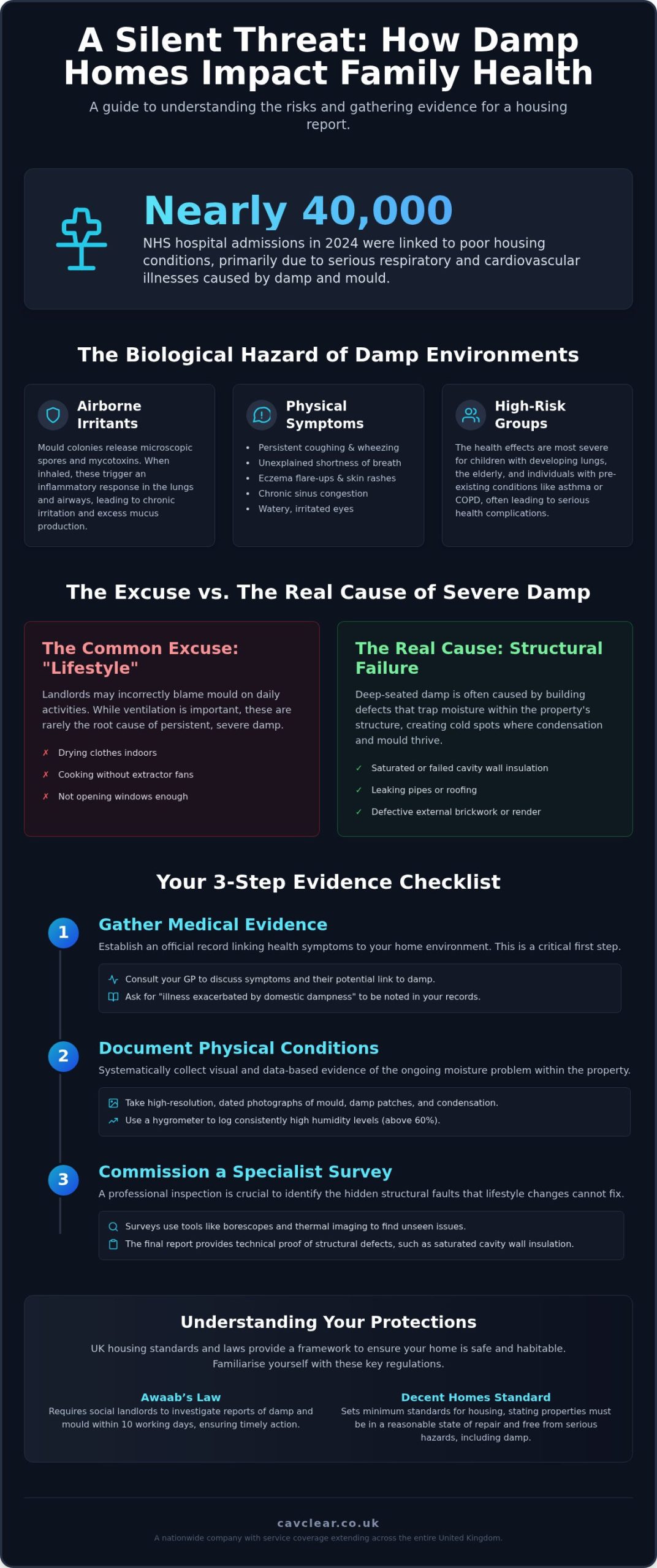
In 2024, poor housing conditions contributed to nearly 40,000 NHS hospital admissions for serious respiratory and cardiovascular illnesses. If your family is struggling with persistent coughs or worsening asthma, you already know that a damp home is more than an eyesore; it’s a direct threat to your wellbeing. It is frustrating when landlords dismiss these serious concerns as “lifestyle issues” like drying laundry indoors, especially when the root cause is often a structural failure. Learning how to prove damp is affecting your family’s health for a housing report is essential to moving past these excuses and securing the professional repairs your property requires.
We understand the stress of living in an environment that feels unsafe. Recent legislation like the Renters’ Rights Act 2025 and Awaab’s Law has strengthened protections, requiring social landlords to investigate damp reports within 10 working days. However, success still depends on clear, technical evidence. You’ll learn how to combine medical documentation with technical data, such as cavity wall surveys, to create a logical link between property defects and health outcomes. This guide provides a checklist of evidence to gather, from GP records to specialist damp inspections. Our goal is to help you achieve a home that is professionally repaired and dry, focusing on long term asset health and the permanent restoration of your comfort.
Key Takeaways
- Understand how mould spores and mycotoxins trigger inflammatory responses, which specifically impact vulnerable groups such as children and those with pre-existing respiratory conditions.
- Establish a formal medical record by consulting a GP to document the direct link between property dampness and your family’s ongoing health symptoms.
- Learn how to prove damp is affecting your family’s health for a housing report by gathering high-resolution photography and consistent hygrometer data as evidence of persistent moisture.
- Recognise the importance of specialist technical surveys that use borescopes and thermal imaging to uncover hidden structural issues like saturated cavity wall insulation.
- Familiarise yourself with your rights under Awaab’s Law and the Decent Homes Standard to ensure your property is restored to a safe, dry, and habitable condition.
The Link Between Property Dampness and Family Respiratory Health
Exposure to structural dampness isn’t just a cosmetic issue; it’s a significant biological hazard. When mould colonies establish themselves on internal surfaces, they release microscopic spores and toxic metabolites known as mycotoxins into the air. Once inhaled, these particles trigger an immediate inflammatory response within the bronchial tubes and lung tissue. This biological reaction causes the airways to constrict and produce excess mucus, leading to chronic irritation that the body cannot resolve while the environmental trigger remains present. Prolonged exposure to high humidity levels above 60% facilitates rapid fungal growth, creating a self-sustaining cycle of poor air quality that compromises both the property and the health of its occupants.
The Health effects of structural damp are most pronounced in vulnerable groups who spend more time indoors. Children’s developing lungs are particularly sensitive to airborne irritants, often leading to early-onset respiratory issues or persistent infections. The elderly and individuals with pre-existing conditions like asthma or COPD frequently experience severe exacerbations that require medical intervention. Beyond the physical, the psychological toll is profound. Living with the constant smell of damp and the sight of spreading mould causes chronic stress and disrupts sleep patterns, which further weakens the immune system. Understanding these biological and psychological connections is the first step in knowing how to prove damp is affecting your family’s health for a housing claim.
Common Physical Symptoms Linked to Mould Exposure
Physical reactions to mould often mimic seasonal allergies but persist year-round. You might notice family members suffering from a cluster of symptoms that refuse to clear with standard over-the-counter treatments. Typical physical signs include:
- Respiratory distress: Persistent coughing, wheezing, and unexplained shortness of breath.
- Skin conditions: Sudden eczema flare-ups and red, itchy rashes that appear without a change in diet or detergents.
- Sinus issues: Chronic congestion, frequent sneezing, and watery, irritated eyes.
These symptoms typically worsen during the winter months when internal moisture levels rise and the property’s structural defects become more apparent.
Why “Lifestyle” is Rarely the Root Cause of Severe Mould
Landlords frequently suggest that “lifestyle choices,” such as drying clothes indoors or inadequate ventilation, are the primary causes of mould. This argument often overlooks significant technical faults within the building’s envelope that make mould growth inevitable. Structural failures, such as saturated or slumped cavity wall insulation, create severe “cold spots” on internal walls. These spots act as magnets for condensation because the wall temperature drops below the dew point, regardless of how often you open the windows. When insulation becomes defective, it holds moisture against the inner leaf of the wall, leading to deep-seated dampness. Addressing these structural deficiencies through professional cavity extraction is the only way to achieve a permanent, dry solution and protect the long-term health of the building.
Steps to Gather Medical Proof of Property-Related Illness
Establishing a clear medical history is a vital component in demonstrating the impact of your living conditions. Start by consulting your GP specifically to discuss the connection between your home environment and the symptoms your family is experiencing. It isn’t enough to simply treat the cough or the rash; the underlying cause needs to be documented within your NHS records. This creates a chronological link that technical experts can later correlate with property defects.
Working with Your GP and Medical Specialists
When you speak with a medical professional, explicitly ask them to record “suspected environmental triggers” or “illness exacerbated by domestic dampness” in their consultation notes. Request formal medical records that note the presence of damp in the property as a contributing factor to your family’s health issues. This documentation is a cornerstone of how to prove damp is affecting your family’s health for a housing report. Securing referrals for allergy testing is also beneficial. It identifies specific sensitivities to mould species like Aspergillus or Penicillium. Finally, request a “Summary of Care” from your surgery. This document highlights the timeline of illnesses, making it easier to see if health problems began or worsened after a structural failure occurred.
Maintaining a Symptom and Environment Diary
Consistency is key when gathering evidence. Track symptom patterns by noting whether health issues improve when family members are away from the home for several days, such as during a holiday or a stay with relatives. If family members have respiratory issues, a peak flow diary provides objective data on lung function over time. This helps demonstrate the daily reality of living in a compromised environment.
Use a hygrometer to record daily humidity levels alongside your health observations. This helps prove that symptoms peak when internal moisture levels exceed 60% or during high-rainfall periods. Don’t forget the value of photographic evidence. Take high-resolution photos of physical symptoms like skin rashes or eye inflammation to include in your records. While medical proof is essential, it often points toward structural failures like saturated wall insulation. Arranging a professional cavity wall survey provides the technical data needed to validate these medical observations and secure a permanent fix for your property.
Documenting the Physical Evidence Within the Property
Visible mould is frequently just a symptom of a deeper structural failure within the building envelope. To build a robust evidence base, you must document the physical state of the property with technical precision. This involves more than just a few snapshots; you need a chronological record that pairs health observations with environmental data. Understanding how to prove damp is affecting your family’s health for a housing claim requires a dual focus on internal symptoms and the external building defects that cause them. By documenting the environment systematically, you move the conversation away from “lifestyle” excuses and toward structural accountability.
High-resolution photography serves as your most persuasive tool. Don’t just photograph the mould on the ceiling or around window frames. Move wardrobes and pull back carpets to reveal hidden growth. These areas often harbour high concentrations of spores because of poor airflow and cold wall surfaces. In addition to visual records, use a hygrometer to provide data-driven proof of persistent internal moisture levels. If your logs show humidity consistently exceeding 60% despite regular heating and ventilation, it demonstrates a structural inability to manage moisture. Pair this with a formal log of all repair requests and the property owner’s responses to show a clear timeline of neglect.
Photographic Evidence Best Practices
When taking photos, follow a structured methodology to ensure the evidence is undeniable. Start with “wide shots” to provide context of the entire room, then move in for “close-ups” of the affected area. Always place a scale reference, such as a coin or a ruler, next to the mould to show its extent. Ensure all images are date-stamped and stored in a secure digital folder. If you’ve attempted to clean the area, photograph the progression of regrowth. Documenting how quickly mould returns after cleaning proves the issue is deep-seated and cannot be resolved by superficial maintenance.
Tracking External Property Defects
External faults are frequently the primary source of internal dampness. Inspect your outer walls for salt staining, which indicates penetrating damp, or horizontal cracking in the mortar joints. These cracks often signal failing wall ties, which can compromise the stability of the building and allow moisture to bridge the gap between wall leaves. To understand how these issues manifest inside, it helps to know What is a wall cavity? and how it should function. When external brickwork fails or gutters become blocked, water enters the cavity and saturates the internal leaf. This creates a permanent cold spot that no amount of internal heating can fix.
Why Specialist Technical Surveys are Vital for Evidence
A general visual inspection often fails to identify why a property remains damp despite adequate heating and ventilation. When you’re documenting how to prove damp is affecting your family’s health for a housing claim, you need technical data that moves beyond surface observations. Specialist damp and mould surveys use non-invasive technology to look inside the building’s structure. This methodology identifies the root cause of moisture ingress rather than simply noting the presence of mould on a wall. By uncovering the underlying technical faults, you provide the evidence needed to ensure the property is restored to a safe and habitable state.
Professional equipment like thermal imaging cameras highlights temperature differentials across internal surfaces, pinpointing cold spots where condensation is inevitable. Borescopes allow technicians to see inside the wall cavity itself, revealing blocked vents or debris that bridges the gap between brick layers. A professional technical survey provides empirical data to prove that defective or saturated cavity wall insulation is creating cold bridges, which directly causes persistent internal dampness. This evidence is crucial for shifting the focus from tenant “lifestyle” factors to structural liability and long-term asset health.
The Role of Independent Dampness Specialists
An independent report carries significantly more weight than a landlord’s in-house assessment. Internal maintenance teams often lack the specialist tools or the motivation to identify expensive structural faults. Our Professional Damp Survey Guide explains how these detailed reports provide a roadmap for necessary repairs. Technicians must be accredited and experienced in UK property structures to ensure the findings meet the required technical standards. This transparency ensures that the property owner receives an unbiased diagnosis of the building’s health, which is vital for securing a permanent fix.
Identifying Hidden Structural Failures
The presence of black mould is often a direct result of cold bridging within the wall cavity. Cold bridging occurs when a material, such as wet insulation or a mortar “snod”, allows heat to escape and moisture to enter. Borescopic inspections reveal the state of internal wall ties and whether insulation has slumped or become saturated over time. In many cases, cavity wall insulation removal is the only permanent fix for structural dampness. Removing the failed material restores the cavity’s original purpose: keeping the inner leaf of the property dry and protecting the family from respiratory risks.
If you suspect your home has hidden structural issues, you can book a specialist cavity wall survey to receive a comprehensive technical report and begin the journey toward a dry, safe home.
Meeting UK Housing Standards and Ensuring Structural Safety
The transition from documenting property defects to securing a permanent resolution requires a firm understanding of current UK housing regulations. As of June 2026, the Housing Health and Safety Rating System (HHSRS) has undergone a significant update that classifies damp and mould growth as a major Category 1 hazard. This classification legally obligates local authorities to take action when a property fails to meet basic safety requirements. Understanding how to prove damp is affecting your family’s health for a housing claim is the final step in transitioning from a victim of poor property conditions to an advocate for your home’s structural integrity. By presenting a combined medical and technical evidence log, you provide the necessary justification for a formal inspection under the Decent Homes Standard.
Legal Obligations for UK Property Owners
The Homes (Fitness for Human Habitation) Act 2018 requires all landlords to ensure their properties are safe for occupants throughout the duration of a tenancy. Under Awaab’s Law, which was fully implemented for social housing by October 2025, landlords must investigate reports of damp and mould within 10 working days. If a significant hazard is identified, safety work must be completed within 5 working days. While these specific timeframes currently serve as the benchmark for social housing, the Renters’ Rights Act 2025 has significantly strengthened the position of private tenants. Since the abolition of Section 21 evictions on May 1, 2026, residents can now report structural issues without fear of retaliatory action. If a property owner fails to respond, your evidence log can be used to trigger a formal assessment by the local council, which has the power to issue fines of up to £30,000 for non-compliance.
Securing Long-Term Structural Remediation
Remedial efforts must focus on rectifying the underlying cause of dampness rather than merely treating the visible symptoms. Applying anti-mould paint or washing walls with bleach are temporary measures that do not address the structural failures causing moisture ingress. If your technical survey identifies “cold bridging” or moisture bridging, the resolution often involves major works such as wall tie replacement or the extraction of saturated insulation. These repairs restore the property’s ability to shed water and maintain a dry internal environment. Once the work is finished, always insist on a post-remedial report. This document confirms the property is now dry and safe, providing a final assurance that the investment in your property’s future has successfully protected your family’s health.
Restoring Your Home to a Safe and Habitable Condition
You now have a clear framework for documenting the link between property defects and family health. By combining formal medical records with technical data from specialist surveys, you move beyond surface-level observations. This evidence is vital for proving that structural failures, such as saturated cavity insulation or failing wall ties, are the root cause of your environmental issues. Learning how to prove damp is affecting your family’s health for a housing claim empowers you to hold property owners accountable under the latest UK housing standards.
Securing a permanent fix requires more than just cleaning mould; it demands a professional diagnosis. Our accredited nationwide technicians provide detailed technical reports that serve as a reliable evidence base for property owners. We specialize in structural damp remediation and the removal of defective insulation to protect your long-term asset health and family wellbeing. Book a Professional Damp and Mould Survey with CavClear to start the process of making your home dry and safe again. You don’t have to face these structural challenges alone, and we’re here to provide the expert solutions you need.
Frequently Asked Questions
What is the most important piece of evidence for a housing condition case?
A detailed evidence log combining medical documentation with a specialist technical report is the most vital evidence. Medical records from your GP establish the health impact, while a technical survey identifies structural faults like saturated insulation. This dual approach is essential for anyone learning how to prove damp is affecting your family’s health for a housing claim. It moves the conversation beyond subjective lifestyle arguments toward objective structural liability and building safety.
How long do I need to document health issues before they are considered “proven”?
There is no statutory minimum duration for documenting health issues, but a pattern of recurring symptoms is most persuasive. Records showing that respiratory problems worsen during winter or periods of high rainfall help establish a link to the property’s condition. Tracking these symptoms over several months provides the necessary data for your medical records. This consistency is a key part of how to prove damp is affecting your family’s health for a housing claim successfully.
Can a landlord evict me for reporting damp and mould in 2026?
Following the Renters’ Rights Act 2025, no-fault Section 21 evictions were abolished on May 1, 2026. This means landlords cannot legally evict you simply for reporting damp or mould. These protections ensure that residents can seek necessary repairs without the fear of retaliatory action. If your property is unsafe, you have the right to request a formal inspection to ensure the building meets the required safety standards for human habitation.
What should I do if my GP refuses to write a letter about my home environment?
If a GP is hesitant to write a formal letter, simply ask them to document your concerns about the home environment within your consultation notes. These notes are part of your official medical record and can be accessed via a Summary of Care request. This documentation establishes a timeline of illness that correlates with property dampness. It provides the medical proof needed to support technical findings from a professional damp and mould survey.
Is a damp survey different from a general building survey?
A specialist damp survey is a diagnostic process that goes much deeper than a general building survey. While a general survey provides a broad overview of a property’s condition, a damp survey uses technical equipment like borescopes and thermal imaging. These tools allow technicians to inspect the wall cavity and identify hidden issues like slumped insulation or failing wall ties. This specific technical data is required to identify the root cause of moisture ingress.
How does Awaab’s Law protect tenants in private rentals?
Awaab’s Law legally requires social landlords to investigate damp reports within 10 working days as of October 2025. For private rentals, the Renters’ Rights Act 2025 introduces similar standards to ensure all homes are fit for habitation. While the strict timelines for private landlords are not expected to be in force until 2027, these regulations provide a clear benchmark for acceptable response times. Gathering evidence helps trigger these legal protections for your family.
What happens if a professional survey finds that cavity insulation is the cause of the damp?
If a survey identifies that defective cavity insulation is causing damp, the material should be professionally removed. Saturated insulation acts as a bridge for moisture, leading to persistent cold spots and mould growth. Our specialists perform cavity wall insulation extraction to restore the property’s structural integrity. This process ensures the wall cavity functions correctly, keeping the internal leaf dry and preventing the respiratory issues associated with prolonged damp exposure.
Do I have to pay for an independent damp survey myself?
Residents often pay for an independent survey to ensure the findings are unbiased and technically accurate. Landlords may use their own maintenance staff, but these internal checks often overlook structural failures like saturated wall insulation. An independent report from an accredited technician provides a transparent assessment of the building’s health. This investment ensures that any remedial work addresses the actual cause of the damp, leading to a permanent fix and a safer home.
Recent Comments