
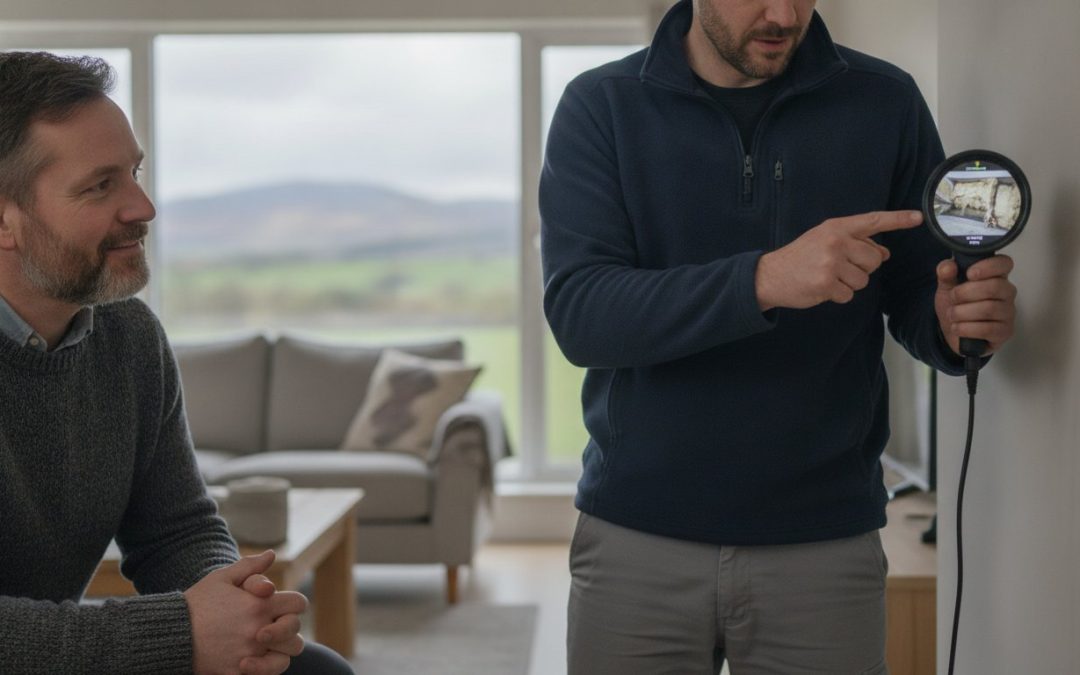
You’ve finally secured a buyer for your property, only for the Home Report to return a Category 3 rating for dampness based on a brief check with a handheld moisture meter. This single finding often triggers an immediate mortgage retention, threatening to collapse your sale and leaving you frustrated by a lack of technical detail. It’s common for general surveyors to flag surface moisture without investigating the underlying cause, such as compromised cavity wall insulation or failing wall ties.
You don’t have to accept these vague findings as final. By challenging a home report’s damp assessment with specialist technical evidence, you can provide lenders with the forensic clarity they need to release funds. This article outlines the exact process for disputing inaccurate assessments through professional cavity inspections and structural reports. You’ll learn how to identify the true source of moisture and secure the definitive proof required to protect your property’s value and ensure your sale proceeds without unnecessary delay.
Key Takeaways
- Understand how a Category 3 damp rating impacts property sales and why these findings often rely on limited, surface-level moisture meter data.
- Learn the professional steps for challenging a home report’s damp assessment Scotland by commissioning forensic evidence that goes beyond the initial Single Survey.
- Identify how defective cavity wall insulation often causes misdiagnosed dampness and why a borescope inspection is vital for locating the true source of moisture.
- Discover the specific technical requirements for a specialist report to satisfy mortgage lenders and overturn a retention on a property sale.
- Recognise how professional remedial actions, such as cavity extraction, provide a permanent solution that restores both structural health and market value.
Understanding the Impact of a Category 3 Damp Rating in Scotland
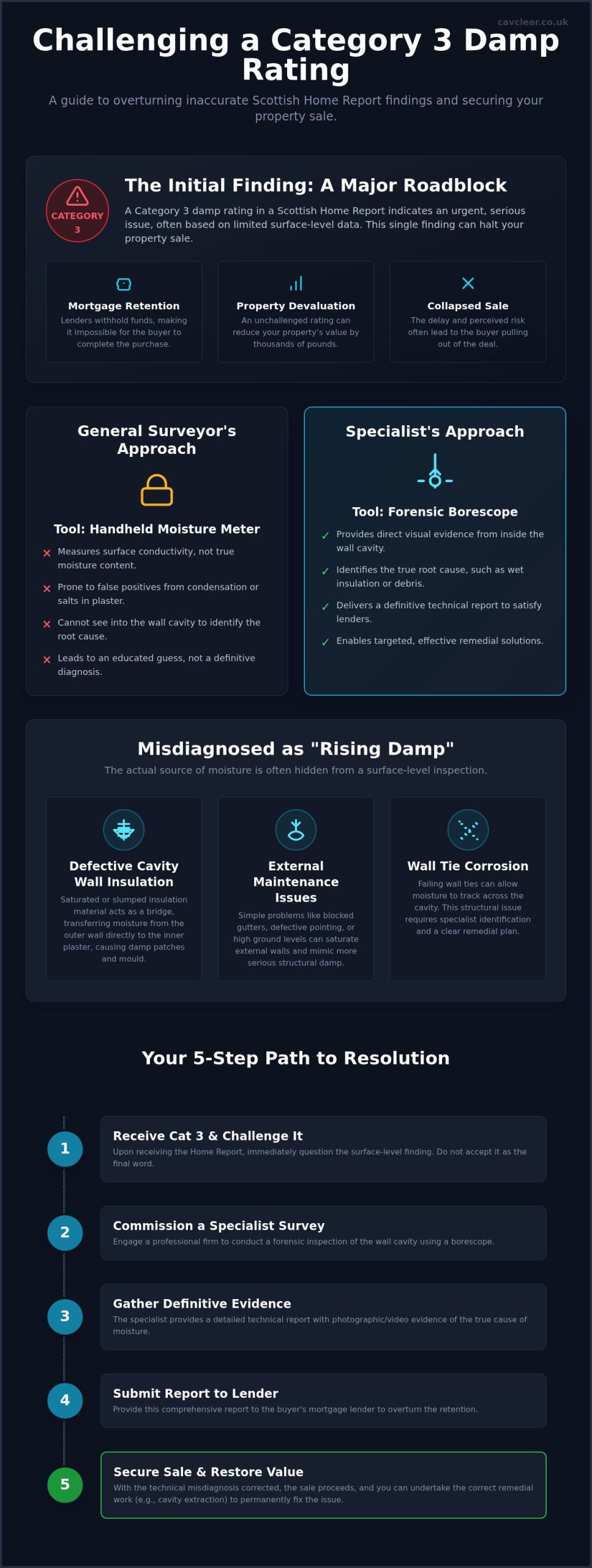
The Scottish Home Report system was designed to provide transparency for buyers, yet its Single Survey component often creates significant hurdles for sellers. Within this survey, a surveyor assigns a numerical rating to various elements of the building to indicate its condition. While Category 1 and 2 ratings are manageable, a Category 3 rating for dampness indicates a serious, urgent issue that requires immediate attention. This classification often triggers a defensive reaction from lenders, who view the property as a high-risk asset until the issue is resolved.
For most lenders, a Category 3 rating is a red flag that typically leads to a mortgage retention. This means the bank withholds a portion of the loan until professional remedial work is completed and verified. This creates a stalemate where the buyer cannot secure the full funds and the seller faces a potential price drop or a collapsed deal. The problem often stems from the tools used during these inspections. Most RICS surveyors rely on basic handheld moisture meters that measure surface conductivity. These devices are prone to false positives caused by surface condensation or high salt content in plaster, leading to a misdiagnosis of rising damp when the issue is actually environmental or related to the wall cavity.
Why General Home Reports Can Be Inaccurate
General surveyors are trained to identify symptoms rather than root causes. When they encounter high readings on a moisture meter, they often recommend further investigation by a specialist without confirming if the moisture is penetrating from the outside or condensing from the inside. This distinction is critical for challenging a home report’s damp assessment Scotland effectively. A standard visual inspection simply doesn’t allow a surveyor to see into the wall cavity to determine if moisture is being bridged by defective insulation or structural debris. Without forensic tools like borescopes, a surveyor’s report remains a series of educated guesses based on surface-level observations.
The Financial Risk of Unchallenged Assessments
Accepting an inaccurate damp rating at face value can be an expensive mistake for any homeowner. An unchallenged Category 3 rating can devalue a property by thousands of pounds as buyers factor in the perceived cost of extensive repairs. Beyond the financial loss, the stress of a sale falling through at the final hour is immense. By challenging a home report’s damp assessment Scotland with technical evidence, you shift the narrative from a property defect to a technical misdiagnosis. This proactive approach protects your equity and provides the reassurance lenders need to proceed with the mortgage application.
Common Reasons for Damp Misdiagnosis in Home Reports
Home Reports in Scotland often provide a surface-level snapshot that fails to identify the technical root of moisture issues. Surveyors frequently mislabel internal condensation or high humidity as rising damp. This common misdiagnosis is a central reason for challenging a home report’s damp assessment Scotland. Several external factors often mimic structural failure:
- Blocked or leaking gutters that saturate the external masonry.
- High ground levels or new patios that bridge the damp-proof course.
- Defective pointing that allows wind-driven rain to penetrate the outer leaf.
When a moisture meter triggers a high reading, the surveyor flags the symptom without investigating the source. This leads to an alarmist rating for a problem that might only require simple maintenance rather than expensive chemical treatments. It’s essential to look beyond the meter reading to understand the environmental context of the building.
The Hidden Culprit: Defective Cavity Wall Insulation
In the harsh Scottish climate, defective cavity wall insulation is a frequent cause of internal dampness. Retrospective insulation often becomes saturated by wind-driven rain, which is a common occurrence in exposed coastal or highland regions. Once wet, the insulation material acts as a moisture bridge. It transfers water from the external brickwork directly to the internal plaster. This process creates “cold spots” where condensation forms, often appearing as dark patches of mould. Understanding what is a cavity wall is essential for homeowners. It helps them see how this space must remain clear to allow for natural drainage and ventilation. If the cavity is blocked, the property cannot “breathe,” leading to persistent environmental dampness.
Wall Tie Corrosion and Moisture Ingress
Structural integrity and moisture protection are linked through the health of wall ties. When these metal components corrode, they expand and cause horizontal cracking in mortar joints. These cracks serve as direct pathways for water ingress. This leads to damp patches that appear unrelated to ground-level issues. A standard survey rarely includes a borescope inspection to check tie condition. Consequently, a homeowner might be told they have penetrating damp when they actually have a structural defect. Identifying these issues early through a specialist wall tie survey ensures the property remains safe and dry. It provides the forensic evidence needed to correct a surveyor’s initial assumptions and provides a clear path toward a permanent fix.
The Process of Challenging a Home Report Damp Assessment
Correcting an inaccurate damp rating requires a methodical approach that prioritises technical evidence over visual assumptions. The Home Report is a legal document, but it represents a single point in time and often lacks the forensic depth needed for a complex moisture diagnosis. If you believe your property has been unfairly penalised, you must follow a structured path to resolution. It’s not enough to simply disagree; you must provide a superior level of data that the original surveyor cannot ignore.
Start by reviewing the Single Survey for vague or “suggestive” language. Surveyors often use phrases like “moisture readings were suggestive of rising damp” or “further investigation is recommended.” These caveats are your entry point for challenging a home report’s damp assessment Scotland. Once you identify these openings, you must commission an independent specialist survey with forensic capabilities. This isn’t a general building survey. It’s a targeted inspection designed to rule out internal moisture bridges and structural defects within the wall cavity itself.
The core steps to overturning a rating include:
- Forensic Inspection: Commission a specialist to use borescopes to view the internal cavity leaf and insulation state.
- Data Collection: Document heat loss patterns and moisture levels at various depths within the masonry.
- Surveyor Engagement: Present the specialist findings to the original RICS surveyor to request a formal rating amendment.
- Lender Submission: Provide the finalised technical report to the mortgage lender to satisfy their retention conditions.
Gathering Forensic Evidence
Specialist surveys provide the high-resolution data that general moisture meters lack. We use borescopes to inspect the health of the wall cavity, allowing us to see exactly where insulation has slumped or where mortar debris has created a bridge for water. Thermal imaging further identifies heat loss patterns caused by wet insulation, providing a visual map of structural performance. This level of technical reporting carries significantly more weight with lenders than a general survey because it replaces suspicion with documented fact.
Communicating with Surveyors and Solicitors
Once you have your specialist evidence, you must formally request a review of the Home Report findings. Your solicitor plays a vital role here, managing the communication during the conveyancing process to ensure the buyer’s lender receives the updated information promptly. A clear, technical remedial plan often suffices to lift a mortgage retention, as it demonstrates that the underlying cause is understood and a permanent fix is available. This professional transparency prevents the sale from stalling and restores confidence in the property’s structural health.
Securing a Specialist Damp and Cavity Survey as Evidence
When you’re challenging a home report’s damp assessment Scotland, the quality of your evidence determines the outcome. Many homeowners make the mistake of requesting “expert” surveys from local contractors. These often result in a simple quote for chemical damp proofing rather than a diagnostic investigation. A professional, technical inspection is a paid service because it involves high-level diagnostic work and forensic equipment. Independent specialists have no vested interest in recommending unnecessary treatments; their goal is to provide a factual, evidence-based report that identifies the true state of the property.
A robust specialist report should move beyond surface readings. You should expect a document that includes high-resolution borescope footage from inside the wall cavity, clear photographic evidence of structural components, and a detailed remedial plan. This level of transparency is essential for challenging a home report’s damp assessment Scotland because it provides the “why” behind the moisture, not just the “where.” Lenders require this level of certainty before they’ll consider lifting a mortgage retention or amending a property’s rating.
To ensure your evidence is irrefutable, you should commission a professional damp survey that specifically targets the wall cavity and structural ties. This diagnostic approach provides the definitive data needed to satisfy both surveyors and solicitors.
Identifying Remedial Requirements
The survey might reveal that the damp is caused by saturated, retrospective insulation. In these cases, insulation extraction is often the only permanent solution to stop moisture bridging across the cavity. If the inspection identifies corroded ties, a planned wall tie replacement will restore structural integrity and prevent further water ingress through mortar cracks. Identifying these specific requirements allows you to present a clear, costed path to resolution, which is far more persuasive to a buyer than a vague Category 3 warning.
Satisfying Mortgage Lender Criteria
Lenders don’t just want to know there’s a problem; they want to know it’s being handled by a competent, nationwide specialist. Your report must demonstrate that the contractor is accredited and follows industry-standard methodologies for structural repairs and insulation extraction. A report from a recognised national firm carries significant weight, providing the long-term assurances that banks require to release funds. By presenting a professional remedial plan, you prove that the property is a sound investment, effectively neutralising the negative impact of the initial Home Report findings.
If you need forensic evidence to protect your property sale, you can book a specialist cavity survey with our accredited technical team today.
Restoring Property Value with Professional Remedial Solutions
Once you’ve identified the technical fault through a specialist survey, the final stage of challenging a home report’s damp assessment Scotland is the implementation of professional remedial work. Addressing the root cause, such as saturated cavity wall insulation or failing wall ties, provides a permanent fix that simple surface treatments cannot match. This technical resolution is what lenders and buyers need to see to move forward with the transaction. By rectifying the fault based on forensic evidence, you replace uncertainty with structural assurance.
A clean, clear wall cavity is essential for the long-term health of any property. When you remove defective insulation, you restore the building’s ability to manage moisture through natural ventilation and drainage. This process doesn’t just fix a damp patch; it protects the structural integrity of the inner leaf and prevents future environmental issues. When the work is complete, you can provide a completion certificate to the original surveyor. This evidence allows them to update the Home Report to a “Category 1” status, reflecting that no immediate repairs are needed. This update is vital for restoring the full market value of your home and ensuring buyer confidence remains high.
The Specialist Approach to Insulation Extraction
Professional cavity extraction is a clean and non-disruptive process that uses specialised vacuum machinery to remove debris and wet material. Unlike DIY attempts or general builder “fixes” that often leave pockets of wet insulation behind, our methodology ensures the cavity is entirely clear. Leaving even small amounts of saturated material can lead to recurring damp issues, which is why a specialist approach is required for a permanent result. Our technicians focus on leaving the site tidy while ensuring the structural “breathing space” of your home is fully restored.
Investing in Your Property’s Future
Viewing remedial work as a vital investment rather than just a repair changes the narrative for potential buyers. It demonstrates that you take property maintenance seriously and have proactively protected the asset’s structural health. A property with a clear cavity and new wall ties is often in a better position than one with unknown internal conditions. Taking these steps ensures your home remains a safe, dry, and efficient environment for years to come. It’s about more than just passing a survey; it’s about the long-term efficiency and comfort of the building.
If you’re ready to secure your property’s future and resolve moisture issues for good, contact CavClear for a specialist survey and expert advice. Our national team provides the technical reports and remedial solutions needed to protect your investment.
Securing Your Property Sale with Specialist Evidence
A Category 3 damp rating doesn’t have to be the end of your property transaction. As we’ve explored, standard surveys often rely on surface-level moisture meters that fail to identify the technical root of the problem. By challenging a home report’s damp assessment Scotland through forensic investigation, you provide the clarity that mortgage lenders and buyers require to proceed with confidence. This process replaces vague assumptions with documented facts, ensuring that your home’s structural integrity is accurately represented.
Our nationwide specialist technicians provide the comprehensive technical reporting needed to satisfy RICS surveyors and lift mortgage retentions. We focus on the long-term health of your property, offering expertise in cavity wall structural integrity and the professional extraction of saturated insulation. Don’t let an inaccurate assessment devalue your asset or stall your move. Taking a proactive, expert-led approach is the most effective way to restore your property’s status and protect your financial investment. You can move forward knowing the true condition of your building is professionally verified.
Book a specialist damp and cavity survey with CavClear today to secure the definitive evidence required for your property sale.
Frequently Asked Questions
Can I challenge a Home Report if I think the damp assessment is wrong?
You can challenge any finding in a Home Report if you have credible, technical evidence to support your position. Home Reports are single-point-in-time assessments that often rely on surface readings. If you provide a specialist report containing borescope footage or thermal imaging, the original surveyor has a professional duty to review this data. This is the primary method for challenging a home report’s damp assessment Scotland and can lead to a formal rating amendment.
What is the difference between a general survey and a specialist damp survey?
A general surveyor typically uses a handheld moisture meter to measure surface conductivity, which can flag condensation or salts as structural damp. A specialist survey uses forensic tools to inspect the wall cavity itself. These inspections identify the root cause, such as defective insulation or corroded wall ties, rather than just recording moisture symptoms. This technical depth provides a more accurate diagnosis of the building’s structural health and environmental performance.
How much does it cost to challenge a damp rating in a Home Report?
The cost depends on the level of forensic investigation required for your property. Professional survey and reporting fees cover the accredited technician’s time and the use of specialist diagnostic equipment like borescopes. While there is an initial cost for a technical report, it’s often significantly lower than the financial loss caused by a mortgage retention or a reduced sale price. Investing in expert evidence protects your equity during the conveyancing process.
Will a mortgage lender accept an independent damp report?
Lenders generally accept independent reports from accredited national specialists who provide a clear diagnosis and a remedial action plan. The report must move beyond surface observations to show the true state of the wall cavity. Providing this level of forensic detail satisfies the lender’s risk assessment and often allows them to lift a mortgage retention. It’s vital that the specialist contractor is recognised for their expertise in structural repairs and insulation extraction.
Why did my Home Report flag damp when I have no visible signs?
Moisture meters often trigger “high” readings due to internal condensation, high humidity, or hygroscopic salts in the plaster rather than structural leaks. Additionally, moisture might be trapped within the cavity by saturated insulation, creating internal cold spots that haven’t yet caused visible mould or staining. A specialist can determine if the reading is a false positive or an early warning of a hidden issue, such as a bridge in the wall cavity.
How long does it take to get a specialist damp and cavity survey?
A specialist on-site inspection usually takes between one and three hours, depending on the property’s size and complexity. Following the site visit, a comprehensive technical report is typically produced within a few working days. This timeframe allows our technicians to analyse borescope footage and moisture data thoroughly. This professional documentation provides the definitive evidence needed to update your Home Report and satisfy lender requirements without causing long delays to your sale.
What happens if the specialist survey confirms there is a damp problem?
If a problem is confirmed, the specialist will provide a detailed remedial action plan to solve the issue permanently. This might include services such as cavity wall insulation removal or wall tie replacement. Having a professional plan in place is often sufficient to satisfy buyers and lenders. It proves the issue is understood and a permanent fix is available, which helps maintain the property’s value and allows the transaction to proceed.
Can a Home Report rating be changed after it has been published?
Surveyors can and do amend ratings when presented with superior technical evidence that contradicts their initial findings. When challenging a home report’s damp assessment Scotland, you submit a specialist report proving the original Category 3 rating was inaccurate or that the cause has been identified and managed. The surveyor then issues a revised Single Survey, which reflects the property’s actual condition and removes the barriers to securing a mortgage.
Recent Comments