

What if the persistent black mould returning to your walls every winter has nothing to do with your daily habits and everything to do with what’s trapped inside your cavity walls? It’s exhausting to scrub damp patches only for them to reappear weeks later, especially when you’re also facing higher heating bills caused by moisture-heavy walls. You shouldn’t have to live with the fear of hidden structural damage or the stress of recurring environmental hazards that threaten your family’s health.
A professional condensation survey identifies the precise source of dampness; it moves beyond surface symptoms to provide a technical roadmap for a permanent solution. By choosing a methodical diagnostic approach, you gain the clarity needed to protect your property’s long term asset health and efficiency. This guide details how expert diagnostics and 2026 legislative standards, such as the Renters’ Rights Act and Phase 2 of Awaab’s Law, ensure your home remains a safe and dry environment. We’ll examine the technical failures often found in older properties and the non-disruptive methodology used by specialist technicians to restore structural integrity.
Key Takeaways
- Discover how a professional condensation survey uses scientific data and environmental monitoring to identify the exact source of moisture rather than just treating surface symptoms.
- Understand the technical diagnostic process that maps humidity levels and temperature variations to pinpoint where structural faults are occurring.
- Learn why defective cavity wall insulation is a frequent hidden cause of cold spots and how its removal can permanently resolve recurring damp issues.
- Gain insights into interpreting a technical report so you can use photographic evidence and moisture readings to secure insurance or plan remedial work.
- Explore why a methodical, nationwide approach to property health is a vital investment in the long term efficiency and structural integrity of your home.
What is a Professional Condensation Survey?
A professional condensation survey is a comprehensive technical assessment designed to uncover the specific reasons why moisture accumulates on your property’s internal surfaces. It moves beyond basic visual inspections by utilizing scientific data and environmental monitoring to identify the root causes of dampness. While a standard building survey might note the presence of mould, a specialist condensation survey diagnoses the technical “why” behind the problem. This process is essential for homeowners who deal with persistent black mould or musty damp odours that reappear despite regular cleaning.
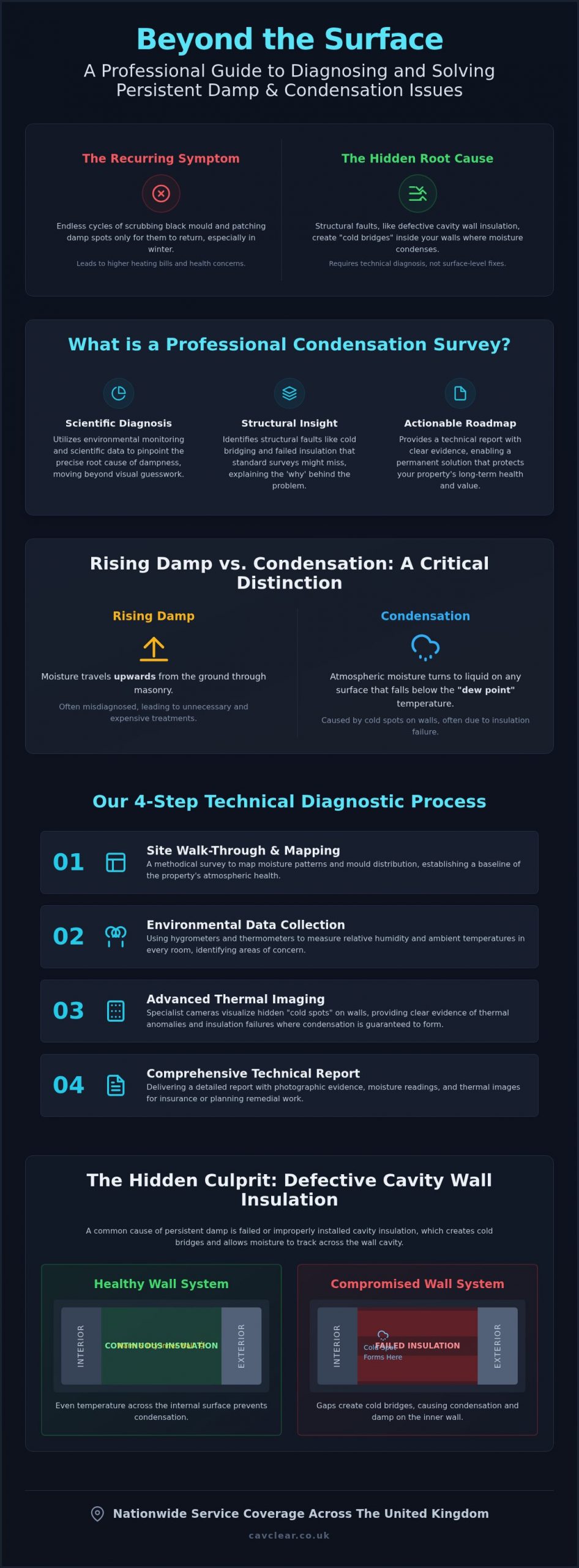
To find a permanent fix, you must understand the physics of your home. What is condensation? Scientific definitions explain it as the process where water vapour in the air transforms into liquid upon contact with a colder surface. In a domestic setting, this often occurs because of “cold bridging,” where specific areas of a wall are significantly colder than the rest of the room. Our technicians use thermal imaging and hygrometers to differentiate between lifestyle-induced humidity, such as cooking or drying clothes, and structural faults like failed insulation that create these cold spots. This methodical approach ensures that the solution provided is tailored to the building’s specific thermal performance.
The Difference Between Damp and Condensation
Confusing condensation with rising damp often leads to expensive and entirely unnecessary treatments. Rising damp travels upwards through masonry from the ground, whereas condensation is an atmospheric issue that targets cold surfaces at any height. A professional assessment calculates the “dew point,” which is the exact temperature where air can no longer hold its water vapour. If your internal walls fall below this temperature, moisture will form regardless of how often you open your windows. Understanding this distinction ensures you invest in structural repairs rather than cosmetic fixes that fail to address the underlying thermal mechanics of the property.
When Should You Book a Specialist Survey?
You should consider booking a specialist survey if you notice warning signs that surface treatments cannot resolve. These include water streaming down windows every morning, mould growth on the back of furniture, or a persistent damp smell that lingers even after airing out a room. The winter months are the most critical time for an accurate assessment because the temperature difference between the inside and outside of your home is at its highest. This makes structural cold spots much easier to detect. We provide nationwide service coverage across the United Kingdom, ensuring that whether you’re purchasing a new property or planning a renovation, you have access to a definitive diagnosis of your home’s environmental health.
The Technical Process: How We Diagnose Moisture Issues
A professional condensation survey begins with a methodical site walk-through to map moisture patterns and mould growth across the property. We don’t simply record where the mould is visible. We analyze the distribution of moisture to understand how the building’s structure interacts with the internal environment. This diagnostic phase involves measuring relative humidity and ambient temperature in every room to establish a baseline for the property’s atmospheric health. By identifying specific areas of concern, we can move from observation to technical measurement with precision.
Advanced Surveying Equipment
We use specialist tools to visualize what the naked eye cannot detect. Thermal imaging cameras allow us to see “cold spots” on walls and ceilings where condensation is guaranteed to form. These images provide clear evidence of thermal anomalies, often caused by gaps in insulation or structural cold bridges. Technical guidance on preventing and solving condensation problems emphasizes that insulation must be continuous to be effective. If a wall surface is significantly colder than the rest of the room, moisture will inevitably settle there.
Electronic moisture meters are used to measure the depth of dampness within masonry, helping us distinguish between surface condensation and deeper structural saturation. We also deploy hygrometers to track how air moisture levels fluctuate throughout the day. These readings tell us if the property’s environment is consistently supportive of mould growth or if issues are tied to specific events like cooking or bathing. If you’re concerned about hidden moisture, a professional inspection will provide the data-driven answers you need.
Environmental Data Collection
Our technicians assess the efficacy of existing ventilation systems, including extractor fans and trickle vents, to ensure they’re removing moisture as intended. We also analyze the property layout and heating consistency. Large furniture placed against external walls or rooms that remain unheated can create stagnant air pockets that trap moisture. Relative humidity measures the moisture content in the air compared to its total capacity at a specific temperature; maintaining this level below 60% is critical for preventing fungal growth.
Where structural issues are suspected inside the walls, we use borescope technology for internal inspections. This allows us to look inside the cavity without causing disruption to the masonry. This step is vital for identifying failed cavity insulation or wall tie corrosion that might be creating cold bridges. This level of technical rigor ensures that your condensation survey results in a permanent remedial action plan rather than a temporary cosmetic fix.
Hidden Causes: Why Your Cavity Walls Might Be the Problem
Many property owners view condensation as a simple ventilation failure. However, a technical condensation survey often reveals that the root cause is hidden deep within the building’s fabric. Understanding what is a cavity wall is vital to solving these issues; these structures were originally designed with an empty air gap to act as a barrier against moisture transfer. When this gap is filled with retrospective insulation, it can create a physical bridge that allows cold and dampness to bypass the property’s natural defenses. This structural failure leads to the persistent internal moisture that many homeowners struggle to fix with standard dehumidifiers.
Retrospective insulation is frequently the primary driver of modern condensation issues in the UK. If the material was installed incorrectly or has since become compromised by water ingress, it no longer provides a thermal barrier. Instead, it holds moisture against the inner leaf of the masonry. This significantly lowers the surface temperature of your internal walls, making condensation inevitable whenever you cook, bathe, or even breathe. Effective management involves Controlling moisture in your home by ensuring the building envelope remains dry and technically functional.
The Danger of Wet Insulation
When cavity insulation becomes saturated, it loses its thermal resistance and begins to act as a conductor. This wet material draws heat away from the internal leaf of the wall through a process called thermal bridging. During a condensation survey, our technicians often find that the “cold spots” where black mould consistently grows are perfectly aligned with gaps or slumped sections of wet insulation. In these cases, surface cleaning is only a temporary measure. A permanent fix requires professional cavity wall insulation removal to restore the wall’s ability to breathe and maintain a consistent internal temperature.
Cold Bridging and Structural Defects
Structural faults such as lintel failure or the accumulation of mortar debris at the base of the cavity also contribute to moisture problems. These defects trap water and create direct paths for dampness to reach the interior, bypassing the cavity’s protective function. Wall tie corrosion is another significant factor that compromises thermal integrity. As ties rust, they expand and can bridge the cavity, leading to localized damp patches that look like standard condensation. We often recommend a wall tie replacement alongside moisture control measures to ensure long term structural stability. Addressing these hidden defects is a vital investment in your property’s future health and energy efficiency.
Interpreting Your Professional Survey Report
A professional report is the definitive outcome of your condensation survey. It provides a structured, technical breakdown of the environmental data collected during the site visit. Unlike generic assessments, this document includes precise moisture readings and atmospheric data that illustrate exactly how your property is performing. It serves as a transparent record of the technical faults identified, ensuring you have the evidence required to make informed decisions about your home’s future.
The core of the report consists of photographic evidence. We include thermal imaging captures that highlight specific cold bridges where condensation is occurring. If structural faults like slumped insulation or wall tie corrosion were found during the borescope inspection, these are documented with clear internal imagery. This level of detail is vital for property owners who need to prove the necessity of remedial work to insurers or to satisfy structural requirements during a property transaction.
The Remedial Action Plan
A critical component of the report is the remedial action plan. This section differentiates between lifestyle advice, such as improving ventilation habits, and essential structural fixes. While minor adjustments can help, the report often prioritizes technical interventions like cavity extraction or wall tie replacement. This prioritized list allows you to address the most severe issues first, ensuring your budget is spent where it will have the greatest impact. Because our reports are prepared to high technical standards, they serve as reliable documents for planning long term property maintenance and energy efficiency.
The document also includes detailed estimates for any necessary specialist contracting fees. This transparency ensures there are no hidden costs when moving forward with the recommended repairs. If you’re ready to secure a definitive diagnosis for your property, you can book a professional survey with our specialist team today.
Long-Term Property Health
Addressing the findings in your report is a vital investment in your property’s future. Ignoring persistent moisture issues can lead to secondary damage, such as wet rot or significant structural decay in timber elements. By implementing permanent solutions, you protect the long term asset health and efficiency of your home.
A clean, dry property also maintains its market value for future resale. Prospective buyers and surveyors look for evidence that dampness has been professionally diagnosed and rectified rather than just covered up. Beyond financial considerations, the primary goal is ensuring the comfort and safety of all occupants. A permanent fix removes the health risks associated with mould spores and creates a more stable living environment. Our nationwide service coverage ensures that property owners across the United Kingdom can access this level of professional expertise and long term assurance.
Why Choose Cav Clear for Your Nationwide Survey?
Choosing a specialist for your property diagnostics is a vital investment in your home’s future. Cav Clear provides a level of technical rigor that general building contractors often cannot match. Our nationwide service coverage across the entire United Kingdom ensures that every property owner has access to specialist accredited technicians. We prioritize a methodical and educational approach that puts the homeowner first, explaining the science behind moisture accumulation rather than just pointing out the symptoms. This transparency allows you to make informed decisions about structural repairs and long-term asset health.
Our expertise focuses on complex cavity wall and structural moisture issues that are frequently misdiagnosed. We understand that recurring damp is often a symptom of underlying technical faults. By using a clean and non-disruptive methodology, we identify these issues without causing unnecessary stress or damage to your masonry. A professional condensation survey from our team provides the long-term assurances you need to restore comfort and efficiency to your living environment.
Expertise You Can Trust
We take pride in rectifying the poor workmanship of others. Many properties suffer from persistent dampness because of incorrectly installed materials or failed structural components that were never properly addressed. Our technicians are specifically trained to identify these failures. We maintain a firm stance against the installation of retrospective cavity wall insulation, as this practice is a leading cause of moisture bridging and wall tie corrosion in UK homes. Instead, we focus on identifying and removing these hazards to restore your property’s natural thermal performance.
Using accredited technicians is essential for a valid technical property inspection. Our surveyors use calibrated equipment to ensure every reading is accurate and reliable. This precision is what allows us to provide a clear roadmap for remedial action that actually works. We don’t offer temporary cover-ups; we provide permanent solutions based on structural integrity and proven methodology.
Taking the Next Step
The process for booking your condensation survey is straightforward and designed to be low-pressure. Once you contact our team, we arrange a visit that fits your schedule. When our surveyors arrive at your property, they conduct a thorough, room-by-room assessment using the advanced equipment discussed in previous sections. They respect your home, ensuring the diagnostic process is as non-intrusive as possible while still gathering the deep technical data required for a definitive report.
After the on-site assessment, you receive a comprehensive technical report detailing every finding and recommendation. This document serves as your guide to restoring a healthy, dry environment. You can protect your property with a professional survey from Cav Clear and take the first step toward a permanent fix for your home’s moisture problems.
Restore Your Home’s Structural Integrity
Persistent moisture and recurring black mould are technical symptoms of a building that isn’t performing correctly. A professional condensation survey provides the scientific data needed to identify hidden cold bridges and failed cavity insulation that surface cleaning simply cannot fix. By utilizing advanced diagnostics, you can implement a permanent remedial action plan that protects your property’s long-term asset health and efficiency.
Cav Clear offers specialist expertise in structural moisture removal with nationwide UK coverage. Our accredited technicians deliver detailed technical reporting that serves as a vital investment in your home’s future, ensuring comfort and safety for all occupants. We focus on rectifying technical faults with a clean and non-disruptive methodology, providing the professional rigor required for lasting results. Don’t let hidden moisture compromise your living environment any longer.
Book your professional condensation survey with Cav Clear today and take the first step toward a dry, healthy property.
Frequently Asked Questions
What is the main purpose of a condensation survey?
The primary objective of a condensation survey is to diagnose the underlying technical reasons for moisture accumulation on internal surfaces. It moves beyond simple visual checks to analyze the building’s thermal performance and environmental conditions. By identifying exactly why dampness occurs, we can recommend a permanent solution that restores your property’s health and efficiency while preventing the return of hazardous mould growth.
How long does a professional moisture inspection usually take?
A professional moisture inspection typically takes between one and three hours to complete, depending on the property’s size and complexity. Our technicians conduct a methodical room-by-room assessment to ensure no technical fault is overlooked. This timeframe allows for detailed environmental monitoring, surface temperature testing, and internal wall inspections using borescope technology where structural issues are suspected inside the cavity.
Will I need to leave my home during the survey process?
You don’t need to leave your home during the survey process because our methodology is clean and non-disruptive. Our surveyors work systematically through each room, and you’re welcome to stay and ask questions about the technical findings. We aim to provide a low-pressure experience that minimizes any impact on your daily routine while we gather the necessary data.
Can a survey distinguish between condensation and rising damp?
A specialist survey can definitively distinguish between condensation and rising damp by analyzing moisture patterns and wall temperatures. Condensation is an atmospheric issue that targets cold spots at any height, whereas rising damp specifically travels from the ground up through masonry. We use moisture meters and thermal imaging to verify the exact source of dampness and prevent unnecessary treatments.
What kind of equipment do your surveyors use to find mould?
Our surveyors use specialist equipment like thermal imaging cameras to visualize cold bridging and electronic moisture meters to measure masonry saturation. We also deploy hygrometers to track relative humidity and borescopes to inspect the internal condition of cavity walls. This technical approach ensures we find the structural causes of mould that are often invisible to the naked eye during a standard inspection.
Is condensation always caused by the way I live in the house?
Condensation is not always caused by lifestyle habits; it’s frequently the result of structural failures like defective cavity wall insulation. While activities like cooking contribute to humidity, a healthy building should manage this moisture effectively. If your walls have cold spots due to insulation gaps or thermal bridges, condensation will occur regardless of how you live in the property.
What happens if the survey finds a structural issue like failed insulation?
If the survey identifies a structural issue such as failed insulation or wall tie corrosion, we provide a detailed remedial action plan. We specialize in the removal of defective cavity wall insulation and wall tie replacement to restore the property’s thermal integrity. These technical solutions address the root cause of the problem to provide a permanent fix for your home.
Do I get a formal written report after the survey is completed?
You’ll receive a comprehensive formal written report after the condensation survey is finalized and the data is analyzed. This technical document includes moisture readings, photographic evidence of cold bridges, and a prioritized list of remedial recommendations. It serves as a reliable record for property maintenance, insurance purposes, or future resale requirements, ensuring you have a clear roadmap for your property’s health.
Recent Comments