
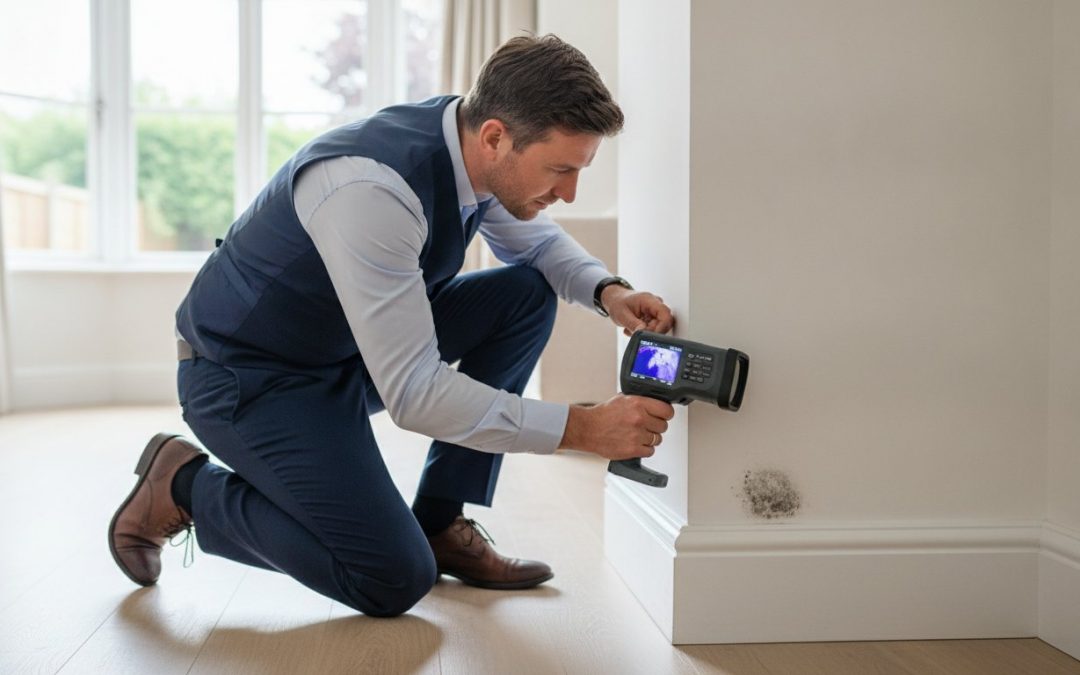
What if the recurring black mould on your walls isn’t a result of your lifestyle, but a symptom of a hidden structural failure? You’ve likely spent significant sums on specialist cleaners and followed conflicting advice from general builders, yet the damp patches always return. It’s a stressful cycle that puts your family’s health at risk, especially since toxic mould is linked to over 1,200 deaths in the UK every year. Engaging a professional black mould investigation service is the only way to stop the guesswork and address the moisture at its technical source.
We understand that a dry, safe home is a non-negotiable priority for any property owner. This guide explains how a technical assessment identifies specific faults, such as saturated cavity wall insulation or wall tie corrosion, which often bypass general inspections. You’ll learn how a definitive diagnosis leads to a long-term remedial plan, moving beyond surface-level cleaning to ensure the permanent restoration of your property’s structural integrity. We’ll outline the methodical process of moving from observation to a professional remedy, providing the clarity you need to protect your asset’s future health and efficiency.
Key Takeaways
- Understand why surface-level cleaning fails and how a forensic diagnostic process distinguishes between simple condensation and serious structural water ingress.
- Identify how saturated cavity wall insulation acts as a moisture bridge, creating cold spots that facilitate persistent mould growth deep within your property’s structure.
- Discover why a professional black mould investigation service is superior to DIY testing, using technical moisture mapping to identify the precise source of dampness.
- Learn what to expect during a non-invasive technical inspection, including a methodical analysis of both internal and external wall conditions to find the root cause.
- Gain a clear roadmap for permanent restoration, positioning cavity wall insulation extraction as a vital investment in your property’s long-term health and safety.
Why Surface Cleaning Fails: The Necessity of a Black Mould Investigation Service
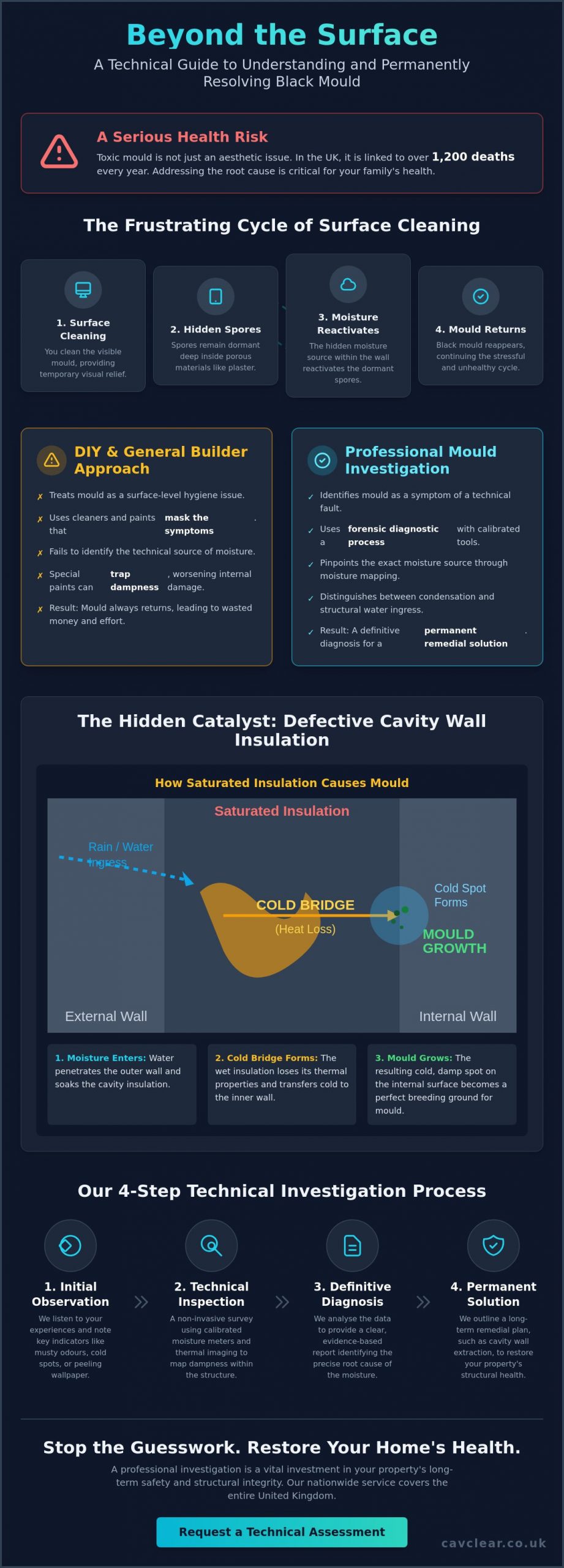
Many property owners mistakenly treat mould as a hygiene issue rather than a technical fault. While scrubbing walls with bleach provides temporary relief, it doesn’t address the environmental conditions that allow fungi to thrive. A professional black mould investigation service moves beyond visual inspections. It functions as a forensic diagnostic process, using calibrated equipment to identify why moisture is present in the first place. This methodical approach ensures that we don’t just treat the symptom, but rectify the underlying cause.
Understanding the distinction between atmospheric condensation and structural ingress is vital. Condensation typically occurs when warm, moist air meets cold internal surfaces. Structural ingress happens when water penetrates the building fabric from the outside, often due to defective masonry or saturated cavity insulation. If you only clean the surface, you leave the “hidden damp” trapped within the walls. This moisture continues to degrade your property’s structural integrity while you remain unaware of the scale of the problem. A professional assessment provides the clarity needed to distinguish between these two very different issues.
Relying on mould-resistant paints often complicates the issue. These products create a non-porous film that masks dangerous underlying faults. While the wall might look clean for a few months, the moisture remains trapped behind the paint layer. This creates a perfect breeding ground for Stachybotrys chartarum (black mold), which can proliferate in the dark, damp voids of your home’s structure without being detected. By the time the mould breaks through the paint, the internal damage is often extensive.
The Cycle of Recurring Mould
Mould spores are remarkably resilient. They often remain dormant deep within porous masonry or plasterwork even after you’ve applied surface treatments. When temperatures fluctuate, these hidden moisture reservoirs reactivate. This cycle leads to the frustrating reappearance of black spots just weeks after an expensive cleaning. For many homeowners, this constant failure of DIY remedies creates significant psychological stress. It’s a exhausting pattern that only stops once the moisture source is permanently removed from the building fabric.
When to Move Beyond DIY Solutions
You should consider a professional survey when you notice persistent indicators of moisture. These include musty odours in rooms with no visible growth or wallpaper that feels damp or cold to the touch. These signs often point to issues within structural voids like wall cavities. Ignoring these symptoms allows moisture to sit against wall ties and timber frames, leading to long-term asset damage. For a detailed breakdown of what a technical assessment involves, you can consult our Professional Damp Survey Guide. Identifying the root cause early is a vital investment in the future health and safety of your property.
Identifying the Structural Catalysts: Defective Insulation and Cavity Issues
While Section 1 established the importance of forensic diagnostics, we must now look at the specific technical failures occurring within the wall itself. A common misconception exists that all insulation is beneficial for property health. In reality, defective or inappropriately installed material is frequently the primary driver of persistent dampness. When a black mould investigation service assesses a property, we often find that the cavity, which was designed to be a protective air gap, has been compromised by materials that facilitate moisture transfer rather than preventing it.
Saturated insulation creates a condition known as cold bridging. When the material within the cavity becomes wet, it loses its thermal properties and begins to conduct cold temperatures from the external leaf directly to the internal wall. This causes the internal surface temperature to drop significantly, often falling below the dew point. This temperature drop triggers localized condensation, creating the perfect environment for fungal spores to colonise. As highlighted in this EPA guide to mold and moisture, controlling these internal moisture levels is the only way to prevent growth. Without addressing the thermal bridge, surface treatments will always fail.
The Danger of Saturated Cavity Insulation
When insulation material slumps or becomes wet due to penetrating damp, it prevents the cavity from ‘breathing’. This creates a wicking effect, where moisture is drawn across the cavity from the outer masonry to the inner leaf. Instead of rainwater evaporating naturally through the cavity’s airflow, it remains trapped against the internal structure. Over time, this leads to the degradation of plaster and the emergence of black mould. In these instances, the only viable solution is a professional Cavity Wall Insulation Removal to restore the wall’s original protective function.
Wall Tie Failure and Moisture Ingress
Structural instability often goes hand in hand with moisture issues. When steel wall ties are exposed to moisture within a damp cavity, they begin to rust and expand. This expansion exerts significant pressure on the surrounding masonry, leading to horizontal cracking in the mortar joints. These cracks provide a direct path for rainwater to enter the building fabric, resulting in localised mould patches that align with the position of the failing ties. Our nationwide team performs detailed cavity wall surveys to identify these faults before they escalate into major structural repairs. Wall tie surveys identify hidden corrosion by using borescopes to visually inspect the condition of the metal within the cavity before structural failure occurs.
Professional Mould Surveys vs. DIY Testing: Evaluating the Evidence
Many property owners begin their search for a resolution by purchasing “petri dish” DIY kits from high street retailers. These kits often provide a false sense of progress without offering a technical resolution. A professional black mould investigation service differs fundamentally because it focuses on multi-point moisture mapping rather than simple presence detection. While a home test might confirm that mould is present, it cannot identify the structural fault allowing moisture to accumulate within the building fabric.
Air sampling alone is frequently insufficient for identifying structural damp. Spores are naturally present in every UK home, meaning a positive result from a basic air test provides no actionable data. It doesn’t explain why the spores are colonising a specific corner of a room or whether the moisture is originating from a saturated cavity. According to the EPA guidance on mould and moisture control, the only way to stop fungal growth is to control the moisture source. A professional investigation uses calibrated equipment to find that source, moving beyond the limitations of simple air quality checks.
The Limits of Home Testing Kits
The primary issue with DIY kits is their lack of context. They tell you what is in the air but not why it’s there. Furthermore, we often see homeowners misled by “expert surveys” offered by companies that primarily install insulation. These are frequently sales pitches rather than objective structural assessments. An independent investigation provides an unbiased report that identifies the actual fault, whether it’s a cold bridge or a failing wall tie, without the conflict of interest inherent in companies looking to sell you new products.
Technical Standards in Professional Reporting
A comprehensive professional report serves as a vital technical roadmap for your property’s future. It must include precise moisture readings from deep within the masonry and thermal imagery that highlights specific cold bridges. This level of detail is essential when dealing with insurers or providing evidence during a property sale. It’s a formal document that proves you’ve taken the correct steps to protect the building’s structural integrity. By choosing the right dampness specialists, you ensure your survey is conducted by technicians with professional indemnity insurance. This protection is a vital investment in your property’s long-term health and efficiency, providing the assurances needed for a permanent fix.
What to Expect During a Technical Mould Inspection
A professional black mould investigation service identifies the specific technical triggers for moisture ingress through a methodical, multi-stage assessment. We don’t rely on visual assumptions. Instead, our technicians use a suite of calibrated instruments to build a comprehensive picture of your property’s environmental health. This process is entirely non-invasive, meaning we can identify faults within the wall cavity or sub-floor voids without damaging your decor or structural masonry. We operate across the entire United Kingdom, providing property owners with the technical clarity needed to resolve persistent dampness.
We begin by evaluating the relationship between the internal atmosphere and the external building envelope. This holistic approach is essential because mould often thrives in specific micro-climates created by structural defects. By mapping moisture concentrations across different surfaces, we can pinpoint the highest point of saturation. This data allows us to distinguish between lifestyle-related condensation and serious structural failures, such as saturated insulation or compromised damp proof courses. Our goal is to provide a definitive diagnosis that leads to a permanent solution for your property.
Advanced Diagnostic Tools
Our technicians use specialized equipment to verify what lies beneath the surface. Borescope inspections allow us to view the interior of the wall cavity through existing mortar joints. This is vital for checking if insulation has slumped or if wall ties are showing signs of corrosion. Thermal imaging cameras identify cold spots and thermal bridges, which are often invisible to the naked eye but serve as catalysts for fungal growth. Electronic moisture meters then provide a quantitative damp profile of the masonry, ensuring we understand the depth of the moisture penetration.
The Step-by-Step Inspection Process
- Step 1: External Visual Assessment. We inspect the brickwork, guttering, and damp proof course (DPC) to identify paths for rainwater ingress.
- Step 2: Internal Moisture Mapping. We use salt analysis and moisture meters to determine if the dampness is originating from within the wall or the room.
- Step 3: Cavity and Void Inspection. Using high-resolution optics, we examine the sub-floor and cavity voids to check for debris or defective materials.
- Step 4: Atmospheric Monitoring. We measure relative humidity and dew points to confirm or rule out condensation as a contributing factor.
This systematic approach ensures that every potential moisture source is accounted for. If you suspect your property has hidden damp issues, our nationwide team can provide a definitive diagnosis. Book a comprehensive cavity wall survey today to secure the long-term health and structural integrity of your home.
Restoring Property Health: Long-Term Remedial Solutions
The technical data gathered during a black mould investigation service serves as the essential roadmap for property restoration. Without this forensic evidence, any remedial work remains speculative and often fails to address the underlying cause. By identifying the exact moisture source, we can transition from observation to the physical rectification of structural faults. This methodical progression ensures that the investment you make in your property results in a permanent, dry living environment rather than another temporary patch. We provide these technical solutions across the United Kingdom, ensuring that every property owner has access to expert structural care.
Restoring the original design function of the wall cavity is often the most effective way to eliminate recurring mould. Cavities were engineered to provide a protective air buffer between the external environment and your home’s interior. When this space is occupied by saturated or slumped insulation, that thermal barrier is compromised. Extraction of these defective materials is a primary remedy for many damp-affected homes. It removes the moisture reservoir and allows the masonry to dry naturally, which fundamentally prevents future fungal colonisation. This process restores the building’s structural integrity while protecting your family’s health.
The Remediation Action Plan
A successful remediation plan moves quickly from diagnosis to the physical extraction of defective materials. Once we identify that insulation is saturated, our technicians use specialized equipment to clear the cavity void completely. This restoration of the air gap is vital because it allows for proper thermoregulation of the internal leaf. When the wall can breathe, internal surface temperatures rise above the dew point, effectively stopping condensation before it starts. For more detailed advice on maintaining a healthy indoor environment, you can consult the UK Homeowner’s Guide to Black Mould. Our methodology focuses on removing the cause, not just hiding the effect.
Securing Your Property’s Future
Long-term dryness often requires specific structural repairs, such as wall tie replacement. Rusted ties don’t just threaten the stability of your walls; they create pathways for moisture ingress that fuel mould growth. By replacing these components alongside cavity cleaning, we ensure the building remains resilient against the UK’s wet climate. We take pride in our clean and non-disruptive methodology, which is essential for occupied homes. Our technicians work with professional rigor to ensure your property is left tidy and safe. Taking proactive steps now is a vital investment in your property’s future asset health and efficiency. Contact CavClear for a nationwide structural investigation to begin your journey toward a permanently dry and healthy home.
Securing a Mould-no-obligation Future for Your Property
Recurring mould isn’t a problem you can scrub away; it’s a signal of a structural failure that requires technical intervention. We’ve explored how saturated cavity insulation and corroded wall ties act as moisture bridges, creating the cold spots where fungi thrive. Relying on a professional black mould investigation service is the only way to move from temporary fixes to a permanent resolution. Our accredited nationwide technicians use advanced diagnostic tools to provide the definitive evidence needed to protect your property’s long-term health and structural integrity.
You’ll receive a detailed technical report that outlines exactly where moisture is entering and the precise steps required for restoration. Whether your home requires cavity wall insulation extraction or wall tie replacement, our methodology is designed to be clean and non-disruptive. This approach ensures your property’s asset health is restored without compromising your comfort. It’s time to stop the cycle of recurring dampness and invest in a dry, safe environment for your family. Book a Specialist Structural Investigation with CavClear today to take the first step toward a healthier home. We are ready to help you restore your property to its optimal condition.
Frequently Asked Questions
Is a professional black mould investigation different from a damp survey?
Yes, these assessments differ significantly in their technical focus. While a standard damp survey often looks for rising damp or plumbing leaks, a black mould investigation service analyzes the specific environmental and structural conditions that allow fungi to colonize. It uses specialized tools like thermal imaging and borescope optics to identify hidden triggers, such as cold bridging or saturated insulation, that a general survey might overlook.
How long does a mould investigation take to complete?
A technical investigation typically takes between two and four hours to perform. The exact duration depends on the property’s size and the complexity of the moisture issues present. Our technicians require this time to conduct thorough moisture mapping, atmospheric monitoring, and cavity void inspections to ensure every potential structural fault is identified and documented in the final report.
Can defective cavity wall insulation really cause black mould?
Defective cavity wall insulation is one of the most common structural causes of persistent mould growth. When insulation material becomes saturated or slumps within the wall, it acts as a moisture bridge between the external and internal leaves. This creates localized cold spots on your internal walls where condensation consistently forms, providing the damp environment necessary for spores to thrive.
Do I need to leave my property during the mould investigation?
No, you don’t need to vacate your home while the survey is conducted. The investigation process is entirely non-invasive and clean. Technicians use electronic sensors and high-resolution optical equipment that requires no major structural work or drilling. You can continue your daily routine safely while we gather the technical data needed to diagnose the moisture source.
What are the most common structural causes of mould in UK homes?
The most frequent structural drivers include saturated cavity insulation, corroded wall ties, and compromised damp proof courses. Blocked air bricks and defective rainwater goods also play a significant role by allowing moisture to penetrate the masonry. These faults create a damp environment within the building fabric that surface cleaning cannot resolve, making a professional black mould investigation service essential for a permanent fix.
Will the investigation report be accepted by my insurance company?
Yes, our professional reports serve as formal technical evidence for insurance providers. We provide a detailed analysis of structural faults and moisture levels supported by data from calibrated diagnostic tools. This level of professional reporting is vital for demonstrating that the dampness is a result of a specific technical failure rather than a lack of maintenance or tenant lifestyle choices.
Why is my mould only appearing on external-facing walls?
Mould appears on external walls because they are the primary barrier between your home’s interior and the outside elements. These walls are more susceptible to penetrating damp and thermal bridging. If the cavity is compromised by debris or wet insulation, the wall loses its ability to retain heat, leading to cold internal surfaces where moisture from the air consistently condenses into liquid water.
Can I just paint over black mould once it has been investigated?
You shouldn’t paint over mould until the underlying structural fault is permanently rectified. Applying paint, even specialized “anti-mould” products, merely masks the symptom while the moisture continues to degrade the masonry underneath. Once the technical investigation identifies the moisture source and the fault is repaired, the area must be professionally cleaned and fully dried before any redecoration begins.
Recent Comments