

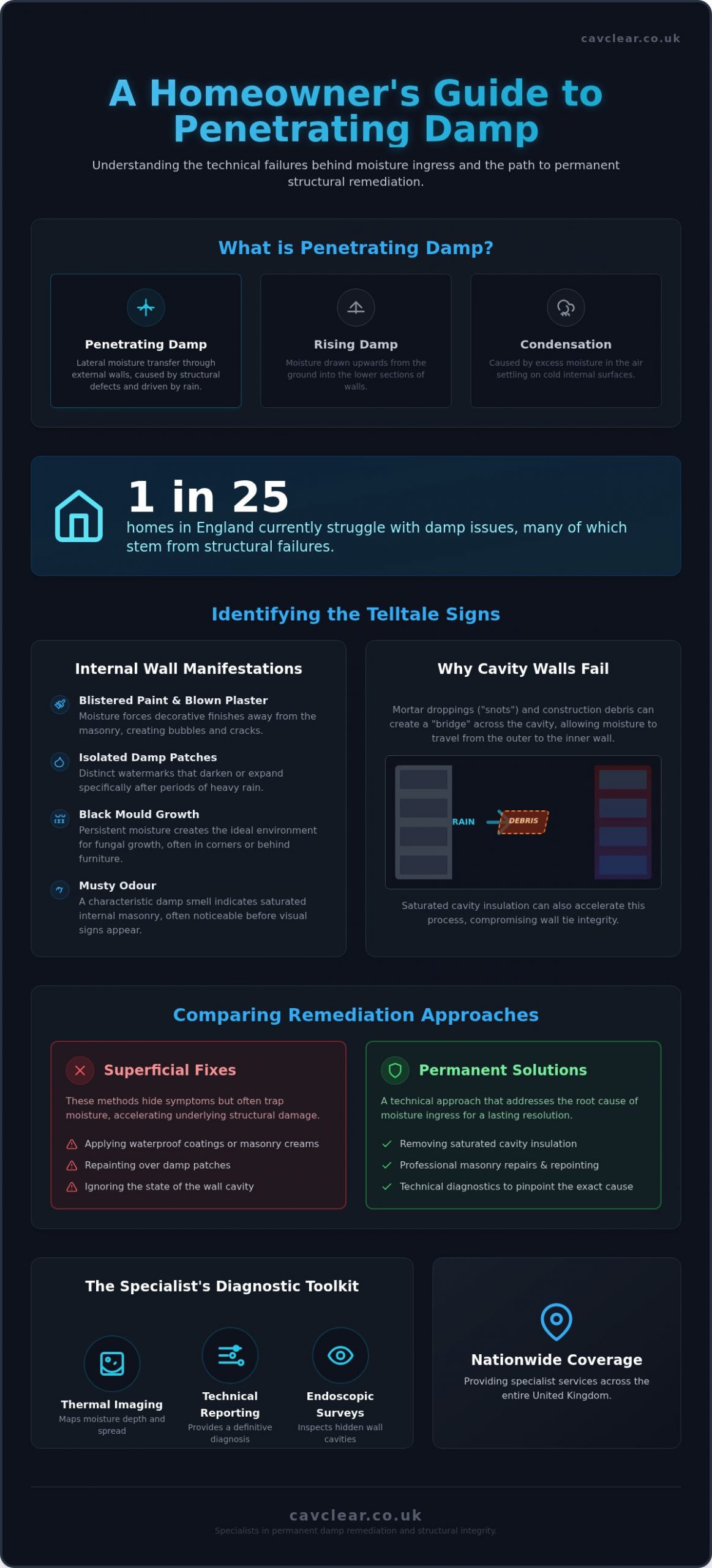
Applying a waterproof coating to a damp wall is often like painting over a crack in a foundation; it hides the symptom while the underlying structural damage continues to accelerate. If you’ve spent hundreds of pounds on masonry creams only to see dark patches return after the first autumn storm, you aren’t alone. Approximately 1 in 25 homes in England currently struggle with damp issues, and for many, the problem isn’t just on the surface. When you hire a penetrating damp specialist, you’re moving beyond temporary fixes and looking for a definitive resolution to moisture ingress.
We understand the stress of dealing with saturated cavity insulation and the genuine concern that your wall ties may be failing due to prolonged exposure to moisture. It’s exhausting to throw money at quick fixes that don’t address the core issue. This guide will show you how a technical approach to structural remediation can permanently eradicate dampness and restore your property’s integrity. We’ll explore the necessity of professional cavity wall surveys, the impact of Awaab’s Law on property standards, and how detailed technical reporting provides the peace of mind that your home is finally secure and dry.
Key Takeaways
- Understand that penetrating damp is a technical fault involving lateral moisture transfer, often exacerbated by the UK’s specific environmental conditions and ageing masonry.
- Learn to identify critical visual indicators such as blistered paint and watermarks that darken during heavy rain, signaling a breach in the building’s external envelope.
- Recognize why a penetrating damp specialist uses advanced diagnostic tools like thermal imaging to map moisture depth and prevent the high costs of misdiagnosis.
- Discover the structural necessity of removing saturated cavity insulation to protect wall tie integrity and prevent recurring internal dampness.
- Focus on permanent remediation strategies, such as professional masonry repairs and cavity extraction, rather than relying on superficial and ineffective external coatings.
What is Penetrating Damp and How Does it Affect UK Properties?
Penetrating damp is a specific technical fault involving lateral moisture transfer through the external building envelope. Unlike rising damp, which originates from ground-level moisture, or condensation, which is caused by internal humidity, this issue results from external structural failures. Understanding What is Penetrating Damp is essential for property owners across the UK, where wind-driven rain and ageing masonry often create the perfect conditions for water ingress. Many older properties lack modern barriers, making them particularly susceptible to environmental saturation during the winter months.
Standard building maintenance often fails to address deep-seated moisture because it focuses solely on surface symptoms. Applying external coatings or basic repointing without addressing the internal cavity state is a common mistake. If moisture is already trapped behind the facade, these surface treatments can actually worsen the problem by sealing moisture inside. A penetrating damp specialist evaluates the entire wall structure, including the hidden cavity, to ensure that remediation addresses the actual root cause rather than just the visual evidence.
The Mechanics of Lateral Moisture Transfer
Water ingress follows the path of least resistance through cracks in render or porous brickwork. During heavy storms, wind pressure forces moisture into these structural defects. Penetrating damp is moisture that moves horizontally through walls rather than vertically from the ground. Once the external leaf is saturated, the water seeks a bridge to the internal masonry. This process isn’t always immediate; it often involves a slow accumulation of moisture that eventually causes “blown” plaster and significant decorative damage inside the home.
Why Cavity Walls Are Not Immune
A common misconception is that a cavity wall acts as a permanent moisture barrier. While you may understand what is a cavity wall and its design intent, structural failures frequently bridge this gap. Debris at the base of the cavity or “snots,” which are excess mortar deposits dropped during construction, create physical bridges between the external and internal leaves. When these bridges exist, moisture travels across the cavity and saturates the internal wall leaf. This transfer is often accelerated if the cavity contains defective or saturated materials. A penetrating damp specialist identifies these bridges through endoscopic surveys to facilitate a permanent structural fix.
Identifying the Signs of Penetrating Damp
Recognising the early indicators of moisture ingress is vital for maintaining the structural integrity of your property. Unlike condensation, which often presents as a light mist on windows or uniform dampness on cold surfaces, penetrating damp manifests as distinct, isolated patches. These patches typically darken or expand specifically after periods of heavy rain. If you notice a watermark that seems to “breathe” with the weather, it’s a clear signal that the building’s external envelope has been breached. A penetrating damp specialist interprets these visual cues to determine exactly where the external leaf is failing.
Ignoring these symptoms leads to secondary damage that is both costly and hazardous. Persistent moisture within the masonry often results in the emergence of black mould in affected areas. This isn’t just an aesthetic issue; it indicates a deep-seated saturation that standard cleaning cannot resolve. When the internal masonry remains wet, it creates an environment where fungal growth thrives, often hidden behind furniture or within the wall structure itself.
Internal Wall Manifestations
On internal surfaces, look for blistered paint and “blown” plaster. This occurs when moisture forces the decorative finish away from the masonry. These patches often appear near windows, doors, or roofline defects where the structural seal is most vulnerable. You might also notice a characteristic musty odour. This scent is a reliable indicator of saturated internal masonry and often precedes the visible appearance of watermarks. If these signs are present, arranging a professional wall tie survey can help determine if the moisture is compromising your property’s structural stability.
External Structural Red Flags
The external facade often reveals the root cause before internal damage becomes severe. Look for efflorescence, which appears as white, powdery salt deposits left behind as moisture evaporates from the brickwork. Saturated bricks that appear darker than the surrounding masonry, combined with moss or algae growth, suggest that the wall is no longer shedding water effectively. Check for cracked or hollow-sounding render, as these defects trap water against the brickwork rather than diverting it. Additionally, failing rainwater goods, such as blocked gutters or leaking downpipes, often cause localized saturation. A penetrating damp specialist will examine these external red flags to map the path of water ingress and recommend a precise remediation strategy.
The Specialist Survey: A Technical Diagnostic Process
A general building inspection often identifies the symptoms of damp but fails to isolate the specific structural breach causing it. Relying on a standard valuation report can lead to expensive misdiagnosis, as these inspections lack the specialized equipment required to map moisture depth. A professional damp survey is the only way to avoid these errors. By engaging a penetrating damp specialist, you ensure that the diagnostic process moves beyond visual observation into technical verification.
Specialists utilize endoscopic cameras to perform non-disruptive inspections of the wall cavity. These tools allow us to identify “snots,” debris, or saturated insulation that bridges the gap between masonry leaves. This level of detail is essential for properties across the United Kingdom, where wind-driven rain can turn a small external crack into a major internal saturation point if the cavity health is compromised. It’s a proactive step that protects the long-term structural integrity of the asset.
Mapping Moisture with Precision
Precision is critical when distinguishing between surface-level condensation and deep-seated structural damp. Thermal imaging cameras allow technicians to identify cold bridges and hidden moisture pockets that are invisible to the naked eye. These devices map temperature differentials on the wall surface, highlighting areas where moisture has compromised the thermal performance of the masonry. Technicians use deep-probe moisture meters to assess the core of the wall. This data ensures that remedial recommendations are based on the actual moisture content within the structure rather than just surface readings.
Structural Reporting and Remedial Planning
A professional technical report serves as a vital investment in your property’s future. It provides a clear, evidence-based roadmap for restoration that’s often required by insurers and mortgage lenders. The report moves the process from observation to remedial action, detailing exactly which external defects require repair and whether the internal cavity must be cleared. In many cases, prolonged moisture exposure leads to the degradation of structural fixings. A penetrating damp specialist will evaluate the condition of these components, often recommending wall tie replacement as part of a comprehensive remediation strategy. This integrated approach ensures the building remains both dry and structurally stable for years to come.
Remedial Solutions for Penetrating Damp
Effective remediation requires a dual approach that addresses both the external breach and the internal cavity condition. Many property owners mistakenly believe that applying a masonry cream or repointing a few bricks will solve the problem. However, a penetrating damp specialist understands that if the cavity is compromised, surface treatments are insufficient. Addressing external defects like cracked render and failing rainwater goods is essential, but these actions must be combined with structural drying and reinforcement to ensure a permanent fix. Standard building maintenance often misses the hidden moisture reservoirs trapped within the walls.
Internal restoration also requires specific technical considerations. When moisture penetrates masonry, it carries hygroscopic salts into the internal plaster. Standard gypsum plaster will continue to absorb moisture from the air even after the leak is fixed, leading to persistent damp patches. We utilize specialist salt-retardant plaster mixes to prevent recurring staining. This ensures a clean, dry finish that preserves the building’s aesthetic value and prevents the return of damp indicators even in high-humidity environments.
The Critical Role of Insulation Extraction
When cavity wall insulation becomes saturated, it loses its thermal properties and transforms into a permanent moisture bridge. This allows water to transfer directly from the external leaf to the internal leaf, bypassing the building’s natural defenses. In such cases, cavity wall insulation removal is the only viable path to restoration. Leaving wet material in situ leads to long-term timber decay and persistent mould growth. Our extraction process is clean and non-disruptive, using high-powered vacuum systems to clear the cavity. This allows the masonry to breathe and dry naturally, restoring the wall’s ability to insulate and protect the property.
Structural Stability and Wall Tie Integrity
Prolonged dampness significantly accelerates the corrosion of mild steel wall ties. As these ties rust, they expand to several times their original size, exerting immense pressure on the mortar joints. This expansion causes horizontal cracking in the external leaf, which creates even more entry points for wind-driven rain. It’s a destructive cycle that compromises the bond between the two wall leaves. A penetrating damp specialist will assess the health of these fixings and install remedial stainless steel ties where necessary. This restores structural stability and prevents the progressive masonry failure often seen in neglected damp-affected properties. Restoring this bond is a vital investment in the long-term health of your asset.
If you suspect your cavity insulation is holding moisture and compromising your wall ties, it’s vital to act before structural damage worsens. You can book a professional cavity extraction survey to verify the health of your walls and secure a permanent solution.
Choosing a Nationwide Penetrating Damp Specialist
Standardization is the foundation of effective structural remediation. While local generalists might offer a quick fix, they often lack the specialized vacuum systems or endoscopic equipment required for deep-cavity work. A penetrating damp specialist operating on a national scale provides consistent technical protocols. This ensures the same high standard of remediation across the United Kingdom, providing homeowners with the assurance that their repair follows rigorous technical standards. This consistency is vital for maintaining property value, as it ensures that the diagnosis and subsequent solution are based on standardized engineering principles rather than local guesswork.
Accreditation and Technical Expertise
Property owners should prioritize contractors with specific experience in insulation extraction and structural masonry repair. Many general builders offer surface-level treatments, such as applying external sealants, which fail to address the core issue of saturated cavity insulation. You need a specialist who understands that structural health and moisture management are linked. We focus on comprehensive solutions that include detailed technical surveys performed by accredited technicians. This expertise ensures that every extraction is clean and non-disruptive. By choosing dampness specialists with a structural focus, you avoid the high costs of repeat repairs and ineffective treatments.
Long-Term Asset Protection
Professional remediation acts as a vital investment in the property’s future. Removing saturated materials and restoring wall tie integrity directly improves the thermal efficiency of the home, which helps to stabilize internal temperatures. Additionally, the professional documentation provided after a specialist survey is invaluable during future property transactions. During the sale of your home, having a detailed technical report that proves the root cause was identified and rectified protects your asset’s value. It provides prospective buyers and mortgage lenders with the confidence that the building is structurally sound and dry. Permanent structural repairs offer a level of security that cosmetic fixes simply cannot match.
Contact our nationwide specialists for a technical property survey today.
Securing Your Property’s Structural Future
Resolving moisture ingress requires a shift from cosmetic fixes to structural remediation. We’ve explored how identifying external breaches and assessing cavity health are the only ways to ensure a permanent solution. By focusing on the root cause; whether it’s saturated insulation or corroded wall ties; you protect the long-term integrity of your asset. Standard repairs often fail because they overlook the moisture trapped within the building fabric.
Engaging a penetrating damp specialist provides you with the technical expertise and accredited technicians needed for precise diagnostics. Our nationwide team focuses on clean insulation extraction and wall tie repair to restore both comfort and safety to your home. Detailed technical reporting ensures you have the documentation required for future property sales and long-term peace of mind. This methodical approach ensures that every structural fault is addressed with professional rigor.
Book a Professional Structural and Damp Survey with CavClear today. Taking this proactive step is a vital investment in your home’s longevity. You don’t have to live with recurring dampness when a permanent, expert resolution is available to protect your property for years to come.
Frequently Asked Questions
What is the most common cause of penetrating damp in the UK?
The primary cause is the failure of the building’s external envelope combined with the UK’s high levels of wind-driven rain. Defects such as cracked render, porous masonry, and degraded mortar joints allow moisture to bypass the external leaf. When these faults occur alongside blocked gutters or failing downpipes, the masonry becomes saturated. This leads to the lateral transfer of moisture that a penetrating damp specialist identifies during a technical survey.
Can penetrating damp be fixed from the inside of the property?
No, penetrating damp cannot be permanently resolved from the inside. While waterproof paints or tanking slurries might temporarily hide the symptoms, they don’t address the external source of water ingress. Moisture will continue to accumulate behind the internal finish, leading to accelerated masonry decay and potential structural issues. A permanent fix requires identifying and rectifying the external defect and ensuring the cavity is clear of saturated materials.
How long does it take for a wall to dry out after penetrating damp treatment?
Drying times vary based on the wall’s thickness and the level of ventilation, but a common industry guideline is one month for every 25mm (one inch) of wall depth. For a standard UK cavity wall, this process can take several months. Using dehumidifiers and ensuring consistent airflow can assist, but the wall must dry naturally from the core to prevent future issues with hygroscopic salts or mould.
Does saturated cavity wall insulation always need to be removed?
Yes, saturated cavity wall insulation must be removed because it loses its thermal properties and acts as a permanent moisture bridge. Once material like mineral wool or urea-formaldehyde foam becomes wet, it cannot dry out effectively within the dark, unventilated cavity. Leaving it in situ ensures that moisture continues to transfer to the internal leaf, making it impossible to resolve the damp issue without full cavity wall insulation extraction.
Will penetrating damp cause structural damage if left untreated?
Yes, untreated penetrating damp poses a significant risk to the building’s structural integrity. Persistent moisture accelerates the corrosion of metal wall ties, leading to horizontal cracking and the eventual separation of the masonry leaves. This moisture ingress can also reach structural timbers, such as floor joists and roof beams, which leads to wet or dry rot. A penetrating damp specialist assesses these risks to prevent long-term asset degradation.
How much does a specialist penetrating damp survey cost?
A professional damp survey in the United Kingdom typically costs between £150 and £400 depending on the size and complexity of the property. For larger buildings or those requiring advanced diagnostic tools like thermal imaging, costs can rise to over £600. Homeowners should ensure the survey is conducted by an accredited technician who provides a detailed technical report rather than a basic visual inspection.
What is the difference between penetrating damp and rising damp?
The primary difference lies in the direction of moisture travel. Penetrating damp is the lateral (horizontal) movement of water through the walls from an external source, such as rain. Rising damp is the vertical movement of ground water through capillary action, typically limited to the lower sections of the ground floor. Correct diagnosis is essential because the remedial strategies for these two issues are entirely different.
Can I paint over a damp patch once the external leak is fixed?
You should not paint over a damp patch immediately after fixing the external leak. The internal masonry must be completely dry, and any salt-contaminated plaster should be replaced with a salt-retardant mix. If you paint too early, the trapped moisture will cause the new paint to blister and peel. Technicians will often recommend a specific drying period and specialized re-plastering to ensure the decorative finish remains intact.
Recent Comments