
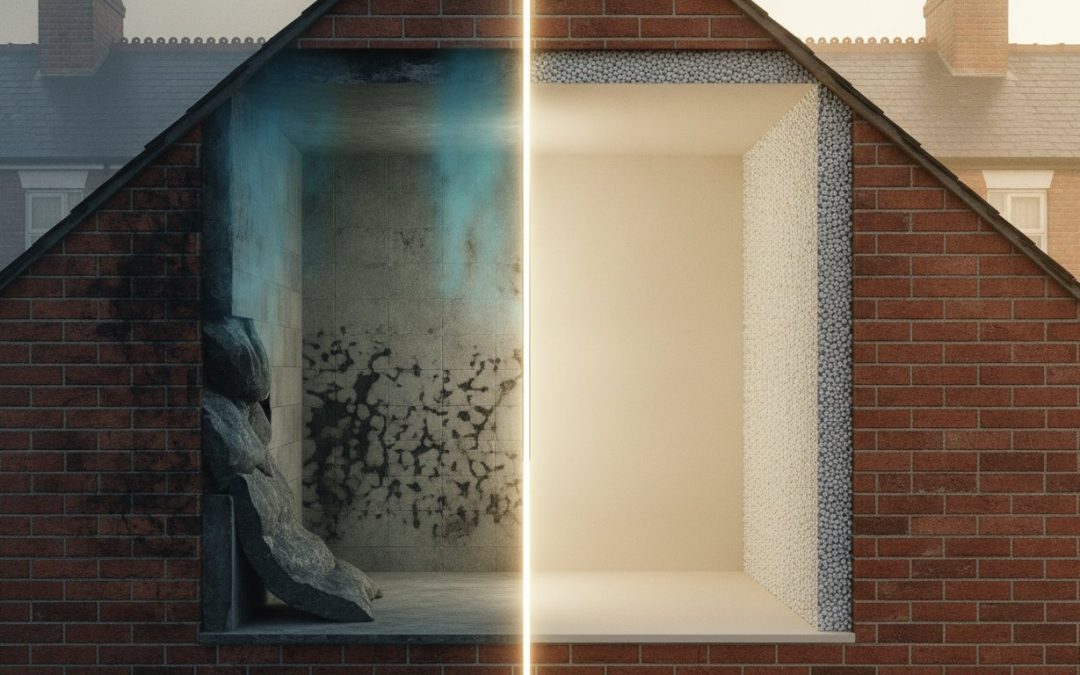
With 10% of private rented dwellings in England currently affected by damp, and over 1 million children living in moisture-compromised homes, the era of ignoring structural faults is over. If you’re a property owner or a tenant, understanding the current landlord responsibility for damp UK is no longer optional; it’s a matter of legal compliance and public health. For too long, the conversation around mould has focused on “lifestyle choices” like drying clothes indoors, but the data shows that the root causes are almost always technical.
We know that dealing with persistent damp is a frustrating experience that can make a home feel unsafe. This specialist guide provides a clear roadmap through the 2026 legal landscape, including the implications of the Renters’ Rights Act and the expected extension of Awaab’s Law to private landlords. You’ll learn how to identify whether defective cavity wall insulation or failing wall ties are the true culprits behind the moisture. As a nationwide specialist, we’ll show you how to move beyond cosmetic fixes and achieve a permanent structural resolution that restores the integrity of the property for the long term.
Key Takeaways
- Understand the statutory repair duties defined by the Landlord and Tenant Act 1985 and how they ensure properties remain fit for human habitation.
- Discover why modern standards shift the focus from “tenant lifestyle” to the technical performance of the building’s structure.
- Learn about the evolving landscape of landlord responsibility for damp UK, including the impact of 2026 regulations on both social and private housing.
- Identify the critical technical differences between rising damp, penetrating damp, and issues caused by defective cavity insulation.
- Explore how professional cavity wall insulation extraction and wall tie replacement provide permanent solutions rather than temporary cosmetic fixes.
Landlord Responsibility for Damp in the UK: The Legal Framework
Landlords hold a statutory duty to ensure their properties remain fit for human habitation throughout the duration of a tenancy. This isn’t merely a matter of property aesthetics; it’s a legal requirement designed to protect the health of occupants and the structural integrity of the building. The primary legislation governing landlord responsibility for damp UK is the Landlord and Tenant Act 1985. Under Section 11 of this Act, landlords must keep the structure and exterior of the property in good repair. This includes maintaining the roof, external walls, windows, and doors to prevent water ingress that leads to penetrating damp.
The Homes (Fitness for Human Habitation) Act
The Homes (Fitness for Human Habitation) Act 2018 strengthened tenant protections by requiring that all rented properties, across both social and private sectors, are expert from serious hazards. Under the Housing Health and Safety Rating System (HHSRS), damp and mould are classified as one of the 29 hazards that local authorities use to assess property safety. If a property is deemed unfit due to persistent dampness, the landlord is legally obligated to carry out repairs to restore the dwelling to a habitable standard. This legislation ensures that tenants aren’t forced to live in environments that compromise their respiratory health.
Awaab’s Law and New 2026 Requirements
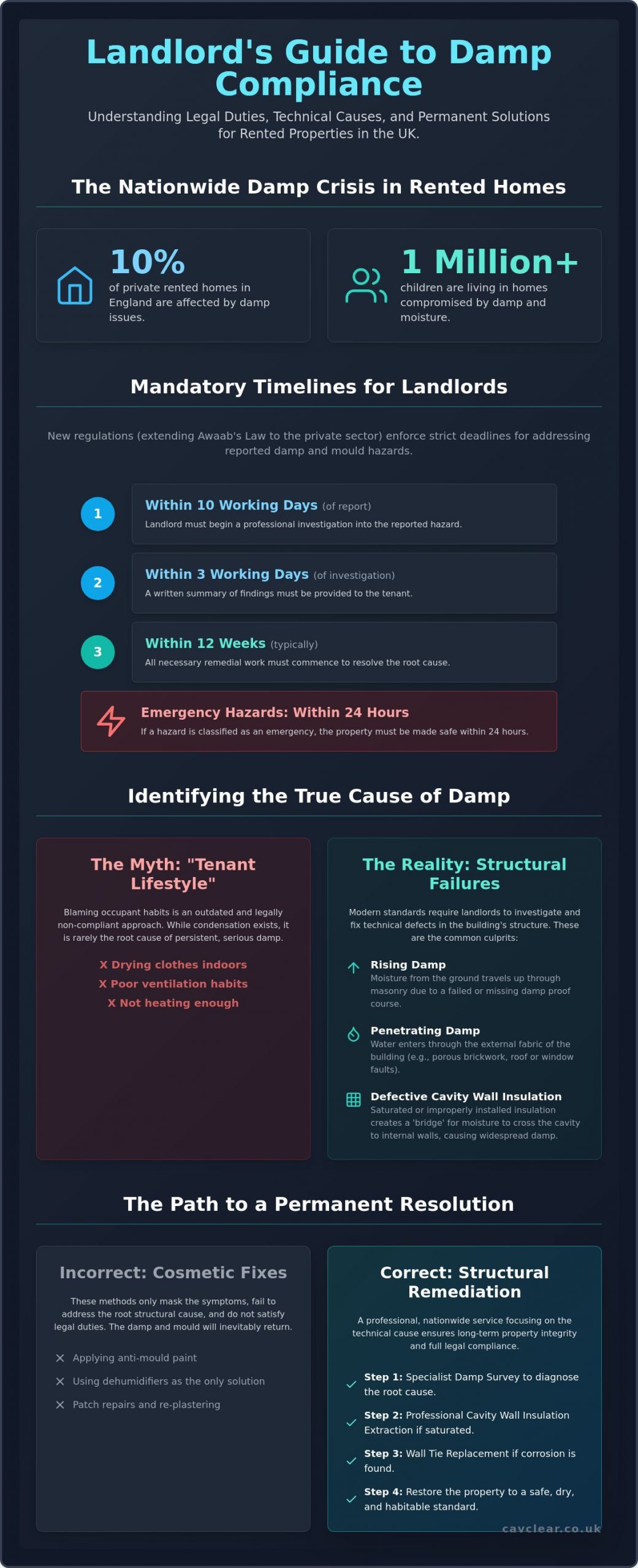
The legal landscape has shifted toward even stricter accountability with the implementation of Awaab’s Law. While initially focused on social housing, the Renters’ Rights Act 2025 is expected to extend these rigorous standards to the private rented sector during 2026. This shift in landlord responsibility for damp UK introduces mandatory timelines for addressing moisture issues. For example, landlords must now begin an investigation into significant hazards within 10 working days of a report being made. If the hazard is classified as an emergency, the property must be made safe within 24 hours. While these legal requirements set a new baseline for the industry, premium providers like Unipad have already established high standards for luxury student accommodation by prioritizing structural health and proactive maintenance.
These regulations highlight the importance of understanding Structural Damp Causes and UK Regulations to ensure compliance. Under the 2025 regulations, a written summary of findings must be provided to the tenant within 3 working days of an investigation’s completion, and all remedial work must typically commence within 12 weeks. This methodical approach replaces the outdated practice of blaming tenant lifestyle and instead mandates a professional diagnostic process to identify and resolve the root cause of the dampness.
Identifying the Technical Causes: Structural vs. Lifestyle Damp
Accurately diagnosing the source of moisture is the first step toward a permanent resolution. When investigating dampness, we must distinguish between internal environmental factors and external structural failures. Condensation is the most frequent misdiagnosis for structural issues; landlords often assume high humidity or tenant habits are the sole cause. However, structural defects like failing masonry or saturated cavities facilitate mould growth regardless of how well a tenant heats the home. Understanding the technical nuances of these faults is essential for fulfilling the landlord responsibility for damp UK and ensuring the safety of the property asset.
Structural dampness typically manifests in three forms: rising, penetrating, and cavity-related moisture. Rising damp occurs when moisture travels vertically through masonry from the ground, typically due to a breached or non-existent damp proof course. Penetrating damp involves water entering through the external envelope of the building, such as roofs, windows, or porous brickwork. The House of Commons Library Damp and Mould Briefing confirms that legal standards like Awaab’s Law emphasize identifying root causes rather than defaulting to lifestyle blame. This is a critical component of landlord responsibility for damp UK, as failing to identify a structural fault can lead to prolonged health hazards for occupants.
The Role of Defective Cavity Wall Insulation
Cavity wall insulation was originally intended to improve thermal efficiency, but when it becomes wet or slumps, it creates a bridge for moisture to cross the cavity. Rainwater penetrates the outer leaf of the masonry and travels across the saturated insulation to the internal wall. This results in localized damp patches and mould that won’t disappear with simple ventilation. In these cases, cavity wall insulation removal is often the only permanent fix to restore the building’s ability to shed moisture and stay dry. Removing the saturated material allows the cavity to function as a thermal break once again.
Wall Tie Corrosion and Moisture Ingress
Failing wall ties are another silent driver of moisture issues in older properties. When steel ties corrode, they expand, causing horizontal cracking in the mortar joints of the external leaf. These cracks allow even more water to enter the cavity, accelerating the cycle of decay and leading to significant heat loss. Identifying the early signs of structural movement, such as bulging walls or visible cracks, is vital for maintaining long-term safety. A professional wall tie survey offers the technical evidence required to plan a permanent remedial strategy and protect the building’s structural integrity.
The Myth of “Tenant Lifestyle” in Damp Disputes
For decades, “lifestyle factors” served as a convenient shield for property owners seeking to avoid costly repairs. Landlords frequently cite activities like drying laundry indoors, cooking without lids, or failing to open windows as the primary drivers of black mould. However, modern building standards and recent legal precedents have fundamentally changed how we assign blame. Determining the extent of landlord responsibility for damp UK requires a shift away from anecdotal observations toward technical evidence. A property is legally required to handle the moisture produced by normal, everyday living without developing structural or environmental hazards.
If a home develops damp despite reasonable use, the issue usually lies with the building’s thermal performance or ventilation capacity. A property that lacks adequate insulation or possesses an inefficient heating system will naturally suffer from cold internal surfaces. When warm, moist air hits these cold spots, condensation forms. This is not a tenant error; it is a structural failure to maintain a consistent thermal envelope. In these scenarios, even the most diligent occupant cannot prevent mould growth because the building’s fabric is fundamentally compromised.
Structural Faults Misdiagnosed as Condensation
Many issues dismissed as “lifestyle condensation” are actually the result of cold bridging. This occurs when there are gaps or slumping in the wall insulation, creating specific cold patches on the internal plaster. We also frequently find that blocked air bricks or compromised sub-floor ventilation are the true culprits behind rising humidity levels. A property must be able to facilitate natural airflow through its structure and ventilation points to prevent the accumulation of interstitial moisture. When these technical elements fail, the resulting dampness is a matter of landlord responsibility for damp UK, necessitating a professional remedial approach rather than just a change in tenant habits.
When the Tenant is Responsible
While the legal burden rests heavily on the landlord, occupants do have a role in maintaining a healthy internal environment. Tenant responsibility typically applies only when they deliberately interfere with the property’s built-in defenses. This includes the intentional blocking of trickle vents, air bricks, or mechanical extractors provided by the landlord. If a tenant produces excessive moisture beyond what is considered “normal living” and refuses to use the provided ventilation tools, they may be held accountable. However, the landlord has a clear duty to provide functional equipment and clear, written guidance on how to manage the property’s specific ventilation systems. Without this evidence-based approach, blaming the occupant remains a weak legal position in 2026.
Navigating the Inspection Process: Specialist Damp Surveys
Visual checks by a letting agent or a standard environmental health officer often only scratch the surface. While these inspections identify the presence of mould, they rarely uncover the technical catalyst hidden within the building’s fabric. To truly fulfill landlord responsibility for damp UK, a deeper diagnostic approach is required. An independent damp survey provides the empirical data needed to distinguish between surface condensation and deep-seated structural failure. By using advanced tools like thermal imaging, we can detect temperature variations that indicate cold spots or moisture pockets. Borescope inspections further enhance this by allowing us to look inside the wall cavity through a tiny pilot hole, identifying slumping insulation or corroded wall ties that are invisible to the naked eye.
What to Expect from a Professional Survey
A specialist survey involves a methodical assessment of the building’s entire envelope. Technicians use moisture mapping to plot the exact distribution of dampness across internal walls, which helps pinpoint the precise entry point of external water. We conduct borescope inspections by inserting a high-definition camera into the cavity, allowing us to evaluate the condition of the insulation and the integrity of the wall ties without disruptive demolition. This non-invasive process results in a comprehensive technical report that outlines the root cause of the problem with forensic precision. It provides a clear remedial action plan, ensuring that any work undertaken, such as cavity wall insulation extraction, addresses the source rather than just the symptoms.
Legal Weight of Expert Reporting
In the context of 2026 regulations and the increased focus on tenant health, a specialist technical report carries significant legal weight. It transforms a tenant’s subjective complaint into an objective structural fact, which often triggers mandatory repair obligations for the landlord. Accredited surveyors provide the unbiased property data necessary to settle disputes and justify the investment in high-value remedial works. If a report identifies saturated material or compromised ties, it serves as the primary evidence needed to plan a permanent fix. This level of detail protects both the landlord’s long-term asset value and the tenant’s safety by ensuring repairs are based on technical reality rather than guesswork.
To secure a definitive diagnosis of your property’s structural health, you can schedule a specialist wall tie survey with our nationwide team.
Specialist Remedial Solutions: Restoring Property Integrity
Redecorating a damp wall with anti-mould paint is a temporary measure that fails to address the underlying structural fault. For property owners, this reactive approach often leads to recurring maintenance costs and ongoing tenant dissatisfaction. True resolution involves identifying the technical failure within the building’s fabric and implementing a permanent fix. In many UK properties, the root cause of moisture ingress is hidden within the cavity itself. Fulfilling the landlord responsibility for damp UK means moving beyond cosmetic repairs to restore the property’s structural integrity and environmental safety. By addressing the source of the moisture, you protect the long-term health of the building and its occupants.
Our methodology focuses on the restoration of the building’s original design intent. When a cavity is clear and functioning correctly, it acts as a thermal break that prevents moisture from crossing into the living space. If this system is compromised by debris or failed materials, the property will remain damp regardless of how much it is heated. We use specialist equipment to clear these obstructions, ensuring a clean and non-disruptive resolution. This technical approach is essential for meeting the 2026 standards for housing fitness and structural durability.
Cavity Wall Insulation Extraction
When cavity insulation becomes saturated or slumps, it creates a direct conduit for water to travel from the external leaf to the internal plaster. Professional cavity wall insulation extraction is the only effective way to break this moisture bridge. By removing the defective material, we allow the cavity to breathe and the internal walls to dry out naturally. This process is vital for the permanent prevention of black mould, which thrives in the cold, damp conditions created by failed insulation. Once the cavity is clear, the building’s thermal performance stabilizes, which helps to eliminate the cold spots that trigger condensation.
Remedial Wall Tie Replacement
Prolonged exposure to moisture within a cavity often leads to the corrosion of original steel wall ties. As these ties rust, they expand and cause horizontal cracking in the mortar joints, further compromising the building’s weather resistance. If left unaddressed, this corrosion can lead to significant structural movement or even wall collapse. Under the landlord responsibility for damp UK, ensuring structural stability is a non-negotiable duty. A professional wall tie replacement using high-quality stainless steel remedial ties provides a permanent solution. This specialist maintenance preserves the asset’s long-term value and guarantees the safety of its occupants without the need for extensive reconstruction.
Securing the Structural Health of Your Rented Property
The 2026 regulatory environment has fundamentally shifted the burden of proof from the tenant to the building’s structure. Landlords must now move beyond temporary redecoration and address the technical failures, such as saturated insulation or corroding wall ties, that compromise a home. Navigating the legalities of landlord responsibility for damp UK requires evidence-based diagnostics rather than surface-level observations. Identifying the root cause is the only way to ensure long-term compliance and occupant safety.
Our team of accredited specialist surveyors provides the detailed technical reporting needed to settle disputes and plan permanent resolutions. We offer nationwide remedial services for structural damp, ensuring your property meets modern safety standards while preserving its asset value. You can take the first step toward restoring your building’s health and comfort by choosing a specialist partner dedicated to structural integrity and non-disruptive methodology.
Book a Professional Damp and Mould Survey Today to protect your investment and ensure a safe environment for your residents.
Frequently Asked Questions
Is a landlord responsible for black mould in the UK?
Yes, landlords are legally responsible for black mould if it results from structural defects, rising damp, or inadequate ventilation systems. Under the Landlord and Tenant Act 1985, the property owner must maintain the building’s exterior and structure to prevent moisture ingress. If mould growth compromises the health of occupants, it constitutes a hazard that the landlord must remediate to ensure the dwelling remains fit for human habitation.
How long does a landlord have to fix damp and mould under Awaab’s Law?
Under the timelines established by Awaab’s Law, landlords must investigate significant damp and mould issues within 10 working days of a report. If the hazard is deemed an emergency, the property must be made safe within 24 hours. Following the investigation, a written summary of findings is required within 3 working days, and remedial work must typically commence within 12 weeks to ensure a permanent resolution.
Can a landlord evict me for reporting damp issues in 2026?
Tenants are protected from retaliatory evictions when they report legitimate maintenance concerns. The Renters’ Rights Act 2025 and subsequent 2026 updates have significantly restricted a landlord’s ability to issue no-fault evictions. If you report damp, your landlord cannot legally end your tenancy as a direct response to your request for structural repairs or a specialist technical survey.
Who pays for a damp survey in a rented property?
The landlord is responsible for the cost of inspections and surveys required to identify the root cause of dampness as part of their repair duties. While a tenant may choose to commission an independent specialist survey to provide technical evidence of a structural fault, the ultimate cost of investigation and repair rests with the property owner. This is a core part of landlord responsibility for damp UK in maintaining a safe asset.
Can I withhold rent if my landlord refuses to fix damp?
You should not withhold rent, as this creates a risk of eviction due to rent arrears. Instead, you should follow formal procedures by notifying the landlord in writing and contacting your local authority’s environmental health department if they fail to act. Legal frameworks provide mechanisms to compel landlords to perform repairs without the tenant needing to pause their contractual rent payments.
What is the difference between penetrating damp and condensation?
Penetrating damp occurs when water enters the property through external defects like cracked masonry or failed wall cavities. In contrast, condensation is caused by internal water vapour settling on cold surfaces. Many cases of condensation are actually caused by structural cold bridging, where missing or slumped insulation makes internal walls excessively cold, facilitating mould growth regardless of how the tenant uses the property.
Does my landlord have to provide an extractor fan in the bathroom?
Landlords must provide adequate ventilation to meet the Homes (Fitness for Human Habitation) Act standards. If a bathroom doesn’t have an openable window or sufficient natural airflow, the installation of a functional mechanical extractor fan is mandatory. Effective ventilation is a critical component in managing internal humidity and preventing the accumulation of moisture that leads to environmental hazards.
Is failed cavity wall insulation a landlord responsibility?
Failed or saturated cavity wall insulation is a structural defect and falls entirely under the landlord’s repair obligations. When insulation material slumps or becomes wet, it acts as a bridge for moisture to travel from the external leaf to the internal walls. Resolving this issue requires professional cavity wall insulation extraction to restore the building’s thermal performance and fulfill the landlord responsibility for damp UK by eliminating the source of the moisture.
Recent Comments