
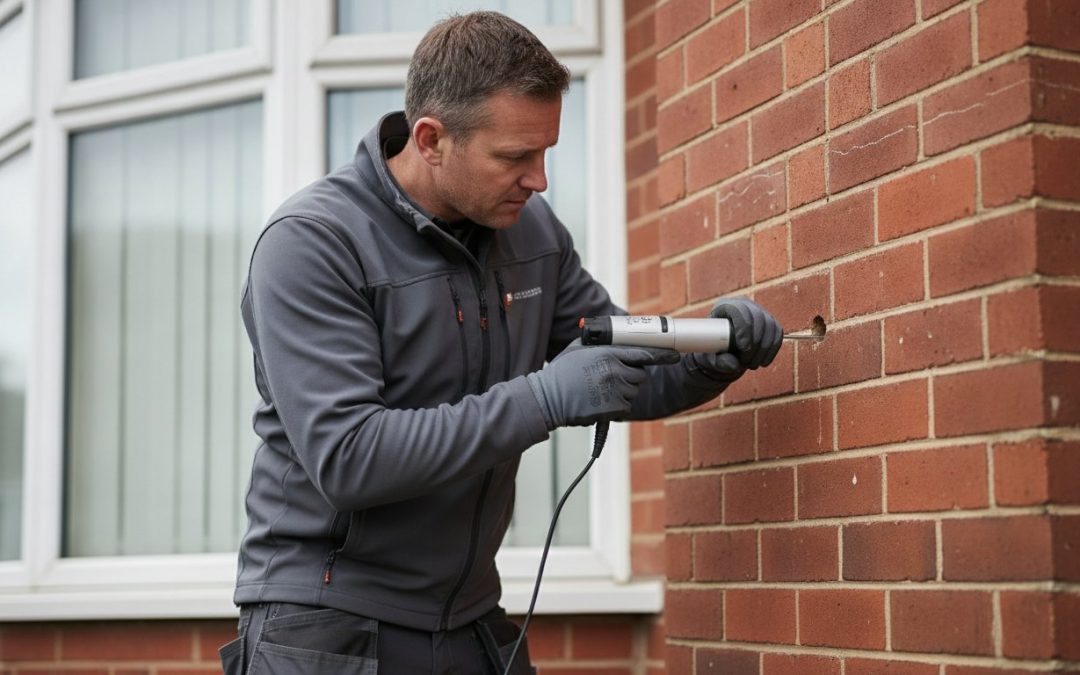
If you’ve noticed horizontal cracks in your brickwork or subtle bulging in your masonry, is your home’s structural integrity actually at risk? It’s natural to feel anxious when you spot signs of movement, especially when you’re worried about hidden costs or the severity of the damage. You’re likely wondering how long does a wall tie survey take and whether a specialist will need to spend an entire day drilling into your external walls.
A professional wall tie survey is a precision diagnostic event designed to provide clarity without causing unnecessary disruption. For a standard semi-detached property in the UK, the process typically takes between one and two hours. This article will explain the technical methodology our surveyors use, including borescope inspections and metal detection, to give you a clear picture of your property’s health. You’ll understand the exact timeline of the inspection and why identifying the underlying cause of structural stress is the vital first step in protecting your property’s future.
Key Takeaways
- Understand that a professional inspection for a typical UK semi-detached property is a non-disruptive process, and you will learn exactly how long does a wall tie survey take to complete.
- Learn how technical surveyors use metal detection and borescope diagnostics to map the structural integrity of your walls without causing damage.
- Discover the critical link between the internal cavity environment, specifically moisture-bridging insulation, and the acceleration of wall tie corrosion.
- Identify the physical warning signs, such as horizontal cracking and masonry bulging, that signify a high risk of structural failure.
- Gain insight into the Condition Grade system used in professional reports to help you prioritize repairs and protect your long-term asset health.
How Long Does a Wall Tie Survey Take? Timelines and Expectations
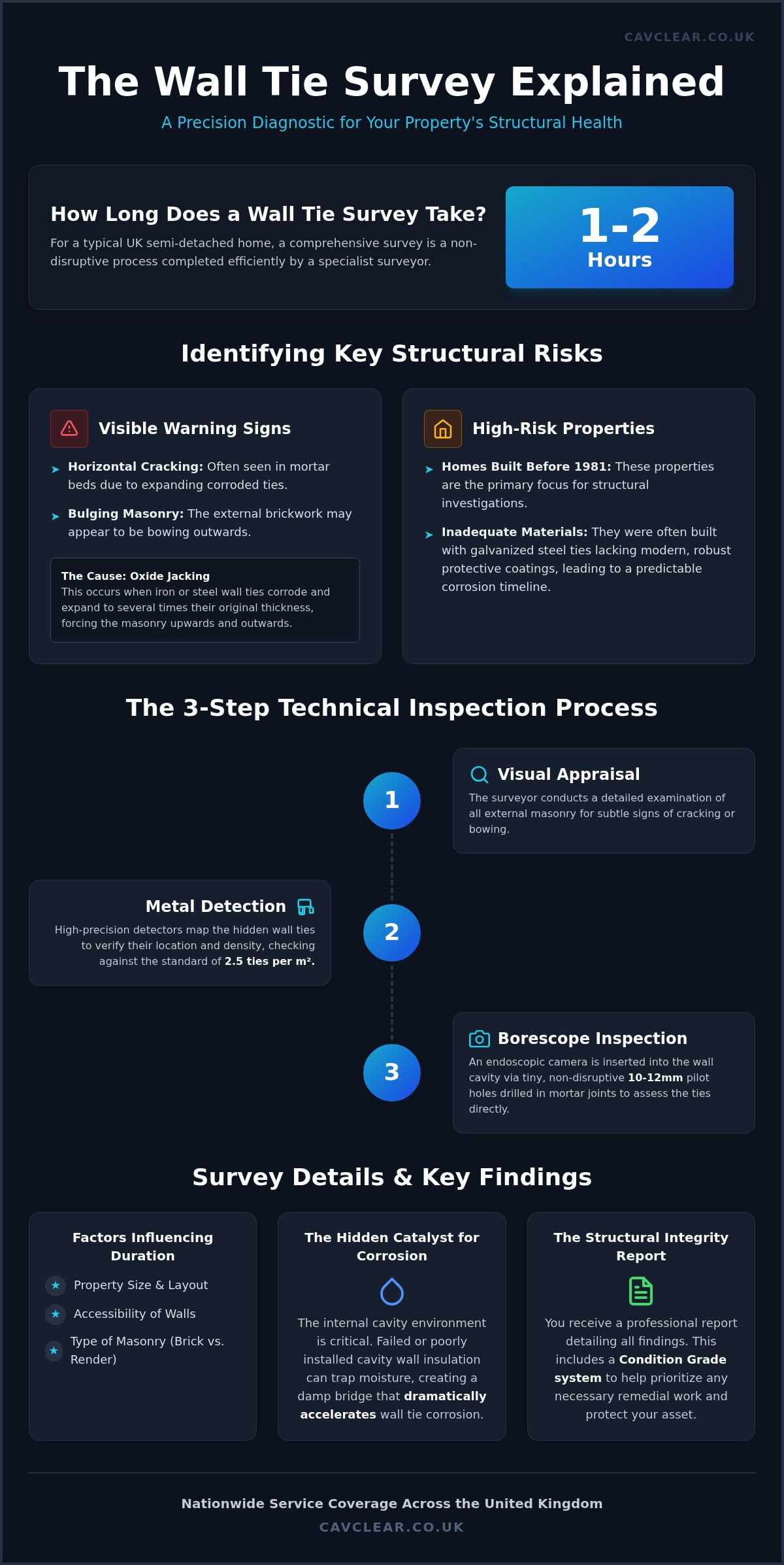
A wall tie survey is a technical diagnostic procedure used to assess the condition of cavity wall ties. These metal components act as essential structural connectors, bridging the gap between the internal and external leaves of a masonry wall to ensure stability. When property owners ask how long does a wall tie survey take, the answer depends on the specific configuration and size of the building. For a typical UK semi-detached home, a thorough inspection usually takes between 1 and 2 hours. Our surveyors require access to the entire external perimeter of the property to perform a comprehensive assessment of every elevation.
The process isn’t merely a visual check from the ground. It’s a systematic evaluation that involves mapping the wall ties and looking inside the cavity itself. This 1 to 2 hour window allows our technicians to set up specialized equipment, such as metal detectors and borescopes, to verify the physical state of your home’s structural skeleton. We prioritize a methodical pace to ensure no technical fault is overlooked.
Factors That Influence Survey Duration
Property size is the most significant variable in determining the timeline. A large detached home with four or more elevations naturally requires more time than a mid terrace house with only two accessible faces. Accessibility also plays a critical role in the inspection speed. If masonry is obscured by dense vegetation, conservatories, or situated at a significant height, the surveyor must take additional care to position equipment safely. The type of masonry matters as well. While bare brick allows for straightforward pilot hole placement, rendered walls require a more delicate approach to ensure the inspection remains non-disruptive and visually clean.
Why Property Age Dictates the Depth of Inspection
Buildings constructed before 1981 are the primary focus of our structural investigations. Before this date, many UK properties were fitted with galvanized steel ties that lacked the robust protective coatings required for long term durability. These older ties have a predictable failure window due to corrosion, often referred to as oxide jacking. In these older homes, we conduct a more intensive metal detection phase to map the exact grid pattern of the ties. This ensures that the density of the connectors meets modern safety standards. Because older properties are at a higher risk of structural fatigue, we spend more time verifying the integrity of the metal within the cavity to protect your long term asset health.
The Technical Methodology: What Happens During the Inspection?
A professional inspection is a systematic process that moves from external observation to internal cavity analysis. The surveyor begins with a detailed visual appraisal of the masonry. They look specifically for Signs of wall tie failure, such as horizontal cracking in the mortar beds or subtle bowing of the external brick leaf. This cracking often results from “oxide jacking,” a process where corroding iron or steel expands to several times its original thickness, physically lifting the masonry above it. Because these signs can be subtle, the surveyor must examine every elevation with technical precision.
Understanding the steps involved helps clarify how long does a wall tie survey take for a standard UK home. Once the visual check is complete, the surveyor uses high-precision metal detection to map the internal structure. This is followed by the drilling of small, non-disruptive pilot holes into the mortar joints. These holes, typically only 10mm to 12mm in diameter, allow for the insertion of an endoscopic camera. This methodology ensures the building remains structurally sound and visually clean throughout the diagnostic event.
Locating Ties with High-Precision Metal Detection
Surveyors don’t guess where your wall ties are located. They use specialized metal detectors to find hidden connectors without damaging the brickwork. This mapping phase is essential because it allows the technician to check the tie density against original building standards. UK regulations generally require a minimum of 2.5 ties per square metre. If the survey reveals missing or incorrectly spaced ties, the property may be at risk of structural instability even if corrosion hasn’t yet occurred. Identifying these “hidden” gaps is a critical part of a professional wall tie survey.
Borescope Inspections: Seeing Inside the Cavity
The most vital stage of the inspection involves the use of a high-definition borescope. This camera provides a clear view of the “leaf-end” of the tie, which is the part embedded in the outer brickwork most prone to moisture. The surveyor looks for specific signs of oxidation, such as red rust or white zinc salts on galvanized ties. They also inspect the cavity itself for debris, mortar droppings, or standing water. These environmental factors can accelerate metal degradation. By seeing exactly what’s happening inside the wall, our specialists can provide a factual grading of the tie condition rather than relying on assumptions.
The Hidden Catalyst: How Cavity Insulation Affects Survey Findings
The fundamental design of what is a cavity wall relies on a clear air space to prevent moisture from transferring from the external brick leaf to the internal one. When this space is filled with insulation, the internal environment of the wall changes significantly. A comprehensive professional wall tie survey doesn’t just look at the metal connectors; it evaluates the state of the material surrounding them. Homeowners often wonder how long does a wall tie survey take when they suspect insulation issues, but the depth of this environmental analysis is what guarantees a reliable diagnosis. A portion of the inspection time is dedicated to diagnosing whether your insulation is actively damaging your home’s structural skeleton.
Moisture Bridging and Accelerated Corrosion
Defective or poorly installed insulation often acts like a sponge. It absorbs water through the external brickwork and holds it directly against the wall ties. This phenomenon, known as moisture bridging, creates a permanently damp environment that accelerates the oxidation of galvanized steel. While a tie in a clear cavity might last many decades, one encased in saturated mineral wool or urea-formaldehyde foam can fail much faster. During the borescope phase of the inspection, our technicians specifically look for “bridging” where debris or insulation has clumped around a tie. This environmental assessment is vital because replacing ties without addressing the wet insulation is only a temporary fix. It’s a technical fault that requires a specific technical solution to ensure long-term asset health.
The Risks of Retrospective Insulation
Our nationwide technical team maintains a firm stance against the installation of retrospective cavity wall insulation. These installations frequently lead to significant dampness and structural issues that compromise the property’s integrity. Retrospective fill can hide the early warning signs of tie failure from the naked eye, such as small cracks that would otherwise be visible to a trained surveyor. A clear cavity allows for natural ventilation, which is essential for the longevity of both the masonry and the metal connectors. If our survey identifies that your insulation is saturated or causing “oxide jacking,” we will recommend cavity wall insulation removal as a necessary step to restore the property’s structural health. This proactive approach ensures that your remedial investment provides a permanent solution rather than a cosmetic patch. When you understand how long does a wall tie survey take, you can appreciate the meticulous care we take to inspect every hidden corner of the cavity.
Interpreting the Signs: When Should You Book a Survey?
Structural movement is rarely a sudden event. It’s usually the result of long-term environmental stress within the cavity. Identifying the early warning signs of wall tie failure allows you to intervene before the damage requires extensive masonry reconstruction. While you might be concerned about how long does a wall tie survey take, the brief duration of a professional inspection is a minor investment compared to the risk of a wall collapsing. If you notice any of the following symptoms, your property requires an immediate technical assessment.
- Horizontal cracking: Look for cracks in the mortar joints that appear at regular intervals, typically every 4 to 6 courses of brickwork. This pattern matches the original spacing of the wall ties.
- Masonry bulging: If the external brick leaf appears to bow outwards, it suggests the ties have snapped or lost their grip, allowing the outer wall to move independently from the inner structure.
- Patterned dampness: Internal damp patches that appear in a grid-like pattern often indicate that corroded ties are acting as a bridge, allowing moisture to cross the cavity.
- Structural sagging: Sagging lintels over windows and doors, or the visible lifting of roof edges, are serious indicators of verticality loss.
- Frame separation: Gaps appearing between your external masonry and window or door frames suggest the outer leaf is leaning away from the building’s core.
The Mechanics of Oxide Jacking
When original steel ties are exposed to moisture, they begin to rust. This oxidation process is not just a surface change; it’s a physical expansion. As the metal corrodes, the resulting rust occupies a volume several times larger than the original steel. This expansion generates immense pressure within the mortar joint, effectively acting as a slow-motion hydraulic jack that lifts the bricks above it. Oxide jacking is a progressive structural threat where the volume of corrosion products creates enough force to displace entire sections of masonry. This displacement is what causes the characteristic horizontal cracking seen in older UK homes.
Visual Signs vs. Internal Reality
It’s a common misconception that a wall is safe if it looks straight. In many cases, wall ties can be almost entirely corroded through while the external leaf remains temporarily held by friction and mortar. The danger lies in “verticality loss,” where the outer leaf begins to lean imperceptibly. By the time a bulge is visible to the naked eye, the structural integrity of the wall is already severely compromised. Proactive surveys identify these hidden faults during the borescope phase, long before minor cracks evolve into a total failure of the masonry. If you’ve spotted even subtle cracking, it’s time to book a wall tie survey to verify the internal condition of your cavity.
The Structural Integrity Report and Remedial Solutions
The survey concludes with the production of a comprehensive structural integrity report. While the question of how long does a wall tie survey take is answered by the 1 to 2 hours spent on-site, the diagnostic value is captured in this technical document. A professional report contains photographic evidence from the borescope inspection, a map of tie density, and a clear grading of the metal’s condition. This document transforms raw observations into an actionable plan for your property’s preservation.
We use the Condition Grade system, ranging from 1 to 4, to determine the urgency of remedial work. Grade 1 indicates ties in good condition with minimal surface oxidation. Grade 4 signifies severe corrosion or “oxide jacking” that poses an immediate risk to the building’s stability. This grading removes ambiguity; it provides you with a clear, low-pressure path toward a structural resolution. By categorising the risk, we help you prioritise repairs that protect your home’s long-term asset health.
Understanding Your Technical Survey Report
This report acts as a vital asset during property transactions or building insurance renewals. Lenders frequently require proof of structural health before approving mortgages on older UK homes. If the survey confirms failure, the transition to wall tie replacement becomes the necessary technical solution. Our surveyors recommend specific remedial ties based on your masonry type. We use high-grade stainless steel for all remedial works to prevent a future recurrence of corrosion. This ensures the repair is a permanent fix rather than a temporary patch.
Long-Term Property Preservation
Framing the survey as the first step in property preservation helps you view the process as a vital investment in your home’s future value. Rectifying poor workmanship or natural metal fatigue restores your property’s comfort and security. While structural integrity is paramount, you might also learn more about Scaitec Security Solutions Ltd for advanced electronic security and fire systems to further protect your home. A structurally sound, moisture-expert cavity is essential for long-term safety. By using our nationwide team of accredited specialists, you ensure that any remedial work meets the highest technical standards. This proactive approach provides a permanent fix that protects your investment for decades to come. When you understand how long does a wall tie survey take, you can see that a small amount of time today prevents significant structural costs tomorrow.
A wall tie survey is more than a simple inspection; it’s a vital diagnostic event that ensures the longevity of your home. By understanding how long does a wall tie survey take, you can prepare for a non-disruptive, technical assessment that typically concludes within two hours. This process identifies critical faults like oxide jacking and moisture bridging within the cavity, providing you with a clear roadmap for structural restoration rather than relying on guesswork.
Our accredited technical surveyors provide comprehensive technical reporting that serves as a permanent record of your property’s health. With nationwide UK service coverage, we offer the expertise needed to address complex cavity issues with precision and reliability. Don’t let horizontal cracks or bulging masonry become a source of long-term stress. You can Book a Professional Wall Tie Survey with CavClear today to secure your property’s integrity. Taking this proactive step protects your investment and restores the comfort and safety of your home for the future.
Frequently Asked Questions
How can I tell if my wall ties have failed?
You can identify potential failure by looking for horizontal cracks in the mortar joints, typically spaced every 450mm vertically. Other indicators include bulging brickwork or gaps appearing between external masonry and window frames. These signs suggest that the internal metal connectors are expanding due to corrosion or have snapped entirely. If you notice these symptoms, you should investigate how long does a wall tie survey take to ensure a specialist can assess the internal cavity condition promptly.
What is the main cause of wall tie corrosion?
The primary cause of corrosion is the exposure of metal ties to moisture and oxygen within the cavity. In older UK properties, ties were often manufactured from galvanized steel with thin protective coatings that eventually degrade. This process is frequently accelerated by saturated cavity wall insulation, which acts as a moisture bridge. Once the protective zinc layer fails, the underlying steel oxidizes and expands, leading to the structural phenomenon known as oxide jacking.
Is wall tie failure dangerous for my home?
Wall tie failure represents a significant structural risk to any property. Wall ties are essential for binding the outer masonry leaf to the inner structural core of the building. When they fail, the external wall can become unstable and susceptible to collapse during high winds or extreme weather. While the initial signs like cracking may seem cosmetic, they indicate a progressive loss of verticality that can eventually compromise the entire safety of the property.
Can I just repoint the cracks instead of replacing the ties?
Repointing is a cosmetic fix that does not address the underlying technical fault. If the cracks are caused by oxide jacking, the corroding ties will continue to expand and exert pressure on the masonry. Filling the gaps with new mortar will only lead to further cracking as the metal continues to oxidize. A permanent solution requires the installation of stainless steel remedial ties and, in some cases, the isolation of the original corroded connectors.
How much does a professional wall tie survey cost?
A specialist wall tie survey typically costs between £250 and £600, depending on the property size and the complexity of the inspection. This fee covers the use of technical equipment such as borescopes and metal detectors, as well as the production of a detailed structural integrity report. While costs vary, the survey provides the diagnostic value needed to avoid unnecessary remedial work and ensures that any investment in repairs is based on factual evidence.
Do all cavity walls have wall ties?
All standard cavity walls constructed in the UK require wall ties to ensure structural stability. These connectors are designed to transfer lateral loads between the two leaves of masonry. Properties built from the early 20th century onwards typically feature these ties. However, the type of tie used and the spacing between them vary depending on the building regulations in place at the time of construction. A survey verifies if your home meets modern density requirements.
How long do remedial wall ties last?
Modern remedial wall ties are manufactured from high-grade stainless steel, which offers exceptional resistance to corrosion. When installed correctly by accredited specialists, these ties are designed to last for the remaining life of the building. Unlike the original galvanized steel ties used in pre-1981 properties, stainless steel does not suffer from the same oxidation risks. This makes the replacement a permanent investment in your property’s long-term asset health and structural integrity.
Will failing wall ties affect my ability to sell my house?
Failing wall ties can significantly complicate a property sale. Building surveyors often flag horizontal cracking or bulging masonry during a pre-purchase inspection, which can lead mortgage lenders to withhold funds until a specialist report is provided. Knowing how long does a wall tie survey take is helpful here, as a quick 1 to 2 hour inspection can provide the documentation needed to reassure buyers and lenders. A clear structural report facilitates a smoother transaction.
Arrange a cavity wall tie survey
Start with an inspection of the accessible masonry and sampled wall ties. CavClear provides a written report with photographs, findings, limitations and recommendations, with a quotation for repairs where required. We can also inspect insulated cavities using an agreed access method.
Arrange a cavity wall tie survey or send your property and access details. Call 0333 220 2463.
Recent Comments