
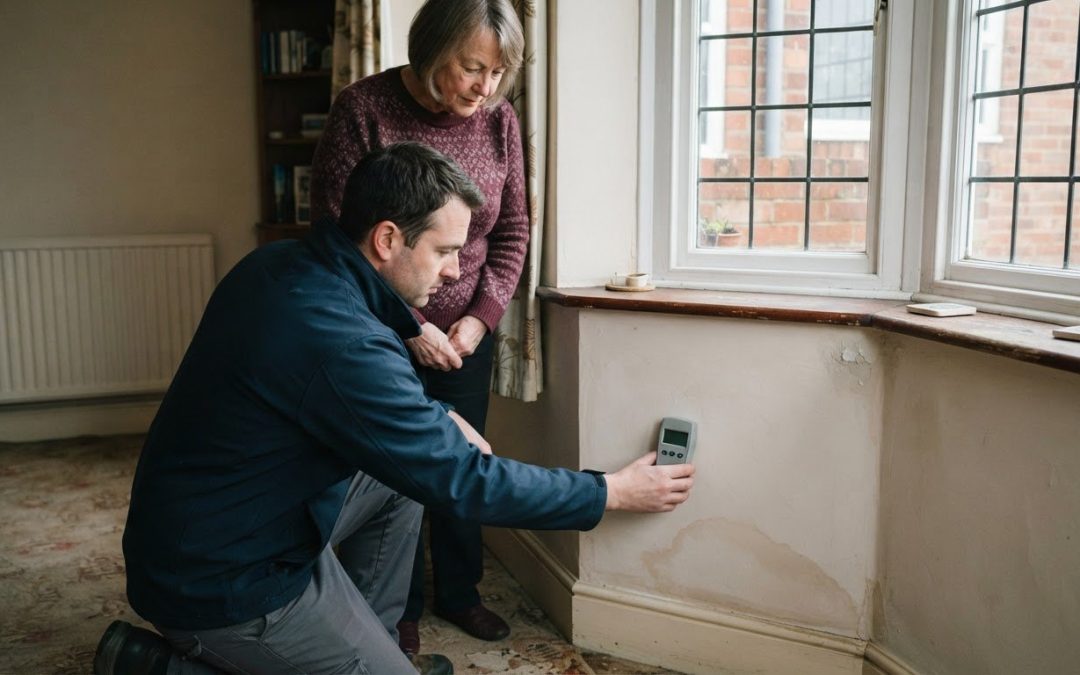
If you’re deciding how to spot a cowboy damp proofing company, start by separating diagnosis from treatment. A damp survey should investigate the cause, and remedial work should follow only when the findings support it. A treatment quote alone does not explain why damp is present.
It’s understandable to want a clear fix when staining, mould or damaged plaster is affecting your home. But damp has several possible causes, and the right next step depends on the evidence, not simply a recommendation to install a damp-proof course.
This guide explains when to seek a survey or treatment, and how to assess an inspection, written findings, guarantee terms, trade memberships and a company’s history. It also covers warning signs such as pressure to commit quickly, vague work descriptions and unclear business details, helping you make a considered decision about your property.
Key Takeaways
- Choose an independent damp surveyor when the cause is unclear; treatment should follow a supported diagnosis.
- Look for a written inspection report that explains the findings and links them to the recommended work.
- Read guarantee terms carefully, including what protection applies and what happens if the original company stops trading.
- Check what a trade membership or certification actually covers rather than relying on a badge alone.
- Use company records, reviews and complaint history to build a clearer picture of a firm’s trading record.
2. Guarantee and insurance-backed guarantee terms
A guarantee should explain what treatment covers, how long protection lasts, and who responds if a problem returns. A company’s own guarantee depends on that business remaining able to honour it. If the firm stops trading, a long guarantee may have little practical value unless another party backs it. Insurance-backed guarantees for damp-proofing work can offer up to 20 years of protection, but the term alone doesn’t establish what the policy covers.
Read the complete guarantee before agreeing to treatment. Check whether it covers the specified work, the materials, or both, and note any exclusions, maintenance conditions and steps for reporting a fault. The document should identify the property, work completed, start date and party responsible for handling an issue. Written terms provide a clearer record than a verbal assurance or unexplained certificate.
An insurance-backed guarantee is separate from a contractor’s own promise. It may provide protection if the contractor ceases trading, but only under the policy’s stated conditions. Check who underwrites it, when cover begins, what evidence confirms the work was completed and how to contact the insurer. Make sure it applies to the proposed treatment, not a different service or product. Keep the signed paperwork with the quotation and completion records.
Trade-body promise schemes are another arrangement, not a substitute for reading the individual guarantee. Check the scheme’s written terms for its scope, eligibility rules, exclusions and process if the original contractor stops trading. A membership badge alone does not show that a particular treatment qualifies. The guarantee should name the responsible scheme or insurer, rather than relying on a salesperson’s verbal explanation.
Keep a clear record of damp symptoms, inspection findings, agreed treatment and any follow-up. This helps you compare completed work with the guarantee’s scope if the problem returns. A guarantee should relate to a diagnosis and defined work, not promise a completely dry property without explaining the cause or remedy.
Before accepting a proposal, compare its written scope with the guarantee. If a quote covers damp-proof treatment but excludes associated plasterwork, for example, the documents should make that distinction clear. Look for the duration, covered remedy, exclusions and process for raising a problem. If terms are missing or contradictory, pause before signing. A useful guarantee explains its limits, not just its headline length.
3. Property inspections and identifying the cause of damp
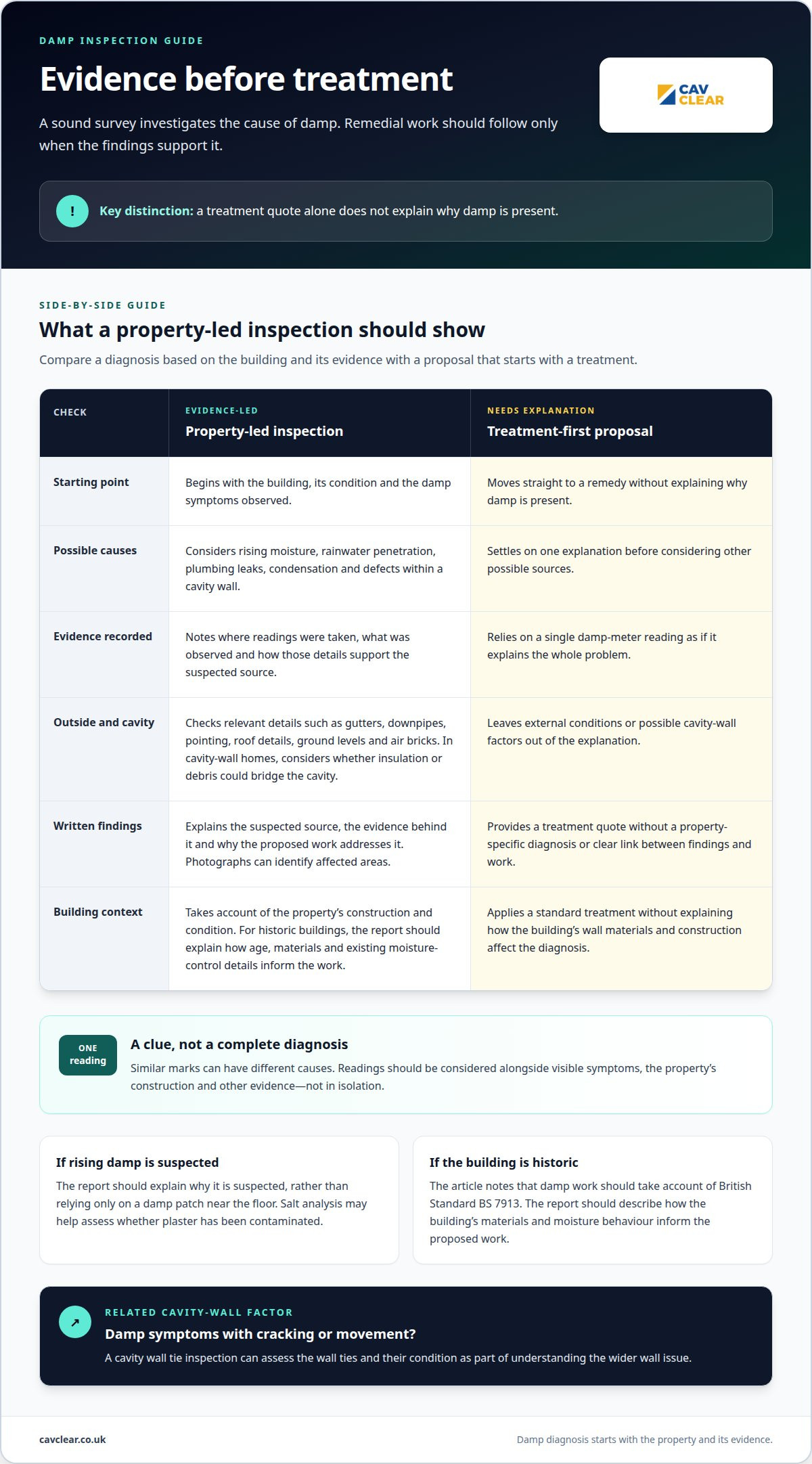
A sound inspection starts with the building, not a preselected treatment. Damp may result from rising moisture, rainwater penetration, plumbing leaks, condensation or defects within a cavity wall. Similar marks can have different causes, so one damp-meter reading cannot explain the whole problem. The inspection should relate readings and visible symptoms to the property’s construction and condition.
Look for a report that records where readings were taken and what the inspector observed. It should explain the suspected source, the evidence supporting that conclusion and why the recommended work addresses it. Photographs can identify affected areas, while salt analysis may help assess whether plaster has been contaminated. A recommendation for chemical treatment should explain why rising damp is suspected, rather than rely only on a damp patch near the floor.
The inspection should also consider external conditions. Check whether gutters, downpipes, pointing, roof details, ground levels or air bricks could let water in or restrict ventilation. Moisture on an internal wall below a leaking gutter, for example, may point to rainwater penetration rather than a failed damp-proof course. In cavity-wall properties, the inspector should consider whether insulation or debris could bridge the cavity and transfer moisture across the wall.
Historic buildings need a careful approach because their construction materials and moisture behaviour can differ from modern masonry. The British Standards Institution says damp work on historic buildings should take account of British Standard BS 7913. A report should explain how the building’s age, wall materials, finishes, and existing moisture-control details inform the proposed work. Waterproofing or replacing historic material without understanding the wall build-up can obscure the original cause.
For commercial premises, the inspection should document affected rooms, building use, visible damage and any areas where moisture could affect stored goods or equipment. Ask for a clear record of observations and proposed next steps so the property manager can assess how the work relates to the building’s needs. A diagnosis should distinguish active water entry from old staining or localised condensation.
Trade directories and membership schemes can help identify firms for further consideration, but a listing does not replace a property-specific report. Assess whether the surveyor explains the inspection method and gives a reasoned diagnosis, rather than moving straight to a standard treatment package. If cavity bridging is a concern, a targeted inspection can help establish whether the wall construction is contributing to damp symptoms.
For signs of damp alongside cracking or movement in cavity masonry, a cavity wall tie inspection can assess the wall ties and their condition as part of understanding the wider wall issue.
4. Recognised trade association memberships
Trade association membership can indicate that a contractor has met a scheme’s entry requirements, but it does not prove that every diagnosis or treatment is suitable. Check the organisation’s name, the contractor’s current membership status and whether membership covers the proposed work. A logo on a van or quotation does not establish what the membership means or which services it applies to.
Verify membership through the association’s current directory or membership service. Match the business name and trading details, then check that the listed member is the firm preparing your quote. If a salesperson uses a different trading name, ask for the relationship to be explained in writing. Keep any membership certificate with the inspection report and quotation.
TrustMark registration is identified as a positive sign when choosing a UK damp contractor. For landlords, guidance also points to PAS 2035 certification or an equivalent accreditation. Check what the named scheme covers and whether it applies to the contractor and specific service. Certification for one activity doesn’t automatically demonstrate competence in rising damp diagnosis, timber treatment, or plasterwork.
Selected Federation of Damp certification courses are independently City & Guilds Assured. This describes the assurance attached to those courses, not a blanket endorsement of every contractor or treatment. Ask which qualification or course a certificate represents, who issued it and whether it relates to the recommended work. The credential should be relevant to the person carrying out the inspection or treatment.
Rogue traders may use impressive badges, urgent language or a standard treatment package to encourage a quick decision. Compare any badge with the association’s directory and the written proposal. A recommendation to treat rising damp, for example, should explain the evidence behind that diagnosis, rather than rely on a logo or a damp patch beside the skirting. If the sales pitch changes when you ask for written details, pause before agreeing.
Use the quotation to understand exactly what the contractor proposes. It should identify the business, describe the work and state what is included or excluded. Compare these details with the membership or certificate being presented. If a credential relates to a different service, it tells you little about the suitability of the proposed damp treatment.
Trading history adds context, but years in business alone do not prove technical competence. Consider it alongside relevant qualifications, current membership and a property-specific inspection. A contractor who explains a certificate’s limits and connects their recommendation to recorded findings gives you more useful evidence than a badge without context.
Before taking action, write down the organisation’s name and the exact membership or qualification being presented. Verify those details independently, then compare them with the contractor named on the paperwork. This helps distinguish a relevant, current credential from a vague reference to association membership.
5. Researching a damp-proofing company’s trading history
A trading history gives context for a damp-proofing company’s experience, but the age of its current business name doesn’t tell the whole story. Start with the company number shown on its quotation or paperwork. Compare the registered business name and incorporation date with the details the contractor gives you. One reported company-number check found an incorporation date of 2007, despite the specialist saying he had been trading for ten years. That difference shows why dates and business identities matter.
Look beyond a claim such as “established for years”. Record the company number and the names shown on the quote and guarantee. If the details differ, ask for a written explanation of how the businesses are connected. A change of name or structure may have a reasonable explanation, but it should be clear which entity will carry out the work and remain responsible for the paperwork.
Several dissolved companies linked to the same builder are a warning sign worth examining. A dissolved business does not, by itself, explain why it closed or prove the quality of its work. It does make it important to distinguish the current contractor from earlier businesses. Check whether the proposed firm has a consistent record and whether past trading names appear in its documents, reviews or references.
The guidance uses at least five years of trading history as a benchmark. Treat it as one part of your assessment, not a guarantee of sound diagnosis or workmanship. A newer company may have staff with relevant experience, while a long-running firm may still recommend unsuitable treatment. Consider the business record alongside who will inspect the property, how work will be carried out and whether the proposed solution matches the reported cause.
Reviews can help reveal patterns, especially when customers describe specific work such as damp treatment, plaster repairs or timber treatment. Look for dated accounts explaining what was inspected and whether the contractor kept in contact. A short rating without details tells you less than a review describing the process from survey to completed work. Compare different accounts rather than relying on one unusually positive or negative example.
References offer another practical check. Ask for examples of comparable work and note whether the reference concerns the same type of damp problem. Experience with one repair does not automatically mean a contractor has the right background for another. Treating internal plaster, for example, does not in itself demonstrate skill in diagnosing moisture entering through a cavity wall. Specific examples help you judge whether the firm’s experience suits your property.
Bring the findings together before deciding: confirm the business identity, review its trading history, look for repeated changes or dissolved companies, and assess relevant feedback. Judge the record behind the name, then relate it to the inspection and work proposed for your home.
5. How can I check a damp proofing company’s reviews, trading history and complaints?
Start by matching the company name on the quotation with its registered business details. A company number helps distinguish firms with similar names and lets you examine the recorded trading history. One reported check found that a damp-proofing company was incorporated in 2007, despite its specialist saying he had traded for ten years. That example shows why you should compare specific dates, not rely on a general statement about experience.
Look for consistency across the business name, company number, trading address and paperwork. If the quote and guarantee name different businesses, ask for a clear written explanation of their relationship. Several dissolved companies linked to one trader deserve closer scrutiny, particularly if the current business has recently appeared under a different name. These details do not prove poor work, but they help clarify which firm you are dealing with.
Read reviews for detail rather than relying on an overall score. A useful review describes the inspection, diagnosis, work completed and how the firm handled follow-up. “Excellent service”, for example, gives little insight into damp work. A dated account describing a survey, recommended treatment and communication during the job offers more relevant information.
Compare feedback across different review platforms and look for recurring themes. Several accounts mentioning missed appointments, unclear work descriptions or difficulty reaching the contractor may indicate a pattern. A small number of negative reviews also needs context. Check whether the company responded with specific information and a practical explanation, rather than dismissing every concern.
Ask for references from customers with a similar property or damp issue. A reference about treating a cellar may tell you little about diagnosing moisture around a cavity wall. Focus on whether the customer describes a clear inspection, suitable recommendations and work that matched the agreed scope. References are most useful when they relate closely to the proposed job.
You can seek local advice about whether concerns have been raised about a potential contractor. Treat any response as one part of your assessment, alongside the company’s record and customer feedback. An absence of recorded complaints does not prove that the proposed work is suitable.
Use at least five years of trading history as one reference point, not as a substitute for checking a firm’s work. Confirm dates against the company record, then compare them with reviews and references from the same period. If the company is newer, focus on the experience and relevant work history of the people conducting the inspection.
Bring the findings together before deciding: confirm the trading identity, check dated reviews, look for recurring concerns and assess relevant references. A pattern across these sources gives a more balanced picture than one review or an impressive claim about experience.
CavClear
CavClear can help when damp symptoms may involve cavity wall insulation or failing wall ties, rather than a general damp-proofing issue. Its Cavity Wall Insulation Surveys and Wall Tie Surveys assess these parts of the property. Cavity Wall Insulation Removal and Wall Tie Replacement address identified cavity-wall problems.
If an inspection points to wet or defective cavity wall insulation, or cracking that may relate to wall tie failure, a specialist survey can clarify the findings and recommended remedial work. Contact CavClear to discuss your property and the concerns you have identified.
Choose the next step that fits your property
Knowing how to spot a cowboy damp proofing company gives you a stronger basis for deciding what to do next. If moisture or cracking may involve cavity wall defects, keep the inspection findings and photographs together. This makes it easier to explain what you have noticed and focus attention on the areas that need assessment.
CavClear provides Cavity Wall Insulation Removal, Wall Tie Surveys and Wall Tie Replacement nationwide across the UK. These services are relevant when concerns centre on defective cavity wall insulation or potentially failing wall ties, rather than general damp treatment. A specialist assessment can clarify the cavity-wall issue and appropriate remedial action.
You can take the next step at your own pace. Discuss your cavity wall concerns with CavClear and explain what you’ve observed in your property. A clear, evidence-led approach helps you move forward with greater confidence and protect your home’s long-term condition.
Frequently Asked Questions
1. Damp proofing company or damp surveyor, which do you actually need?
Choose a survey when you need the cause of damp identified before deciding on work. Choose a treatment contractor when the diagnosis already supports a defined repair or damp-control measure. If a contractor offers both, assess the inspection findings separately from the proposed work. Ask whether the report explains how the recommended treatment addresses the specific source of moisture.
2. How can homeowners spot genuine expertise in damp diagnosis?
Look for a professional who can explain how the building’s construction informs their diagnosis. Ask them to relate observations to the damp pattern, external conditions and materials, rather than relying on a single reading. Can they explain why a nearby wall or room has different symptoms? Clear reasoning matters more than technical language or a confident sales presentation.
3. How do you recognise a legitimate damp specialist and avoid costly impostors?
Confirm the business identity on the written quotation and match it to the name used during the inspection. A genuine specialist should describe their role, explain the basis of their recommendation and provide clear paperwork. Be cautious if someone arrives unexpectedly, insists on immediate agreement or refuses to put proposed work in writing. These checks can help you spot a cowboy damp proofing company without relying on appearances.
4. What practical steps should homeowners take first?
Record where damp appears and when you notice it. Take dated photographs, note recent leaks or heavy rain, and check whether the affected area is near a window, roof junction, pipe or external wall. Keep previous survey reports and repair invoices together. These observations give an inspector useful context and can help distinguish a recurring moisture source from old staining or damage left by an earlier leak.
5. What are the warning signs of a cowboy damp proofing company in the UK?
Watch for pressure to sign immediately, cash requested upfront, vague quotations or a contractor who avoids providing a business address. Other concerns include a lack of relevant references, workers changing without explanation, poor site safety and difficulty reaching the firm after work starts. One warning sign alone does not establish poor workmanship, but several together justify pausing to review the proposal.
6. What qualifications and accreditations should a reputable damp proofing company have?
No single credential proves competence across every damp-related service. Match qualifications and memberships to the work involved, and verify the named organisation and scope. For cavity-wall work, CavClear is Fully affiliated and trained by the Wall Tie Installers Federation and TrustMark registered for cavity wall insulation removal. These credentials relate to cavity-wall services, not a general endorsement of every damp diagnosis or treatment.
7. Should a damp survey be independent of the company selling damp proofing work?
An independent survey can help when you want a diagnosis separate from a contractor’s treatment proposal. It is particularly useful if the recommended work is extensive or the cause remains uncertain. A contractor-led inspection can also provide useful findings, but assess the evidence and reasoning separately from the quotation. In either case, the survey should explain the suspected cause before setting out remedial work.
8. What should a proper damp survey report include?
A useful report identifies the areas inspected, describes property features relevant to moisture and records observations, with photographs where appropriate. It should explain the likely cause, distinguish evidence from assumptions and connect each recommendation to a finding. If a report recommends work to a cavity wall, for example, it should describe the observed concern and explain why that remedy relates to the damp symptoms.
Recent Comments