
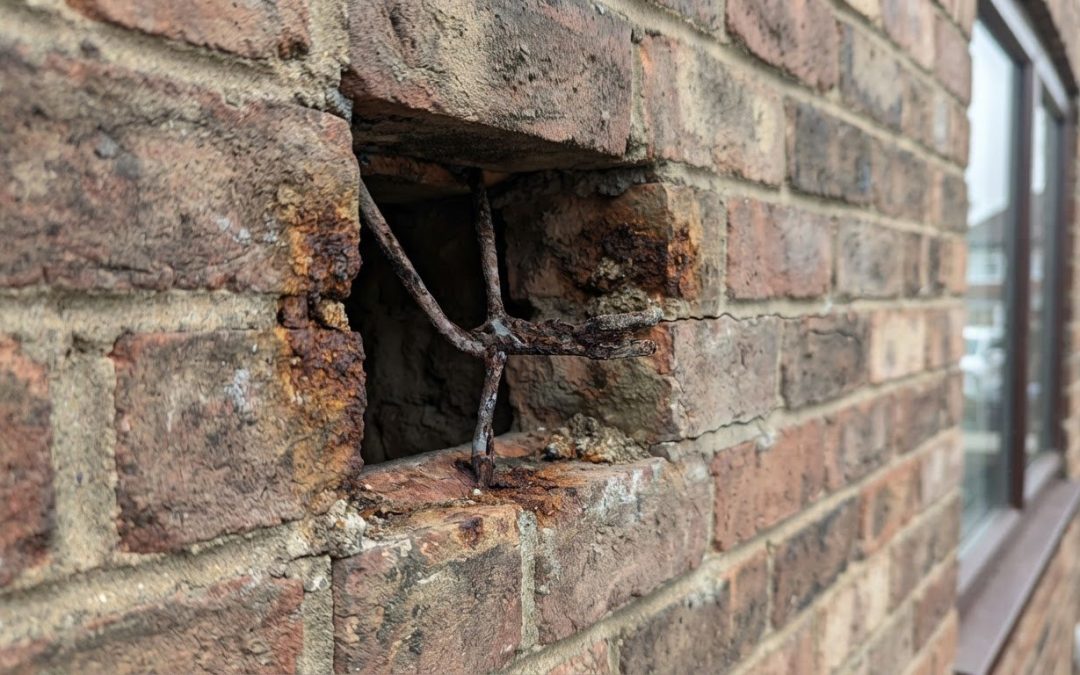
A wall can look sound while its ties are failing. Homes built before the mid-1980s are especially at risk because their wall ties may be prone to corrosion. Explaining the risks of ignoring wall tie failure to your family starts with knowing that corroded ties can allow masonry to move and, in severe cases, contribute to a wall collapsing.
It’s understandable to expect a hidden fault to show obvious signs, but wall ties sit inside the cavity and can deteriorate without visible cracks. When warning signs do appear, they may include horizontal cracks in mortar joints, bulging brickwork or masonry shifting around openings.
This article explains which properties may be more vulnerable, what changes to look for and how failing ties can affect an external wall’s stability. You’ll also learn how a targeted wall tie inspection can help establish whether signs point to tie failure or another issue, so you can respond calmly and make informed decisions about your home.
Key Takeaways
- Older cavity-wall homes may contain ties vulnerable to corrosion, which can weaken the connection between the inner and outer walls.
- Watch for regular horizontal mortar cracks, bulging brickwork or masonry shifting around openings, but remember these signs can have other causes.
- Wall ties are concealed, so the absence of visible cracks doesn’t prove they’re sound; a targeted survey can assess their condition.
- As ties corrode and lose their bond, masonry may move or become unstable, with severe failure potentially leading to collapse.
- Understanding the cause of cracking or movement helps identify whether wall tie replacement or another remedial step is appropriate.
How corroded wall ties can cause wall movement and structural instability
Wall ties connect the inner and outer leaves of a cavity wall, helping them act as one structural unit. In UK homes, corrosion can weaken that connection and allow the outer masonry to move.
Older Wall-Tie Materials
Wall-tie material and protection affect how well a tie resists corrosion. Older ties may be galvanised metal wire, ungalvanised metal or coated iron-based metal. Mild steel was widely used in UK properties up to the late 1980s, unless ties were properly galvanised or stainless. These materials can behave differently as moisture reaches the metal, so a property’s construction date provides context, not a diagnosis.
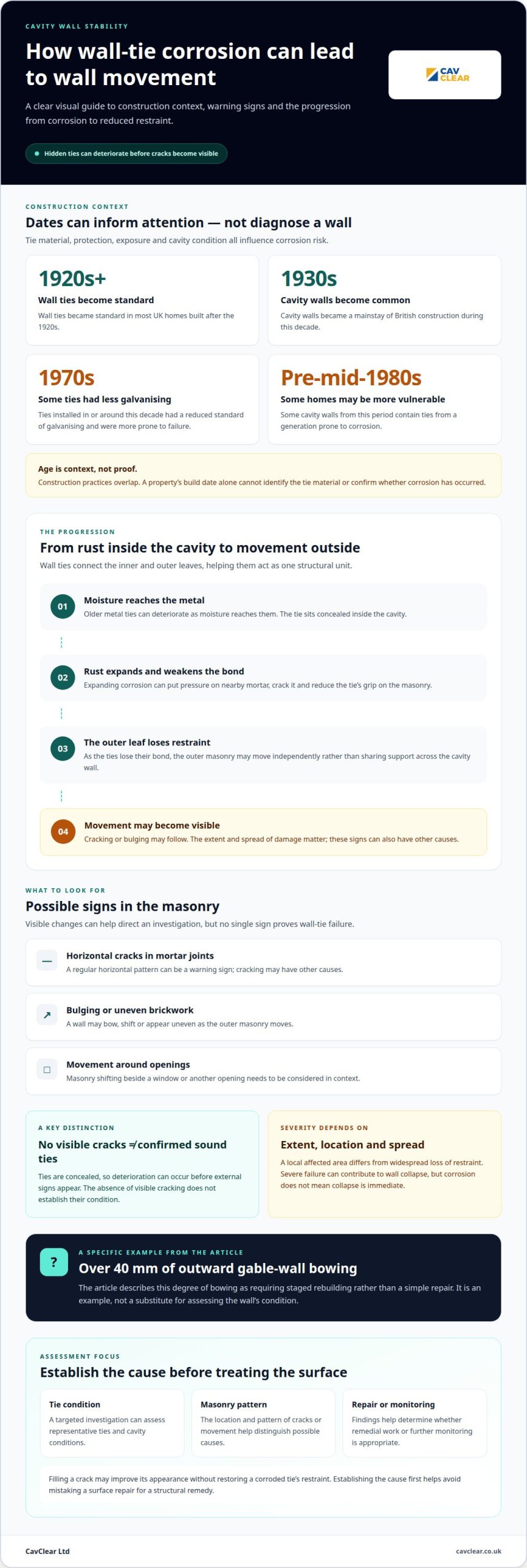
Some cavity walls built before the mid-1980s contain ties from a generation prone to corrosion. Ties installed in or around the 1970s had a reduced standard of galvanising and were more prone to failure. Construction practices overlap, however. A house’s age alone cannot show which material sits inside its cavity or whether its ties have corroded.
Corrosion and Expansion
Corrosion is the deterioration of metal as it reacts with moisture and its surroundings. As a wall tie rusts, it can expand, crack nearby mortar and lose its bond with the masonry. Because the tie sits within a confined cavity, damage can build out of sight before the external brickwork shows movement.
Wall-Tie Corrosion in Older UK Homes
Cavity walls became a mainstay of British construction since the 1930s, and wall ties became standard in most UK homes built after the 1920s. Their presence is necessary, but older mild steel ties can deteriorate over time, particularly where moisture reaches them. Older homes are not all alike: tie material, protection, exposure and the condition of the cavity influence the risk.
For example, two neighbouring houses from the same decade may have different tie materials or different levels of corrosion. A home built before the 1990s may merit attention, but age alone does not establish failure. A targeted investigation can locate representative ties and assess their condition, rather than treating the build date as proof of a defect.
Loss of Restraint and Wall Movement
Loss of restraint occurs when corroded ties no longer hold the outer masonry securely against the inner wall leaf. As the ties’ bond weakens, the outer wall can move independently rather than sharing support across the cavity-wall structure. Movement may progress from local cracking to wider instability, particularly if several ties have deteriorated.
From Corrosion to Structural Instability
The process can develop in stages. A tie corrodes, expanding rust puts pressure on nearby mortar, and its grip on the masonry weakens. The outer leaf then has less restraint against movement. Cracks or bulging may follow, although these signs can have other causes. Their pattern and location help distinguish a possible tie problem from other defects.
Corrosion does not mean a wall will collapse immediately. The extent and distribution of damage matter: one affected area is different from widespread loss of restraint across an elevation. A specialist wall-tie investigation can assess representative ties, cavity conditions and signs of movement. This evidence helps determine whether repair or further monitoring is appropriate.
Why the Cause Matters
Repointing a crack may improve its appearance without restoring a corroded tie’s restraint. For example, a filled mortar joint may open again if movement continues behind the brickwork. Establishing the cause first helps avoid mistaking a surface repair for a structural remedy. A sound assessment considers tie condition alongside visible masonry and the property’s construction history.
Structural and safety risks of wall tie failure
Failed wall ties can allow the outer leaf to move separately from the inner wall. The level of concern depends on the extent and location of damage and its effect on the surrounding masonry. A measured explanation helps family members focus on what has been observed and what needs assessment, rather than assuming the worst.
Movement in the Outer Brickwork
Movement occurs when weakened ties no longer restrain the outer brickwork against the inner leaf. The outer masonry may then bow, shift or become uneven instead of sharing support across the cavity wall. Movement can extend beyond one patch of brickwork, so a specialist assessment considers its pattern and location, not just one visible crack.
For example, a crack beside a window may raise different questions from movement across a broad wall face. Neither pattern proves tie failure. Other defects can produce similar signs, so visible brickwork needs to be considered alongside the condition of ties inside the cavity.
A practical way of explaining the risks of ignoring wall tie failure to family is to separate observed changes from what remains unknown. Point out the affected area, explain that cracking can have several causes, and agree to establish the cause before cosmetic repairs. This keeps the discussion factual and gives everyone a shared next step: arrange an assessment and don’t mistake a surface repair for proof that the structure is sound.
Structural Damage from Failed Ties
Structural damage can develop when reduced restraint allows the outer masonry to move, putting stress on nearby brickwork. Cracked mortar, displaced bricks or a bulging wall may signal a developing problem, although each sign needs interpretation. Continued movement can further weaken the wall and make remedial work more extensive.
A gable wall bowing outward by over 40mm is described as requiring staged rebuilding rather than a simple repair. This shows why the amount and spread of movement matter. It doesn’t mean every crack requires rebuilding. An assessment must distinguish local damage from broader instability and establish whether failed ties are involved.
Insurance and Family Next Steps
There is no single answer for every UK home insurance policy. Read the wording about structural damage and ask your insurer how it applies to your circumstances. Keep the discussion focused on the actual damage and inspection findings, rather than assuming all wall tie problems receive the same treatment.
If you’re explaining the risks of ignoring wall tie failure to family, agree on a practical next step: decide who will record visible changes and arrange an assessment. Photograph cracks or displacement, note where they appear, and avoid repointing them before the cause is established. If a wall appears to be changing, keep people clear of the affected area while its condition is assessed.
A targeted investigation can inspect representative ties and consider the masonry, helping distinguish tie-related movement from other causes. The findings can inform whether remedial work or further observation is appropriate. A cavity wall tie inspection can help assess suspected failure and give your household a clearer basis for discussing next steps.
Early signs such as bulging walls and rust staining
Look for changes in the brickwork, especially regular horizontal cracks, bulging or displaced masonry. These signs can have other causes, so they need assessment rather than assumption.
Cracks, Bulges and Displacement
Horizontal cracks along mortar joints, sometimes appearing at regular intervals, can be an early sign of wall tie failure. Pay attention to cracks that follow a bed joint across the wall, rather than treating every isolated crack as evidence of the same fault. Cracks around every sixth brick layer are one pattern worth investigating.
Also look for outward bulging, uneven brickwork or masonry lifting around openings such as windows. A change in the line of a wall may be easier to notice from an angle or against a straight reference point. Photograph the area and record the date so later observations can be compared with its original condition.
These signs don’t prove that ties have failed. Other defects can cause similar cracking or movement, so a surveyor needs to consider the pattern, location and surrounding masonry. Avoid repointing or filling cracks before establishing their cause. A surface repair can hide a developing pattern without addressing the underlying problem.
Why a Clear Wall Doesn’t Rule Out Failure
Failing wire ties don’t always cause visible cracks in external walls. Because the ties sit inside the cavity, deterioration may remain concealed while the brick face appears unchanged. So an absence of cracking doesn’t show that every tie is sound.
A standard home survey won’t see most ties inside a cavity unless it includes a targeted investigation. A specialist inspection can locate representative ties and examine the cavity with a borescope or camera. If cavity wall insulation obscures damaged ties, some mortar or brickwork may need to be removed to expose their ends for assessment.
Rust Staining and the Next Diagnostic Step
Rust staining may appear around a wall tie’s position, but it’s an uncommon warning sign because ties are concealed. Don’t rely on staining alone or wait for it before taking other changes seriously. Regular horizontal cracks, bulging and displaced brickwork are useful observations for a diagnosis, even though none confirms tie failure by itself.
Keep a simple record: note the crack’s location, photograph it and compare the image with later observations. Share that history with the surveyor, along with any visible bulging or movement around openings. The findings can then inform whether wall tie replacement or another remedial response is appropriate. The diagnosis should guide the repair, not the appearance of a single crack.
Understanding Child Neglect as a Separate Issue
Child neglect is separate from neglect of property and should not be confused with wall tie failure. According to the NSPCC, neglect is the ongoing failure to meet a child’s basic needs, and 1 in 10 children in the UK have experienced it.
If a child tells you they have experienced neglect, the NSPCC advises adults to listen carefully, reassure the child and report what they have said as soon as possible. That safeguarding response is separate from documenting cracks or arranging a cavity wall assessment.
Risk of external masonry collapse
Severely weakened walls can bulge or undulate as their restraint deteriorates. In the worst cases, some or all of the external masonry can collapse.
Collapse is the most serious possible outcome, not an inevitable result of every failed tie. The risk depends on the condition and extent of damage, the wall’s movement and the restraint that remains across the elevation. For example, a local defect differs from widespread loss of restraint across a gable wall. An inspection helps establish the actual condition before anyone assumes the whole building is unsafe.
Age can help identify where closer attention may be useful. UK cavity-wall homes built between 1920-80 are identified as having ties from a generation prone to corrosion. Homes built before the 1990s are also especially susceptible to cavity wall tie corrosion. These dates indicate potential risk, not proof: material, protection and exposure all affect how installed ties perform.
Later construction isn’t an automatic guarantee of sound ties. Properties built after 2000 use stainless steel ties, although flaws are still possible. A visible crack in a newer home still deserves a proper diagnosis, while an older property with no obvious movement still cannot be judged by age alone. The inspection should focus on the ties and masonry, not just the year of construction.
Children may be at greater risk if they play or walk close to a visibly unstable wall. The immediate practical step is to keep them away from the affected area while its condition is assessed. Explain, for example, that a bulge or loose masonry needs checking before anyone leans against the wall or plays beside it. This is a precaution, not a prediction that collapse will occur.
Cavity wall insulation can complicate an inspection because material inside the cavity may conceal tie damage. A specialist can assess how the insulation affects visibility and access to the ties. Mortar joints matter too: cracks, displacement and changes in the wall’s shape provide useful context, but none confirms collapse risk on its own. The inspection needs to consider the pattern across the elevation.
Where wall ties have failed, the repair decision depends on the assessment findings. Relevant questions include how much masonry has moved, whether damage is local or widespread, and whether the ties still provide restraint. Stainless-steel replacement ties may be appropriate after diagnosis, but the visible condition of the mortar alone cannot determine the work needed.
When discussing the issue with your household, separate observed facts from the worst-case possibility. Point out the exact area, describe changes such as a growing bulge, and agree to keep children clear until an inspection clarifies the risk. This gives family members a practical safety measure without presenting collapse as certain. A timely, evidence-based assessment supports decisions about protecting occupants and addressing damaged masonry.
CavClear: Cavity Wall Insulation Removal
CavClear can investigate whether concerns relate to failing wall ties, cavity wall defects or problematic insulation. Its Wall Tie Surveys and Cavity Wall Surveys assess cavity-wall condition, while Wall Tie Replacement addresses ties identified as failing. Where defective cavity wall insulation is contributing to property problems, Cavity Wall Insulation Removal may be appropriate.
A clear diagnosis helps you discuss the findings and practical next steps with your family. Contact CavClear to discuss a wall tie or cavity wall concern and the appropriate survey or remedial service.
Make a Clear Plan for Your Home
Explaining the risks of ignoring wall tie failure to your family doesn’t mean asking them to expect the worst. It means giving everyone a calm, practical way to respond: record what you’ve noticed, agree who will arrange an assessment, and keep the household informed as you learn more.
A clear diagnosis can replace uncertainty with a sensible decision about what happens next. It also helps family members understand why a repair should address the cause, rather than simply conceal visible damage. Keep photographs and inspection findings together so the household can refer to the same information when discussing the property.
If wall movement or tie failure is a concern, take the next step by discussing the property with a specialist. CavClear provides Wall Tie Surveys, Wall Tie Replacement and Cavity Wall Insulation Removal, depending on the issue identified. Contact CavClear about wall tie concerns and take a measured step towards protecting your home’s long-term condition.
Frequently Asked Questions
Who is at risk?
People living in or regularly passing beside a property with severely weakened external masonry face the most direct risk. UK cavity-wall homes built between 1920-80 are associated with wall ties prone to corrosion, although age alone doesn’t establish failure. Children playing near an affected wall deserve particular consideration. Keep household members away from visibly bulging or shifting masonry until its condition has been assessed.
Are Corroded Wall Ties Dangerous?
Corroded wall ties are a structural concern because they can lose their bond and fail to restrain the outer wall. This can allow masonry to move, and severe deterioration may lead to partial or complete collapse of the external leaf. Corrosion itself is concealed inside the cavity, so the level of risk depends on the ties’ condition and the wall’s movement, not simply on the presence of rust.
What are wall ties and how do they fail in UK cavity walls?
Wall ties are metal connectors that join the inner and outer leaves of a cavity wall, helping them act as one structural unit. Most UK homes built after the 1920s use ties, but older properties can contain mild steel or lightly protected metal. Moisture can corrode these materials; rust expansion then stresses mortar and weakens the tie’s hold. A targeted inspection assesses the hidden components.
What are the warning signs of wall tie failure?
Warning signs include horizontal cracks following mortar joints, outward bulging, displaced bricks and lifting around windows or doors. A practical step is to photograph each affected area from the same position and note the date, so you can compare changes. These signs aren’t proof of tie failure, and some failing ties cause no visible cracks. A surveyor can investigate the cavity and consider other causes.
What safety risks can failed wall ties pose to a home and its occupants?
Failed ties can leave external masonry with less restraint, increasing the risk of movement and instability. If a wall is visibly bulging or bricks appear displaced, keep people, especially children, clear of the immediate area while arranging an assessment. Don’t lean ladders against the affected section or try to secure loose masonry yourself. An inspection should establish whether the concern involves ties or another defect.
What damage can happen if wall tie failure is left untreated?
As restraint weakens, the outer leaf can crack, bulge or move away from the inner structure. Corrosion can also fracture surrounding mortar joints, while continued movement can worsen damage across the elevation. Severe wall-tie failure can require part of a house to be rebuilt. Repointing a crack without identifying its cause won’t restore a failed tie, so diagnosis should guide any repair decision.
How quickly can wall tie failure become dangerous, and what factors affect the risk?
There’s no single progression rate that applies to every wall. Older mild steel ties typically begin to fail after 30 to 50 years, while the risk after deterioration depends on corrosion extent, moisture exposure, tie material and how damage is distributed. A small affected area differs from widespread loss of restraint. An inspection of representative ties and surrounding masonry helps assess the property’s current condition.
Recent Comments