
What if the recommendation for a full structural repair is actually based on a visual guess rather than a physical fact? Many UK homeowners find themselves in a state of panic after a general building survey flags potential masonry issues, but getting a second opinion on wall tie failure is the only way to replace anxiety with evidence. It’s understandable to feel a sense of distrust when you’re faced with a significant repair bill but haven’t seen the actual condition of the ties inside your cavity walls. You deserve to know whether a crack is a minor cosmetic blemish or a genuine threat to your property’s stability.
This guide will show you how specialist diagnostic tools, such as high-resolution borescopes, provide the intrusive evidence that general surveys lack. We’ll examine the critical differences between a standard homebuyer’s report and a dedicated wall tie inspection conducted by technical experts. By the end of this article, you’ll understand how to verify the health of your property’s structural components. This knowledge ensures you make an informed decision about the long-term preservation of your home while avoiding unnecessary expenses for work your property might not even require.
Key Takeaways
- Understand why general homebuyer reports often rely on standard cautionary language and why a visual inspection alone cannot confirm the internal state of your masonry.
- Learn the technical process of getting a second opinion on wall tie failure to differentiate between minor cosmetic cracks and serious structural corrosion.
- Discover the importance of intrusive diagnostics, such as high-resolution borescope imagery, which provides definitive physical evidence of tie integrity within the cavity.
- Gain clarity on how to interpret specialist reports by understanding the industry-standard corrosion grading system, ranging from Grade 1 to Grade 4.
- Identify how a specialist survey from a nationwide provider ensures you receive a transparent, evidence-based recommendation for the long-term health of your property.
Why Seek a Second Opinion on Wall Tie Failure?
A standard homebuyer’s report often triggers immediate concern for property owners. These documents frequently include cautionary remarks about structural integrity that can feel alarmist without providing specific evidence. Getting a second opinion on wall tie failure is a logical step when a general survey uses vague language to describe potential masonry issues. Because wall tie replacement represents a significant investment in your property’s long term health, you shouldn’t commit to remedial work based on a visual guess. A specialist verification protects your finances and ensures that any work performed is strictly necessary.
Distrust often arises when a general surveyor suggests expensive repairs without looking inside the cavity. For both buyers and lenders, a second opinion provides the technical certainty required to proceed with a property transaction. It moves the conversation away from speculation and toward a data-driven assessment of the building’s structural state. This transparency is vital for maintaining the value of your asset and ensuring the safety of its occupants.
The “Cautionary” Survey Report vs. Reality
General surveyors often flag properties built between 1920 and 1981 by default. During this period, many builders used mild steel or galvanized ties that have a predictable lifespan of 15 to 20 years. However, a surveyor might conflate loose mortar or simple weathering with active tie corrosion. They’re often “covering their backs” by recommending further investigation. While it’s risky to ignore these warnings, it’s equally wasteful to pay for remedial work if the ties are still structurally sound. A specialist survey determines if the ties are actually failing or if the masonry just needs standard maintenance.
Signs That Demand a Specialist Investigation
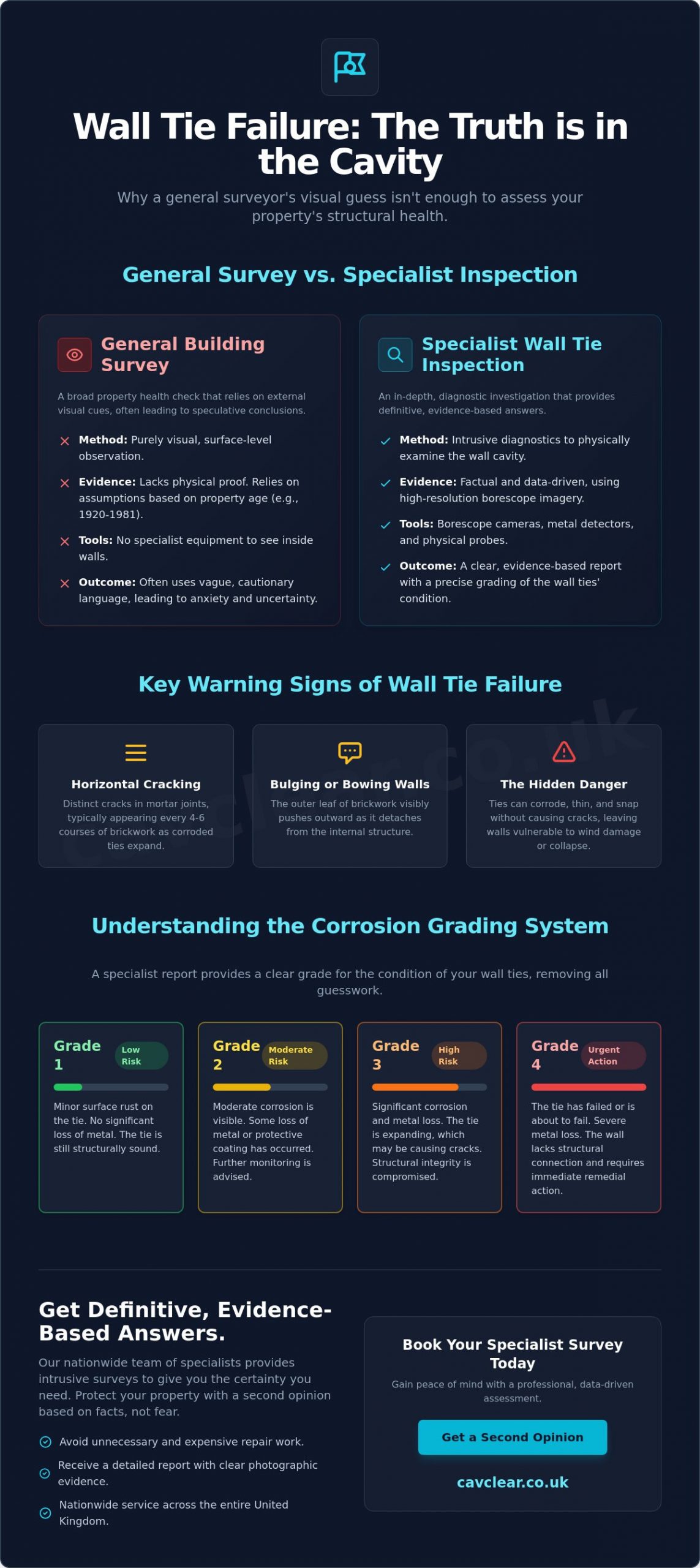
To understand the urgency of the situation, homeowners should first understand what cavity wall ties are and how they behave when they fail. When steel ties corrode, they expand to several times their original size. This physical expansion forces the mortar joints apart, creating distinct horizontal cracks at regular intervals, usually every four to six courses of brickwork. You might also notice the external leaf of the wall “bowing” or bulging outward as it loses its connection to the internal structure.
It’s vital to remember that the absence of cracks doesn’t always mean your ties are healthy. In some cases, ties can thin and snap without causing masonry expansion, leaving the wall vulnerable to wind loading without any external warning signs. Getting a second opinion on wall tie failure involves an intrusive inspection that identifies these hidden threats before they lead to a structural collapse. This proactive approach is the only way to confirm the safety of your home with absolute certainty.
General Building Surveys vs. Specialist Wall Tie Inspections
A general building survey is a broad health check of a property. It identifies visible symptoms like masonry cracking or bulging but lacks the diagnostic tools to investigate the root cause hidden within the cavity. Getting a second opinion on wall tie failure requires moving beyond these surface-level observations. Specialist inspections use intrusive methods to provide a definitive answer about the state of the metal components holding your home together. While a general surveyor might recommend work based on a property’s age, a specialist provides a factual assessment of the actual hardware.
The difference lies in the evidence. General surveyors are often limited by their insurance and equipment, meaning they can only report on what they see from the pavement. A specialist technician uses physical probing and digital diagnostics to eliminate the guesswork. This process ensures that you don’t spend money on structural repairs that your property might not actually need, while also catching hidden faults that a visual check would miss.
The Role of Borescope Cameras and Metal Detectors
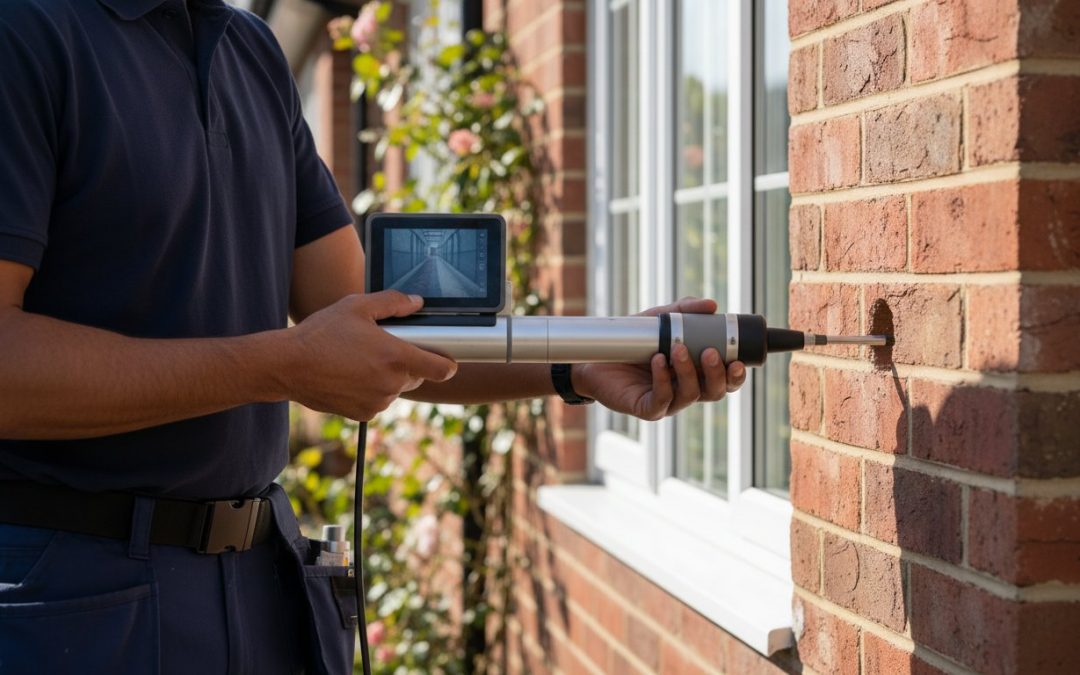
Specialist technicians utilize high-sensitivity metal detectors to map the location of existing ties. This verification is essential because many older properties suffer from irregular installation patterns or insufficient tie density. Borescope cameras are then inserted to allow for direct visual confirmation of the ties’ condition. We reference the history of wall tie standards to understand that ties in pre-1981 homes are particularly susceptible to corrosion due to the materials used at the time. A visual-only second opinion is effectively no better than the first report; without looking inside the wall, it remains a speculative exercise.
Intrusive Testing: What to Expect During the Visit
Homeowners often worry about property damage during a specialist visit. In reality, the process is clean and non-disruptive. Technicians drill small, discreet holes into the mortar joints, typically 10mm to 12mm in diameter. These entry points allow the borescope to enter the cavity and inspect the ties without damaging the brickwork. In specific scenarios, a single brick might be removed to extract a tie for physical analysis, allowing for the measurement of metal loss using calibrated tools. This level of detail ensures the inspection is professionally executed and leaves your property’s facade undisturbed once the holes are matched and filled.
The outcome of this process is a comprehensive report that includes a tie density map. This document identifies exactly where ties are located and, more importantly, where they are missing or failing. This data-driven approach allows for an accurate calculation of structural risk. If you’re currently facing uncertainty following a general survey, booking a professional wall tie survey offers the evidence-based clarity required to protect your investment and ensure long-term structural integrity.
Evaluating Specialist Findings: Generalists vs. Remedial Experts
When you receive a report suggesting structural instability, your first instinct might be to call a structural engineer. While these professionals are experts in load-bearing physics, they often lack the intrusive diagnostic tools required for a definitive cavity inspection. Getting a second opinion on wall tie failure from a remedial specialist ensures that the diagnosis is based on physical evidence rather than theoretical risk. This distinction is critical because many general engineers will simply reiterate the findings of a homebuyer’s report without ever seeing the ties themselves. A specialist technician focuses on the specific hardware within the wall, providing a level of detail that generalists cannot match.
Homeowners frequently worry that a specialist contractor will always find a problem to secure work. You can identify an impartial expert by their insistence on technical methodology and transparency. A reliable specialist will use high-resolution borescopes to provide photographic proof of corrosion. They will also distinguish between different tie types. For instance, heavy fishtail ties are prone to causing significant masonry expansion when they rust. In contrast, thin wire ties can corrode and snap without leaving a single mark on the outside of your house. Identifying these nuances is the hallmark of a true specialist.
Addressing Potential Conflicts of Interest
Transparency is the most effective tool against biased reporting. A reputable specialist provides detailed photographic evidence in every remedial recommendation, ensuring you see exactly what they see. They should also provide a fixed-price quote based on the physical evidence found during the survey. To provide an accurate second opinion, the specialist must have a deep understanding of what is a cavity wall and how its specific mechanics influence tie degradation. This knowledge allows them to offer a solution that prioritizes the long term health of your asset rather than a quick fix.
Understanding Invisible Corrosion in Pre-1981 Homes
The history of UK property construction reveals why 1981 is a critical cutoff date. Before this year, the standard zinc coating on wall ties was significantly thinner, making them highly susceptible to corrosion. Many properties built in this era use bright wire ties. These components are particularly dangerous because they can fail entirely without causing horizontal cracking in the mortar. This invisible failure means the outer leaf of your home could be detached from the inner leaf with no visual warning. Specialist verification is the only way to catch this. We follow the standards for specialist remedial stabilisation to ensure that every inspection accounts for these hidden risks, moving beyond age-based assumptions to deliver a factual report on your property’s integrity.
How to Interpret a Specialist Second Opinion Report
Once the technical inspection is complete, the resulting document should serve as a definitive structural audit of your property. A professional report is more than a summary of observations; it is a data-driven record of your home’s internal condition. When you are getting a second opinion on wall tie failure, the quality of the report determines whether you can move forward with confidence or remain in a state of uncertainty. A vague letter without physical evidence is insufficient for making informed decisions about property preservation.
Every specialist report must include high-resolution borescope imagery. These photographs provide the “intrusive evidence” required to verify the state of the ties within the cavity. The document should also provide a clear classification of tie corrosion, typically ranging from Grade 1 (no corrosion) to Grade 4 (severe structural failure). Additionally, the technician should specify the exact type of ties found and their current density per square metre. This level of detail allows you to compare the current state of your masonry against modern safety standards.
Critical Questions for Your Remedial Surveyor
Interpreting the findings requires a proactive approach. You should ask your surveyor specific questions to ensure the diagnosis is thorough. Start by asking to see the photographic evidence of the corrosion for each elevation of the house. It’s common for one side of a property to show more degradation than others due to weather exposure. You must also ask if the proposed solution includes isolating the old, expanding ties. Simply installing new hardware is not enough if the original steel is left to continue rusting and cracking your brickwork.
Evaluating the Proposed Remedial Action Plan
The action plan should outline a permanent fix, not a temporary patch. If the report identifies Grade 3 or Grade 4 corrosion, the recommendation must include the installation of stainless steel remedial ties that meet current British Standards. It is vital that the old ties are either physically removed or isolated using specialist sleeves to prevent “jacking,” which is the process of expanding rust forcing mortar joints apart. View the wall tie replacement process as a long-term investment in the stability of your asset. A comprehensive quote should cover all necessary elevations and structural supports to ensure the entire building is secured.
If you have received a general survey that lacks these technical details, it is time to secure a fact-based assessment. You can book a nationwide wall tie survey today to receive a transparent report backed by high-resolution digital evidence.
CavClear: Nationwide Specialist Wall Tie Surveys and Remediation
CavClear provides authoritative second opinions for homeowners and property buyers across the entire United Kingdom. We understand the stress that follows an ambiguous building survey, and our service is designed to replace that uncertainty with technical precision. Getting a second opinion on wall tie failure from our accredited technicians ensures that your property’s structural integrity is assessed using physical facts rather than visual assumptions. Our nationwide coverage means that expert diagnostic support is available regardless of your location, providing a consistent standard of professional rigor for every client.
Our methodology focuses on evidence-based diagnostics that leave no room for doubt. We utilize advanced borescope technology to look inside the cavity, capturing high-resolution digital imagery that forms the basis of every recommendation we make. This transparent approach empowers you to make the right decision for your property’s future. We prioritize long-term asset health, ensuring that any remedial work we propose is strictly necessary, structurally effective, and compliant with modern building standards. By focusing on the physical state of the ties, we eliminate the guesswork that often leads to over-specified and expensive repairs.
Professional Integrity and Non-Disruptive Solutions
Our specialist surveys provide the technical clarity required to satisfy the stringent requirements of mortgage lenders and insurers. By delivering a report backed by intrusive digital evidence, we remove the “cautionary” hurdles that often stall property transactions or inflate insurance premiums. We are also the trusted choice for a professional damp survey and structural repairs. This holistic understanding of building physics ensures that our solutions are clean and non-disruptive. We restore property safety and comfort without causing unnecessary disturbance to your daily life or the building’s external facade.
Secure Your Property’s Future Today
Acting on specialist advice is essential to prevent wall collapse or significant masonry distortion. In many instances, getting a second opinion on wall tie failure actually saves you money. It prevents the high costs associated with unnecessary remedial work when ties are still sound, while also identifying critical faults before they escalate into emergency structural failures. A specialist survey is a vital investment in the stability and value of your home. You can contact our expert team today for a comprehensive nationwide wall tie inspection and secure the permanent fix your property deserves.
Secure Your Investment with Technical Certainty
Our team of accredited technicians utilizes advanced borescope diagnostics to provide a clear, evidence-based assessment of your masonry. We deliver comprehensive technical reporting that satisfies lenders and provides you with absolute clarity. Don’t let structural uncertainty affect your property’s value or your peace of mind. You can book an expert nationwide wall tie survey with CavClear today to receive a transparent evaluation of your home. Taking this proactive step restores your comfort and ensures your property remains safe and secure for decades to come.
Frequently Asked Questions
Is a second opinion necessary if the first surveyor only found “suspected” failure?
A second opinion is essential when a general surveyor uses the term “suspected” because it indicates a lack of physical evidence. General surveys are visual and non-intrusive, meaning they cannot confirm the internal state of the metal ties. Getting a second opinion on wall tie failure ensures that you don’t pay for expensive structural repairs based on a visual guess. We use high-resolution borescopes to provide the physical confirmation that a general report lacks.
Can wall tie failure be fixed without replacing every tie in the house?
Targeted remediation is often possible if the corrosion is localized to a specific elevation or section of the building. A specialist survey maps the tie density and condition across the entire property using calibrated metal detectors and cameras. This data-driven approach allows for a precise remedial plan that only addresses the failing areas. You don’t always need a full house replacement if the evidence shows that certain sections remain structurally sound and secure.
How much does a specialist wall tie survey cost compared to a general one?
A specialist wall tie survey carries a specific fee because it involves the use of specialized diagnostic equipment and technical expertise. In contrast, a general homebuyer’s survey is a broad visual check included in a larger property report. While the specialist survey is an additional upfront cost, it provides the intrusive evidence needed to avoid the much higher expense of unnecessary structural work. It’s a vital investment in the accuracy of your property’s health report.
Will a specialist second opinion be accepted by my mortgage lender?
Mortgage lenders and insurers typically prioritize specialist reports because they contain high-resolution photographic evidence and technical data. A general survey often triggers a “retention” or a request for further investigation before a loan is approved. Providing a technical report from an accredited specialist demonstrates that you’ve performed due diligence. This transparency often satisfies the lender’s requirement for structural certainty and protects the long term health of the asset.
What happens if I ignore the signs of wall tie failure mentioned in a survey?
Ignoring the symptoms of corrosion can lead to significant structural distortion or the eventual collapse of the external masonry leaf. As ties rust and expand, they force mortar joints apart, which compromises the building’s stability and weather resistance. Delaying action often results in more expensive repairs later, as the damage spreads from the ties to the brickwork itself. Proactive verification is the safest and most cost-effective path to property preservation.
How long does a specialist wall tie inspection usually take to complete?
A standard specialist inspection usually takes between two and four hours to complete. This timeframe allows the technician to scan all elevations with a metal detector and perform borescope investigations at various points. The duration depends on the size of the property and the accessibility of the cavity walls. Once the physical check is finished, the data is compiled into a comprehensive technical report that includes photographic evidence of the ties’ condition.
Do I need to move out of the property while a second opinion survey is conducted?
You don’t need to move out or vacate the property while the survey is being conducted. The process is entirely non-disruptive and primarily takes place on the exterior of the building. Technicians drill small, discreet holes into the mortar joints to insert the camera, and these are then professionally filled and matched. You can continue your daily routine inside the home while we secure the evidence needed for your structural report.
Can I use a borescope myself to check my own wall ties?
While consumer-grade borescopes are available, they’re not a substitute for a professional inspection. Identifying the difference between surface oxidation and structural Grade 4 corrosion requires technical training and experience. Professionals also use calibrated metal detectors to verify tie density and installation patterns. Getting a second opinion on wall tie failure from an expert ensures the report is accurate, authoritative, and acceptable to lenders or insurers.
Recent Comments