
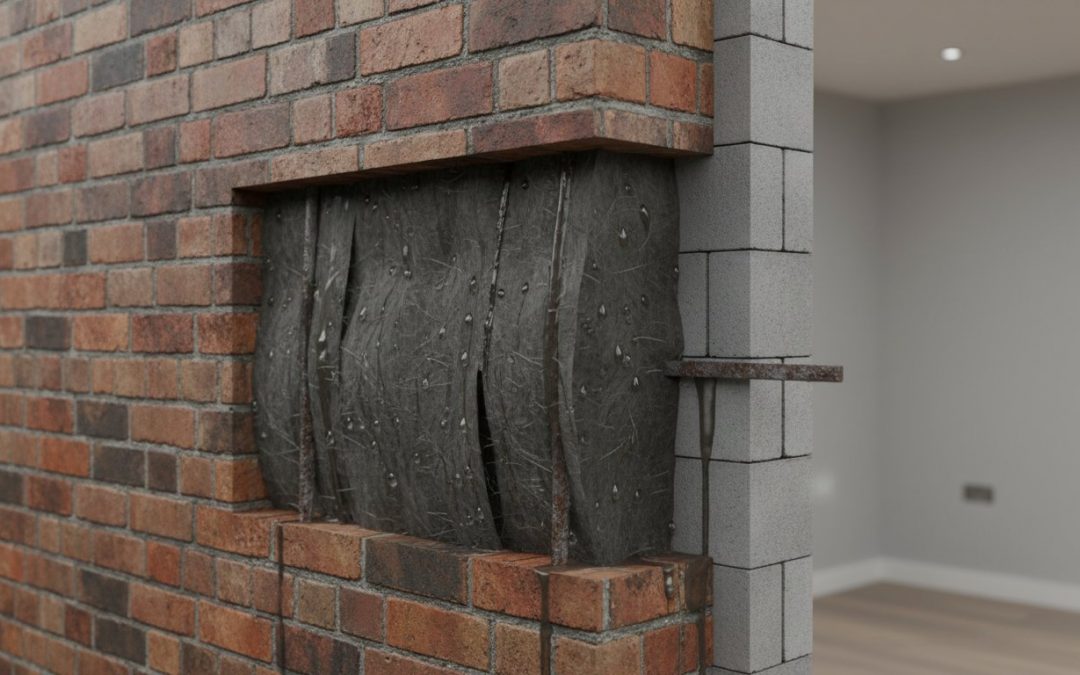
Your home’s insulation might be the primary reason your walls are failing and your heating bills are rising. While many homeowners expected a warmer property, saturated insulation often acts as a bridge for moisture, leading to persistent damp and structural decay. Understanding the cost to remove damp insulation UK is the first step toward reclaiming a healthy living environment. You’re probably tired of wiping condensation from windows and seeing black mould return no matter how much you heat the house. It’s a stressful situation, but it’s one that can be fixed through a methodical, specialist approach.
This guide provides a comprehensive breakdown of the technical variables that influence extraction pricing in 2026. We’ll explain how factors like property size and the type of defective material determine the final quote. You’ll also learn why removing this debris is a structural necessity to prevent wall tie corrosion and restore your home’s natural thermal efficiency. We’re here to provide the clarity you need to make an informed decision about your property’s long-term health and your family’s comfort. By restoring the integrity of your cavity walls, you can ensure a dry, efficient home for decades to come.
Key Takeaways
- Understand the 2026 pricing for professional extraction, with the average cost to remove damp insulation UK typically ranging from £21 to £25 per square metre.
- Learn how saturated insulation acts as a “bridge” for moisture, creating structural risks such as accelerated wall tie corrosion and internal damp.
- Discover the specialist technical process used to safely clear cavities, involving borescope mapping and strategic extraction points to ensure a thorough clean.
- Identify the critical factors that influence project costs, from the specific type of defective material to the extent of insulation saturation.
- Recognize why maintaining a clear, breathable cavity is the only professional solution for restoring structural integrity and long-term property health.
What is the Average Cost to Remove Damp Insulation in the UK?
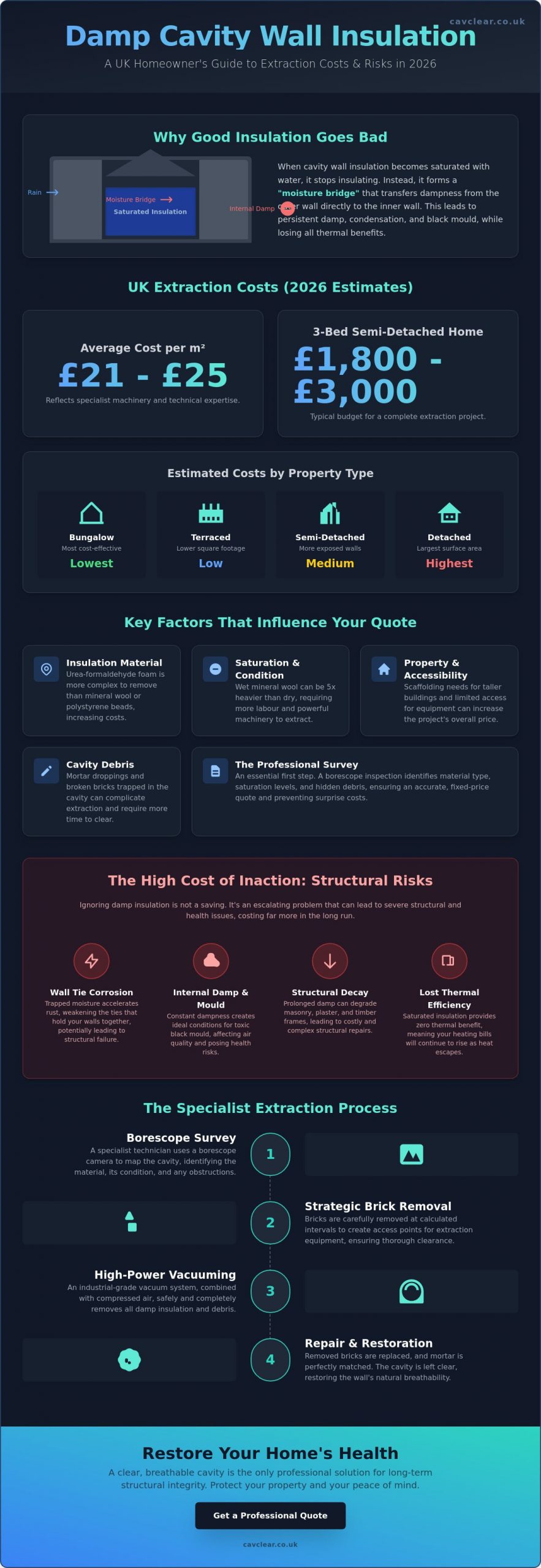
In 2026, the average cost to remove damp insulation UK typically ranges from £21 to £25 per square metre. For a standard three-bedroom semi-detached property, homeowners should budget between £1,800 and £3,000 for a complete extraction project. These figures reflect the specialized machinery and technical expertise required to safely clear a wall cavity without compromising the building’s structure. While some may consider these costs an unexpected burden, they represent a vital investment in protecting the property from long-term masonry damage and internal mold growth.
Professional extraction is a non-negotiable requirement for properties suffering from interstitial condensation. When insulation becomes saturated, it loses its thermal properties and begins to act as a bridge for moisture. DIY attempts often fail because standard domestic tools cannot reach the debris settled at the base of the wall. Specialists use high-powered industrial vacuums and compressed air systems to ensure every fragment of wet material is removed. This professional approach guarantees a clear cavity, which is the only way to restore the home’s natural breathability and thermal efficiency.
Cost Breakdown by Property Type
The total price of an extraction project depends heavily on the size and accessibility of the building. Terraced houses often have the lowest square metre requirements, but costs can rise if narrow alleyways or shared boundaries complicate equipment setup. Semi-detached and detached homes naturally incur higher costs because they have more exposed elevations that require treatment. Bungalows are generally the most cost-effective property type to service. Their reduced height often eliminates the need for extensive scaffolding, which significantly lowers the overall labour and equipment hire fees.
The Role of the Professional Survey
A comprehensive damp survey is the essential first step for any accurate quote. This diagnostic phase allows a specialist to identify the specific type of material inside the wall. Mineral fibre and polystyrene beads are common, but urea-formaldehyde foam is more difficult to extract and requires a higher level of technical skill. The surveyor will also check the Cavity Wall Construction for hidden debris, such as mortar droppings or broken bricks, which often trap moisture and complicate the extraction process.
Detecting these issues early prevents mid-project price hikes and ensures the team uses the correct extraction pattern. A survey provides the transparency homeowners need, moving the process from guesswork to a guaranteed technical solution. By identifying the root cause of the dampness, specialists can ensure the extraction provides a permanent fix for the property’s health.
Primary Factors Affecting the Price of Cavity Extraction
Determining the cost to remove damp insulation UK involves a detailed assessment of a property’s specific structural and material conditions. No two extraction projects are identical, as the technical requirements change based on the type of material used and the current state of the cavity. Specialists must evaluate these variables to ensure the structural integrity of the building remains intact while achieving a 100% clearance rate.
The condition of the material is a significant price driver. When insulation becomes saturated, it loses its lightweight properties. Saturated mineral wool can weigh five times more than dry material, which places additional strain on extraction machinery and increases the labor time required to clear the wall. If the insulation has slumped to the bottom of the cavity, it often forms a dense, compacted block that requires mechanical agitation to break apart before vacuuming can begin.
Insulation Material Complexity
The technical approach varies significantly depending on the substance inside the walls. Mineral wool is a common culprit for damp issues; it often becomes a heavy, sodden mass that requires high-powered, industrial-grade vacuum suction to remove. This process is methodical and focuses on preventing any fibers from remaining trapped behind wall ties.
Bonded beads present a different challenge. These are often installed with an adhesive that, over time, can fail or become too rigid. Extraction specialists frequently use chemical breaking agents to release the bond, allowing the beads to flow expertly into the extraction nozzle. Urea-formaldehyde foam is the most complex material to handle. It doesn’t flow like beads or wool. Instead, it requires a high density of drill points and manual agitation to pulverize the hardened foam into a dust that can be safely extracted. Homeowners should refer to UK Government Guidance to understand the standards expected for addressing these faulty installations.
Access and Structural Obstacles
Physical barriers around a property often dictate the choice of equipment and the number of technicians required. Conservatories or single-story extensions can limit ground-level access, meaning specialists must use reach-extending tools or specialized scaffolding. Narrow alleyways or properties with restricted boundaries also complicate the setup of high-volume vacuum units. These logistical hurdles increase the time spent on-site, which directly influences the total cost to remove damp insulation UK.
Construction debris, often referred to as “snots” in the trade, also impacts the project. These are lumps of mortar that fell into the cavity during the original build. They act as bridges for moisture and can trap damp insulation in hard-to-reach pockets. A specialist must identify these obstructions using borescope cameras to ensure the cavity is entirely clear. If your property is suffering from persistent cold spots, you can book a professional cavity inspection to identify the exact cause of the failure.
Property height is the final major factor. Work on a standard two-story house is straightforward, but three-story townhouses or apartment blocks require enhanced safety equipment and high-reach platforms. Every additional meter of height increases the technical difficulty of maintaining suction pressure, requiring more sophisticated machinery to complete the job effectively.
The True Cost of Inaction: Damp Insulation and Structural Risks
Cavity walls are designed to protect your home by creating a physical break between the external environment and your living space. When insulation becomes saturated, it destroys this protection by acting as a moisture bridge. Instead of a clear air gap, you have a sodden mass that pulls water directly from the outer brickwork to your internal walls. This constant transfer of moisture creates a cycle of decay that worsens with every storm. The material doesn’t dry out on its own; it remains trapped, keeping your walls cold and damp year-round.
Ignoring these signs is a gamble with your property’s future. The initial cost to remove damp insulation UK homeowners pay is a necessary investment to prevent catastrophic repair bills. Common structural issues caused by inaction include:
- Timber Decay: Floor joists embedded in damp masonry can develop advanced wet rot, compromising the safety of your floors.
- Plaster Failure: Constant moisture causes hygroscopic salts to migrate to the surface, causing internal plaster to bubble and blow.
- Thermal Bridging: Saturated insulation conducts heat out of the home, meaning your heating system has to work twice as hard for half the result.
Wall Tie Corrosion and Structural Stability
Steel wall ties are the hidden anchors that hold your property’s two leaves of masonry together. When wet insulation is left in the cavity, it holds moisture against these steel components, leading to rapid corrosion. As steel rusts, it expands to several times its original size. This expansion is strong enough to crack mortar joints and cause external walls to bulge or “bow.” We offer a comprehensive service that integrates wall tie replacement with our extraction process to secure your home’s stability. Structural failure isn’t just a safety issue; it can lead to insurance companies rejecting claims or a significant drop in property resale value during a survey.
Health Implications and Internal Damage
The internal impact of damp insulation is often the most distressing for families. Saturated material causes cold spots on your walls where moisture in the air condenses. This is the primary driver for black mould growth. While redecorating might provide a temporary fix, the mould will return as long as the wet insulation remains. By restoring the original “clear cavity,” we allow the building to breathe and dry out naturally. This is the most effective way to manage the cost to remove damp insulation UK residents face while ensuring a permanent solution that protects your family’s health. Our specialist team focuses on a clean, non-invasive extraction that restores your home to its original design standards, backed by a long-term guarantee for your peace of mind.
The Technical Extraction Process: A Step-by-Step Breakdown
The extraction of saturated material is a rigorous engineering task that demands precision. When homeowners evaluate the cost to remove damp insulation UK, they’re investing in a methodical five-stage process designed to restore the property’s structural health. This isn’t a simple cleaning job; it’s a technical recovery of the wall cavity.
1. Initial Borescope Inspection
Specialists begin by inserting high-definition borescopes into existing mortar joints. This allows the team to map the exact density of the damp material and identify blockages or internal obstructions like wall ties and mortar snots.
2. Strategic Access Points
To facilitate a gravity-assisted extraction, specialists remove specific bricks at the base of the wall, typically just above the damp proof course. This creates controlled exit points for the debris without compromising the building’s stability.
3. High-Pressure Agitation
Compressed air is injected through small holes higher up the wall. This high-pressure system is designed to agitate and loosen compacted or wet wool and beads, ensuring that material trapped around wall ties is expertd for extraction.
4. Industrial Vacuum Extraction
Using high-volume suction, the loosened material is pulled through the extraction points. All debris is funneled directly into sealed containers or heavy-duty bags, preventing any saturated fibers from escaping into the local environment.
5. Final Inspection and Restoration
Once the cavity is clear, a final borescope check confirms 100% removal. The specialists then replace the removed bricks using mortar that is carefully colour-matched to the existing masonry, leaving the facade looking untouched.
Specialist Machinery and Tools
Standard industrial vacuums are insufficient for this task because they lack the lift required to move heavy, water-logged insulation from deep within a cavity. Specialists utilize bespoke high-suction units that can handle the weight of saturated mineral wool or bonded beads. These systems work in tandem with high-definition borescopes to provide visual verification of a clean cavity. The compressed air systems used are also specialized; they feature directional nozzles that reach around internal obstructions that would otherwise harbor pockets of damp material.
Ensuring a Clean and Non-Invasive Site
Professionalism is defined by how a specialist manages the site. To protect your garden and driveway, teams use dust-suppression techniques and ensure all extracted material is immediately contained. Inside the home, specialists seal all internal vents to prevent any microscopic debris or dust from entering the living space during the high-pressure phase. This meticulous approach ensures the cavity wall insulation removal is complete and the property remains pristine. The final cost to remove damp insulation UK includes this commitment to a non-invasive, clean exit.
If you’re concerned about the state of your wall cavities, you can book a professional survey with our nationwide team at CavClear
Choosing a Specialist: The CavClear Approach to Cavity Restoration
CavClear prioritizes the long-term structural health of your property. We advocate for a clear, breathable cavity because it’s the only reliable way to ensure moisture doesn’t bridge the gap between your external and internal walls. Many homeowners investigate the cost to remove damp insulation UK only after realizing that wet material is the direct cause of internal damp and persistent mold. We don’t recommend re-insulating a previously failed cavity. A clear, empty space restores the building’s natural ventilation, which prevents wall tie corrosion and protects the masonry from expertze-thaw damage.
Our specialist extraction process is designed to protect the future thermal efficiency of your home. While it sounds counterintuitive, wet insulation actually pulls heat out of a building faster than an empty cavity. By removing the damp material, we allow the inner leaf of the wall to dry. This dry masonry provides better natural insulation than a sodden mass of mineral wool or bonded bead. Our nationwide teams focus on returning your home to its original, functional design.
Accreditation and Peace of Mind
Selecting a specialist requires looking at technical credentials and proven results rather than just the lowest price. Cheap extraction services often use underpowered equipment that leaves significant debris behind at the base of the walls. This remaining material creates moisture bridges that lead to recurring damp issues. Our technicians are trained specifically for structural remedial works and use high-powered vacuum systems to ensure a 100% clear cavity.
This expertise stems from a deep technical understanding of what is a cavity wall and how the UK’s unique weather patterns affect different types of masonry. We provide detailed technical reports after every job, documented with borescope photographic evidence. Every project we undertake comes with a long-term guarantee, providing the security you need for your property’s future.
Next Steps for Your Property
The path to a dry, comfortable home starts with a professional survey. Our specialists use borescope cameras to inspect the internal state of your walls and provide a fixed, transparent quote. When calculating the cost to remove damp insulation UK, we include the full setup, the extraction process, and a comprehensive cleanup. There are no hidden fees or surprise additions to the final invoice.
- Book a Survey: Arrange a site visit to identify the extent of the damp and receive a written technical assessment.
- Property Preparation: Ensure our team has clear access to the external walls of the property on the day of the extraction.
- Permanent Restoration: Once the material is removed, your walls will begin the drying-out process, permanently restoring your home’s structural integrity.
We operate across the entire United Kingdom, bringing national standards to every local project. Our goal is to provide a permanent solution that stops damp at the source, ensuring your home remains a safe and healthy environment for years to come.
Protecting Your Property with Professional Cavity Restoration
Leaving saturated material inside your walls leads to progressive masonry decay and significantly reduced thermal performance. While the cost to remove damp insulation UK homeowners face varies based on property size and the specific type of debris involved, it remains a vital investment to restore your home’s structural health. Professional extraction is a precise technical process that requires the right equipment to avoid further damage to your wall ties and brickwork.
CavClear provides national UK coverage, deploying accredited specialist technicians who utilize non-invasive suction technology to clear contaminated cavities. We back our work with comprehensive structural guarantees, ensuring your property remains dry and efficient for years to come. Taking action now prevents the spread of damp into your internal living spaces and stops the escalation of repair bills. You can restore your comfort and protect your home’s value by choosing a specialist committed to doing the job correctly the first time.
Book a Professional Cavity Survey and Get a Specialist Quote
We look forward to helping you secure a drier, healthier home environment.
Frequently Asked Questions
How long does the average insulation extraction take?
A standard extraction for a three bedroom semi-detached home typically takes 1 to 2 days to complete. Our specialist teams use industrial-grade vacuum machinery to ensure the process is efficient. Larger detached properties or homes with complex layouts may require up to 3 days to ensure every piece of debris is removed from the cavity.
Will removing damp insulation make my house colder?
Removing wet insulation won’t make your house colder because saturated material actually draws heat out of the property through thermal bridging. Wet mineral wool or foam loses its ability to trap heat, acting instead like a cold sponge against your internal walls. Once we clear the cavity, the natural air gap is restored, which helps to stabilise temperatures and eliminate cold spots.
Do I need to re-insulate my walls after the damp material is removed?
You shouldn’t install retrospective cavity wall insulation again because this practice often leads to the same moisture and bridge issues that caused the initial damage. Maintaining a clear and ventilated cavity is the most effective way to protect your home’s structural integrity. If you want to improve thermal efficiency, we recommend exploring external wall solutions that don’t compromise the cavity space.
Can I get a mortgage on a house with damp cavity wall insulation?
Lenders frequently refuse mortgage applications or retain a portion of the funds if a RICS surveyor identifies failing insulation during a Level 2 or Level 3 survey. Damp material is a significant risk factor for wall tie corrosion and structural decay. Professional extraction provides the necessary certification to satisfy lenders that the property is sound and meets standard UK lending criteria.
Is the extraction process messy for my home or garden?
The extraction process is non-invasive and remarkably clean because we use high-powered suction to pull material through hoses directly into sealed bags. Technicians remove specific bricks at the base of your walls to create exit points, which ensures no dust or debris enters your living areas. We clear all waste from the site, ensuring your garden and driveway remain in their original condition.
How do I know if my cavity wall insulation is actually damp?
Signs of saturated insulation include dark mould patches on internal walls, a persistent musty odour, or wallpaper that peels away from the surface. A professional borescope inspection offers 100% certainty by using a camera to view the material inside the wall. Understanding the cost to remove damp insulation UK is a vital first step if your inspection reveals slumped or wet mineral wool.
Does home insurance cover the cost of insulation removal?
Most standard UK insurance policies don’t cover the cost to remove damp insulation UK because they categorise it as a gradual maintenance issue. Insurance providers typically only pay for damage caused by sudden events like a burst pipe or a fire. It’s best to check your specific policy documents, but most homeowners find that extraction is an out-of-pocket investment in their property’s future health.
What happens if the insulation is left in the walls?
Leaving wet insulation in your cavities leads to accelerated wall tie corrosion and the eventual failure of your internal plasterwork. Saturated material holds moisture against the timber or masonry, which can lead to serious structural issues over a 5 to 10 year period. This ongoing dampness creates a permanent breeding ground for black mould, which negatively impacts air quality and significantly reduces the property’s market value.
Recent Comments