
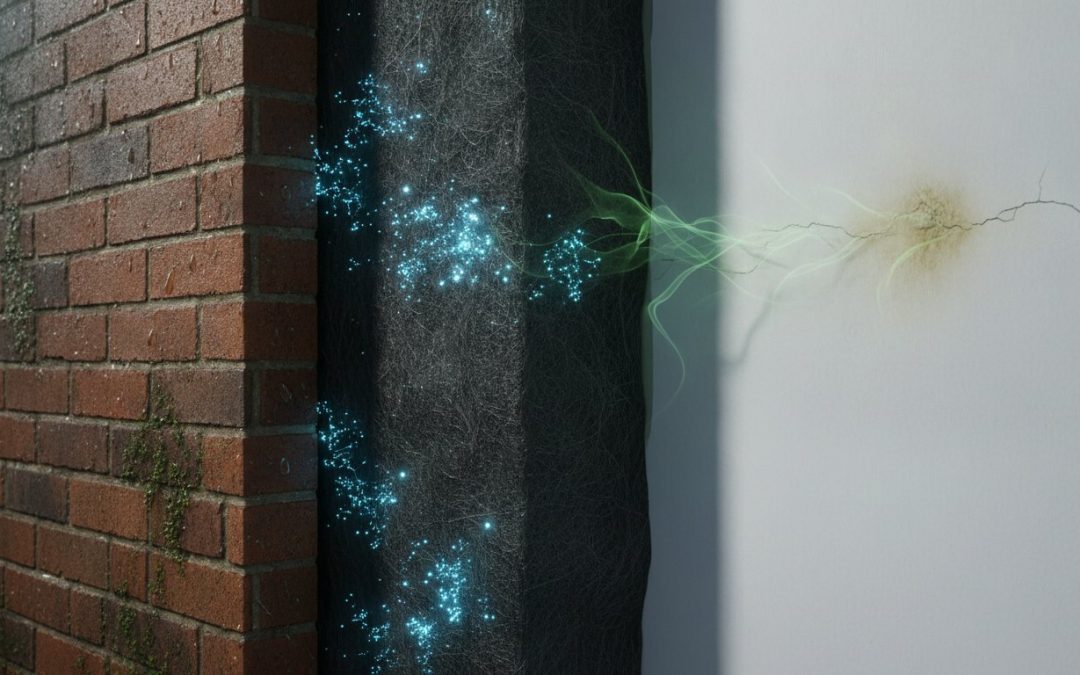
What if that persistent, earthy scent in your hallway isn’t a sign of poor ventilation, but a chemical warning emitted from deep within your property’s structure? You’ve likely tried opening windows or increasing the heating to clear the air, yet the odour remains, creating a constant sense of anxiety about hidden black mould or the potential devaluation of your home. It’s frustrating to feel that your living environment is no longer fresh or healthy despite your best efforts at maintenance.
This article identifies the technical causes of musty smell in house, focusing on the hidden structural defects that often bypass standard cleaning routines. You’ll discover how failing wall ties or saturated cavity insulation can trap moisture, leading to the release of Microbial Volatile Organic Compounds (MVOCs). We’ll guide you through the process of determining whether your issue is a simple environmental factor or a serious structural fault requiring professional cavity extraction to ensure the long-term health and air quality of your property.
Key Takeaways
- Learn about Microbial Volatile Organic Compounds (MVOCs) and how these gases serve as an early warning system for hidden moisture before mould becomes visible.
- Identify the primary causes of musty smell in house, including how defective cavity wall insulation can act as a reservoir for dampness.
- Understand the role of “bridging” in cavity walls, where saturated materials transfer external moisture directly to your internal living spaces.
- Explore the connection between wall tie corrosion and penetrating damp, and why structural integrity is vital for maintaining air quality.
- Discover why professional diagnostic surveys are necessary to find a permanent remedy rather than using temporary DIY masking agents.
What is a Musty Smell? Understanding MVOCs and Property Health
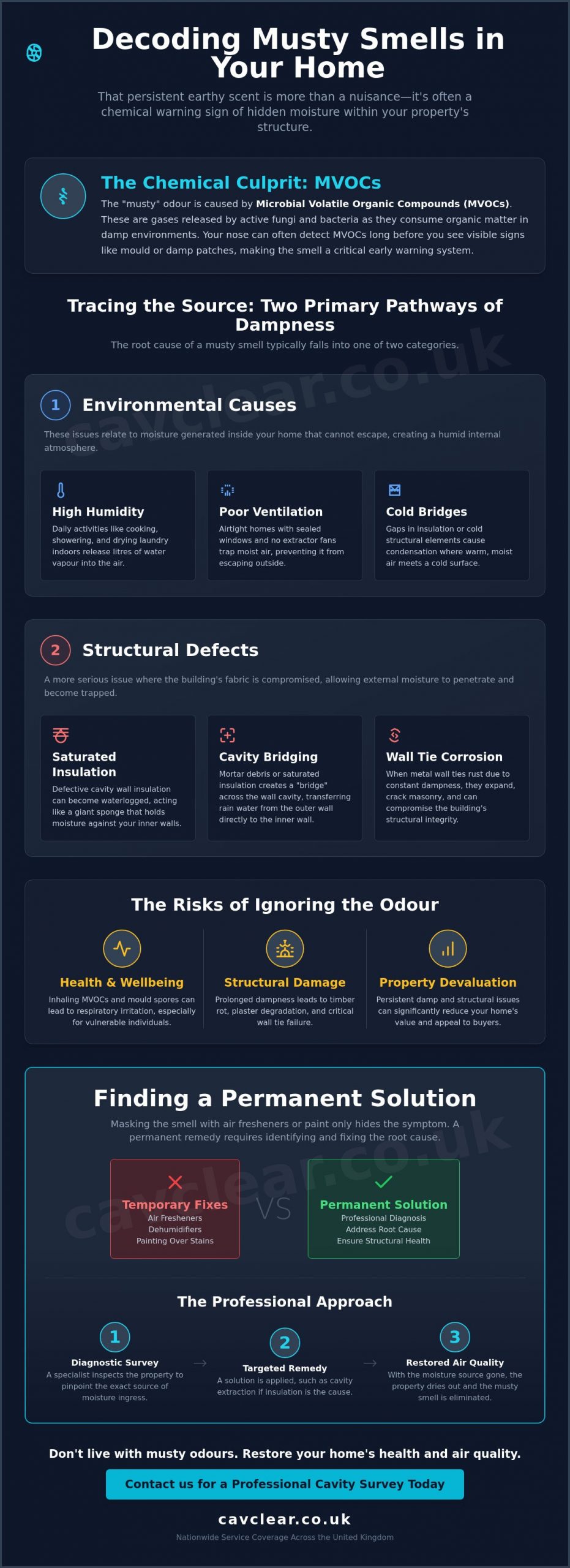
A musty odour is more than an aesthetic nuisance; it is a chemical signature of active biological growth. The distinct scent is caused by Microbial Volatile Organic Compounds (MVOCs), which are gases produced by fungi and bacteria during their metabolic processes. These organisms release these compounds as they digest organic materials like timber, wallpaper paste, or the debris trapped within a wall cavity. Identifying the primary causes of musty smell in house requires looking beyond surface-level issues to the structural health of the building.
The human olfactory system is remarkably sensitive to these gases. It can often detect the presence of moisture-related issues long before visible signs, such as damp patches or black mould, appear on internal walls. While people often dismiss a faint scent as “old house smell,” a persistent musty odour usually indicates that the building’s fabric is currently damp. Surface cleaning with detergents or air fresheners fails because the source of the odour is often embedded deep within the masonry or saturated insulation materials.
The Science of Musty Odours
Fungi and bacteria remain dormant until they encounter a specific level of relative humidity. When moisture levels rise due to structural defects, these spores activate and begin breaking down organic matter. This metabolic activity releases the MVOCs that create the damp scent. You might notice the smell intensifies when the heating is turned on, as the warmth accelerates the evaporation of these gases. Humid weather also plays a role, as it prevents the gases from dispersing, making the causes of musty smell in house more apparent during certain seasons.
Is a Musty Smell Dangerous?
Inhaling MVOCs and spores can lead to respiratory irritation, particularly for vulnerable individuals like children or the elderly. To understand the broader context of these risks, one might ask What is Indoor Mold? and how it affects air quality. The presence of these odours serves as a vital early warning system for structural decay. If you ignore the scent, the underlying moisture can cause timber rot or wall tie corrosion, eventually compromising the safety and value of your property. Identifying the root cause is the only way to restore a healthy living environment and ensure the long-term integrity of the asset.
Common Environmental Causes: Condensation and Humidity
While structural defects are significant, environmental factors often serve as the primary causes of musty smell in house. Modern living habits have increased the moisture load within UK properties. Activities such as drying laundry indoors, cooking without lids, and showering without adequate extraction release several litres of water vapour into the air daily. In older, draughtier homes, this moisture escaped through natural ventilation. Today, double glazing and draught proofing trap this humid air inside, creating a stagnant environment where odours accumulate.
One of the most common technical issues is the “cold bridge” effect. This occurs when a specific part of the building fabric is significantly colder than the surrounding area, often due to gaps in insulation or structural anomalies. When warm, moisture-laden air hits these cold spots, it reaches its dew point and turns into liquid water. You’ll typically find these damp patches in corners or behind large furniture like wardrobes, where airflow is restricted. This localized dampness provides the ideal nutrients for microbial growth, leading to the release of the gases discussed previously. If these environmental fixes don’t resolve the issue, a specialist cavity wall survey can determine if the problem lies deeper than just surface humidity.
The Role of Poor Ventilation
Airtight homes require consistent air exchange to maintain a healthy internal environment. If your property lacks sufficient background ventilation, such as trickle vents or functioning extractor fans, moisture cannot escape. Signs of failing ventilation include heavy condensation on windows every morning or a “stale” atmosphere that persists even after cleaning. According to the EPA Guide to Mold and Moisture, controlling moisture is the most effective way to prevent biological growth and the resulting smells. Consistent airflow is essential to prevent the accumulation of moisture-related gases.
Managing Internal Humidity Levels
UK property owners should aim for a relative humidity level below 60%. When levels exceed this threshold, the risk of condensation and musty odours increases dramatically. While many people rely on portable dehumidifiers, these devices only treat the symptoms rather than the cause. They’re often unable to cope with the deep-seated moisture trapped within wall cavities. Simple lifestyle adjustments, like using extractor fans and keeping internal doors closed when cooking, help manage daily moisture production. However, if the smell remains despite these changes, the source is likely hidden within the building’s fabric.
Structural Causes: When Defective Cavity Wall Insulation Smells
While condensation is a common issue, structural defects are frequently the underlying causes of musty smell in house. Many property owners find that even after intensive cleaning or redecorating, a heavy, earthy scent returns within days. This happens because the odour isn’t on the surface; it’s being emitted from within the wall structure itself. When cavity wall insulation becomes defective, it ceases to be a thermal barrier and instead becomes a massive reservoir for moisture. Unlike the sharp, vinegar-like scent of some surface mildews, damp insulation typically produces a heavy, thick odour that feels trapped in the room’s atmosphere.
This saturation leads to a technical failure known as “bridging.” In a healthy property, the cavity serves as a break that prevents water from crossing from the external brickwork to the internal leaf. However, wet insulation creates a physical bridge. This allows moisture to travel directly across the gap, soaking the inner masonry. Because the insulation is trapped in a dark, unventilated space, it can’t dry out naturally. This creates a perpetual source of dampness that no amount of surface scrubbing will resolve. Identifying the causes of musty smell in house often requires a professional look at the condition of this hidden material.
The Risks of Wet Insulation
Saturated insulation provides the perfect substrate for fungal growth. As the insulation material breaks down or remains damp, it facilitates the release of microbial volatile organic compounds (mVOCs). These gases seep through the porous inner walls and into your living areas. This hidden mould is often more problematic than surface mildew because it remains out of sight, steadily compromising the building’s fabric. In these instances, cavity wall insulation removal is often the only permanent cure. Removing the contaminated material is the only way to stop the odour at its source and restore the property’s structural integrity.
Identifying Cavity Wall Issues
You can often spot signs of insulation failure from the outside. Look for cracked mortar joints, failing pointing, or bricks that appear permanently damp after rain. Internally, you might notice “cold spots” on the walls that feel significantly chillier than the surrounding areas. Understanding what is a wall cavity is essential for diagnosing these issues; it’s a critical air space that must remain clear to function correctly. Debris, such as mortar droppings or old building rubble, can also accumulate at the base of the cavity. This rubble holds moisture against the inner wall, leading to persistent dampness and hygiene issues that contribute to the overall musty scent.
Penetrating Damp and Wall Tie Corrosion
Structural integrity serves as the primary barrier between your living space and the external environment. When the outer envelope of a property fails, the resulting water ingress becomes one of the most overlooked causes of musty smell in house. While condensation is often the first suspicion, persistent odours frequently stem from penetrating damp. This occurs when external moisture bypasses the cavity wall system entirely, saturating the internal masonry and plasterwork. Unlike the surface-level dampness caused by humidity, penetrating damp involves deep-seated moisture that creates a heavy, atmospheric scent that cleaning cannot resolve.
Wall tie corrosion is a significant driver of this structural failure. These metal components are designed to bind the internal and external leaves of a cavity wall together, ensuring the building remains stable. Over several decades, particularly in the damp UK climate, these ties can oxidise and rust. As they corrode, they expand to several times their original size. This expansion exerts immense pressure on the surrounding mortar, leading to structural cracks that act as direct conduits for rainwater. Because these components are hidden from view, the damage often remains undetected until the internal air quality begins to deteriorate.
The Impact of Wall Tie Failure
As corroding ties expand, they often cause distinct horizontal cracking along the mortar joints of the external brickwork. These fractures allow wind-driven rain to enter the cavity in volumes that the original design cannot manage. In severe cases, structural movement can even breach the damp proof course (DPC), allowing moisture to travel vertically and horizontally through the building fabric. Timely wall tie replacement is essential not only for maintaining the safety of the structure but also for preventing the permanent saturation that fuels musty odours. Restoring the structural bond between the wall leaves is a vital step in reclaiming a dry, healthy home.
Detecting Penetrating Damp
Property owners should monitor for specific visual cues that indicate deep-seated moisture ingress. These include tide marks on internal walls, bubbling wallpaper, or plaster that crumbles to the touch. It’s helpful to distinguish the scent; penetrating damp typically smells “earthy” or like wet soil, whereas environmental condensation often produces a sharper, “sour” odour. If you notice these signs, the causes of musty smell in house are likely rooted in external defects like failing pointing or damaged masonry. Identifying these faults early prevents the moisture from reaching a level where it compromises internal hygiene. To ensure your property remains structurally sound and odour-expert, we recommend professional cavity wall tie inspections to assess the condition of your hidden wall ties.
Professional Solutions: How to Eradicate Musty Smells Permanently
Eliminating a persistent odour requires moving beyond temporary masks. Many property owners spend significant amounts on “mould sprays” or high-strength air fresheners, yet these products only disguise the symptoms. When the causes of musty smell in house are structural, such as saturated insulation or failing wall ties, the odour will return as soon as the chemical fragrance fades. Achieving a permanent fix requires a methodical diagnostic approach to identify exactly where moisture is trapped within the building’s fabric. Our nationwide specialists operate across the United Kingdom to provide these high-level diagnostic standards.
A professional damp survey is the essential first step in this restoration process. Unlike a general builder who might suggest a new coat of plaster or a simple dehumidifier, a specialist surveyor uses calibrated equipment to find the moisture’s origin. This technical investigation ensures that any remedial work targets the root cause rather than just the visible damage. This proactive approach reinforces the property’s structural integrity and ensures that the air quality is restored to a safe, healthy level.
The Diagnostic Process
During a professional investigation, we use non-invasive moisture meters to map dampness across your internal walls. If we suspect the issue lies within the cavity, we utilise borescope cameras. These tools allow us to “see” inside the wall structure through small, non-disruptive entry points. We can identify whether the causes of musty smell in house are due to rubble debris, wall tie corrosion, or defective insulation. This level of precision is vital; it prevents unnecessary work and ensures the remedy is tailored to the specific technical fault of your property.
Remedial Action and Restoration
Once the fault is identified, the next step involves removing the physical source of the moisture. For many UK homes, this requires professional cavity wall insulation extraction. By removing saturated or contaminated materials, we allow the masonry to dry out naturally over time. This process is a vital investment in the property’s future, as it prevents further structural decay and restores the home’s thermal efficiency. Following extraction or wall tie replacement, we ensure that the building’s original ventilation paths are clear. This final step guarantees that the structure can breathe again, providing a long-term assurance that the musty scent will not return. Specialist remedial works don’t just fix a smell; they safeguard your asset’s health and your comfort.
While structural repairs address the source of the damp, CFS group Limited provides the professional property maintenance and refurbishment solutions needed to fully restore the interior and exterior of your home.
Restoring Your Home’s Air Quality and Structural Health
Understanding the technical causes of musty smell in house is the first step toward reclaiming your living environment. We’ve explored how microbial volatile organic compounds serve as a chemical warning; these gases often point to hidden issues like saturated cavity insulation or failing wall ties. These structural defects create a reservoir of moisture that surface cleaning simply cannot reach. By identifying whether your dampness is environmental or structural, you can implement a permanent remedy that protects both your property’s value and your long-term comfort.
Our team of accredited technicians provides nationwide coverage across the United Kingdom. We specialise in non-disruptive insulation extraction and provide comprehensive technical reports that move beyond guesswork to offer clear, actionable data. You don’t have to live with persistent odours or the anxiety of hidden mould growth. Professional intervention ensures the building’s fabric is dry and secure.
Book a Professional Damp and Mould Survey with CavClear to identify the root cause of your property’s issues. Restoring your home’s structural integrity is a vital investment in its future. We’re ready to help you return your property to a fresh, healthy state.
Frequently Asked Questions
Why does my house smell musty but I see no mould?
A musty odour is often caused by Microbial Volatile Organic Compounds (MVOCs) released by hidden fungal growth within the wall cavity or under floorboards. The human nose is sensitive enough to detect these gases before mould becomes visible on internal surfaces. It is a chemical signal that moisture is active within the building fabric, suggesting that the causes of musty smell in house are likely structural rather than just surface-level issues.
Can a musty smell make you sick?
Inhaling the gases and spores associated with musty odours can lead to respiratory problems, infections, and asthma attacks. Official guidance from the NHS identifies children, the elderly, and those with weakened immune systems as being particularly vulnerable. A 2026 survey revealed that 61% of people living with damp or mould in their homes required medical treatment for related symptoms, proving that persistent odours are a serious health concern that requires professional resolution.
Will a dehumidifier get rid of a musty smell?
A dehumidifier only manages the symptoms by reducing airborne humidity; it cannot eliminate the root causes of musty smell in house if the source is structural. If moisture is trapped inside saturated cavity insulation or behind masonry, the odour will return as soon as the device is turned off. Permanent removal of the scent requires identifying the technical fault and removing the damp materials that are facilitating microbial growth.
How do I tell the difference between mould and mildew?
Mould is typically a thicker, fuzzy growth that can appear in various colours and penetrates deep into porous materials like plaster or timber. Mildew is generally a surface-level fungi that appears as a flat, powdery patch in grey or white. While both thrive in damp conditions and produce unpleasant scents, mould indicates a more deep-seated moisture problem that can compromise the structural integrity of your property if left untreated.
Does cavity wall insulation cause a musty smell?
Defective or saturated cavity wall insulation is a frequent source of persistent, heavy odours. When insulation material becomes wet due to external masonry defects or “bridging,” it acts as a reservoir for moisture and supports hidden fungal colonies. This trapped dampness releases gases that seep through the inner leaf of the wall and into your living spaces, creating a scent that remains despite frequent cleaning or the use of air fresheners.
Why does my house smell stale after being away for a few days?
Stale air occurs when moisture and MVOCs accumulate in a property without adequate air exchange. In modern, airtight homes, the lack of natural ventilation allows gases produced by building materials or hidden damp spots to reach higher concentrations. This phenomenon is often an early warning that your home’s background ventilation is insufficient to cope with the baseline moisture load, leading to stagnant air that traps unpleasant odours within the rooms.
How much does a professional damp survey cost?
A professional damp survey in the UK typically costs between £150 and £400 depending on the property size and location. If the investigation requires specialist equipment like borescope cameras to inspect the cavity or thermal imaging to map cold spots, you should expect to pay an additional £100 to £200. This technical report is a vital investment that provides a clear diagnostic path toward a permanent solution for your property.
Is a musty smell always a sign of structural damp?
A musty scent is always a sign of excessive moisture, but it is not always structural. While some odours stem from lifestyle factors like inadequate ventilation or drying laundry indoors, persistent scents that don’t respond to increased airflow usually indicate structural failures. Determining whether the issue is environmental or structural is the only way to ensure you apply the correct remedial methodology to restore the air quality and health of your home.
Recent Comments