
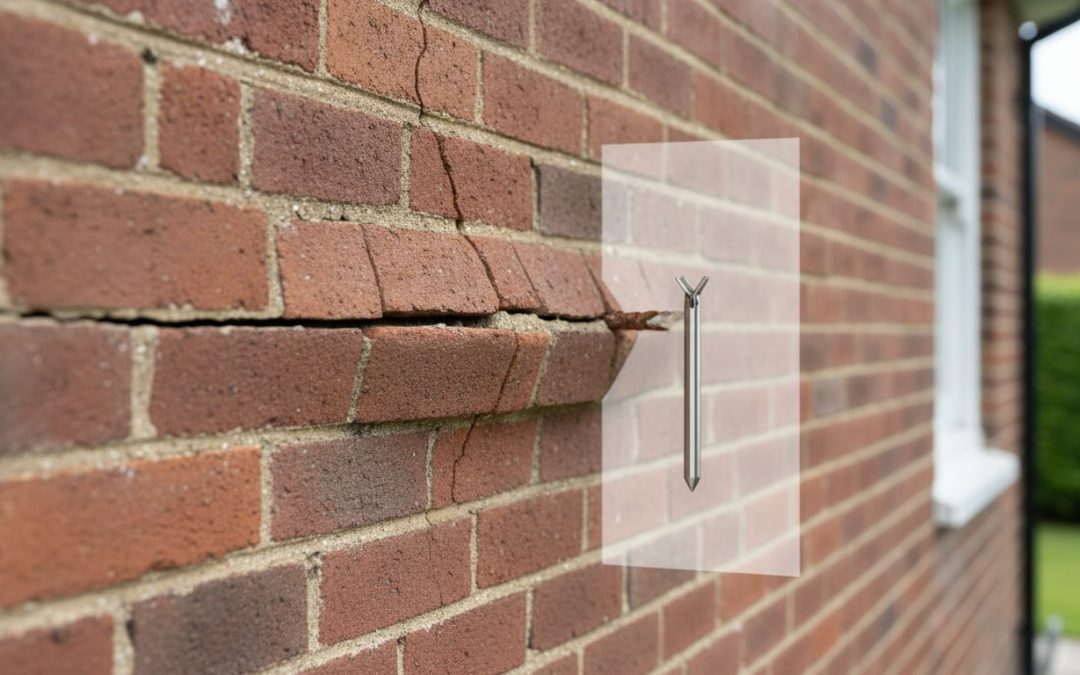
What if the structural safety of your home depended on a component your insurance policy purposefully ignores? It’s a distressing realization for many UK homeowners who discover horizontal cracking or bulging brickwork, only to find their policy documents offer no financial relief. You likely expect your premium to protect against major structural faults, but the question of does home insurance cover wall tie replacement usually results in a firm “no” from providers. Most insurers categorize the corrosion of these essential metal connectors as gradual wear and tear rather than a sudden, insurable event.
We understand that facing potential structural instability is incredibly stressful, especially when repair costs loom. This guide clarifies exactly why standard policies exclude wall tie failure and how you can identify the early warning signs before they escalate into a crisis. You’ll discover a clear plan for structural remediation, from professional surveys to the installation of modern stainless steel replacements. By shifting from reactive worry to proactive maintenance, you can secure your property’s long-term asset health and restore the safety of your home.
Key Takeaways
- Understand why the answer to “does home insurance cover wall tie replacement” is typically no, as insurers classify corrosion as gradual deterioration rather than an accidental event.
- Identify how retrospective cavity wall insulation creates significant structural risks by trapping moisture and accelerating the corrosion of metal wall ties.
- Learn why a professional wall tie survey using high-definition borescopes is essential for accurately diagnosing hidden faults before they lead to structural failure.
- Discover why installing stainless steel remedial ties provides a permanent, corrosion-proof solution that secures the long-term integrity of your property.
- Recognize how proactive structural remediation protects your property’s market value and prevents the high costs associated with emergency repairs or collapse.
Standard Buildings Insurance and Wall Tie Failure: The Reality
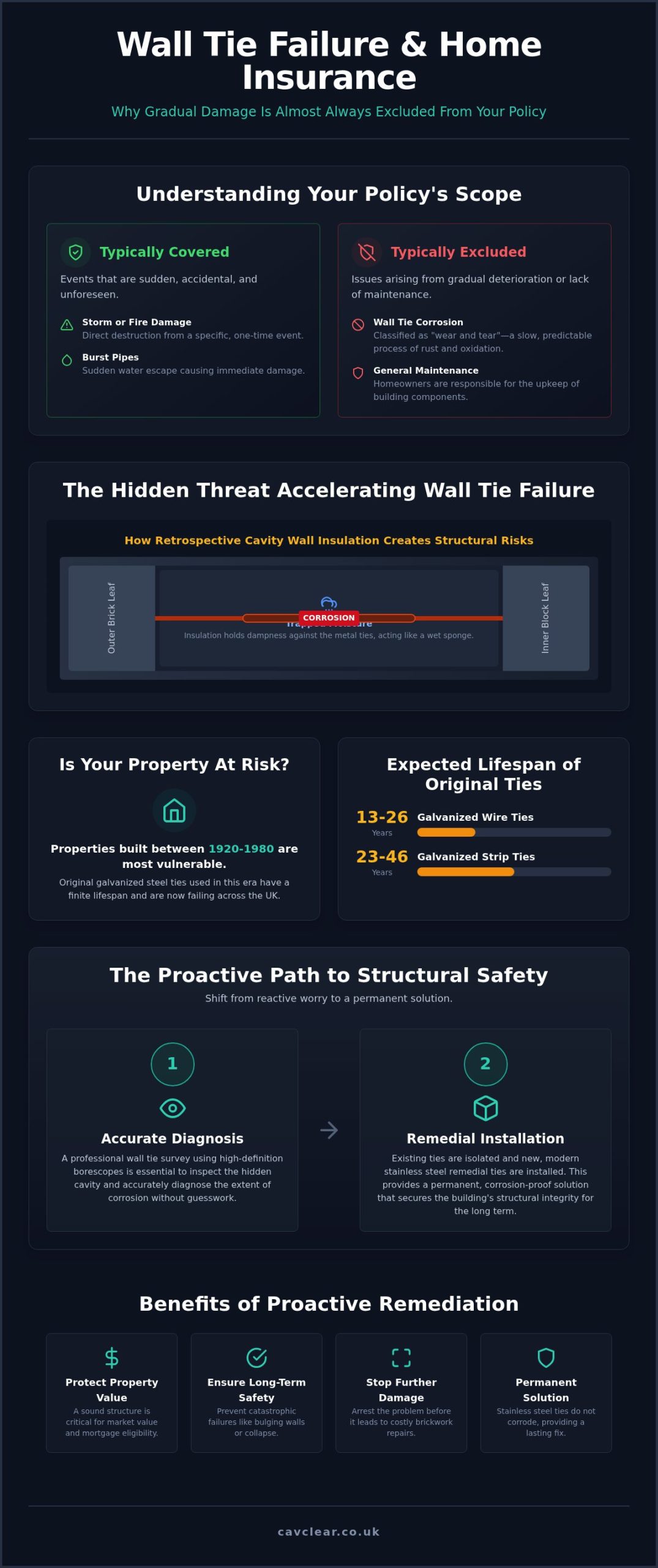
Standard buildings insurance serves as a safety net for sudden, accidental, and unforeseen disasters. If a tree falls on your roof or a pipe bursts, the policy triggers to cover the damage. However, when homeowners ask, does home insurance cover wall tie replacement, the answer is almost universally negative. Insurers view the structural integrity of your walls as a matter of routine maintenance rather than an insurable accident. Because wall tie corrosion is a predictable result of a building’s age and environmental exposure, it rarely qualifies for coverage under standard terms.
The Definition of Accidental Damage vs. Maintenance
The primary reason for rejection lies in the technical definition of an “event.” Insurance covers risks, not certainties. Cavity wall ties are metal components that naturally age over several decades. Because this aging process is predictable and gradual, it doesn’t meet the “sudden” criteria required for a payout. A storm might cause a wall to collapse, but if the underlying cause was corroded ties, the insurer will likely argue that the fault existed long before the wind picked up. They expect property owners to monitor and maintain these hidden structural elements to prevent failures. You’re effectively paying for protection against the unexpected, not the inevitable deterioration of building materials.
Common Policy Exclusions for Older UK Properties
Most UK policy handbooks contain specific wording that excludes “gradual deterioration,” “wear and tear,” and “rust or oxidation.” Since wall tie failure is essentially the slow oxidation of mild steel, it falls squarely into these excluded categories. Properties built between 1920 and 1980 are particularly at risk. The galvanized coatings used during that era have a finite lifespan, often failing after 30 to 60 years depending on local conditions. Insurers are well aware of these timelines and use them to justify exclusions.
If you’re wondering does home insurance cover wall tie replacement for your mid-century home, check your policy schedule for “structural movement” or “subsidence” clauses. While these might sound relevant, they usually only apply if the movement is caused by ground shifts, not by the internal failure of the building’s fabric. If a previous survey highlighted tie issues and you didn’t act, any subsequent damage will definitely be excluded. Maintaining the structural integrity of your cavity walls is a personal financial responsibility. This makes regular inspections a vital investment in your property’s future value and safety.
Why Standard Policies Often Exclude Wall Tie Replacement
Understanding why the answer to does home insurance cover wall tie replacement is usually no requires looking at the chemistry of the building. Corrosion is a slow, relentless process driven by moisture and oxygen reacting with mild steel. Because this happens over decades rather than minutes, underwriters view it as a certainty of aging rather than a risk of loss. They expect homeowners to proactively maintain the structural integrity of their properties through regular assessments and remedial work. Underwriters use actuarial data to predict when certain building components will fail based on the construction date, arguing that a homeowner should anticipate the end of a product’s service life.
Many owners confuse tie failure with subsidence. While subsidence, the downward movement of the ground, is often covered by buildings insurance, tie failure is an internal failure of the masonry fabric. Since the cause is the deterioration of the component itself, it falls outside the scope of “sudden peril” coverage. If you are concerned about the hidden condition of your masonry, booking a specialist wall tie survey provides the technical clarity needed to protect your home’s future value.
The “Wear and Tear” Clause Explained
Insurers rely heavily on the “wear and tear” clause to deny coverage for wall ties. This is particularly relevant for homes built between 1920 and 1980. Research indicates that the lifespan of older galvanized wire ties can be as short as 13 to 26 years. Strip ties from the same era typically last between 23 and 46 years. If your home is 50 years old, an insurer considers the failure of these components to be entirely predictable. In coastal or highly humid environments, salt-laden air accelerates this oxidation, making the ties high-risk assets that require specific attention. Since 1981, the mandatory shift to stainless steel has improved durability, but properties built before this date remain the primary focus for insurance exclusions.
Predictable Deterioration vs. Sudden Perils
There is a fundamental difference between a fire and the slow oxidation of steel. A fire is a sudden peril; rust is a structural evolution. Even if a structural crack appears overnight, the underlying cause, the years of metal fatigue and expansion, is not sudden. Insurers expect property owners to identify these issues early through routine maintenance. Booking a professional wall tie survey allows you to document the condition of your ties before catastrophic failure occurs. This diagnostic approach moves you from observation to recommendation in a steady, logical pace that avoids the stress of emergency repairs.
Factors That Accelerate Wall Tie Corrosion and Damp
The presence of moisture is the primary catalyst for structural decay. While original construction intended the cavity to act as a barrier, several factors often compromise this design. Understanding what is a wall cavity is the first step in recognizing how these spaces can become traps for dampness rather than protectors against it. When moisture enters the cavity, it reacts with the mild steel of older wall ties, leading to rapid oxidation. This process is significantly accelerated by the presence of wet debris or materials that bridge the gap between the inner and outer leaves. Because this deterioration is cumulative and environmental, the answer to does home insurance cover wall tie replacement remains a consistent no, as providers classify these conditions as preventable maintenance issues.
The Hidden Danger of Defective Cavity Insulation
Retrospective cavity wall insulation represents one of the most significant risks to wall tie longevity across the UK. When insulation material becomes saturated, it holds water directly against the metal ties for extended periods. This constant contact creates a corrosive micro-environment that strips away protective coatings far faster than natural aging. Removing this failed material is essential for structural preservation. Our nationwide teams frequently observe that cavity wall insulation removal is the only effective way to stop active corrosion. By clearing the cavity, we restore the original air gap, allowing the structure to breathe and preventing the chemical reactions between wet fibers and steel components.
Environmental Impacts on Structural Stability
Your property’s location plays a decisive role in the speed of metal fatigue. Coastal regions face high levels of salt spray, which acts as a powerful electrolyte, speeding up the rust process. In urban centers, industrial pollutants and acidic rain contribute to the breakdown of both mortar and metal coatings. Penetrating damp through porous brickwork or cracked pointing allows water to reach the ties directly. Once rust begins, the metal expands to several times its original thickness. This expansion effect exerts immense pressure on the surrounding mortar, leading to the characteristic horizontal cracking seen in failing properties. Identifying these symptoms early is vital for long-term asset health. While insurance won’t pay for the fix, addressing these environmental triggers prevents the eventual collapse of the outer leaf and ensures the safety of the building’s occupants.
The Importance of a Professional Wall Tie Survey
Since insurance providers view tie failure as a maintenance issue, a specialist survey is your primary tool for protecting your property’s structural health. You can’t see the condition of metal ties through brickwork. A professional wall tie survey uses non-destructive technology to visualize the cavity space and provide a definitive diagnosis. Because the question of does home insurance cover wall tie replacement almost always leads to a rejection, having a technical report allows you to plan remediation on your own terms before a structural crisis occurs. This survey acts as an essential investment in your property’s future market value.
What Happens During a Technical Inspection?
A technical inspection begins with a visual assessment of the external elevations. Our technicians look for subtle indicators of distress, such as horizontal cracking in the mortar joints or slight bulging of the masonry leaves. Following this, we use high-definition borescope cameras to perform an endoscopic investigation. By drilling small, discrete holes in the mortar, we can inspect the cavity without disrupting the building’s fabric. We also utilize magnetic scanning and metal detection to locate the existing tie pattern. This step is vital to ensure the property meets the standard density of 2.5 ties per square metre. We may also perform the following tasks:
- Tie Sampling: Removing a small number of ties to check for the depth of oxidation.
- Mortar Testing: Assessing the strength of the bed joints to determine the best remedial fix.
- Cavity Debris Check: Identifying if mortar droppings or wet insulation are accelerating metal fatigue.
Understanding Your Professional Survey Report
The resulting document provides a clear, no-nonsense overview of your property’s structural condition. We categorize the condition of the ties using a standardized scale, typically ranging from Grade 1 (no corrosion) to Grade 4 (severe failure or missing ties). This grading system removes ambiguity, allowing you to understand the urgency of any required work. The report includes a detailed remedial action plan tailored to your specific property type and environmental exposure. It’s not just a diagnostic tool; it’s a vital document for property valuations. Mortgage lenders and surveyors frequently request these reports during the sales process to confirm the building’s stability. By documenting the current state of your ties, you provide long-term assurances to future buyers and protect your home’s equity.
To secure your property’s structural integrity, book a detailed wall tie survey with our nationwide specialists today.
Remedial Wall Tie Replacement: A Permanent Solution
While the discovery that does home insurance cover wall tie replacement usually results in a negative response is disappointing, it’s the catalyst for a permanent structural upgrade. We replace failing mild-steel or galvanized ties with high-grade stainless steel remedial ties. These components are corrosion-proof and designed to last for the remaining life of the building. By choosing a specialist remedial solution, you move from managing a risk to securing a long-term asset. This proactive approach restores the structural bond between the inner and outer leaves of your home, ensuring the building remains stable even under high wind loads.
The Installation Process for Remedial Ties
The installation process is methodical and non-disruptive. Our technicians drill precise, small-diameter holes through the outer leaf and into the inner leaf of the masonry. We then insert remedial ties using either a mechanical expansion technique or a high-performance resin fix, depending on the mortar strength identified during the initial survey. This methodology ensures a secure connection without the need for large-scale demolition or rebuilding. It’s a surgical approach to structural repair that maintains the aesthetic integrity of your home. Because the work is performed from the outside, the interior of your property remains entirely unaffected.
A critical part of the process involves the isolation of the original, failing ties. If left unmanaged, the continuing expansion of rusting steel can still cause masonry cracking even after new ties are installed. We use specialist techniques to isolate these old components, effectively “de-commissioning” them so they no longer exert pressure on the mortar joints. This proactive step is what distinguishes a professional specialist from a general builder. It’s a vital investment in preventing future cosmetic damage to your brickwork and ensuring the remedial work remains a permanent fix.
Restoring Structural Integrity and Property Value
Restoring the structural integrity of your cavity walls immediately stabilizes the building and protects its market value. Professional replacement isn’t just a repair cost; it’s a necessary investment that mortgage lenders often require for older properties. Once the ties are secured, we finish the process by pointing the small entry holes with a mortar color-matched to your existing brickwork. This ensures the remedial work is virtually invisible, leaving your home both structurally sound and visually unchanged.
Our nationwide service provides the peace of mind that comes from using accredited technicians who prioritize the long-term health of your property. We focus on delivering a clean, efficient service that addresses the root cause of structural instability. By installing high-grade stainless steel ties, we provide a permanent solution that restores the comfort and security of your home for decades to come.
Protecting Your Home’s Long-Term Structural Integrity
Understanding that does home insurance cover wall tie replacement usually results in a policy exclusion is the first step toward securing your property’s future. Standard insurance focuses on sudden perils, but the stability of your cavity walls relies on consistent, expert maintenance. By addressing corrosion through specialist surveys and the installation of stainless steel remedial ties, you replace an aging liability with a permanent structural asset. This investment prevents the risk of masonry failure and preserves your home’s equity for future buyers and lenders.
As a nationwide specialist, we provide the professional clarity you need. Our accredited structural technicians deliver comprehensive technical reporting and excel in clean, non-disruptive remedial work. We take pride in restoring the safety and comfort of properties across the UK with high-level standards and technical rigor. Don’t wait for visible cracking to become a structural crisis. Book a Professional Wall Tie Survey with CavClear Today and take a proactive step toward a safer, more stable home.
Frequently Asked Questions
Does standard buildings insurance ever cover wall tie replacement?
Standard buildings insurance almost never covers the cost of replacing wall ties. Insurers view the corrosion of these metal components as a form of gradual deterioration or wear and tear, rather than a sudden, accidental event. Because does home insurance cover wall tie replacement is usually a “no,” the responsibility for structural maintenance falls to the homeowner. You should treat wall tie surveys as a routine part of property upkeep to protect the building’s long-term asset health.
How can I tell if my wall ties are failing without a survey?
While a professional survey is the only definitive diagnostic tool, you can look for specific external warning signs. The most common indicator is horizontal cracking in the mortar joints, typically appearing every three to four courses of brickwork. This happens because rusting ties expand to several times their original thickness, exerting upward pressure on the masonry. You might also notice slight bulging of the outer leaf or window frames that appear to be shifting.
What is the average lifespan of a galvanised wall tie?
The lifespan of a galvanized wall tie depends heavily on its design and environmental exposure. Research indicates that older galvanized wire ties often fail within 13 to 26 years, while strip ties from the same era may last between 23 and 46 years. Since 1981, the UK has mandated the use of stainless steel for new builds, which is expected to last for the life of the building. Properties in coastal regions often see significantly faster corrosion rates.
Will failed cavity wall insulation make my wall ties rust faster?
Yes, defective or wet cavity wall insulation significantly accelerates the rust process. When insulation material becomes saturated due to penetrating damp, it holds moisture directly against the metal ties for prolonged periods. This constant contact creates a corrosive micro-environment that strips away protective galvanized coatings. We recommend cavity wall insulation extraction to clear the air gap and prevent this accelerated metal fatigue from compromising your home’s structural integrity and safety.
Can I sell my house if the wall ties are corroded?
Selling a house with corroded wall ties is possible, but it often complicates the transaction. Property surveyors are increasingly vigilant in identifying structural distress during pre-purchase inspections. If failure is suspected, mortgage lenders typically request a detailed technical report before approving funds. Addressing the issue proactively with a specialist survey and remedial replacement ensures a smoother sale process and protects the property’s market value against significant price renegotiations or unexpected delays.
Is wall tie replacement a messy or disruptive process?
Modern wall tie replacement is a clean and non-disruptive methodology. Our accredited technicians perform the work entirely from the exterior of the property, meaning your internal living spaces remain unaffected. The process involves drilling small, precise holes into the mortar joints to insert stainless steel remedial ties. These entry points are then finished with color-matched mortar to ensure the repair is aesthetically sympathetic and virtually invisible once the project is completed.
What happens if I ignore failing wall ties?
Ignoring failing wall ties poses a serious risk to the structural stability of your property. As ties continue to corrode and expand, they lose their ability to securely connect the inner and outer leaves of the cavity wall. This can lead to the outer leaf bulging or bowing outward. In severe cases, especially during periods of high wind loads, the lack of structural connection can cause the outer wall to become unstable or even collapse entirely.
Are there any specific insurance policies that cover wall tie corrosion?
Standard home insurance policies consistently exclude damage related to wall tie corrosion. While some specialist structural warranties or specific “latent defect” policies might offer protection for newer builds, these are separate from standard buildings insurance. Most providers expect homeowners to maintain the building’s fabric through regular inspections. If you’re concerned about coverage, you should review your specific policy schedule for “gradual deterioration” exclusions, which is why does home insurance cover wall tie replacement is rarely a covered peril.
Recent Comments