
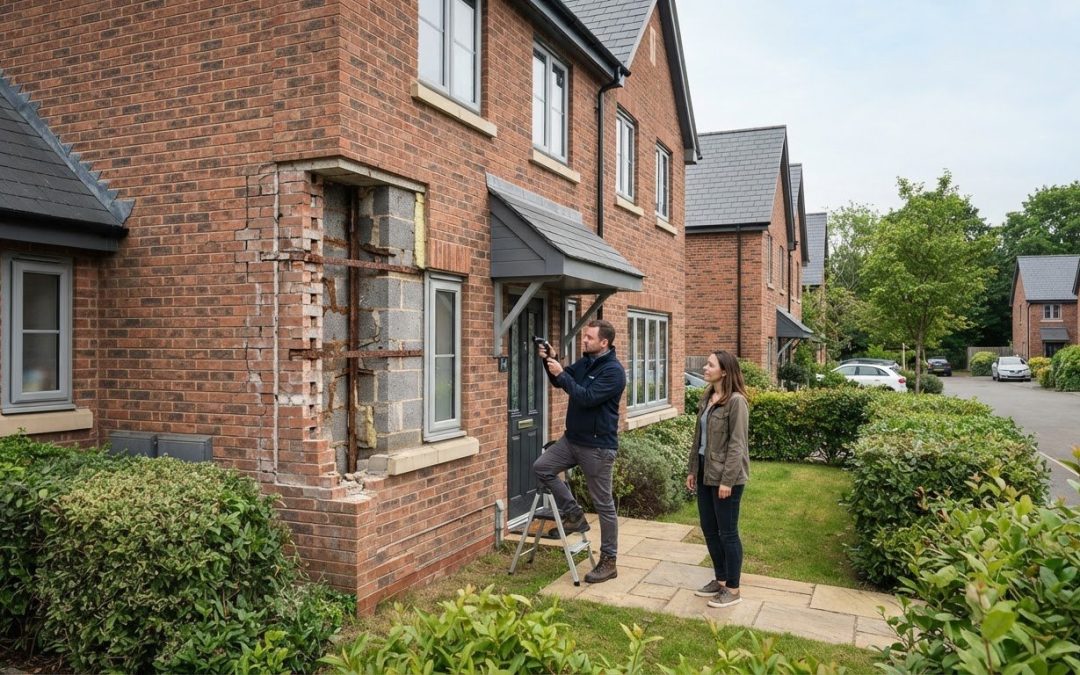
A moderate wall tie finding isn’t, by itself, a verdict on whether a home is safe to live in. If you’re asking, “can you live in a house with moderate wall tie failure?”, the answer depends on the condition of the ties and the wider state of the masonry, not just the word “moderate”. Occupants may be able to remain at home while the issue is assessed, but only an inspection can clarify the condition of the property and the appropriate next steps.
It’s understandable to feel concerned, especially when cracking can have several causes and a report doesn’t explain whether work is urgent. “Moderate” isn’t a formal grade in BRE Digest 401, so don’t treat it as a stand-alone safety assessment. This article explains what the finding may mean for day-to-day living, which changes to brickwork warrant prompt attention, and how a wall tie survey can help clarify the condition of the ties. You’ll also learn how inspection findings and a written report can inform decisions about monitoring, further investigation or remedial work.
Key Takeaways
- Whether can you live in a house with moderate wall tie failure depends on the property and inspection findings, not the label alone.
- Wall ties connect the inner and outer leaves of a cavity wall. Corrosion can affect the ties and put pressure on surrounding masonry.
- Interpret a failure grading alongside the evidence recorded, and note what questions still need investigation.
- While arranging an assessment, keep relevant reports and take dated photographs of visible changes from the same viewpoint. Don’t disturb the wall.
- A specialist survey can locate ties, inspect and grade their condition, and set out recommended next steps in a written report.
Can you live in a house with moderate wall tie failure?
In some cases, occupants can continue their usual day-to-day activities while a wall tie concern is assessed. But the answer to “can you live in a house with moderate wall tie failure?” depends on the condition of that particular property, what an inspection found and whether the masonry has changed. The word “moderate” alone cannot establish that a home is safe or show how extensive the issue may be.
A cavity wall has two masonry leaves, an inner and an outer leaf, connected by metal wall ties. This cavity wall construction helps the walls act together. If ties deteriorate, the outer leaf may be affected, but the report’s wording needs to be considered alongside its evidence and the visible condition of the building.
What does moderate wall tie failure mean?
“Moderate” describes a reported level of concern, not a universal verdict on whether a home is suitable to occupy. Reports may use grading terminology differently, so read the survey’s explanation of its grading and the scope of the inspection. Check which areas were examined, what evidence was recorded and whether the findings relate to sampled ties or a broader assessment. The label alone doesn’t confirm how many ties are affected or how the wall is behaving.
A report records evidence gathered during an inspection. It can guide decisions, but one descriptive word is not a complete assessment of current safety or future performance. If the report recommends further investigation or remedial work, don’t treat continued occupation as a reason to defer that professional advice. Ask for the findings and recommendations to be explained in relation to the specific building.
When should occupants seek prompt professional advice?
Arrange a timely professional assessment if cracking is new, visibly changing or accompanied by movement in the masonry. A noticeable change in the shape of an external wall also warrants prompt attention. These signs can have different causes, so don’t assume they prove wall tie failure. An inspection is needed to assess the wall and determine what the evidence supports.
While arranging advice, note when you first spotted a change and take dated photographs from a consistent viewpoint. Avoid disturbing the wall or trying to test its stability yourself. If you already have a survey or inspection report, keep it available so the specialist can consider its scope, findings and recommendations.
An online article cannot assess a building, verify the condition of its ties or replace a specialist wall tie inspection. It can help you identify questions to raise, but a property-specific assessment is needed to clarify what the reported finding means for your home. Occupation may be possible during that process, but don’t use the word “moderate” alone to decide that assessment can wait.
How wall tie failure affects a cavity wall and its visible condition
A cavity wall is built with two masonry leaves, an outer wall and an inner wall, separated by a gap and connected by metal wall ties. The ties help hold the leaves together so they act as a connected wall rather than two independent skins. For a straightforward overview of this arrangement, see this guide to what a wall cavity is.
What wall ties do inside a cavity wall
Wall ties sit within the cavity, so they’re usually hidden from view. They connect the two leaves and help restrain the outer masonry. If a tie corrodes, its condition and ability to provide that connection may be affected. Rust can also expand and put pressure on nearby mortar or brickwork. The causes and effects of wall tie failure can include damage to surrounding masonry, but the extent and significance depend on the wall and inspection findings.
Wall tie failure is the deterioration or loss of effectiveness of metal ties that connect the inner and outer leaves of a cavity wall. This describes the issue in general terms. It doesn’t confirm that a particular property has failed ties or show how many may be affected. That requires an inspection of the cavity and the ties themselves.
Why cracking needs investigation before its cause is assumed
Horizontal cracking along mortar joints, or stepped cracking that follows the brickwork, may be relevant observations during a cavity-wall assessment. Pressure from corroding ties can contribute to cracking in some cases. However, a crack’s direction or appearance alone can’t establish its cause. Cracking can have other explanations, and not every visible crack indicates wall tie failure.
A specialist considers the pattern and position of cracking alongside the wall’s condition and evidence gathered from within the cavity. A horizontal line of cracking, for example, is worth recording and assessing, but it isn’t enough on its own to conclude that ties have corroded. Ties may also be concealed, so their condition can’t reliably be judged from the outside appearance of the brickwork alone. Visual clues are a reason to investigate, not a diagnosis.
This distinction helps avoid treating every crack as the same problem. A cavity wall tie inspection can establish whether inspected ties show deterioration and provide context for visible masonry changes. The findings help determine whether further investigation, monitoring or remedial work is appropriate for that wall. If cracking is changing or you’re concerned about the cavity wall, a specialist wall tie survey can provide property-specific findings rather than relying on appearance alone.
Moderate wall tie failure: what the rating can and cannot tell you
The word “moderate” can sound like a clear measure of risk, but its meaning depends on how the survey defines and uses it. On its own, it doesn’t show the condition of every wall tie or the whole external wall. To understand what the finding means for your home, read the report alongside its inspection evidence, photographs and any stated limits on the inspection.
A severity label needs to be interpreted alongside the inspection evidence and the condition of the property. This helps you understand whether a finding points to a specific area for further investigation or supports a recommendation for remedial work.
Why the word moderate is not a complete diagnosis
Unless the report explains the term as part of its grading system, don’t assume “moderate” is a standardised grade with the same meaning in every survey. Look for what the inspector observed, which areas or ties were examined and what the inspection could not establish. Keep confirmed observations separate from possible explanations and recommended actions. A report may identify corrosion in inspected ties, for example, without establishing the condition of every tie across the property.
The question “can you live in a house with moderate wall tie failure?” can’t be answered from that label alone. The report should explain the basis for its assessment, while the property’s visible condition and any changes over time provide further context.
Report wording
Evidence recorded
Questions the finding leaves open
“Moderate” or similar description
The report’s definition of the term, inspection scope and any condition grading or photographs.
How does this survey define the wording? Which parts of the wall and which ties were inspected?
Observed deterioration in inspected ties
The locations examined and the condition recorded for those ties.
Does the evidence represent other wall areas, or is further inspection recommended?
Cracking noted alongside tie concerns
The crack locations and any other relevant observations made during the inspection.
Has a connection with tie condition been established, or does the cause need further assessment?
How survey findings shape the next decision
Recommendations should follow the condition and distribution of the ties observed, not a single adjective in isolation. Depending on the evidence and the report’s scope, the next step may be further investigation to clarify the extent of a concern, or remedial work where the findings support it. These are different decisions: further inspection isn’t the same as a recommendation to replace ties, and a moderate description doesn’t mean every tie needs replacing.
The appropriate response depends on the property. The RICS guidance on wall tie repair provides further context on assessment and remedial decisions. A clear written report can help you understand what was inspected, what was found and why a particular next step is recommended, without assuming one repair suits every cavity wall.
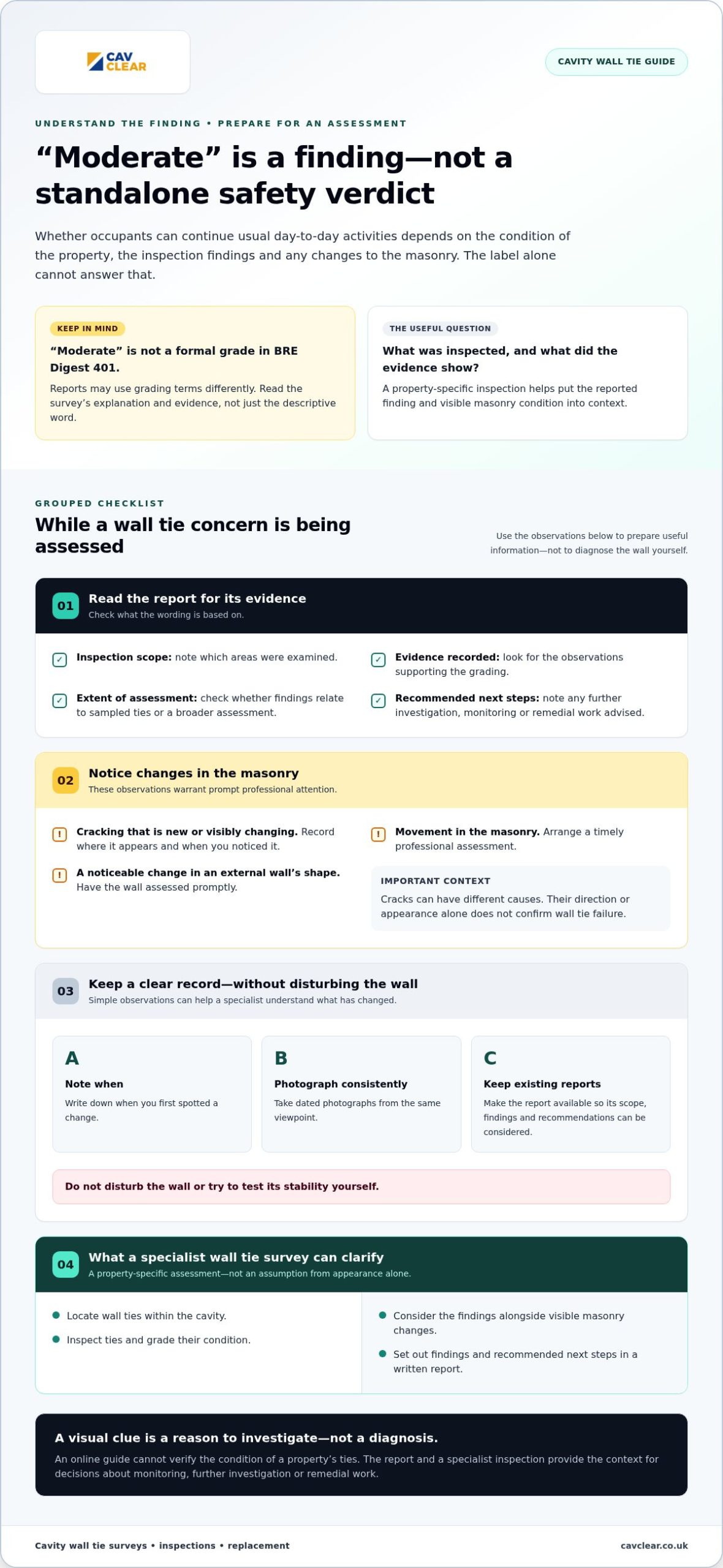
What to do at home while arranging a wall tie assessment
You can take a few practical steps while arranging a property-specific assessment. The aim is to preserve useful information for the surveyor, not to diagnose wall tie failure yourself. A clear record of what you’ve noticed, where it appears and whether it changes can help put the inspection findings into context.
Record changes without trying to diagnose the cause
- Note what you’ve observed. Record when you first noticed cracking or another visible change, where it is on the property and whether its appearance seems to have altered. Keep the description factual. For example, note that a crack appears longer or that a section of brickwork looks different, rather than assuming why it happened.
- Take dated photographs. Photograph visible cracking from a safe, accessible position, using the same viewpoint each time where practical. Include enough surrounding brickwork to show the location, and keep the images dated. Don’t climb, lean out of windows or enter an unsafe area to get a closer view.
- Gather relevant records. Set aside previous survey reports, photographs and details of repairs relating to the affected wall. Share these with the specialist carrying out the assessment. Earlier records may show what has already been inspected or altered, but they don’t replace a current inspection.
- Arrange a specialist assessment. A wall tie survey can investigate the ties and provide findings specific to the property. Until then, don’t drill into the wall, remove mortar or attempt a repair. Disturbing the masonry may affect the evidence available to the surveyor and won’t establish the cause of the visible change.
Know when a change deserves faster attention
If cracking appears to be changing noticeably, or you can see a change in the shape of the external wall, seek prompt professional assessment rather than relying on photographs or an earlier report alone. Where there is visible, significant movement, avoid the affected area until it has been assessed. Keep others away from that area too, without attempting to inspect or test the wall yourself.
A photograph can document a change, but it can’t establish the wall’s condition or determine the urgency on its own. If you’re unsure what a visible change means, describe it clearly when arranging an assessment and share the dated images. This gives the specialist useful context without treating an image as a diagnosis or assuming the cause.
These steps won’t determine whether can you live in a house with moderate wall tie failure applies to your property. They can help you prepare for an informed assessment and avoid disturbing the wall beforehand. CavClear provides nationwide Wall Tie Surveys across the UK. Share your observations and relevant reports so the inspection can focus on the property’s specific condition.
How a specialist wall tie survey informs repair or monitoring
A specialist wall tie survey replaces guesswork with evidence about the property. The process generally involves locating ties, inspecting their condition, recording the findings and setting out appropriate next steps. It helps answer “can you live in a house with moderate wall tie failure?” through inspection evidence rather than the wording of a report alone.
What the wall tie inspection can establish
CavClear’s trained specialists use calibrated metal detectors, wall-tie locators and borescope or endoscope cameras. Locating equipment helps identify tie positions, while a camera provides a view of ties within the cavity. Together, these methods help the surveyor assess inspected ties and record their condition. Findings relate to the property and areas covered by the survey, so read the report alongside its stated scope and any limitations.
The written survey report includes photographs and tie-condition grading, giving you a documented account of what was observed. This helps distinguish recorded findings from assumptions and explains why a particular next step has been recommended. For background on remedial work, the wall tie replacement guide explains the subject in more detail.
How replacement recommendations are explained
A survey finding doesn’t automatically mean replacement is needed. Recommendations should reflect the condition and distribution of the ties inspected, along with the evidence recorded in the report. Depending on those findings, the next step may be further investigation, monitoring or remedial work. A remedial quotation is provided if required, so the proposed work can be considered in relation to the survey results.
If wall tie replacement is recommended, CavClear uses stainless-steel replacement ties. Work is carried out from the exterior wherever possible, and mortar joints are reinstated after replacement. The approach should be based on the property’s inspection findings, rather than applying the same repair to every wall or assuming every tie needs replacing.
A clear report gives you a practical basis for deciding what to do next. It records the inspected tie condition, includes photographs and grading, and explains whether further investigation or remedial work is recommended. A survey is a way to understand the condition of your cavity wall, not an automatic commitment to replacement. If the report identifies a need for work, its findings can guide the scope and help inform decisions about the masonry.
For a property-specific assessment, you can book a specialist wall tie survey. The inspection and written findings provide a clear starting point for deciding whether monitoring, further investigation or remedial work is appropriate.
Take the next step with confidence
A specialist assessment can help you make considered plans for your home instead of relying on uncertainty. It gives you a clearer basis for understanding what to prioritise and how to look after the property.
If you’re still wondering, “can you live in a house with moderate wall tie failure?”, a property-specific survey is a practical way to move from concern to informed decision-making. CavClear provides specialist Wall Tie Surveys throughout the UK, with written findings to help you understand the condition recorded and the recommended next steps.
Book a specialist wall tie survey to get a clear, property-specific assessment and understand whether monitoring, further investigation or remedial work is appropriate.
Frequently Asked Questions
Does moderate wall tie failure always mean every wall tie needs replacing?
No. A recommendation may relate to particular wall areas rather than every tie in the property. Before deciding what work to undertake, check whether the proposed scope identifies the affected elevations and explains whether it covers selected ties or a wider area. This helps clarify what the recommendation is intended to address and avoids assuming that a finding in one part of the wall automatically applies throughout the house.
Can a standard home survey identify wall tie failure?
A standard survey can draw attention to visible concerns, but a report that doesn’t mention wall ties shouldn’t be taken as confirmation that they’re sound. Check the survey’s stated scope and whether it recommends further investigation. If you’re buying a property, any relevant observations can help you decide whether a focused wall-tie assessment is a sensible next step before reaching a view of the property’s condition.
Can wall tie failure cause damp inside a house?
Wall tie failure concerns the connections within a cavity wall, while damp can have several possible causes. Keep a simple record of where moisture appears, when you notice it and whether the affected area changes. For example, note if damp is limited to one room or appears in more than one place. This information can help an assessment consider the symptoms without assuming that failed ties are responsible.
Can wall ties be inspected without opening up the whole wall?
Surveys use metal detectors, wall-tie locators and borescope or endoscope cameras to locate and assess ties. The precise access needed depends on the construction and the areas being examined, so check the survey scope for details of any localised access required. This helps you understand what the visit involves without assuming extensive opening-up is necessary.
Can wall tie failure affect a house purchase?
It can be a factor to understand when assessing a property’s condition, but a visible crack or brief report description doesn’t establish the full extent of a wall-tie issue. If a report recommends a specialist assessment, the findings can help you understand the condition recorded and whether remedial work has been suggested. This supports a more informed decision than planning around an unverified assumption.
How long does wall tie replacement take?
There’s no single duration for every replacement project. The timeframe depends on the property, access, and the type and extent of the required work. Once the remedial scope has been defined, the expected programme can be discussed for that job. A general estimate made before the property and access have been assessed may not reflect the work involved.
Recent Comments