
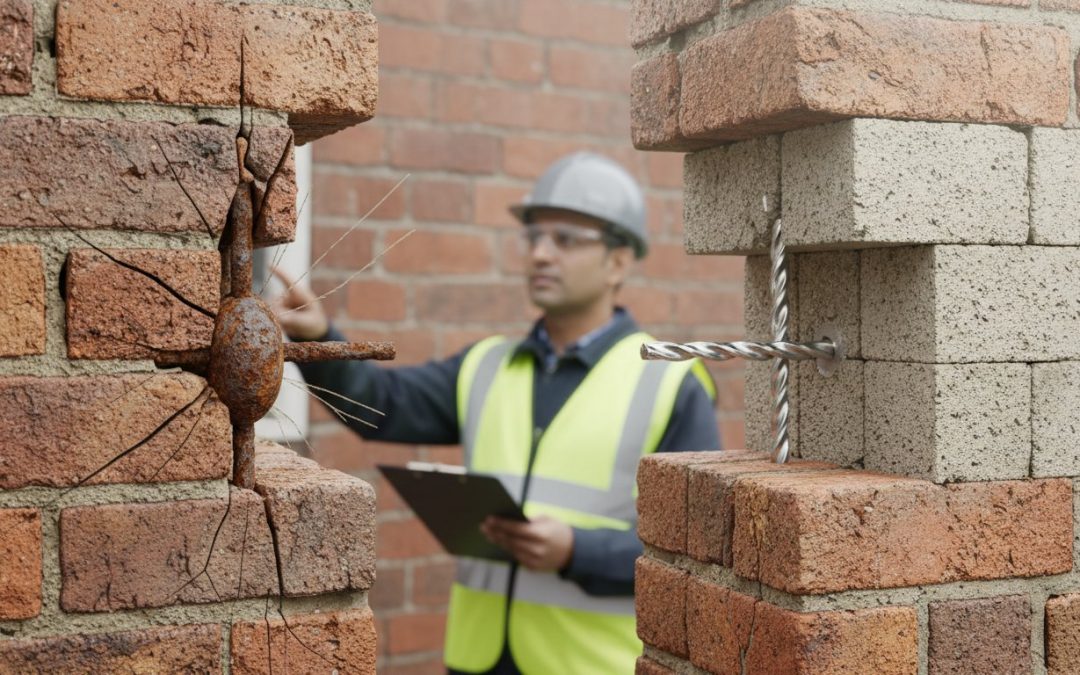
A single rusted metal component, no thicker than a standard pencil, is often the only thing preventing the external leaf of your home from collapsing outward. By 2026, industry data suggests that over 25% of properties built with cavity walls before 1981 will require structural intervention due to tie corrosion. It’s understandable if the sight of horizontal cracking or bulging brickwork causes you significant stress, especially when previous poor workmanship or failed insulation has accelerated the decay. You deserve to feel safe within your own four walls without the constant worry of escalating repair costs or structural failure.
We’ve designed this guide to show you how remedial cavity wall ties provide a permanent solution to restore your home’s structural integrity and prevent masonry collapse. You’ll learn how these specialist fixes rectify the damage caused by moisture and age, ensuring your property remains stable for decades. This article explains the different tie types available, the non-invasive installation process, and the long-term guarantees that provide total peace of mind for your investment.
Key Takeaways
- Understand how modern stainless steel fixings restore the structural bond between wall leaves to prevent masonry collapse without the need for costly rebuilding.
- Identify the critical risks facing pre-1978 properties, including how corroding iron oxide can expand up to seven times its original size and lift your home’s masonry.
- Compare helical, mechanical, and resin systems to determine which remedial cavity wall ties are best suited for your specific brick, block, or stone construction.
- Learn about the specialist diagnostic process, from non-invasive borescope inspections to precision metal detection, used to accurately assess internal structural health.
- Discover why a permanent solution requires addressing root causes, such as the removal of failed insulation, to ensure long-term stability and property protection.
What are Remedial Cavity Wall Ties and Why Do They Matter?
Most UK homes constructed after 1920 rely on cavity wall designs to provide insulation and weather protection. These structures depend entirely on metal ties to remain stable. Remedial cavity wall ties are high-grade stainless steel fixings designed to replace original ties that have failed due to corrosion or poor installation. Specialists install these modern components through the outer leaf and into the inner leaf without the need to dismantle the masonry. This process restores the structural integrity of the property while avoiding the massive costs associated with rebuilding entire elevations.
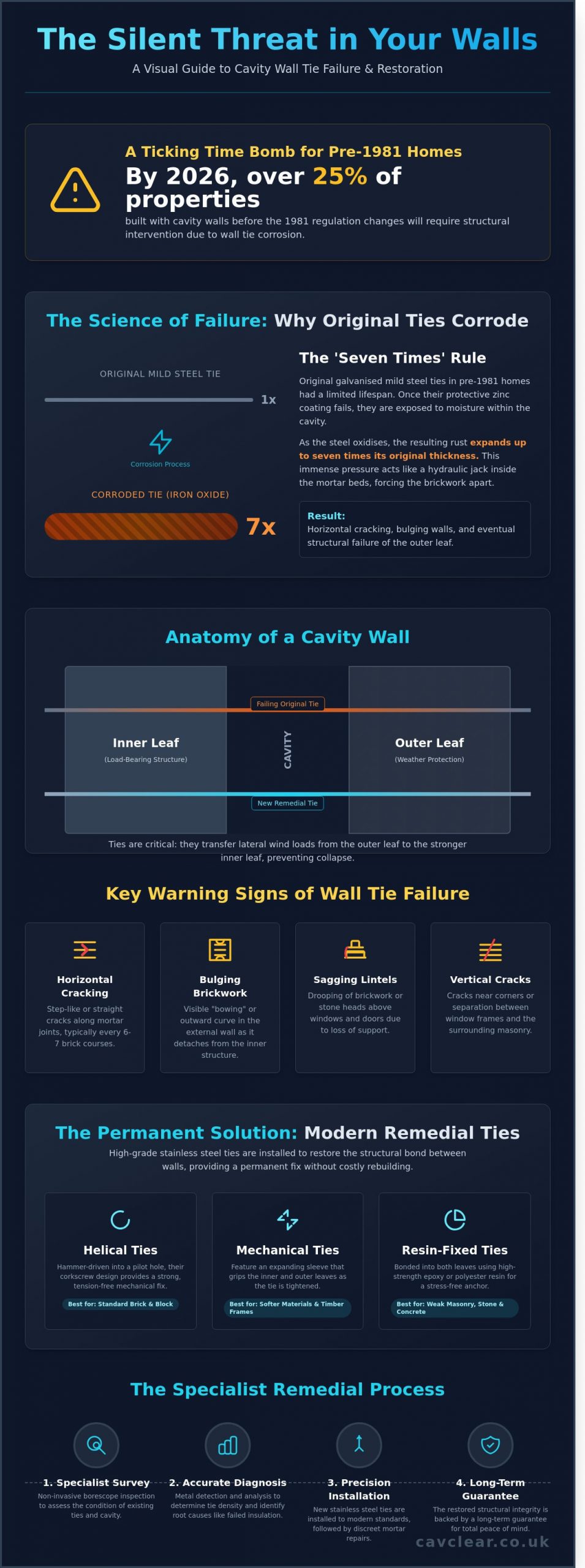
The science behind tie failure is well-documented in British construction history. Until the 1981 amendment to British Standard 1243, builders typically used galvanised mild steel ties. These components were expected to last the life of the building, but many have failed prematurely. When the protective zinc coating breaks down, the steel underneath reacts with moisture and oxygen to form iron oxide. This rust can expand to seven times the original thickness of the metal. Such expansion generates immense pressure within the mortar joints, often leading to structural instability that requires immediate specialist intervention.
Understanding What is a cavity wall tie? helps homeowners grasp why these small components are so critical. They don’t just hold the walls together; they ensure the two separate layers of a building act as a single, rigid unit capable of resisting the UK’s significant wind loads.
The Anatomy of a Cavity Wall
A standard cavity wall consists of two distinct layers. The inner leaf is the primary load-bearing element, supporting the weight of the roof and internal floors. The outer leaf serves as a protective skin against the elements. Because the outer leaf is relatively thin, it cannot stand safely on its own against lateral wind pressure. Remedial cavity wall ties transfer these lateral loads to the stronger inner leaf. If this connection is lost, the outer wall becomes an independent, expertstanding structure. This leads to a high risk of the wall buckling under its own weight or being sucked outward by negative wind pressure during a storm.
Signs Your Property Needs Remedial Ties
Homeowners should look for specific visual cues that indicate a failure in the tie system. Horizontal cracking along mortar joints is the most common symptom. These cracks usually appear every six or seven courses of bricks, coinciding with the original tie positions. You might also notice a visible “bow” or bulge in the brickwork where the outer leaf has begun to detach from the inner structure.
Other warning signs include:
- Sagging lintels above windows or doors.
- Vertical cracks at the corners of the property where the brickwork is pulling apart.
- Separation between window frames and the surrounding masonry.
- Internal dampness caused by moisture travelling across rusted, debris-laden ties.
Identifying these issues early allows for a non-invasive fix. Our nationwide specialists use borescope cameras to inspect the cavity and determine the exact state of the existing ties. This diagnostic approach ensures that we only recommend a solution when it’s genuinely necessary for the long-term safety of your home. Addressing the problem now prevents the eventual collapse of the masonry and preserves the property’s market value.
The Science of Failure: Why Original Wall Ties Corrode
Property owners must understand that wall tie failure is a predictable chemical process rather than a random occurrence. The year 1978 represents a critical threshold for the UK housing stock. Before this date, British Standards permitted the use of mild steel wall ties protected by a thin layer of zinc galvanisation. These coatings were typically designed to provide a service life of 20 to 30 years. Consequently, millions of homes built between 1945 and 1978 have now exceeded the life expectancy of their original structural fixings. When this protective zinc layer eventually sacrificialy dissolves, the underlying steel remains exposed to the elements.
The primary mechanism of damage is governed by the ‘Seven Times’ rule. As mild steel oxidises, the resulting iron oxide (rust) occupies a volume significantly larger than the original metal. In most cases, the corrosion product expands to seven times its initial thickness. This physical expansion exerts immense pressure within the mortar joint, acting like a slow-motion hydraulic jack. Because the mortar cannot compress, the force is transferred directly to the masonry units, leading to visible structural distress. Homeowners who notice these symptoms should consult a comprehensive wall tie replacement guide to understand the technical requirements for a permanent fix.
Environmental factors dictate the speed of this deterioration. Properties located within 5 miles of the British coastline face a much higher risk due to airborne chlorides. Salt air acts as a catalyst, accelerating the electrochemical reaction of rust. Similarly, homes in former industrial heartlands are often exposed to higher levels of sulphur dioxide, which creates an acidic environment that strips protective coatings faster than in rural areas. These external triggers turn a slow degradation into a rapid structural concern that necessitates the installation of remedial cavity wall ties to restore the building’s integrity.
Galvanic Corrosion and Masonry Damage
Galvanic corrosion occurs when moisture acts as an electrolyte between the steel tie and the surrounding mortar. This chemical reaction is particularly aggressive in black ash mortar, which was common in mid-century construction and contains high levels of corrosive sulphates. As the tie expands, it creates characteristic ‘stepped’ or horizontal cracks along the bed joints of the external leaf. These fissures allow even more water to penetrate the cavity, creating a self-sustaining cycle of decay. Over time, this process reduces the home’s thermal efficiency by allowing cold air to bypass the cavity and puts the outer wall at risk of collapsing during high winds.
The Impact of Wet Cavity Insulation
Moisture-saturated insulation is a death sentence for original wall ties. While the cavity was originally designed to be an empty space that prevents water transfer, the presence of sodden mineral wool or urea-formaldehyde foam holds water directly against the metal ties for months at a time. This constant contact ensures the steel never has the opportunity to dry out. Retrospective insulation often causes the very dampness that leads to tie failure. Our specialists frequently find that the extraction of debris and wet material is the first mandatory step in a professional repair. Removing these saturated materials stops the corrosion at its source and allows the wall to breathe again. If you suspect your insulation is holding moisture, you can request a specialist cavity inspection to assess the condition of your ties and insulation levels. Ensuring the cavity is clean before installing remedial cavity wall ties is the only way to guarantee a long-term solution for the property.
Comparing Remedial Wall Tie Systems: Helical, Mechanical, and Resin
Selecting the correct fixing is the most critical stage of any structural repair. In the UK, we categorise remedial cavity wall ties into three distinct technologies: helical, mechanical expansion, and resin-bonded. Using a “one size fits all” strategy often results in secondary structural failure. For instance, an expansion tie used in soft Victorian brickwork can cause the masonry to split, worsening the very instability it was meant to fix. Our specialists match the tie system to the specific density and condition of the masonry, whether it is 1930s fletton brick, modern breeze block, or traditional random stone.
Corrosion resistance is non-negotiable for long-term property health. We exclusively use high-grade stainless steel to ensure the fix lasts for the remaining life of the building. Grade 304 stainless steel is the industry standard for most inland properties. However, for any building located within 5km of the coastline, we upgrade to Grade 316. This marine-grade steel contains molybdenum, which prevents pitting and structural weakening caused by salt-laden air. Choosing inferior galvanised or lower-grade steel is a false economy that leads to renewed wall tie failure within 10 to 15 years.
Helical Wall Ties: The Modern Specialist Choice
Helical ties feature a continuous screw-like thread that cuts into the masonry as it is driven into a pilot hole. This design provides a consistent, distributed grip across both the inner and outer leaves without relying on concentrated expansion pressure. It is a “dry” fix system. This means it doesn’t require chemical resins or exert outward force, making it the safest option for fragile or thin-walled masonry commonly found in pre-war housing. These ties are particularly effective in timber-frame constructions because they allow for natural thermal movement without losing their grip.
The installation process for helical remedial cavity wall ties is exceptionally clean and non-invasive. Because they don’t rely on expansion, they can be installed closer to the edges of bricks without the risk of cracking the face of the masonry. This precision is vital for maintaining the aesthetic integrity of historical facades while restoring structural stability. We typically use 6mm or 8mm diameters depending on the cavity width and load requirements specified in the structural survey.
Mechanical and Resin Fixings
Mechanical expansion ties work by tightening a nut or torque-bolt to expand a stainless steel sleeve against the sides of a pre-drilled hole. These are highly effective in hard, solid materials like dense concrete blocks or high-strength engineering bricks. They provide an immediate, high-load anchor that can be tested for tension straight after installation. However, they aren’t suitable for perforated bricks or hollow blocks where the sleeve might expand into an empty void rather than a solid surface.
Resin-bonded ties solve the problem of compromised or hollow substrates. By injecting a rapid-cure polyester or epoxy resin into the hole, the tie is bonded to the masonry without any mechanical stress. This is the preferred method for buildings with weathered stone or 1970s-style hollow pot blocks. Resin systems offer roughly 25% higher load-bearing capacity in poor-quality materials compared to mechanical alternatives. While the resin requires a curing period of 20 to 60 minutes depending on the ambient temperature, the resulting bond is incredibly durable and airtight.
The success of this method hinges on the quality of the chemical agent used. Professional installers source these high-performance anchoring resins from specialist manufacturers, with UK-based suppliers like Bondrite Adhesives Ltd offering the industrial-grade polyester and epoxy systems required for such critical structural work.
Speed of installation varies between these systems. Helical ties are generally the fastest to install, often allowing a specialist team to complete a standard three-bedroom semi-detached house in a single day. Resin fixings take longer due to the precision required in cleaning the drill holes and the chemical setting time. Regardless of the system chosen, every installation must adhere to BS EN 845-1 standards to ensure the structural integrity of your home is fully restored and guaranteed for the future.
The Remedial Process: From Specialist Survey to Installation
Installing remedial cavity wall ties is a methodical engineering task that demands precision and technical rigour. It’s not a simple case of drilling holes and hoping for the best; it’s a structured five-step process designed to restore the structural integrity of your home for decades. We follow a strict protocol that ensures every new tie performs its job under the specific load conditions of your property.
- Step 1: The Borescope Inspection – We begin by inserting a high-definition endoscope through a small 8mm pilot hole. This allows us to visually confirm the level of corrosion on existing ties and check for internal debris. If we find mortar droppings or old insulation blocking the cavity, we identify these as high-risk areas for moisture bridge formation.
- Step 2: Metal Detection – Our specialists use professional-grade sub-surface scanners to map the exact location of the original wall ties. This prevents us from accidentally drilling into existing metalwork and helps us establish a precise new grid that complies with current building standards.
- Step 3: Precision Drilling – We create entry points into the masonry at staggered intervals, typically spaced at 900mm horizontally and 450mm vertically. We use diamond-tipped bits to ensure clean holes that don’t damage the surrounding brickwork or create unnecessary vibration.
- Step 4: Installation and Testing – We install high-grade stainless steel ties, choosing between mechanical or resin-bonded systems based on the density of your bricks. We don’t just walk away once they’re in; we perform pull-out tests on at least 5% of the new ties. These tests ensure the ties can withstand forces often exceeding 2.5kN, providing the necessary resistance against wind suction.
- Step 5: Isolation and Making Good – The final stage involves treating the old, failing ties to prevent further damage. Once the structure is secure, we seal the entry points using colour-matched mortar. This ensures the repair is virtually invisible and the weather-tightness of the outer leaf is fully restored.
Why a Specialist Wall Tie Survey is Essential
A professional survey moves beyond a visual guess to provide a comprehensive technical diagnostic report. We use endoscopes to look deep into the cavity, checking for moisture levels and wall tie density that a standard valuation survey might miss. This data-driven approach ensures we only recommend the work that’s truly necessary for your property’s safety. You can book one of our Wall Tie Surveys to receive a detailed assessment from our nationwide team.
The Crucial Step of Tie Isolation
Simply adding new ties isn’t enough because the original “rusting” problem remains. When iron or mild steel ties corrode, they can expand to 7 times their original thickness. This expansion creates immense pressure, leading to horizontal cracking in the mortar joints. We use specialised isolation sleeves or physical removal techniques to neutralise these old ties. This prevents future masonry “lifting” and ensures the finished repair is both structurally sound and aesthetically clean.
If you’ve noticed cracks in your brickwork or bulging walls, it’s vital to act before the damage worsens. Our team provides a permanent, guaranteed solution to restore your home’s stability. Learn more about our comprehensive cavity tie replacement process for an expert consultation on your property.
Protecting Your Home: The CavClear Specialist Approach
Structural repairs demand a level of precision that goes beyond the capabilities of a general builder. While a local tradesman might offer to repoint a wall or patch a crack, they often lack the diagnostic tools to identify why the masonry is failing. CavClear began its journey in Manchester in 2014, and we’ve built our reputation on solving the complex issues hidden within the building envelope. We don’t just treat the symptoms; we address the environmental factors causing the decay. Our teams operate across the entire UK, bringing specialist expertise to every corner of the country.
Identifying the root cause is our primary objective. In approximately 75% of the cases we inspect, wall tie corrosion is significantly accelerated by the presence of wet or degraded cavity insulation. This saturated material holds moisture against the metal ties, creating a constant corrosive reaction. Our commitment to your home’s health includes the professional extraction of this debris. Installing remedial cavity wall ties into a damp, cluttered cavity is a temporary fix at best. By clearing the cavity first, we ensure the new fixings inhabit a dry, ventilated environment that prevents future degradation.
The long-term benefits of this specialist approach are clear. A property with documented structural repairs and a clean cavity maintains its market value and provides total peace of mind for the occupants. You’re not just paying for a repair; you’re investing in the permanent restoration of your home’s structural skeleton. We use active, direct communication to keep you informed at every stage, from the initial borescope inspection to the final completion of the works.
Guaranteed Structural Integrity
Mortgage lenders and insurance providers require certainty before they approve applications on older properties. A home showing signs of masonry movement can see its valuation decrease by 10% or more if professional certification isn’t provided. We provide 25-year guarantees that are fully transferable to new owners, ensuring your property remains a viable asset. Every installation follows strict building standards, using high-grade stainless steel components designed to outlast the original galvanised ties. Our technicians use non-invasive techniques, such as small-diameter drilling, to minimise disruption to your brickwork and daily life.
The Link Between Cavity Health and Tie Longevity
A clean, dry cavity represents the ideal environment for any structural fixing. When debris or failing insulation bridges the gap between your walls, it creates a path for water to travel. This doesn’t just cause internal damp; it creates a micro-climate that attacks your wall ties. Our holistic approach means we survey damp levels, insulation condition, and tie integrity at the same time. This 360-degree view allows us to provide a comprehensive solution that protects your home from the inside out. We don’t believe in half-measures because your safety depends on the stability of your walls.
Book your specialist wall tie survey with CavClear today to ensure your property receives the expert attention it deserves.
Securing Your Home’s Future Structural Health
Protecting your property requires more than just cosmetic repairs. Original wall ties installed in UK homes before 1981 often lack the durability to withstand modern moisture levels. This leads to oxidation and significant masonry damage over time. Identifying these faults early through a specialist borescope diagnostic report prevents repair costs that can exceed £5,000 for major structural failures. By installing remedial cavity wall ties, you restore the essential connection between your home’s inner and outer leaves. This process ensures your building remains stable against wind loads and environmental stress.
Our accredited technicians provide nationwide UK coverage, ensuring every installation meets strict professional safety standards. We use advanced helical and resin systems that provide a permanent fix without the need for invasive reconstruction. Every project we undertake includes a 25-year structural guarantee that offers lasting peace of mind. Taking proactive steps today safeguards your investment and maintains the property’s market value for decades. It’s the most effective way to restore comfort and safety to your living space. We’re ready to help you protect what matters most.
Request a Professional Wall Tie Survey and Report
Your home deserves the highest standard of care and expertise.
Frequently Asked Questions
How much does remedial wall tie replacement cost per m2?
Remedial wall tie replacement typically costs between £40 and £60 per square metre for a standard semi-detached property in the United Kingdom. This price includes the specialist survey, materials, and the installation of stainless steel ties across the elevations. Total project costs for a full house often range from £1,500 to £2,500 depending on the property’s footprint. We provide a fixed quote after a borescope inspection to ensure transparency and peace of mind for every homeowner.
Can I sell my house with failed wall ties?
You can sell a house with failed wall ties, but most mortgage lenders require a structural report and proof of repair before they approve a loan. Surveyors identify horizontal cracking or bulging in 85% of cases involving pre-1981 properties. If the ties aren’t replaced, buyers often demand a price reduction that exceeds the actual repair cost. Completing the work beforehand ensures the sale proceeds without delays or significant devaluations.
How long do remedial wall ties last?
Stainless steel remedial cavity wall ties are designed to last for the remaining life of the building, typically carrying a 25 year guarantee. We use Grade 304 or 316 stainless steel which resists corrosion even in harsh coastal environments. Unlike the original galvanised ties installed in 1930s to 1980s homes, these modern replacements don’t oxidise or expand. This permanent fix restores the structural integrity of your elevations for decades.
Do all cavity walls need remedial ties eventually?
Most cavity walls constructed between 1930 and 1981 will eventually require tie replacement because the original galvanised steel has a finite lifespan. British Standards changed in 1981 to require higher levels of zinc coating, and later, stainless steel. Statistics show that roughly 3 million homes in the UK currently suffer from wall tie transition or failure. Regular inspections help identify the early stages of corrosion before structural cracking becomes visible.
Is the installation of remedial ties a messy process?
The installation of remedial cavity wall ties is a clean and non-invasive process that doesn’t require internal access to your home. Our specialists drill small 10mm holes into the mortar joints, which means the brickwork remains undisturbed. We use dust extraction systems to keep the site tidy and colour-match the pointing to ensure the repair is invisible. You won’t need to vacate the property or move furniture during the work.
What happens if I ignore failing wall ties?
Ignoring failing wall ties leads to outer leaf collapse, severe structural bulging, and internal damp issues. As ties corrode, they expand to seven times their original thickness, forcing mortar joints apart and creating horizontal cracks. In extreme weather conditions with wind speeds over 50mph, the lack of lateral restraint can cause the entire wall to peel away. Addressing the fault early prevents the need for expensive rebuilding work later.
How do I know if my wall ties are made of galvanised steel?
A specialist identifies galvanised steel ties by using a borescope camera and a metal detector to locate and inspect them within the cavity. If your home was built before 1981, it almost certainly contains galvanised ties that are prone to rusting. We look for the characteristic ferrous oxide bubbling on the tie surface during our diagnostic survey. This 30 minute inspection provides a clear picture of the tie condition without removing any bricks.
Will my building insurance cover remedial wall ties?
Standard building insurance policies rarely cover the cost of remedial wall ties because they view corrosion as a gradual maintenance issue. Most UK insurers exclude wear and tear or gradual deterioration from their coverage terms. However, some specialist structural warranties might provide protection if the failure causes sudden impact damage. It’s best to check your specific policy documents or contact your provider for clarification on their structural integrity clauses.
Recent Comments