
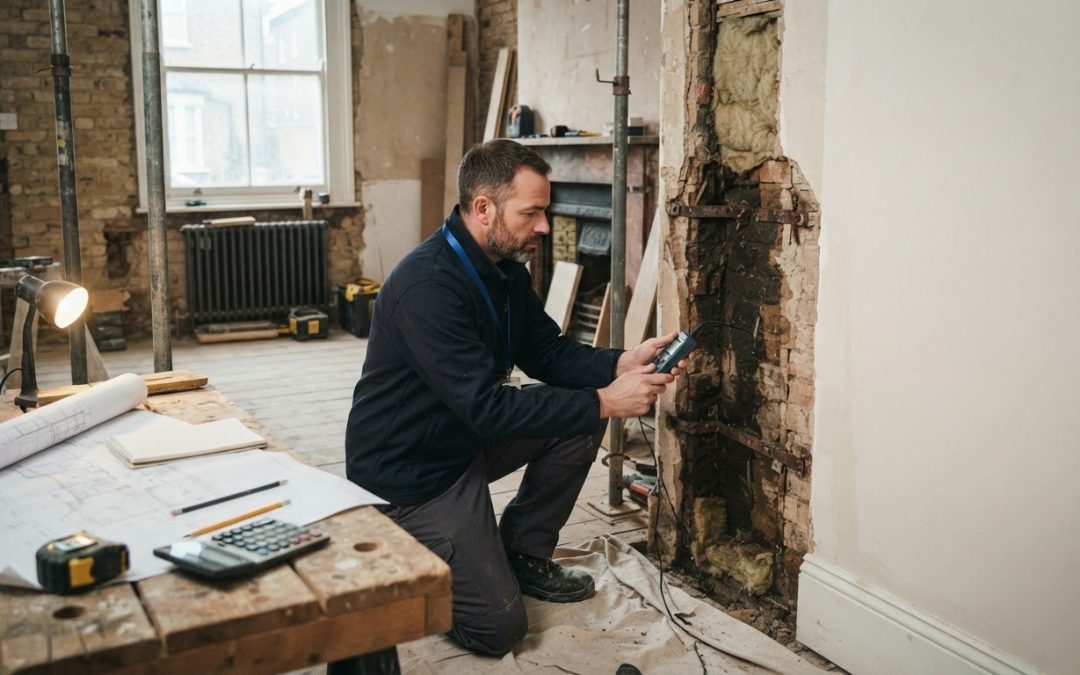
What if the damp repair that changes your renovation budget is the one you can’t see yet? If you’re asking how much to budget for hidden damp repairs in a renovation, the answer depends on what is behind the finishes and what is causing the moisture. A stained wall may point to an issue within the cavity, but the mark alone cannot confirm the cause.
It’s understandable to want a firm figure before work starts. However, the scope may only become clear after a specialist investigation or once affected areas are opened up. Budgeting for diagnosis first can help you avoid paying for cosmetic repairs that leave the underlying issue unaddressed.
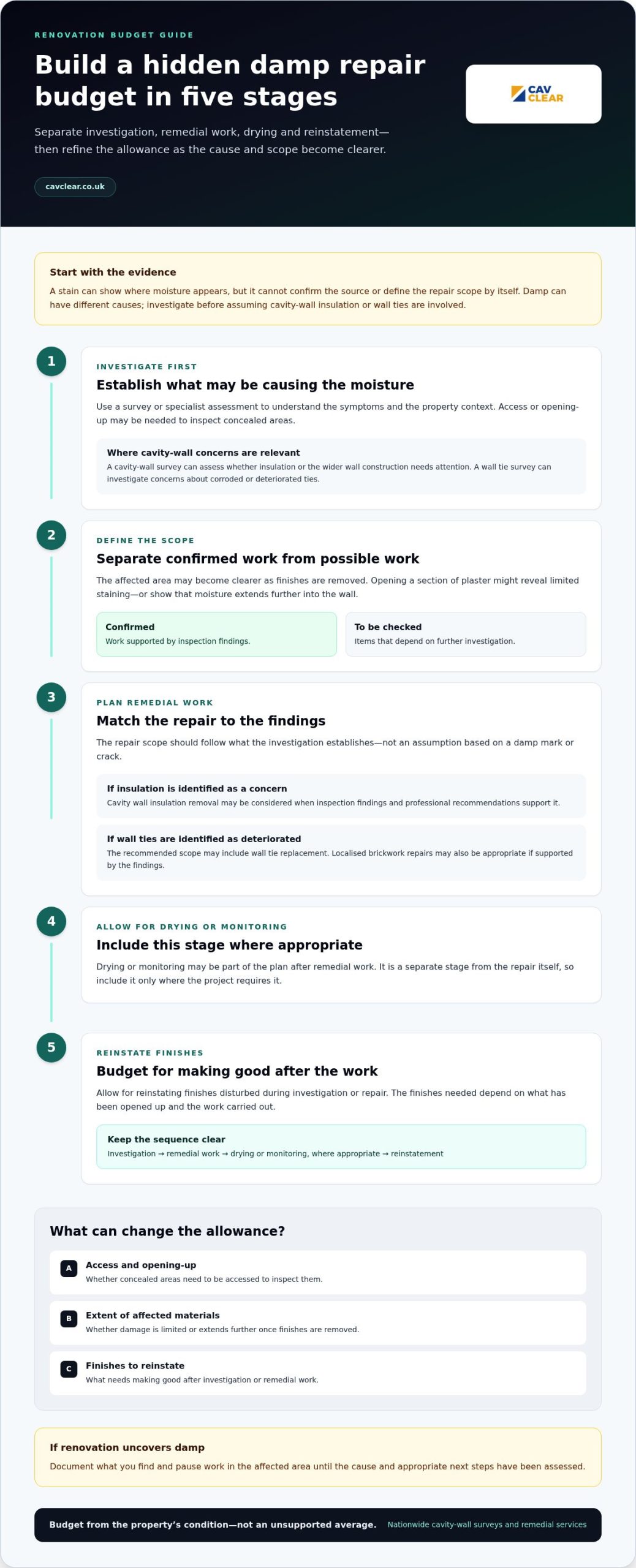
This guide explains the stages that can affect your renovation allowance, from investigating concealed damage to carrying out remedial work and making good afterwards. It also covers when a cavity-wall survey or specialist assessment may be relevant, including where defective cavity wall insulation or failing wall ties could be contributing to damp. CavClear provides nationwide cavity-wall surveys and remedial services to help property owners understand findings and plan the work. The aim is a proportionate budget based on the property’s condition, not an unsupported average.
Key Takeaways
- To work out how much to budget for hidden damp repairs in a renovation, separate investigation, remedial work, drying and reinstatement rather than treating them as one task.
- Moisture symptoms can have different causes. Consider whether cavity-wall insulation or wall ties need specialist investigation before setting the repair scope.
- Build your budget around factors that can change the work, including access, the extent of concealed damage and the finishes that need reinstating.
- If renovation work uncovers damp, document what you find and pause work in the affected area until the cause and appropriate next steps have been assessed.
- A nationwide cavity-wall survey can help clarify whether cavity wall insulation removal or wall tie replacement is relevant to the remedial plan.
What hidden damp repairs can add to a renovation budget
Hidden damp repairs are works identified after finishes are removed or an investigation examines moisture-related symptoms. Renovation may expose damp plaster, stained masonry or damaged materials that were not visible before. This can change the work plan, but it does not automatically mean the whole area needs extensive repairs.
Plan the work in stages: investigate the likely cause, carry out any required remedial work, allow for drying or monitoring where appropriate, then reinstate affected finishes. These stages are related but not interchangeable. A budget that covers only the visible repair may miss investigation or making good. Conversely, assuming every stage is needed can overstate the scope.
Which costs belong in a damp-repair budget?
Keep investigation separate from remedial work. A survey or specialist assessment helps establish what needs attention; the repair scope sets out the work recommended in light of the findings. Access or opening-up may also be needed to inspect concealed areas. Include these items where the project requires them, then allow for reinstating finishes disturbed during investigation or repair.
The extent of affected materials may become clearer as work progresses. Removing a section of plaster, for example, might show that staining is limited or that moisture extends further into the wall. Separate confirmed work from items that depend on what further investigation reveals.
Why renovation can reveal concealed moisture
Paint, wallpaper, plasterboard and fitted units can hide staining or damp materials. Removing them may expose earlier damage, but a newly visible mark is a reason to investigate, not a diagnosis. The building fabric, the location and pattern of symptoms, and external conditions all help build a clearer picture of what may be happening. Background terminology such as damp-proof courses and membranes is covered in this overview of damp proofing methods.
A visible damp symptom can show where moisture appears, but it cannot establish the source or define the repair scope on its own.
Moisture can have different causes, so damp does not automatically mean cavity-wall insulation or wall ties are defective. Where symptoms or other findings point to a cavity-wall issue, a cavity wall survey or wall tie inspection can help establish whether specialist remedial work is relevant. CavClear provides specialist cavity-wall inspections and remedial services, including cavity wall insulation removal and wall tie replacement where the findings support that work.
So, how much to budget for hidden damp repairs in a renovation depends on what the investigation establishes, which repairs are needed and what must be reinstated afterwards. Separate these stages in your project plan and review the allowance when the scope becomes clearer.
How cavity-wall defects can change hidden damp repair scope
Damp inside a home can have several possible causes. A leak, an external defect or an issue within a cavity wall may produce overlapping symptoms, so staining alone cannot identify the source. An investigation should consider the property’s construction, the position and pattern of symptoms, and relevant external conditions.
Defective cavity wall insulation may contribute to moisture problems in some properties, for example if the material is wet or affecting how the cavity manages moisture. That possibility does not mean insulation is responsible whenever a wall feels damp. A cavity-wall survey can help establish whether the insulation and wider wall construction warrant further attention before remedial work is considered.
A damp patch is an observed symptom, not proof of a cavity-wall defect.
When cavity wall insulation may need investigation
Persistent damp symptoms, signs of moisture around external walls or relevant findings during renovation can be reasons to investigate. They are not proof that insulation has failed. A Cavity Wall Insulation Survey assesses the cavity-wall context and helps inform what, if anything, should happen next. Cavity wall insulation removal should be considered when inspection findings and professional recommendations support it. For budgeting, the scope should follow the evidence, not an assumption based on a mark on the wall.
When wall ties or brickwork may affect the scope
Wall ties connect the two leaves of a cavity wall. If they corrode or deteriorate, they may be associated with cracking or movement in the masonry, although those symptoms can have other causes. A Wall Tie Survey can assess concerns about the ties and help determine whether they are relevant to the repair plan.
Cracking in mortar joints or around openings may warrant closer investigation, but does not confirm wall tie failure. If a survey identifies deteriorated ties, the recommended scope may include wall tie replacement. Localised brickwork repairs may also be appropriate if the findings support them. The extent of any work depends on the inspection, so avoid adding assumed repairs to the budget before the cause and affected area are understood.
If renovation findings raise questions about the cavity or wall ties, a specialist cavity-wall survey can help clarify the issue and inform the remedial scope. CavClear provides nationwide cavity-wall inspections and remedial services, including cavity wall insulation removal and wall tie replacement where supported by the findings.
How to build a realistic budget for hidden damp repairs
A useful budget shows what is known, what depends on further investigation and which tasks are separate. Rather than relying on a single provisional total, list each stage and record the assumptions behind it. This makes it easier to revise the plan if opening-up work or survey findings change the scope.
Budget lines to keep separate
Use separate lines for investigation and reporting, any required access or opening-up, specialist remedial work, and drying, monitoring or reinstatement where applicable. A survey identifies and reports on findings; it is not the same as carrying out recommended remedial work. Opening-up and reinstatement are conditional, not automatic. Include them only where the project scope requires them.
Keep cavity wall insulation removal and wall tie work as distinct scopes if they are recommended. This helps separate a cavity-wall remedy from general damp-related repairs or finishing work.
| Budget area | What may affect the scope | What to record |
|---|---|---|
| Investigation | Property construction, the symptoms being assessed and the inspection or reporting required. | Survey coverage, findings and any limits or assumptions. |
| Access and opening-up | Where inspection or remedial work needs access, and whether finishes or fittings must be disturbed. | What areas may need opening and whether making good is included. |
| Specialist remedial work | The confirmed cause, affected areas and the method recommended for the specific defect. | Each recommended task, including cavity-wall work as a separate item where relevant. |
| Drying, monitoring and reinstatement | The condition and extent of affected materials, and what needs to be repaired or replaced after remedial work. | Which steps are confirmed, which are conditional and what completion involves. |
What makes estimates differ
Two estimates may describe different work, even if both refer to damp repairs. The property layout can affect access; the location and extent of affected materials can change what needs opening or replacing; and investigation findings can add, remove or refine remedial tasks. Compare like with like, rather than looking at headline totals alone.
Check that each estimate sets out the work included, areas covered, access or opening-up assumptions, and whether reinstatement is part of the scope. Mark confirmed work separately from provisional allowances that depend on further findings. Avoid applying a fixed contingency percentage without project-specific evidence. For a clearer view of how much to budget for hidden damp repairs in a renovation, update the budget once investigation establishes what the property needs.
What to do when renovation uncovers unexpected damp
Finding damp after removing a finish can disrupt your renovation plan, but it does not confirm what caused the moisture or how much repair is needed. Staining, mould and cracking are symptoms to investigate, not diagnoses. Follow a clear sequence to document the issue and base decisions on findings rather than assumptions.
- Document what you’ve found. Take photographs and note where staining, mould, damp materials or cracking appear. Record what was removed and whether the condition changes across the exposed area.
- Pause work in the affected area. Avoid covering the symptoms or continuing finishes that could make inspection harder. Unrelated renovation work may be able to continue if it does not interfere with the investigation.
- Investigate the possible cause. Arrange an assessment suited to the concern. If the signs may relate to a cavity wall, a specialist cavity-wall survey or wall tie inspection can assess that part of the building.
- Review the written findings and scope. Separate what has been observed from what remains uncertain. Identify the recommended work, the areas it covers and any access or opening-up needed.
- Update the plan before proceeding. Revise the renovation allowance to include confirmed additional work, and keep conditional items separate until further findings support them.
Questions to resolve before approving remedial work
Use the written findings to establish what the investigation observed and what remains unclear. Check which remedial tasks are recommended, where they apply, and whether drying, monitoring or reinstatement is included. This helps distinguish work needed to address a property concern from cosmetic finishes that can be scheduled later. If cracking is present, do not assume wall ties are the cause without an inspection.
How to revise the renovation plan
If the investigation confirms additional work is necessary, update both the scope and the budget. Coordinate plastering, decorating and other affected finishes with the specialist remedial sequence, so they do not cover areas that still need attention. Keep a record of new findings and agreed changes. A provisional allowance reflects uncertainty; it should not quietly become an assumed requirement.
This process gives you a more reliable basis for deciding how much to budget for hidden damp repairs in a renovation. Where the findings point to a cavity-wall concern, arrange a specialist cavity-wall survey with CavClear to help clarify the issue and inform the remedial scope.
How CavClear can help assess cavity-wall-related damp repairs
Damp symptoms can have several causes, and not every case relates to a cavity wall. Where the property’s construction, visible signs or renovation findings raise concerns about the cavity, a specialist inspection can help establish whether a cavity-wall issue is relevant. CavClear provides nationwide UK surveys and remedial services focused on cavity-wall problems.
Depending on the concern, an assessment may involve a cavity wall survey, a Cavity Wall Insulation Survey or a Wall Tie Survey. If findings identify defective insulation or deteriorated wall ties, the report can set out relevant remedial recommendations. These may include cavity wall insulation removal or wall tie replacement where the inspection supports that work. Recommendations depend on the property’s circumstances, not on damp symptoms alone.
What a specialist cavity-wall assessment can clarify
An inspection helps distinguish observed symptoms from findings about the cavity-wall system. A written report and remedial recommendations can help define which areas need attention, what work is supported by the findings and what remains outside the established scope. This gives you a clearer basis for updating renovation plans without assuming every damp issue requires cavity-wall repairs.
CavClear is TrustMark registered for cavity wall insulation removal and a member of the Wall Tie Installers Federation. These credentials relate to the stated services and membership; the assessment itself remains specific to the property and the evidence gathered.
Plan the next step with CavClear
If you’re arranging a survey, share the renovation timeline and the symptoms or findings you have recorded. Details such as where damp or cracking appears, which finishes have been removed and whether work is underway can help frame the concern for inspection. CavClear provides nationwide coverage throughout the United Kingdom.
A cavity-wall survey is appropriate when there is a reason to investigate the cavity, its insulation or wall ties. It will not determine the cause of every damp problem, but it can help establish whether cavity-wall findings should shape the remedial plan and budget. For a more informed view of how much to budget for hidden damp repairs in a renovation, arrange an assessment before committing to cavity-wall remedial work.
Arrange a CavClear survey for your property.
Plan your renovation budget with clearer findings
Hidden damp can change a renovation plan, but staining, mould or cracking alone will not confirm the cause or define the repair. Separate investigation, specialist remedial work and reinstatement in your budget, then revise provisional allowances when the findings establish what the property needs. This is a more dependable way to decide how much to budget for hidden damp repairs in a renovation than relying on an assumed figure.
Where symptoms point to a possible cavity-wall issue, a specialist survey can help clarify whether insulation or wall ties are relevant. CavClear provides nationwide UK cavity-wall surveys and remedial services, including cavity wall insulation removal and wall tie replacement. CavClear is TrustMark registered for cavity wall insulation removal and a member of the Wall Tie Installers Federation.
If you’re planning renovation work and need to understand a cavity-wall concern, arrange a CavClear survey for your property. Clear findings can help you plan the next steps with greater confidence.
Frequently Asked Questions
How much should I budget for hidden damp repairs in a renovation?
There isn’t a reliable figure without knowing the cause and extent of the issue. To plan how much to budget for hidden damp repairs in a renovation, separate investigation and reporting from remedial work, access or opening-up, drying or monitoring, and reinstatement. Keep confirmed tasks distinct from provisional allowances, then update the budget when findings clarify which areas and repairs are involved.
What can make hidden damp repairs more expensive?
The scope can grow if investigation reveals that moisture-affected materials extend beyond the area first exposed, or if specialist remedial work is needed. Access, opening up finishes and making good afterwards can also affect the work involved. The type of defect matters too: a cavity-wall issue may need a different remedy from another moisture source. Compare estimates by their included tasks and assumptions, not just their totals.
Can cavity wall insulation cause damp during a renovation?
Defective or incorrectly installed cavity wall insulation may contribute to moisture problems in some properties, but damp symptoms alone do not prove that insulation is responsible. Renovation can expose staining or damp materials that were previously hidden. A Cavity Wall Insulation Survey can assess the cavity-wall context and help determine whether further action, including cavity wall insulation removal, is supported by inspection findings and professional recommendations.
Should I stop renovation work if I uncover damp?
Pause work in the affected area if continuing could cover the evidence or make inspection more difficult. Photograph the staining, mould or damp materials, note where they appear, and arrange an appropriate investigation before repairing or replacing finishes. These symptoms do not confirm the cause. Unrelated work may be able to continue if it will not disturb the area or obstruct the assessment.
Can wall tie problems cause damp or cracking?
Deteriorated or corroded wall ties can be associated with cracking or movement in masonry, but cracking can have other causes and needs inspection. Damp is not, on its own, proof of wall tie failure. A Wall Tie Survey can assess the condition of ties where there are relevant concerns. Replacement or localised brickwork repairs should be based on survey findings and the recommended scope.
Do I need a damp survey before renovating an older property?
Not every older property needs a damp survey before renovation. Consider an appropriate investigation if you have noticed persistent damp symptoms, mould, unexplained staining or cracking, or if renovation work exposes concealed damage. The right assessment depends on the symptoms and building context. If the concern may involve a cavity wall, a specialist cavity-wall survey can help establish whether that system is relevant to the findings.
Does every damp problem need cavity wall insulation removal?
No. Damp can have different causes, and cavity wall insulation removal is relevant only where inspection findings and professional recommendations support it. A specialist survey can assess whether insulation or another cavity-wall issue is contributing to the symptoms. If the investigation points elsewhere, a cavity-wall remedy may not address the underlying cause. Base decisions on the property’s findings rather than assuming all damp has the same source.
Recent Comments