
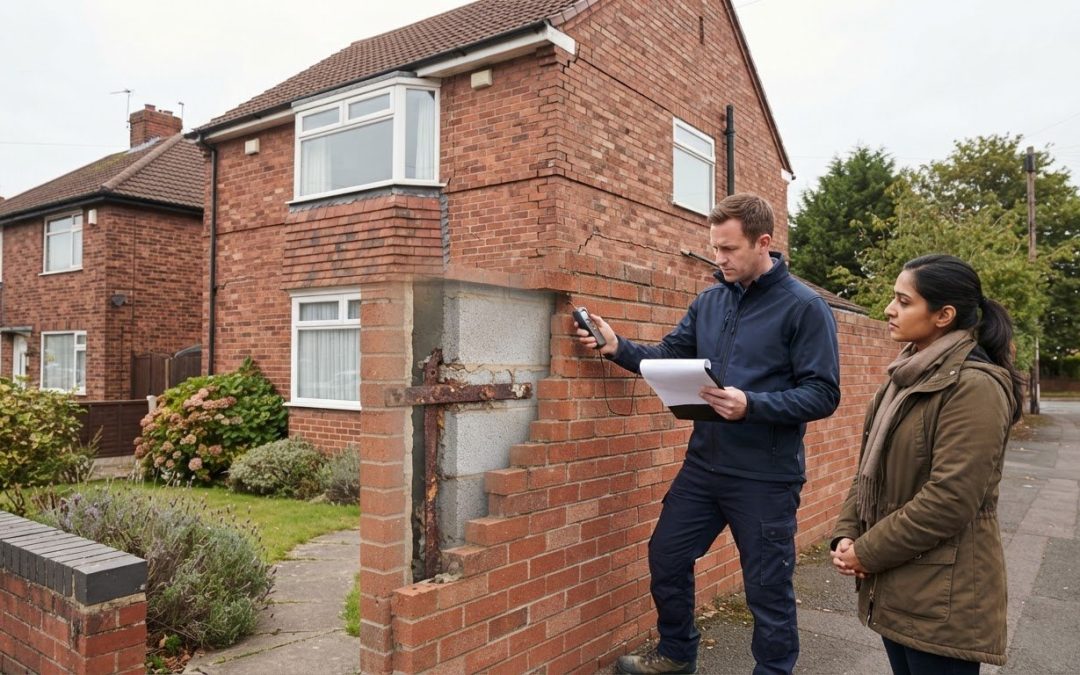
If you’re asking, “can I sue a surveyor for missing wall tie failure?”, the answer depends on the survey’s scope, what could reasonably have been identified at the time, and whether the omission caused you a financial loss. A later discovery of a defect does not, by itself, establish that the surveyor was responsible.
It’s understandable to feel concerned when cracking or movement appears, especially if you don’t know whether it is changing. However, cracks alone don’t confirm wall tie failure, and deteriorating ties inside a cavity may not be visible during a general survey. Two separate assessments can help clarify matters: a review of the original survey’s scope and findings, and a specialist inspection of the wall ties’ current condition.
This guide explains why a defect may be missed, which records and observations to organise, and how a specialist wall tie survey can establish whether the ties need remedial work. CavClear provides nationwide Wall Tie Surveys and Cavity Wall Tie Inspections across the UK, helping homeowners understand the condition of their masonry before deciding what to do next.
Key Takeaways
- Whether a surveyor may be responsible depends on the survey’s scope, the information available at the time and what the report recorded. Finding a defect later doesn’t automatically establish responsibility.
- Before asking “can I sue a surveyor for missing wall tie failure?”, check what the original survey was designed to inspect and what it recommended.
- Keep the survey instruction and report, and take dated photographs of visible changes. Avoid disturbing masonry or starting structural repairs before the condition has been assessed.
- A specialist wall tie survey can help establish the ties’ current condition and inform technical recommendations. It cannot, by itself, determine what an earlier surveyor knew or should have found.
- Use the inspection findings alongside your records to decide on appropriate next steps, including whether to seek legal advice.
Can a Surveyor Miss Wall Tie Failure, and What Does That Mean?
Discovering possible wall tie failure after receiving a reassuring survey report can be unsettling. You may wonder whether the problem was hidden, whether the inspection should have identified warning signs, and what to do next. The answer depends on the surveyor’s instruction and inspection scope, the information available at the time, and the evidence now available. Legal responsibility is a separate question for a suitably qualified legal adviser.
Wall tie failure means that the ties connecting the inner and outer masonry leaves of a cavity wall have deteriorated or failed. A cavity wall has two layers of masonry separated by a gap. For background on what wall ties are, this overview explains the basic construction. The cavity is the space between the two masonry leaves.
What do wall ties do in a cavity wall?
Wall ties span the cavity and connect the two masonry leaves, helping them act together. Depending on the property, ties may be made from metal or another material. Metal ties can corrode over time, and deterioration may reduce their effectiveness. This doesn’t mean every older property has failed ties. The condition needs to be assessed in the individual building.
Deteriorating ties may be associated with movement or cracking, but those signs can also have other causes. A crack in the brickwork is a reason to investigate, not proof that the ties have failed.
Why might a survey not identify a wall tie problem?
A general survey is usually based on a visual inspection of accessible parts of the property. Wall ties sit within the cavity, so their condition may not be directly visible from inside or outside. A surveyor may record visible cracking, bulging or other concerns and recommend further investigation without being able to confirm the concealed cause.
A specialist wall tie investigation has a different focus: it assesses the ties themselves using methods suited to the property and purpose of the inspection. Whether this level of investigation formed part of the original instruction matters. The report’s scope, access limitations and stated exclusions help explain what was examined and what was not.
So, can I sue a surveyor for missing wall tie failure? A later discovery alone doesn’t settle the question. The relevant comparison is between what the surveyor was asked to inspect, what could reasonably be observed at the time, what the report said, and what subsequent evidence shows. A specialist inspection can assess a particular property, while legal advice is needed to consider responsibility. CavClear’s nationwide Wall Tie Surveys and Cavity Wall Tie Inspections can establish the current condition of the ties and inform technical recommendations, but they don’t determine what an earlier surveyor knew or should have found.
What Should a Survey Have Covered to Identify Wall Tie Failure?
Start with the documents from the original inspection. The survey instruction, report type and any terms or exclusions help show what the surveyor was asked to examine. Read the full report, not just its summary. Look for descriptions of accessible areas, notes about cracking or movement, access limitations, and recommendations for further investigation.
The RICS Home Survey Standard provides information about home survey levels and reporting. It may help you understand the context of the report, but it does not decide whether a particular inspection was adequate. If you’re asking, “can I sue a surveyor for missing wall tie failure?”, a qualified legal adviser can assess how the instruction, report and evidence apply to your circumstances.
Was the inspection visual or specialist?
A visual survey records conditions that can be seen in accessible areas. It may describe cracking or bulging brickwork, but those observations don’t reveal the concealed condition of wall ties or prove what caused the signs. A specialist Wall Tie Survey focuses on assessing the ties themselves, using methods selected for the building and purpose of the investigation.
Methods may include a borescope inspection through small, localised openings in mortar joints, or a more localised open-up investigation where appropriate. A borescope allows the cavity to be viewed through a small opening. No single method suits every property. The survey scope and the building’s construction help determine what inspection is suitable.
What signs and records are relevant?
Stepped cracking, bulging masonry or signs of movement are observations worth recording and investigating. On their own, they are not proof of wall tie failure. Compare what the earlier report noted with dated photographs, repair history and your later observations. This can help establish when signs were visible or changed without assuming what caused them.
Organise the evidence in date order. Include the survey instruction and report, photographs taken around the inspection date, records of previous masonry repairs, and clear photographs of later changes. Note where each image was taken and when, if known. Keep the original files where possible, as they may retain useful date information.
If the report recommends further investigation, record whether that step was taken and what it found. A current specialist inspection can establish the ties’ condition now, but cannot alone establish what was visible or reasonably apparent during an earlier survey. For background on possible remedial work, see a guide to wall tie replacement.
For a focused assessment of current tie condition, CavClear carries out nationwide Wall Tie Surveys and provides findings to inform technical recommendations. Any decision about a surveyor’s responsibility is separate and should be discussed with a qualified legal adviser.
How Is Surveyor Responsibility Assessed When Wall Ties Were Missed?
A later discovery of deteriorated wall ties doesn’t, by itself, show that the surveyor was responsible. The assessment needs to consider what the surveyor was instructed to inspect, the inspection’s scope and limitations, what was visible or known at the time, and how the report described relevant observations or recommendations. Subsequent findings can add technical information, but they need to be considered alongside the earlier records.
This means the question “can I sue a surveyor for missing wall tie failure” has both a technical and a legal side. A wall tie specialist can assess the masonry ties’ present condition. A suitably qualified legal professional can advise on responsibility and whether there may be grounds for formal action. Neither assessment replaces the other.
| Question | Who can assess it? |
|---|---|
| What condition are the wall ties in now? | A specialist carrying out a wall tie inspection or survey. |
| What did the original survey cover, and what did it record? | The survey instruction and report provide the starting point for review. |
| Does the evidence support legal responsibility? | A suitably qualified legal professional, considering the relevant facts and jurisdiction. |
What evidence may help clarify the timeline?
Gather the survey instruction and full report, purchase documents, dated photographs, and records of repairs or other inspections. Put them in date order where possible. Photographs taken around the original survey may help show what was visible then, while later images can document changes over time.
A current specialist inspection can describe the wall ties’ present condition and inform technical recommendations. It may not establish their exact condition on the date of an earlier survey. No single photograph, report or inspection automatically determines responsibility or the outcome of a legal matter.
When should a homeowner seek legal advice?
If you’re considering formal action, seek prompt advice from a suitably qualified legal professional. Legal standards, procedures and time limits can differ across the UK and depend on the circumstances, so ask for current advice specific to the relevant jurisdiction rather than relying on general guidance.
CavClear provides nationwide Wall Tie Surveys, inspections and related technical recommendations. These findings can help explain the property’s current condition, but they are not legal opinions about a surveyor’s responsibility.
What Should You Do After Discovering Possible Wall Tie Failure?
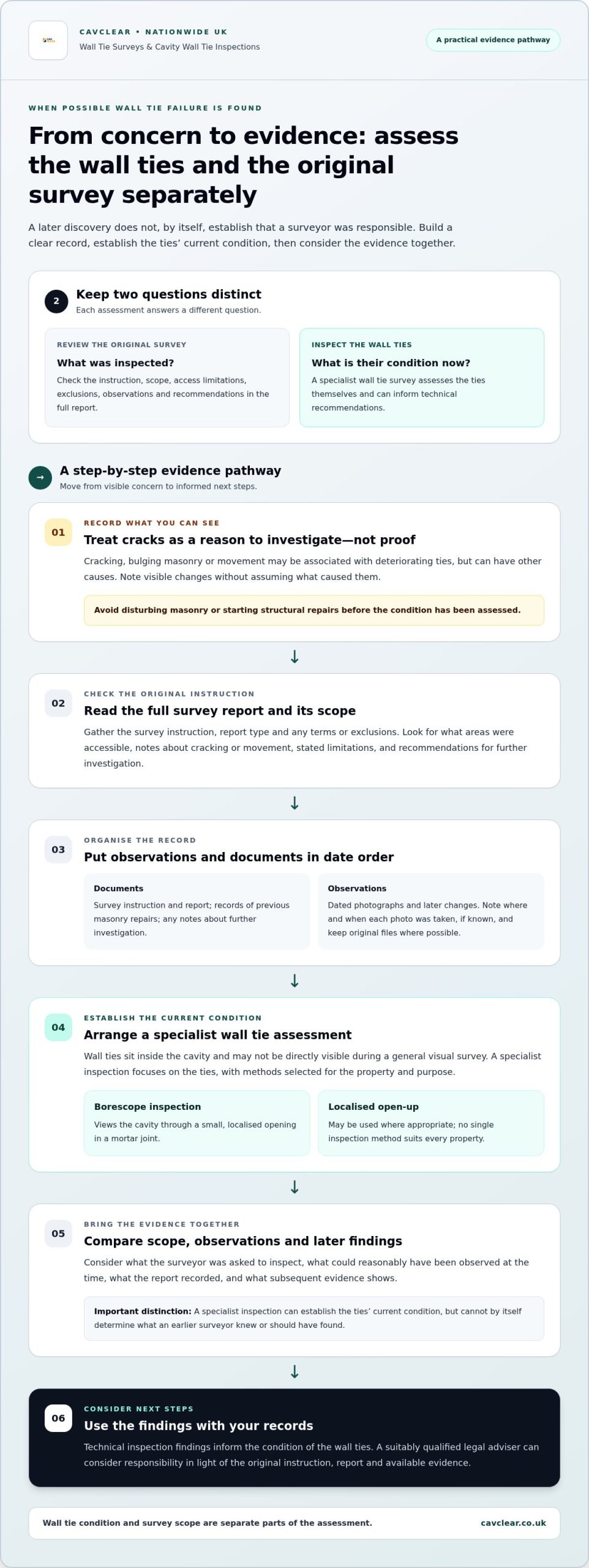
Take a measured approach. Keep the paperwork, record what you can see, and arrange a specialist assessment before deciding on repairs or other next steps. Cracking or movement can have different causes, so don’t treat a suspected wall tie problem as confirmed until the property has been inspected.
- Preserve records: Keep the original survey instruction and report, purchase documents, photographs, and any records of past repairs or inspections.
- Record visible changes: Take dated photographs from a safe position and note where changes appear and when you first noticed them.
- Review the report: Check its inspection scope, limitations, observations and recommendations.
- Arrange a specialist inspection: A focused Wall Tie Survey can assess current tie conditions and inform recommendations.
- Consider legal advice: If you’re considering formal action, seek advice from a suitably qualified legal professional.
Don’t drill into, remove or otherwise disturb masonry yourself, and don’t start structural repairs before the condition has been properly assessed. If you’re concerned about an immediate safety risk, keep people away from the affected area and seek appropriate professional attention promptly. This is a precaution, not a diagnosis of your property.
How should you prepare for a specialist wall tie survey?
Gather previous survey reports, property photographs and repair records, then prepare a brief timeline of changes you’ve observed. Point out the locations of cracking, bulging or other concerns, describing them as observations rather than confirmed evidence of tie failure. The inspection method should suit the property and the purpose of the assessment, with recommendations based on what the investigation finds.
What can an inspection report establish?
A specialist report can set out the areas inspected, methods used, current observations and any relevant limitations. Depending on the findings, it may recommend monitoring or remedial work. If work is advised, the appropriate treatment depends on the inspection results, not on symptoms alone. A guide to wall tie replacement can explain the general purpose of remedial work, but it cannot determine what your property needs.
A present-day inspection helps clarify the wall ties’ current condition. It doesn’t, by itself, establish their exact condition on the date of an earlier survey or decide whether that survey met a legal standard. If you’re asking, “can I sue a surveyor for missing wall tie failure?”, discuss responsibility and any relevant deadlines with a legal professional who can advise on your circumstances and jurisdiction.
For a focused assessment of the masonry ties, arrange a specialist Wall Tie Survey with CavClear. Our nationwide inspections help establish current conditions and inform technical recommendations.
How Can a Specialist Wall Tie Survey Help You Decide What Comes Next?
A specialist Wall Tie Survey can provide a clearer picture of the masonry ties’ condition now. It focuses on the cavity wall system and uses inspection methods suited to the property and purpose of the assessment. The findings can help explain whether cracking or movement may be related to tie deterioration, or whether further investigation is needed.
This can be useful if a previous report noted cracking, movement or a need for further wall tie investigation. Those signs can have different causes, so they should not be treated as confirmation of wall tie failure. A property-specific inspection helps establish what is present before remedial work is considered.
When is a Wall Tie Survey a useful next step?
Consider a focused survey if a surveyor recommended investigating the ties, or if you’ve noticed changes in the brickwork and want their cause assessed. CavClear provides Wall Tie Surveys across the UK and is a member of the Wall Tie Installers Federation (WTIF). This is a trade membership, not a legal accreditation, and a technical survey does not decide whether an earlier surveyor was responsible.
For background on possible remedial work, read a UK guide to wall tie replacement. The appropriate approach for a particular property depends on inspection findings, not on the presence of cracks alone.
What happens after the findings are documented?
A clear report can record the areas inspected, the methods used, the observed condition of the ties and any relevant limitations. Recommendations should follow those findings. Depending on the assessment, they may involve monitoring or remedial work. Wall Tie Replacement should be considered only where the inspection supports that recommendation.
The report describes the property at the time of inspection. It may help you understand the technical condition and decide what action to take, but it cannot establish exactly what an earlier surveyor knew or should have found. If you’re asking, “can I sue a surveyor for missing wall tie failure?”, keep the technical findings separate from the legal question and seek advice from a suitably qualified legal professional.
If you need a clearer understanding of your masonry ties, arrange a nationwide Wall Tie Survey with CavClear. An inspection can help inform practical next steps for the property’s long-term condition without assuming the cause or remedy before the evidence is assessed.
Take a Clear, Evidence-Led Next Step
Cracking or movement doesn’t confirm wall tie failure, and finding a defect later doesn’t automatically establish that a surveyor was responsible. The original survey’s scope and wording matter, while a specialist inspection can establish the ties’ current condition. Keep the report and supporting records together, and seek qualified legal advice if you’re considering formal action.
If you’re asking, “can I sue a surveyor for missing wall tie failure?”, a Wall Tie Survey can help clarify the technical facts, but it cannot decide legal responsibility. CavClear provides nationwide UK Wall Tie Surveys and Wall Tie Inspections, and is a member of the Wall Tie Installers Federation (WTIF).
For a property-specific assessment, arrange a specialist Wall Tie Survey with CavClear. A clear understanding of the masonry is a practical first step towards deciding what to do next.
Frequently Asked Questions
Can I sue a surveyor for missing wall tie failure?
Whether you can take formal action depends on the survey instruction, its scope, the evidence and the law that applies to your circumstances. Asking “can I sue a surveyor for missing wall tie failure” can’t be answered from the later discovery alone. Finding a defect doesn’t automatically establish responsibility. Arrange a specialist wall tie assessment to understand the property’s current condition, and seek prompt advice from a qualified legal professional. No outcome can be predicted from these facts alone.
What happens if a survey misses wall tie failure?
Keep the survey report and related property records, photograph visible changes with dates where possible, and arrange an appropriate specialist inspection. A focused assessment can investigate the current condition of the wall ties and inform technical recommendations. It may not establish when deterioration began or what was visible at the time of the original survey. A missed or later-discovered issue doesn’t, by itself, mean the surveyor was negligent.
Can a homebuyer survey detect wall tie failure?
It depends on the survey type, its instruction and scope. A visual inspection may record accessible signs, such as cracking, but may not investigate concealed wall ties within a cavity. Read the actual report and instruction for the areas inspected, limitations and recommendations. If concerns remain, a specialist wall tie survey can assess the ties more directly and help establish whether further technical action may be appropriate.
How do you prove a surveyor missed a defect?
No single document automatically establishes a surveyor’s responsibility. Potentially relevant material includes the survey instruction and report, dated photographs, repair history, purchase records and independent technical findings. Together, these may help clarify what was recorded and the property’s condition at different times, but they don’t determine a legal outcome on their own. A qualified legal professional must assess whether the evidence supports formal action under the law in the relevant UK jurisdiction.
Can wall tie failure be hidden from a visual inspection?
Yes. Wall ties are concealed within cavity walls, so their condition may not be visible from the surface. Cracking or movement can be a reason to investigate, but neither proves tie failure or identifies its cause. A specialist may use methods such as borescope inspection or localised opening-up, depending on the property and purpose. Only an appropriate inspection can assess a particular home’s ties; symptoms alone aren’t a diagnosis.
Should I get a wall tie survey after a survey report missed cracking?
A specialist wall tie survey may help assess the ties’ present condition and investigate whether they could be relevant to the cracking. Cracks can have other causes, so they shouldn’t be treated as proof of tie failure. Keep the earlier report and photographs, and share the location and history of the visible changes during the inspection. The findings can inform technical next steps without deciding whether the original survey was adequate.
How long do I have to take legal action against a surveyor?
There isn’t one general deadline that can safely be applied to every situation. Time limits and legal procedures depend on the facts and the UK jurisdiction involved. If you’re considering formal action, seek prompt advice from a qualified legal professional, who can check the current rules for your circumstances. Keep this legal assessment separate from a specialist wall tie inspection, which can establish technical information about the property’s present condition.
Recent Comments