
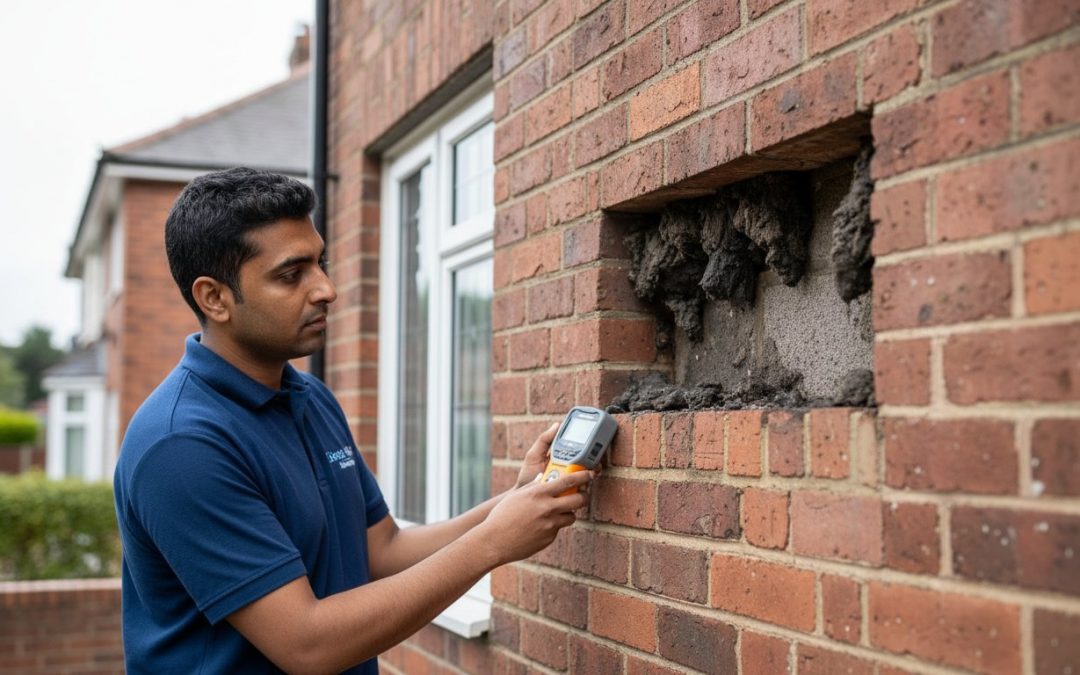
Industry estimates suggest that over 2 million UK homes with retrofitted cavity wall insulation could be susceptible to damp-related issues, turning a promised energy-saving solution into a source of property damage. If you’re seeing the tell-tale signs of rising damp, black mould, or crumbling brickwork, you understand the stress this causes. The confusion is often made worse by wildly different quotes from contractors, making it impossible to know who to trust with the structural integrity of your property.
This guide provides the clarity you need. We will deliver a detailed, no-nonsense breakdown of the cavity wall insulation removal cost you can expect in the UK for 2026, revealing the key factors that determine your final investment. By the end, you’ll understand exactly what contributes to the price, from the type of insulation material to the specialist extraction techniques required, empowering you to secure a dry, healthy home with a guaranteed solution.
Key Takeaways
-
Understand the typical cavity wall insulation removal cost for a UK home, with average 2026 prices for a semi-detached property ranging from £2,800 to £4,600.
-
Learn which specific factors, such as property accessibility and the condition of your mortar, directly influence your final extraction quote.
-
Discover potential hidden costs beyond the initial extraction, including essential structural repairs like wall tie replacement that may be required.
-
Identify the crucial differences between a qualified extraction specialist and a high-pressure salesperson to ensure your property is in safe hands.
Table of Contents
How Much Does Cavity Wall Insulation Removal Cost in 2026?
Understanding the financial investment required to rectify failed cavity wall insulation is the first step toward protecting your property. For homeowners in Manchester, the average cavity wall insulation removal cost for a standard three-bedroom, semi-detached house currently ranges between £2,800 and £4,600. This is not a simple clearance job; it’s a specialist technical procedure that demands precision, industrial-grade equipment, and a deep understanding of building structures to ensure no further damage occurs.
The pricing for this service is not arbitrary. It is meticulously calculated based on the total square metreage of the external wall area requiring extraction. The process involves our accredited technicians using high-powered vacuum machinery connected to a large-bore hose, which carefully draws out the damp and degraded material. Industrial compressed air tools are often used to dislodge stubborn or compacted insulation from the cavity. In 2026, homeowners in Manchester can expect to pay an average of £28 to £36 per square metre for professional extraction, with the final figure depending on the insulation material.
The very structure of your home dictates the scope of the work. A cavity wall, a common UK construction feature for over a century designed to prevent moisture penetration (you can read a technical overview with this guide on What is a Cavity Wall?), can unfortunately trap moisture if the insulation inside it fails. The size of this cavity and the total wall area are the primary drivers of the final quote.
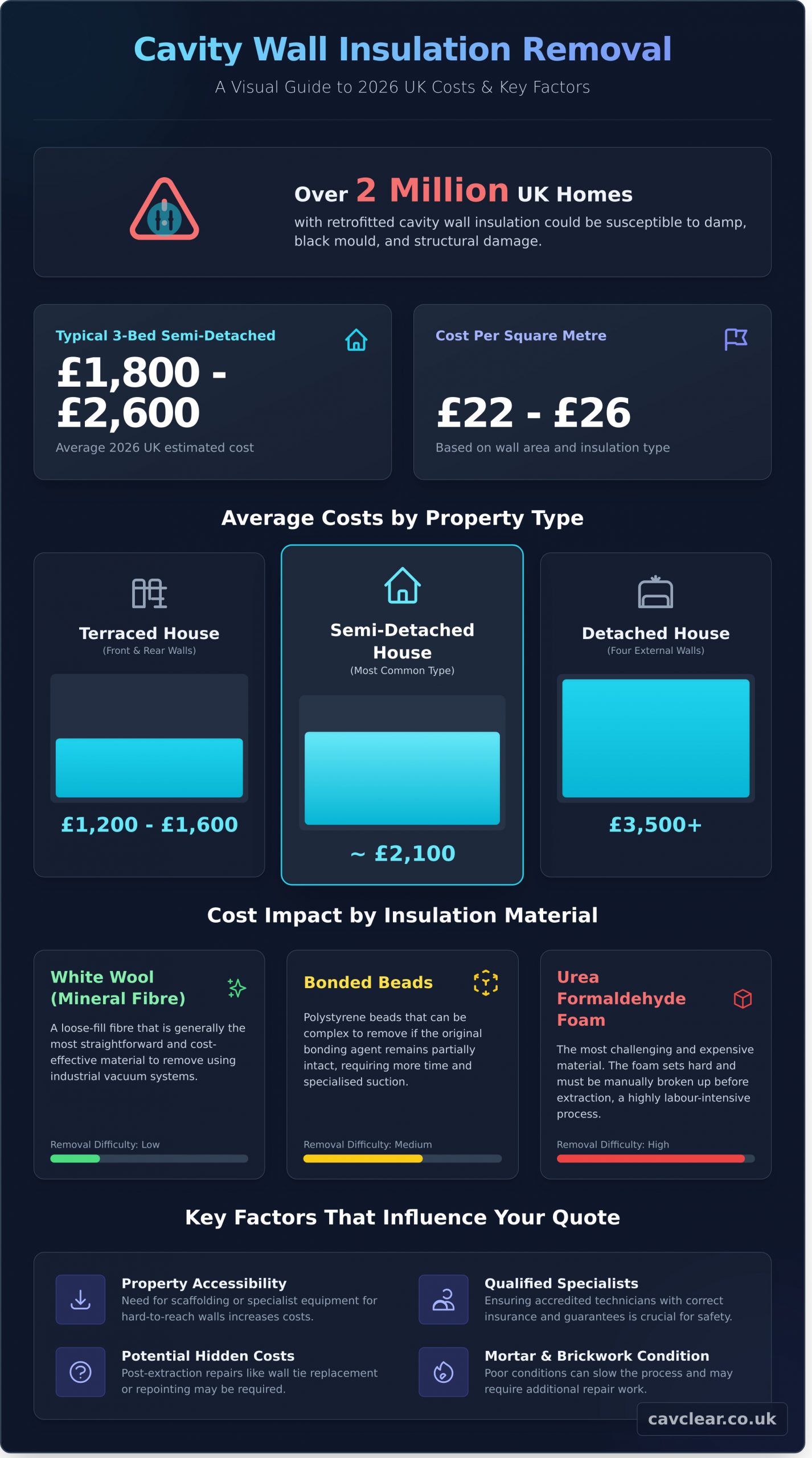
Average Costs by Property Type
The size and style of your home directly influence the total surface area that needs clearing, which is the biggest factor in the overall cost. We’ve found that costs typically break down as follows:
-
Terraced Houses: With only front and rear elevations to clear, the smaller wall area means extraction costs typically range from £1,200 to £1,600.
-
Semi-Detached Properties: As the most common property type we service, these homes with three external walls generally average a cost of around £2,100.
-
Detached Homes: These properties require the most extensive work. With four elevations and a significantly larger surface area, costs can easily exceed £3,500, particularly for larger or more complex building layouts.
Cost Variations by Insulation Material
Not all insulation is created equal, and the material used in the initial installation will significantly impact the time, labour, and equipment needed for its removal. This variance is a key component of the final cavity wall insulation removal cost.
-
White Wool (Mineral Fibre): This is generally the most straightforward material to extract. It’s a loose-fill fibre that, while prone to slumping and water retention, can be removed efficiently with our vacuum systems, making it the most cost-effective scenario.
-
Bonded Beads: Polystyrene beads are blown into the cavity with a bonding agent. If this agent fails, the beads flow expertly and can be extracted with relative ease using specialised suction equipment. If the bonding remains partially intact, the process can be more complex.
-
Urea Formaldehyde Foam: This is the most challenging and therefore most expensive material to remove. The foam sets hard within the cavity and doesn’t break down easily. It often requires being manually broken up with specialist tools before it can be vacuumed out, a labour-intensive process that adds considerable time to the project.
Key Factors That Influence Your Extraction Quote
Receiving a quote for cavity wall insulation removal isn’t like buying an off-the-shelf product. The final figure is a direct reflection of the unique challenges presented by your property. A professional assessment identifies several critical variables that determine the labour, equipment, and time required to restore your home’s structural integrity. Understanding these variables is crucial for homeowners in Manchester to accurately interpret their cavity wall insulation removal cost and appreciate why a one-size-fits-all price is never a sign of a quality service.
The condition of your property’s brickwork, the accessibility of its walls, and the state of the material inside the cavity are the primary cost drivers. A reputable specialist will break these down for you, ensuring complete transparency. Below, we detail the key factors that our technicians assess during a property survey.
Access and Scaffolding Requirements
How our technicians can physically reach the exterior walls is a significant logistical and cost factor. For a standard two-storey semi-detached house with clear access, specialist tower scaffolds and extension ladders are often sufficient. This is the most cost-effective scenario. However, many properties in the Greater Manchester area have features that complicate access, including:
-
Extensions and Conservatories: Structures built against a primary elevation prevent the use of standard ladders. A bespoke scaffolding rig must be erected over the structure, which can add between £600 and £1,800 to the project cost.
-
Narrow Access: Terraced homes with side passages less than 1 metre wide may not permit the use of mobile towers, necessitating more complex scaffolding solutions from the front or rear.
-
Property Height: Any property over two storeys, such as a three-storey townhouse, legally requires full scaffolding to comply with the Work at Height Regulations 2005. This is a non-negotiable safety requirement.
Material Saturation and Debris Levels
The condition of the insulation inside the cavity directly impacts the extraction time. Wet mineral wool is not just damp; it becomes a heavy, dense slurry that can weigh up to 10 times more than when it was dry. This saturated material places immense strain on our industrial vacuum systems, often increasing the extraction time for an elevation by as much as 50%. This additional machine time and labour is a major component of the final cavity wall insulation removal cost.
Furthermore, many cavities contain construction debris like mortar "snots" left behind by the original builders. These obstructions act like dams, trapping wet insulation and blocking the extraction hoses. Our technicians must use specialist borescopes to identify these blockages and work methodically to clear them. This issue is so prevalent that even the UK Parliament CWI guidance acknowledges the systemic problems arising from incorrect installation. If the material has "slumped" and compacted at the base of the wall, a lower row of bricks may need to be removed to ensure a 100% clear cavity, which also adds to the scope of work. A thorough property survey is the only way to identify these hidden issues, which is why we provide a detailed assessment before any work begins.
Beyond the Extraction: Essential Repairs and Hidden Costs
Understanding the total cavity wall insulation removal cost requires looking beyond the price of the extraction itself. A reputable contractor’s quote will be comprehensive, but certain pre-existing or consequential damages can add to the final budget. Failed insulation doesn’t just reduce your home’s thermal efficiency; it can actively cause or conceal serious structural problems that must be rectified to protect your property’s long-term health and value.
Once the saturated insulation is removed, the true condition of your property’s cavity and external walls is revealed. This is when issues like corroded wall ties, damaged brickwork, or failed render become apparent. Addressing these problems at the same time as the extraction is the most efficient and cost-effective approach, preventing future disruption and more expensive repairs down the line.
The Link Between Wet Insulation and Wall Tie Failure
One of the most serious consequences of failed insulation is the accelerated corrosion of steel wall ties. Saturated mineral wool or fibre insulation acts like a damp sponge, holding moisture directly against the metal ties that connect your home’s inner and outer walls. This constant dampness promotes rust, causing the ties to weaken and expand, a process which can compromise your home’s structural stability. Replacing failing wall ties during the extraction process is significantly more cost-effective than arranging a separate visit, as technicians already have access to the cavity. For any Manchester property built before 1981, a pre-extraction boroscopic wall tie survey is a critical diagnostic step to assess corrosion levels and plan for necessary replacements.
The financial impact of ignoring this issue can be substantial. Corroded ties can lead to "blown" or bowed brickwork and significant cracking in the external render. These are not cosmetic issues; they are structural faults that require immediate attention. The cost to repair a section of blown brickwork can range from £800 to over £2,500, a significant expense that must be budgeted for in addition to the extraction itself.
Waste Disposal and Environmental Compliance
The extraction process generates a surprisingly large volume of waste material. A typical three-bedroom semi-detached home can produce between 30 and 40 large, heavy-duty sacks of old insulation, dust, and cavity debris. This material cannot simply be put in your household bin. Under UK environmental law, it’s classified as controlled waste and must be handled by a licensed waste carrier. A professional contractor will factor the cost of specialist bagging, removal from your property, and all associated landfill taxes into their initial quote. Crucially, they must provide you with a waste transfer note. This legal document is your proof that the waste was disposed of responsibly, protecting you from any liability.
Finally, consider the finish. A professional extraction service always includes "making good" the drill holes with colour-matched mortar to blend with your existing brickwork.
How to Identify a Qualified Cavity Wall Extraction Specialist
Selecting the right contractor for cavity wall insulation removal is the single most important decision you will make to protect your property. A low initial quote from an unqualified operator often leads to incomplete work, further damp issues, and significantly higher long-term repair bills. The true cavity wall insulation removal cost isn’t just the price on the invoice; it’s the long-term value and security of having the job completed correctly the first time.
Be cautious of companies offering "expert" surveys. These are frequently sales visits designed to pressure you into a contract. A genuine specialist will recommend an independent technical assessment, which typically costs between £250 and £450. This fee covers a detailed diagnostic process, not a sales pitch, providing you with an unbiased report on the condition of your property’s cavities.
A professional extraction requires industrial-grade machinery. The process involves a powerful compressor that dislodges compacted and damp insulation material, which is then removed by a high-volume vacuum system. If a contractor arrives with equipment resembling a domestic vacuum, they lack the necessary tools to clear your cavities thoroughly. This can leave behind debris that continues to cause thermal bridging and damp penetration.
Finally, verify a company’s credentials. Legitimate specialists will hold accreditations from industry bodies like the British Board of Agrément (BBA) or the Insulation Assurance Authority (IAA) and Trustmark. Crucially, ask for proof of their Public Liability insurance and ensure it specifically covers structural remedial work. A standard policy may not cover damage caused by a botched extraction, leaving you financially exposed.
The Importance of a Professional Survey
A comprehensive survey is non-negotiable. The only way to accurately assess the extent of insulation failure is with a borescope inspection, where a small camera is inserted into the cavity. This diagnostic tool maps the location of wet, slumping, or missing insulation, identifies mortar blockages on wall ties, and detects rubble at the damp-proof course level. This detailed report is essential evidence for any future insurance claims or for satisfying mortgage lenders during a property sale, as over 75% now require such documentation.
Questions to Ask Your Contractor
Before committing to any work, a responsible homeowner should ask direct and specific questions. A qualified specialist will welcome this scrutiny and provide clear, confident answers. We recommend you ask the following:
-
Do you provide an insurance-backed guarantee for both the extraction work and the making good of the brickwork?
-
What is your precise method for ensuring no insulation remains trapped around difficult areas like window reveals, air bricks, or wall ties?
-
Can you provide references and case studies for at least three similar structural remedial projects completed in the Greater Manchester area within the last 12 months?
The answers to these questions will separate the true professionals from the unqualified operators. A specialist’s process is defined by thoroughness, from the initial survey to the final guarantee. This diligence is a critical factor in the overall cavity wall insulation removal cost and ensures a permanent solution to your damp problems. To ensure your property is assessed by an accredited specialist, book a comprehensive borescope survey with CavClear today.
Restoring Your Home’s Integrity with CavClear
Understanding the factors that influence the cavity wall insulation removal cost is the first step; choosing the right specialist to perform the work is the most critical. At Cav Clear Ltd, we provide a methodical, safety-first approach to insulation extraction that protects your property for the long term. Our work isn’t just about removing failed material. It’s about restoring your home’s structural health and your peace of mind.
Many companies simply treat the symptom, which is the saturated insulation. Our accredited technicians are trained diagnosticians who identify the root cause of the damp. A survey from Cav Clear Ltd pinpoints the specific pathways for moisture ingress, whether it’s through porous brickwork, compromised pointing, or issues with roof verges. By identifying the underlying fault in over 98% of initial surveys, we ensure our remedial work provides a permanent solution, not a temporary fix.
A hollowed-out cavity is only part of the solution. The structural integrity of your walls depends on the condition of the metal wall ties holding them together. That is why every Cav Clear Ltd extraction project is combined with a structural wall tie survey. Using endoscopic cameras, our technicians inspect these crucial components for corrosion or failure, a common issue in damp-filled cavities. This comprehensive approach guarantees that once the cavity is clear, the building’s structural stability is confirmed and secure.
Ultimately, our goal is to return your property to its original state of thermal efficiency and weather resistance. By removing the debris and damp-holding material, we allow the cavity to perform its primary function: to prevent penetrating damp and allow the building to breathe. All our work is fully guaranteed and performed by certified professionals, transforming your initial removal cost into a sound investment in your property’s future value and comfort.
Our Specialist Manchester-Based Service
Operating from our head office right here in Manchester, Cav Clear Ltd delivers nationwide expertise with the accountability of a local specialist. We respect your home, using a clean, non-invasive extraction process with industrial-grade vacuums and HEPA filtration to minimise disruption. Following the work, we provide a detailed completion report, including photographic evidence, which provides the transparency required by homeowners, mortgage lenders, and insurance providers across the UK.
Take the First Step Toward a Dry Home
The first action is to gain a clear, professional assessment of your property. Contact our team to arrange a survey with a qualified technician who will determine the exact condition of your insulation and cavity walls. You will receive a transparent, fixed-price quotation detailing the full scope of work, with no hidden fees or high-pressure sales tactics. We provide facts, not fear, allowing you to make an informed decision about your home.
Book your specialist cavity wall survey with Cav Clear Ltd today and secure a permanent solution to damp.
Restore Your Home’s Health with a Specialist Extraction
Understanding the factors that shape your final cavity wall insulation removal cost is the first step toward resolving damp and structural issues. As we’ve detailed, the total expense is influenced by your property’s size, the specific insulation material, and any necessary post-extraction repairs. Choosing a certified professional isn’t just a recommendation; it’s essential for protecting your home’s structural integrity and ensuring the job is done correctly from the start.
At CavClear, we provide the clarity homeowners need. Our accredited technicians operate nationwide from our Manchester base, using specialist extraction equipment to guarantee a clean and thorough process. We believe in complete transparency, which is why every survey is accompanied by a comprehensive structural report detailing the condition of your wall cavity and our precise recommendations.
If you’re concerned about failing insulation, don’t wait for the problem to worsen. Get a specialist quote for cavity wall insulation removal from our team today. Taking decisive action is the best investment you can make in your property’s long-term health and your peace of mind.
Frequently Asked Questions
How long does it take to remove cavity wall insulation?
A standard cavity wall insulation extraction for a three-bedroom semi-detached property in Manchester is completed within 3 to 4 days. The exact duration depends on the property’s size, the type of insulation material present, and the extent of any debris within the cavity. Rock wool can often be removed faster than bonded foam. A pre-extraction survey provides a precise, fixed timeline for your specific property, ensuring minimal disruption to your household.
Can I remove cavity wall insulation myself to save money?
We strongly advise against attempting a DIY removal. This is a specialist process that requires industrial-grade vacuum equipment and technical expertise to perform safely and completely. Attempting it yourself risks incomplete extraction, which won’t solve the underlying damp problem, and can cause irreversible damage to wall ties or brickwork. Professional extraction is the only way to guarantee a clear cavity and protect your property’s structural integrity, providing a certified solution for peace of mind.
Will removing insulation make my house colder and increase energy bills?
Initially, removing failed insulation means your home will lose some thermal protection. However, damp and degraded insulation offers negligible thermal benefit and actively draws heat out of your home while causing structural damage. Removing this faulty material is the essential first step. Once the cavity is clear and dry, we can arrange for the installation of new, high-performance insulation that meets current BBA standards, which will significantly improve your home’s warmth and lower energy bills.
Does the removal process create a lot of mess or dust?
No, our professional extraction technique is a clean and contained process. We use powerful industrial vacuums connected to advanced filtration systems, which pull all insulation debris directly from the wall cavity into a sealed collection vehicle. This industry-standard method contains almost all dust and prevents it from entering your home or settling on your property’s exterior. Our technicians ensure all work areas are left clean and tidy upon completion of the job.
Is cavity wall insulation removal covered by my home insurance?
Whether your home insurance covers the removal depends on your specific policy. Most standard policies don’t cover problems resulting from poor installation or gradual material failure over time. However, if the insulation has become saturated as a direct result of an insured event, such as a major flood or storm damage, you may be able to make a claim. We always recommend you review your policy documents and consult directly with your provider.
What happens if the insulation isn’t removed after it gets wet?
Wet cavity wall insulation does not dry out on its own and will lead to significant property damage. The saturated material creates a "thermal bridge" that transfers cold and moisture directly to your internal walls, causing penetrating damp, black mould, and crumbling plaster. Over a period of 10-15 years, this persistent moisture can corrode steel wall ties, which compromises the structural stability of your home. Prompt extraction is vital to prevent these severe, long-term issues.
How much does a professional borescope survey cost?
In the Manchester area, a comprehensive borescope survey typically costs between £250 and £450. This fee covers a detailed inspection by a qualified technician who will assess the insulation’s condition, identify any damp, and check for debris or damage. The findings are compiled into a formal report that includes photographic evidence and a fixed quotation. This report clarifies your final cavity wall insulation removal cost before any work begins, ensuring complete transparency.
Can you install new insulation after the old material is removed?
Yes, we can arrange for the installation of new insulation once the extraction is complete and the cavity has been certified as clean and dry. We ensure the property is fully prepared for re-insulation with modern, BBA-certified materials like expanded polystyrene (EPS) bonded beads, which are water-resistant and will not slump. This completes the process, restoring your home’s thermal efficiency and providing a guaranteed, long-term solution to prevent future damp problems.
Recent Comments