

Discovering damp in your home is a serious concern, but the anxiety is often magnified by the fear of unpredictable repair bills. Navigating quotes from builders can feel like a minefield, leaving you to worry about hidden charges, unnecessary work, and whether the problem will truly be solved. Gaining a clear and honest understanding of the potential damp proof course cost is the essential first step toward restoring your peace of mind and protecting the structural integrity of your property.
This complete 2026 pricing guide has been created to provide that clarity. We will break down every factor that influences the final price in the UK, from the type of property and extent of the damp to the specific methods used by accredited specialists. You will learn how to identify a fair and transparent quote, understand the work involved, and ensure you are investing in a guaranteed, long-term solution. Our goal is to equip you with the expert knowledge needed to make a confident decision and secure your home against damp permanently.
Key Takeaways
- Learn the six critical factors a specialist surveyor assesses to provide an accurate quote, from wall thickness to the extent of the damp.
- Get a realistic estimate of the 2026 damp proof course cost, with price brackets for different UK property types and a baseline cost per linear metre.
- Discover why a professional damp survey is essential and how ‘cheap’ DPC installations can lead to far greater structural repair costs.
- Follow a clear process for obtaining a guaranteed, fixed-price quote, eliminating the risk of unexpected expenses for a permanent solution.
What is a Damp Proof Course & Why Do Costs Vary So Much?
A Damp Proof Course (DPC) is an essential, impermeable barrier installed at the base of a property’s walls. Its sole purpose is to prevent moisture from the ground rising up through the brickwork via a natural process known as capillary action. This phenomenon, commonly called ‘rising damp’, can cause significant structural and cosmetic damage if left untreated. For a foundational understanding, a detailed technical overview explains what a Damp Proof Course is and its evolution in construction.
Homeowners often search for a simple online price, but the reality is that a fixed quote is impossible without a professional assessment. The final damp proof course cost is not determined by the length of the wall alone; it is dictated by the true cause of the damp, the type of DPC required, and the extent of any associated repair work. An incorrect diagnosis is the most common reason for failed treatments and wasted expenditure.
Types of Damp Proof Courses
The method used to install or repair a DPC directly impacts the overall cost and is chosen based on the property’s age and construction. The most common types in the UK include:
- Chemical Injection DPC: The standard modern solution for existing properties. A specialist technician drills holes into the mortar course and injects a water-repellent chemical cream, which permeates the brickwork to form a new, continuous waterproof barrier.
- Physical DPC (DPM): This is a physical sheet of Damp Proof Membrane (DPM), typically made from plastic or bitumen, which is laid in the mortar bed during the original construction of the property. It is not a remedial solution.
- Electro-Osmotic Systems: A specialist method that involves inserting titanium wires into the wall. A small, safe electrical current is passed through them to repel rising moisture back down into the ground. This is less common and reserved for specific structural situations.
Rising Damp vs. Other Damp Problems
Misdiagnosing rising damp is a frequent and costly error. Installing a chemical DPC will have no effect on dampness caused by other issues, meaning you will have paid for an ineffective solution while the root problem worsens. It is critical to distinguish rising damp from two other common culprits:
- Penetrating Damp: Moisture entering the building horizontally from the outside. This is often due to defective guttering, damaged roofing, cracked render, or poor seals around windows.
- Condensation: This is caused by excess moisture within the home settling on cold surfaces, such as external walls and windows. It is a ventilation issue, not a structural one.
Only a qualified surveyor can accurately diagnose the type of damp affecting your property. A professional survey is not an upsell; it is a vital diagnostic step that ensures you only pay for the correct, guaranteed solution, protecting your investment and restoring your peace of mind.
The 6 Key Factors That Determine Your Final DPC Cost
A professional quotation for damp proofing is never a generic, off-the-shelf price. It is the result of a methodical survey where a qualified technician assesses several critical variables within your property. Understanding these factors will help you recognise the value in a detailed estimate and appreciate why a simple ‘per metre’ price rarely tells the whole story. An accurate survey is the foundation for a permanent solution and ensures the final damp proof course cost reflects the precise work required to protect your home.
Our surveyors evaluate the following six key areas to build your quote:
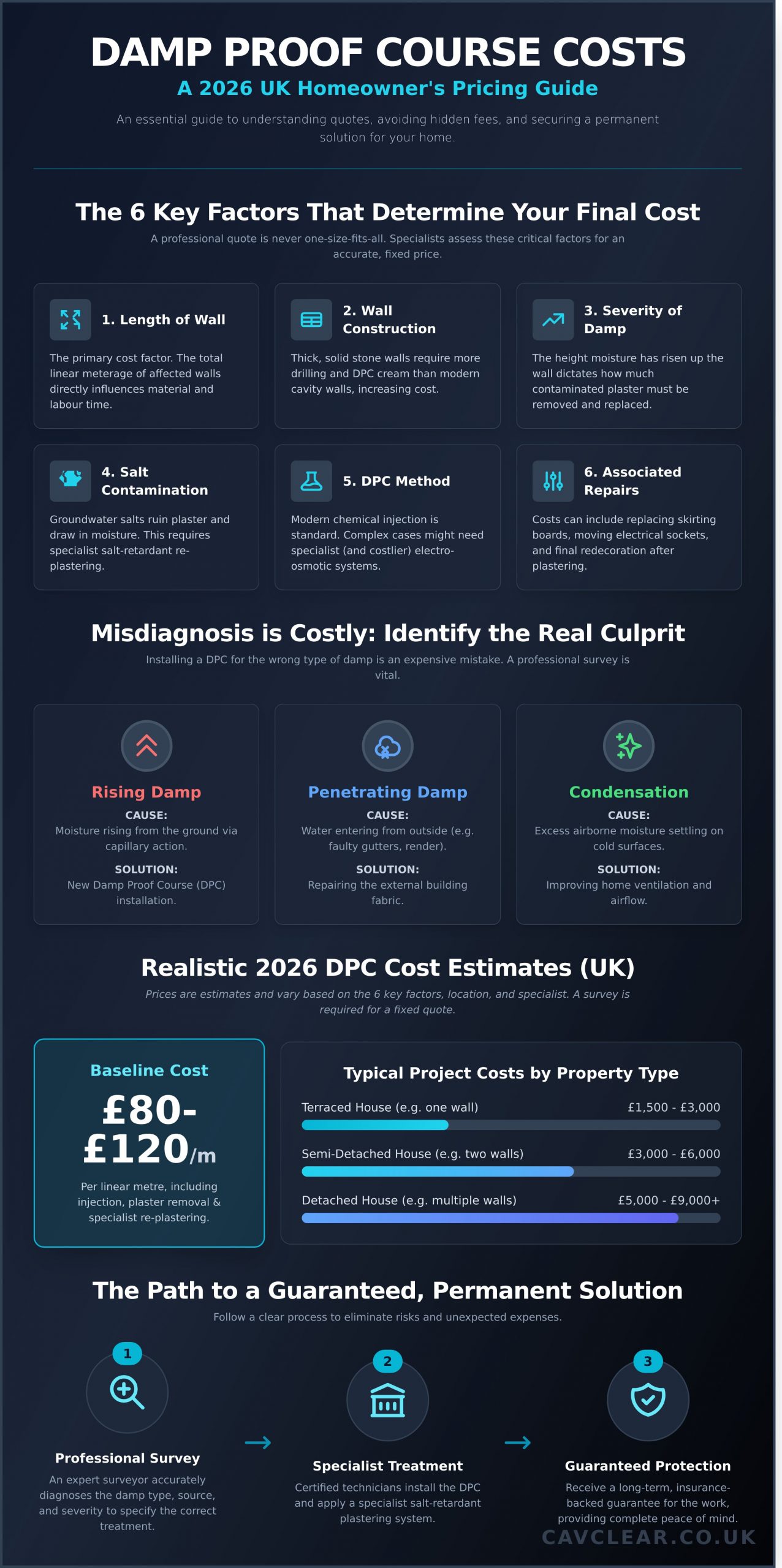
- 1. The Length of Wall Requiring Treatment: The primary cost factor is the linear meterage of the affected walls. A surveyor will measure the full extent of the problem, which may extend beyond the visible signs of damp.
- 2. Wall Construction and Thickness: The type of wall dictates the treatment method and materials required. A standard double-skin brick cavity wall is straightforward to treat. In contrast, a thick, solid stone wall, common in older properties, will require significantly more DPC material and specialist drilling techniques, increasing labour time.
- 3. The Severity and Height of the Damp: Rising damp rarely stops neatly at skirting board level. The survey will determine how high moisture has travelled up the wall. This assessment directly impacts the amount of plaster that must be removed and replaced.
- 4. Degree of Salt Contamination: As groundwater rises through masonry, it deposits hygroscopic salts in the plaster. These salts draw moisture from the air, perpetuating the damp problem even after a new DPC is installed. For this reason, removing the contaminated plaster and re-plastering with a salt-retardant render is an essential, non-negotiable part of the process and a major component of the overall cost.
- 5. Accessibility of the Work Area: The ease with which our technicians can access the affected walls influences labour costs. Treating a clear, empty room is more efficient than working around fixed kitchen units, in tight hallways, or in properties with suspended timber floors that may require lifting.
- 6. The Chosen DPC Method: While chemical injection using a DPC cream is the most common and cost-effective method for most properties, some situations may demand a different approach. A correct diagnosis is paramount; the dangers of misdiagnosis are well-documented by conservation experts, and applying the wrong solution is both ineffective and costly. Our survey ensures the specified method is perfectly suited to your property’s needs.
By carefully considering each of these elements, we provide a transparent and accurate quote that guarantees a long-term solution to your damp problem, giving you complete peace of mind.
A Realistic Breakdown of Damp Proof Course Costs in 2026
Understanding the potential investment required to protect your property is a critical first step. The total damp proof course cost is primarily determined by the length of the wall that needs treatment, the thickness of the wall, and the extent of any associated damage that must be rectified. While every property is unique, we can provide reliable estimates based on common UK house types.
As a baseline, the price for installing a chemical injection damp proof course in 2026 typically falls between £70 and £100 per linear metre. This cost covers the specialist labour and materials for the injection process itself. However, this does not include the essential replastering and finishing work required for a guaranteed, long-term solution.
Average DPC Installation Costs by Property Type
To give you a clearer picture, the table below outlines estimated costs for the DPC injection process based on typical property layouts. Please be aware these are guide prices; only a professional survey can provide a fixed quotation.
| Property Type | Average Wall Length Treated | Estimated DPC Cost Range (Installation Only) |
|---|---|---|
| Terraced House (e.g., front and back walls) | 8 – 12 metres | £700 – £1,400 |
| 3-Bed Semi-Detached House | 10 – 15 metres | £800 – £2,000 |
| Large Detached House | 15 – 25 metres | £1,200 – £3,000+ |
Additional Treatment Costs to Budget For
A new DPC is rarely a standalone job. To permanently solve rising damp, the contaminated plaster must be removed and replaced. This is a non-negotiable step, as the old plaster holds hygroscopic salts that will continue to attract moisture from the air, even after the DPC is fixed. You must also account for:
- Specialist Re-plastering: After the DPC is installed, the affected internal walls must be stripped back to the brickwork and re-plastered using a salt-retardant render. Expect to budget an additional £80 – £120 per square metre for this crucial work.
- Timber Treatment: Prolonged damp can lead to wet or dry rot in timber elements like skirting boards, floorboards, and structural joists. A surveyor will identify if any timber needs to be treated or replaced.
- Making Good: The final stage involves reinstating the room to its original condition. This includes re-fitting radiators, electrical sockets, and finally, redecorating once the new plaster has fully dried.
While addressing structural damp, it’s also a good time to review your property’s external boundaries, as damaged fencing can contribute to poor drainage and moisture issues near the foundations. For those needing to replace or upgrade their perimeter, online suppliers such as Romford Fencing Ltd offer a wide range of materials suitable for any project.
A comprehensive quotation from an accredited specialist will break down each of these elements, giving you a transparent view of the total project cost and ensuring your home is restored to a safe, dry, and comfortable condition.
The Hidden Dangers of a ‘Cheap’ DPC: Why a Survey is Crucial
When faced with signs of damp, the temptation to opt for the cheapest quote or a DIY solution is understandable. However, this approach often leads to greater expense and recurring problems. A low initial price can mask the true long-term damp proof course cost by failing to address the root cause of the issue. The most critical step in permanently resolving damp is not the treatment itself, but an accurate diagnosis.
The Risks of Misdiagnosis
Damp symptoms can be misleading. What appears to be classic rising damp could actually be penetrating damp from a faulty drainpipe, condensation, or a bridged wall cavity. Applying a chemical DPC in these situations is entirely ineffective. You will have wasted hundreds, or even thousands, of pounds on a treatment that was never needed, while the original problem continues to cause damage to your property’s structure and your family’s health.
Consequences of Poor Workmanship
Even if rising damp is correctly identified, a cut-price installation is a false economy. Effective treatment is a technical process that requires specialist knowledge. Common failures from unqualified installers include:
- Failure to remove contaminated plaster: Plasterwork can hold hygroscopic salts that attract moisture from the air, causing damp patches to reappear even after the DPC is installed.
- Incorrect injection technique: Drilling at the wrong height, angle, or depth can create gaps in the chemical barrier, rendering it useless.
- Lack of a meaningful guarantee: A cheap job rarely comes with an insurance-backed guarantee, leaving you with no recourse when the damp returns.
The Value of an Expert Damp Survey
A professional damp survey is not an expense; it is a vital investment in protecting your property. A qualified surveyor uses specialist diagnostic tools to provide a definitive diagnosis, identifying the precise source and extent of the moisture. This ensures the proposed solution is targeted and effective. You receive a detailed report outlining the findings and a clear scope of work, which forms the basis for a reliable, fixed-price quotation. This eliminates guesswork and prevents the cycle of failed treatments and escalating costs. Protect your property with an expert damp survey.
How to Get a Guaranteed, Fixed-Price Quote from CavClear
Navigating the variables of damp proofing can be complex. While understanding the average figures is useful, the only way to determine the precise damp proof course cost for your property is through a professional assessment. At CavClear, we replace estimates with certainty. Our methodical process is designed to provide you with a detailed, fixed-price quotation, ensuring there are no unexpected charges once work begins.
We believe in complete transparency, giving you the clarity and confidence needed to protect your home. Our approach is built on accurate diagnosis, expert recommendations, and a commitment to restoring your property’s health and your peace of mind.
Our Methodical Survey and Diagnosis Process
A correct diagnosis is the foundation of an effective and lasting solution. Our process is systematic and non-invasive, ensuring we identify the true source and extent of the damp issue before recommending any work. It involves three key stages:
- Step 1: Thorough Inspection: A fully accredited and trained surveyor will conduct a comprehensive assessment of the affected areas and the overall property, identifying potential contributing factors.
- Step 2: Specialist Measurement: We use calibrated moisture meters and other specialist diagnostic equipment to gather precise, data-driven evidence of moisture levels within the building materials, removing all guesswork.
- Step 3: Detailed Reporting: You will receive a straightforward report that clearly explains our findings, the root cause of the damp, and our recommended course of action, all in plain English.
What Your CavClear Quote Includes
Your fixed-price quote is a clear and comprehensive document detailing every aspect of the project. We ensure you understand exactly what is included, so you can make an informed decision without the worry of hidden costs. Every CavClear quote covers:
- A Full Cost Breakdown: We provide an itemised list of all labour and material costs. The price we quote is the price you pay.
- All Necessary Remedial Work: Our service includes all associated tasks, such as the removal of damaged plaster and the application of specialist salt-retardant re-plastering, which is essential for a durable finish.
- An Insurance-Backed Guarantee: All our new damp proof course installations are protected by a long-term, insurance-backed guarantee, providing you with ultimate and lasting assurance.
To secure your property against damp and get a definitive, transparent breakdown of your specific damp proof course cost, take the first step. Request your comprehensive damp survey and quote today.
Protecting Your Investment: Final Thoughts on Damp Proof Course Costs
As we have established, understanding the final damp proof course cost is not about finding the lowest price, but about securing a correct, long-term solution for your property. The true value lies in an accurate diagnosis, as factors from wall thickness to the type of damp fundamentally alter the required work. Opting for a quote without a professional survey risks overlooking serious underlying issues, leading to far greater expense and structural damage in the future.
To gain complete clarity and a guaranteed, fixed-price quote, the essential first step is a comprehensive assessment. At CavClear, our nationwide specialist service is delivered by accredited surveyors who correctly identify the cause of your damp, ensuring the proposed solution is both effective and permanent.
Protect your home and your peace of mind with a solution backed by our insurance-backed guarantees. Book a Professional Damp Survey for an Accurate Quote today and take the definitive step towards a dry, healthy, and structurally sound property.
Frequently Asked Questions About Damp Proof Course Costs
How much does a damp proof course cost per metre in the UK?
In 2026, the projected damp proof course cost per linear metre in the UK is typically between £70 and £110. This price usually includes the chemical injection and the essential replastering work that must follow. Factors such as the thickness of the wall, the extent of the existing damage, and ease of access can influence the final quotation. Always seek a detailed breakdown from an accredited specialist to understand the full scope of the work and associated costs.
Can I get a grant for a damp proof course?
Grants for damp proofing work are not widely available for private homeowners in the UK. While there is no national scheme dedicated to this, some local councils may offer discretionary home repair assistance grants or loans. These are often means-tested and reserved for essential works that pose a health and safety risk. We recommend contacting your local authority directly to enquire about any potential support they might provide for property maintenance and repair.
How long does a chemical damp proof course last?
A professionally installed chemical damp proof course provides a durable, long-term solution to rising damp. When carried out by an accredited specialist using high-quality materials, the DPC itself is effective for the lifetime of the building. Reputable installation companies will provide a long-term guarantee, often for 20 to 30 years, which offers homeowners complete peace of mind and protects their investment. Correct installation is the key to this longevity.
Is a damp proof course a legal requirement when selling a house?
While there is no specific law that mandates a damp proof course for a house sale, its presence and condition are critical. If a surveyor’s report for a potential buyer flags damp issues, their mortgage lender will almost certainly require remedial action before approving the loan. Therefore, resolving any DPC issues is a practical necessity to ensure a smooth property transaction and to avoid significant devaluation or a failed sale. A certified DPC provides crucial assurance to all parties.
Financing such essential repairs to satisfy a lender or protect your investment can be a significant concern. For medical professionals, finding the right financial product is often easier with a specialist broker; Doctors Mortgages provides tailored advice on remortgaging to fund home improvements.
What are the signs that my property needs a new damp proof course?
The most common signs of a failed or missing DPC are found on the ground floor. Look for a visible damp ‘tide mark’ on interior walls, typically rising up to one metre from the floor. Other clear indicators include peeling or blistering paint and wallpaper, crumbling plaster, and rotting skirting boards. You may also notice a persistent musty odour or white, salty deposits, known as efflorescence, on the wall’s surface. These signs require urgent professional investigation.
How long does it take to install a damp proof course?
The installation timeline depends on the scale of the project. For an average-sized terraced house wall, the DPC injection process itself can often be completed within a single day. However, the crucial subsequent steps, such as removing the contaminated plaster and replastering with specialist salt-retardant render, will extend the job. A typical project often takes between two and four days to complete, followed by a necessary drying period for the new plasterwork.
Is it worth getting a expert damp survey?
Homeowners should approach “expert” damp surveys with caution. These are typically offered by contractors and function as a sales assessment rather than an impartial diagnosis. An independent survey from a qualified and certified surveyor (CSRT) provides an unbiased, expert report on the true cause of the damp. This is a worthwhile investment, as the problem may be condensation or penetrating damp, which requires a completely different solution than a new DPC, potentially saving you thousands.
Can I do a chemical DPC injection myself?
Although DIY DPC injection kits are available, we strongly advise against undertaking this work yourself. The greatest risk is misdiagnosis; many damp issues are mistaken for rising damp, meaning a DIY DPC would be an ineffective waste of money. Furthermore, professional installation ensures correct application and is supported by a long-term guarantee. This accredited guarantee is essential for peace of mind and will be required by mortgage lenders or future buyers.
Recent Comments