
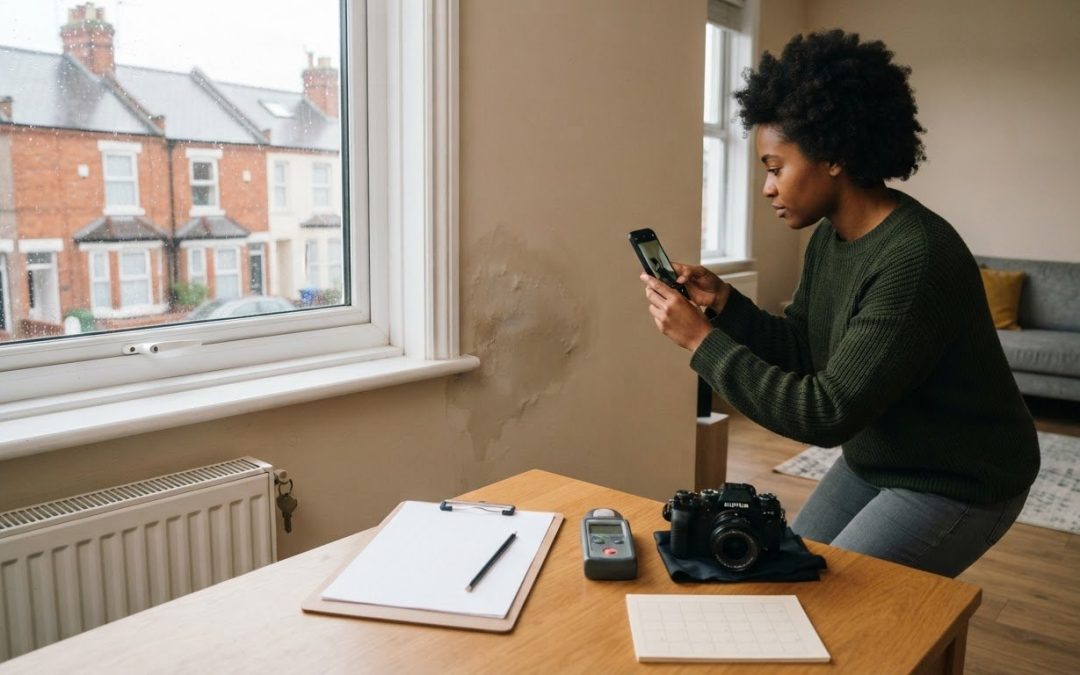
If you’re wondering how to prove damp is not just condensation to a landlord, a clear record of what is happening can be more useful than arguing over the cause. It’s understandable to feel frustrated if your concern is dismissed without an inspection. You don’t need to diagnose the problem yourself. Your observations can help explain why it needs proper investigation.
This guide explains how to record where damp appears, when it changes and whether the pattern seems linked to rainfall. You’ll learn what dated photographs, notes and written messages can document, and how to describe the issue factually without presenting a possible cause as certain.
We’ll also cover how to raise the concern constructively and request a suitable inspection. Damp can have different causes, and visible signs alone can’t confirm which one applies. If your observations raise questions about a cavity-wall issue, such as moisture affecting an internal wall, a specialist cavity-wall survey may help investigate further. The aim is to create a reliable record and support a clear next step, not to diagnose the problem by guesswork.
Key Takeaways
- To understand how to prove damp is not just condensation to a landlord, build a dated record of where it appears and how it changes over time.
- Take photographs from consistent angles, include a wider view of the room and note relevant weather and household context.
- Recurring patches, changes after rainfall and staining can help guide further checks, but no single sign confirms the cause.
- Write to your landlord with specific observations, attach relevant records and request an inspection without presenting a suspected cause as a diagnosis.
- If the damp remains unexplained, a specialist cavity-wall survey may help investigate possible cavity-wall issues, including problems associated with existing insulation.
How to tell whether damp may be more than condensation
A damp mark can be worrying, particularly if a landlord suggests it is condensation before anyone has inspected it. However, a mark on its own cannot establish the source. Condensation forms when humid air meets a cooler surface. It may appear on windows, cold external walls or in room corners, but similar-looking staining can have other explanations. The types of damp in a building include condensation and moisture entering through the building fabric, among other possibilities.
When considering how to prove damp is not just condensation to a landlord, focus first on what you can observe rather than trying to name the cause. A patch that persists, returns in the same place or seems to change with the weather may warrant further investigation. None of these signs confirms a defect on its own.
What condensation can look like in a home
Moisture on window panes, or mould around a cold corner or behind furniture, can be consistent with condensation. Everyday activities such as cooking, bathing and drying clothes indoors add moisture to the air. Limited ventilation may allow humid air to linger. These details provide useful context, but they don’t prove condensation is the only source of damp.
Different causes can also occur at the same time. Condensation in a room, for example, does not rule out a separate issue affecting a wall. Avoid treating the situation as an either-or choice until the property has been properly assessed.
Patterns worth recording for further investigation
Look for details you can record consistently. Note the exact room and area affected, when you first noticed it, and whether the mark changes, spreads or returns after cleaning. Describe visible mould, peeling paint or wallpaper, staining and musty smells in plain terms. If the patch seems to change after rainfall, record that timing without assuming rain is the cause.
Observations can guide an investigation, but they cannot confirm the source of damp. A recurring patch in one location may prompt checks of the surrounding area or external wall, while moisture on a window can help describe room conditions. A professional can consider the pattern as a whole and assess whether further checks, including a cavity-wall inspection, are relevant. Your notes show what you’ve seen; they are not a diagnosis.
What evidence can you collect before contacting your landlord?
A clear record helps your landlord understand what you’ve observed and when it happens. You don’t need specialist equipment or a diagnosis. Record details that can be checked: dates, locations, changes over time and any relevant household or weather context. This is a practical first step in working out how to prove damp is not just condensation to a landlord.
Build a dated damp and condensation record
Use a notebook or phone note to log each occurrence. Keep entries factual and consistent, and include:
- Date and location: identify the room and the precise area, such as the lower corner of an external wall.
- What you see: describe moisture, staining, visible mould or peeling finishes, and note whether the affected area seems to have spread.
- Weather and timing: record rainfall or other conditions that may be relevant, and when you first noticed a change.
- Household context: note activities such as cooking, bathing or drying laundry, and whether windows were opened or ventilation or heating changed.
If you adjust ventilation or heating, record what you changed and what happened afterwards. An improvement is useful context, but it doesn’t establish the source of the damp. Keep your log with copies of messages to your landlord, repair requests, replies and any inspection notes. Official government guidance for rented housing providers also emphasises identifying underlying causes rather than attributing damp and mould simply to a tenant’s lifestyle.
Use photographs and moisture readings carefully
Take photographs in consistent lighting and from the same angle so you can compare changes over time. Include a visible date reference where practical, then take a wider image showing the affected area in relation to the room. Keep the original images and note what each one shows. A close-up captures detail; a wider view makes the location clearer.
A household hygrometer or moisture meter may add context, but readings can vary with conditions, position and how or where the device is used. If you use one, record the reading alongside the time and exact location. Don’t treat a single figure as proof of a particular cause. Avoid scraping finishes, opening walls or making intrusive checks yourself.
Together, these records can help make your landlord’s inspection more focused. If your observations raise questions about a possible cavity-wall issue, you could review CavClear’s cavity-wall survey information as a specialist survey option. Continue documenting the issue and communicating with your landlord; a survey is an investigation, not a substitute for either step.
Which signs may point beyond condensation, and what can they establish?
A recurring damp patch or one that seems to change after rain may give your landlord a reason to investigate further. It does not identify the cause. Leaks, building defects, condensation and other sources of moisture can overlap, so don’t treat any one pattern as a diagnosis. A visible symptom alone cannot establish where the moisture is coming from.
When you’re considering how to prove damp is not just condensation to a landlord, describe the pattern and ask for suitable checks rather than stating a suspected cause as fact. These observations can help explain what you’ve noticed and what an inspection may need to clarify.
| Observation | Possible explanations | What further checks may clarify |
|---|---|---|
| A damp mark repeatedly appears in one localised area. | Condensation, a leak or moisture entering through the building fabric could be considered. | An inspection of the affected area and nearby plumbing or building elements may help identify relevant issues. |
| The patch seems to worsen after rainfall. | Rain-related water entry may be one possibility, but timing alone doesn’t confirm it. | Checks of the external wall and nearby features may help assess whether there is a connection. |
| Staining, mould or damaged paint or wallpaper is visible. | These can result from different moisture conditions, including condensation or another source of damp. | An inspection can consider the location, extent and surrounding conditions together. |
| Cracking or other visible changes appear in masonry alongside damp. | There may be a structural issue to assess, but cracking has multiple possible causes and may be unrelated to the damp. | A suitably relevant building or cavity-wall assessment can examine the signs in context. |
When cavity-wall issues may be relevant
In some properties, defects involving cavity walls or existing cavity wall insulation may contribute to moisture problems. An internal damp mark alone cannot confirm this possibility. A specialist inspection may be relevant if your wider observations raise questions about the cavity. Read the cavity wall insulation removal guide for background on how problems with existing insulation may be investigated.
Wall-tie deterioration can be associated with signs such as cracking or movement in masonry, but those signs can have other explanations. Damp and structural symptoms should be assessed on their own evidence, not assumed to share one cause. Record what you see, where it occurs and when it changes. A professional assessment can then establish whether cavity-wall checks, including a wall tie survey, are appropriate.

How to raise the damp concern with your landlord clearly
A concise, dated message gives your landlord a clear account of the problem and a practical basis for deciding what to inspect. Keep it factual: explain what you’ve seen, share relevant records and ask for an assessment. You don’t need to prove the cause before reporting the damp.
A clear message that invites investigation
Include the affected room and surface, when you first noticed the issue and any changes you’ve recorded. Attach a few dated photographs showing both the detail and where it is in the room. You can offer your fuller log if it would help. Separate observations from possibilities: write “the patch darkened after rainfall” rather than “rain is coming through the wall”.
For example, you could write:
“I’m reporting a damp patch on the external wall in the bedroom, first noticed on [date]. It has returned after cleaning and appeared darker following rainfall on [date]. I’ve attached dated photographs. Please arrange an appropriate inspection to assess the area and let me know the proposed checks and next steps. I can share my full record if useful.”
Keep a copy of your message and attachments, along with the landlord’s reply and any inspection notes. This creates a straightforward timeline and helps everyone refer to the same details.
What to do if the response says it is condensation
Stay calm and bring the conversation back to what you’ve recorded. You might reply: “I understand condensation is a possibility. Could you explain what the assessment was based on and whether the recurring patch and its changes have been checked?” This asks for clarification without insisting on a particular diagnosis or repair.
If the symptoms persist or change, explain what has happened since your first report and ask whether a further inspection is appropriate. A label alone doesn’t establish the cause, but your observations don’t establish a different cause either. The aim is to ensure the pattern is considered and the next steps are clear.
Keep all communication together, including dates, responses and any inspection findings. If you’re unsure what responsibilities or escalation options apply, check current official guidance for your part of the UK and type of tenancy. Don’t rely on general advice where the rules may differ.
If the evidence raises a possible cavity-wall concern, a specialist cavity-wall survey may help investigate that aspect of the property. Explore CavClear’s cavity-wall surveys as a specialist survey option, while continuing to document the issue and communicate with your landlord.
When a specialist damp or cavity-wall survey may help
If damp persists, returns after cleaning or remains unexplained following an inspection, a suitably relevant specialist survey may help clarify what needs checking next. This can be useful where your observations raise questions about the cavity wall or existing cavity wall insulation. A survey is an investigation, not automatic confirmation of a particular defect or remedy.
CavClear provides damp and mould surveys where cavity-wall problems are relevant, alongside cavity-wall inspections and surveys. The appropriate scope depends on the property and the questions that need answering. Your records and communication with the landlord remain important: a specialist survey can add findings, but it doesn’t replace reporting the problem or requesting an inspection from your landlord.
What a specialist inspection may investigate
An inspection may consider visible damp symptoms alongside relevant cavity-wall conditions within the agreed survey scope. The methods depend on the property, access and issues being investigated, so ask what the survey will and won’t cover before it takes place.
A useful report should distinguish observed evidence from interpretation. It may set out findings, explain any limitations and identify whether further checks or remedial work should be considered. This distinction helps prevent a possible cause from being presented as a confirmed diagnosis, and gives you clearer information to share with your landlord.
What to look for in a useful survey report
Check that the report explains its scope, records relevant observations and links any recommendations to the evidence found. If it suggests further cavity-wall investigation or remedial work, ask how that recommendation follows from the findings and whether it addresses the question the survey was asked to examine. Recommendations should be understandable, not simply a list of unexplained work.
For more context on what a survey process and report may involve, read this professional damp survey guide. Use it as background, then check that any survey you consider is relevant to the specific concerns recorded at your property.
If you’re considering how to prove damp is not just condensation to a landlord, a specialist survey may provide additional evidence when a cavity-wall issue is a reasonable question to investigate. It cannot guarantee a particular finding, but it may help clarify the next step. If your observations point towards a possible cavity-wall concern, you can discuss a suitable cavity-wall or damp and mould survey with CavClear. Keep your landlord informed and continue to retain your records.
Take the next step with a clear record
Damp marks alone can’t confirm their cause. A dated record of where they appear, how they change and any relevant weather or household context gives your landlord useful information to investigate. Keep your message factual, ask for an appropriate inspection and distinguish what you’ve observed from what you suspect.
That’s the practical foundation for understanding how to prove damp is not just condensation to a landlord: document the pattern, communicate clearly and avoid diagnosing the problem yourself. If damp persists or your observations raise questions about the cavity wall, a specialist survey may help establish what further checks are relevant. It is an investigation, not automatic confirmation of a particular defect or remedy.
CavClear provides nationwide UK survey and remedial services, is a member of the Wall Tie Installers Federation and is TrustMark registered for cavity wall insulation removal. If a cavity-wall issue may be relevant, discuss whether a specialist cavity-wall survey may be suitable. Contact CavClear to discuss a relevant survey or remedial service, and keep your landlord informed as the issue is investigated.
Frequently Asked Questions
How can I prove damp is not just condensation to my landlord?
You can’t confirm the cause from damp marks alone, but you can give your landlord a clear record to support further investigation. To understand how to prove damp is not just condensation to a landlord, log when and where it appears, photograph changes and note relevant weather or household conditions. Send the record in writing, describe observations rather than diagnoses, and ask for an appropriate inspection.
What evidence should I send my landlord about damp?
Send a concise written description, dated photographs and a brief log of how the issue changes. Include the affected room and surface, when you first noticed the problem, whether it recurs, and any relevant changes after rainfall or household activities. Keep copies of your message, attachments, the landlord’s reply and any inspection notes. This creates a useful timeline without suggesting that the evidence proves one particular cause.
Can a damp meter prove that a wall is not affected by condensation?
No. A household moisture meter reading cannot by itself identify the source of damp or rule out condensation. Results can vary depending on the device, the location tested and the conditions at the time. If you use a meter, record the reading, date, time and exact location as context. Don’t rely on one result as a diagnosis; an appropriate inspection can consider it alongside other observations.
What signs of damp should I photograph for my landlord?
Photograph visible moisture, mould, staining, peeling paint or wallpaper, and any change in the affected area. Take a close view to show detail and a wider view to show where it is in the room. Use a consistent angle and include a visible date reference where practical. Keep the original images and note when each was taken. These photographs document symptoms, but cannot establish their cause alone.
What should I do if my landlord says the damp is condensation?
Reply calmly with the pattern you’ve recorded and ask what checks informed that conclusion. If the patch persists, returns or changes, explain what has happened since your first report and ask whether further inspection is suitable. Keep the exchange factual and retain all messages and responses. If you need to understand your options, check current official guidance relevant to your location and tenancy, as responsibilities and routes for advice can differ.
Can cavity wall insulation problems cause damp in a home?
Problems involving existing cavity wall insulation may contribute to damp in some properties, but insulation is not automatically defective and symptoms alone cannot confirm a cavity-wall issue. Other moisture sources may also be involved. If your observations raise a concern about the cavity or insulation, a specialist cavity-wall survey may help investigate. Any decision about cavity wall insulation removal should follow relevant findings, not an assumption based on a damp patch.
When should I ask for a damp or cavity-wall survey?
Consider asking about a suitably relevant survey if damp persists, returns or remains unexplained after you have reported it and requested an inspection. A cavity-wall survey may be appropriate if the evidence raises questions about cavity-wall conditions. CavClear provides damp and mould surveys where cavity-wall problems are relevant, as well as cavity-wall inspections and surveys. Ask what the survey covers and how its findings relate to any recommended next steps.
Recent Comments