
Did you know that over 60% of damp issues initially identified as rising damp are actually caused by different structural defects like condensation or rainwater management failures? When you’re in the middle of a property transaction, the last thing you want is the uncertainty of a potential money pit hidden behind fresh paint. Arranging a professional pre purchase damp survey is the most effective way to address these concerns and satisfy mortgage lender requirements. It’s natural to feel anxious when structural health is called into question, especially when your financial future is on the line.
This guide demonstrates how a specialist survey identifies hidden risks and protects your property investment through methodical, technical diagnosis. You’ll discover how experts use benchmarks like BRE Digest 245 to differentiate between surface moisture and deep-seated structural faults, such as those caused by failed retrospective insulation. We’ll outline the essential components of a professional report and how it provides the peace of mind you need to proceed. By understanding the diagnostic process, you can secure accurate remedial cost estimates and ensure the long-term health and efficiency of your new home.
Key Takeaways
- Understand why a specialist pre purchase damp survey is essential for satisfying mortgage lenders and uncovering structural risks that standard visual inspections often overlook.
- Learn how technical moisture mapping and exterior masonry assessments identify the specific cause of dampness, moving beyond surface symptoms to locate the root fault.
- Discover the hidden structural dangers within wall cavities, including debris and the significant risks associated with previous retrospective insulation installations.
- Gain clarity on technical survey terminology to better interpret professional reports and secure accurate estimates for any necessary remedial works.
- Recognize the value of independent expertise in preserving long-term asset health and ensuring your property investment remains a secure and comfortable environment.
Why a Pre-Purchase Damp Survey is Essential for UK Homebuyers
Purchasing a property represents a significant financial commitment, yet many buyers overlook the hidden risks lurking within the building’s fabric. While a home might appear sound during a viewing, structural dampness in buildings can quietly compromise masonry and timber. A professional pre purchase damp survey provides a technical diagnostic layer that identifies moisture ingress and wood-rotting fungi before you exchange contracts. It’s an essential step for protecting your investment from the high costs of unforeseen repairs.
This specialist inspection doesn’t just look for surface symptoms. It evaluates the property’s environmental health and structural stability. By identifying faults early, you avoid the “money pit” scenario where hidden damage requires thousands of pounds in remedial work shortly after moving in. Professional surveys focus on long-term asset health, ensuring the property remains a safe and comfortable environment for years to come.
The Difference Between a General Survey and a Damp Investigation
Many buyers assume a standard RICS Level 2 or Level 3 survey is sufficient. While these reports are valuable for broad assessments, they are primarily visual. If a general surveyor encounters a suspect moisture reading, they lack the specialist equipment to determine the underlying cause. They’ll often recommend a specialist follow-up to avoid liability for hidden defects. An accredited technician uses calibrated diagnostic tools to map moisture levels within wall cavities and subfloor voids, looking past fresh paint to find actual technical faults.
Specialists focus on the root cause of moisture transit. This might include identifying high ground levels bridging a damp proof course or detecting debris within a cavity that allows water to cross to the inner leaf. This level of detail is vital for distinguishing between simple condensation and serious structural failures. It’s about getting a definitive answer rather than a vague observation.
Mortgage Approvals and Specialist Reports
Lenders treat dampness as a significant risk to the property’s value. If a valuation flags moisture, the mortgage provider may impose a retention, which involves withholding a portion of the loan until a specialist pre purchase damp survey is conducted. A professional report provides the technical evidence lenders need to satisfy their safety-conscious underwriting criteria. It proves that the property is structurally sound or outlines exactly what is needed to make it so.
These reports also provide a clear, low-pressure path toward resolution during negotiations. With an accurate estimate of remedial costs, you can request a price reduction from the seller. This ensures you have the budget to address structural neglect or fix poor previous workmanship immediately upon completion. It turns a potential deal-breaker into a manageable part of the buying process.
What to Expect During a Professional Damp Investigation
A professional pre purchase damp survey is a methodical process that moves from the external perimeter to the internal living spaces. Technicians follow a diagnostic sequence to identify the three primary types of moisture ingress: rising damp, penetrating damp, and condensation. This approach aligns with RICS damp and mould guidance, which emphasizes that moisture often enters a property through multiple, interacting faults. By mapping these issues accurately, we provide a clear path toward a permanent structural remedy.
Non-Invasive Diagnostic Tools and Techniques
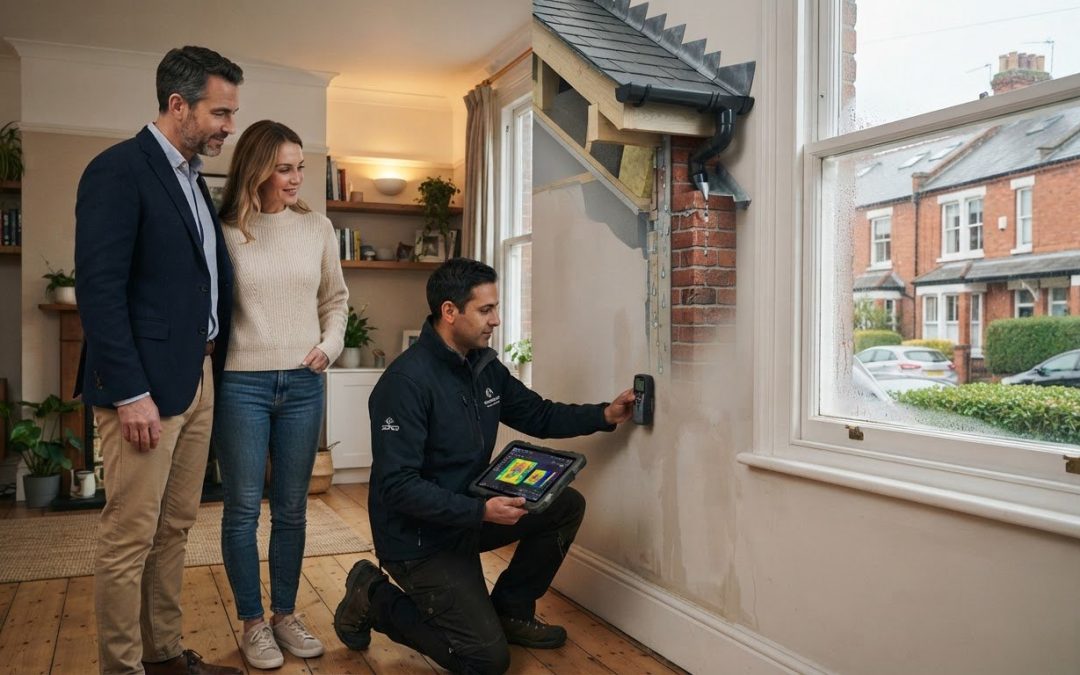
Modern investigations rely on advanced technology to see what the naked eye can’t. Thermal imaging cameras detect cold spots on internal walls, which often indicate thermal bridging or hidden moisture pockets. Calibrated hygrometers measure relative humidity and dew points to determine if a damp patch is a structural leak or an airflow issue. For properties with cavity walls, we often use borescopes. These small cameras allow us to inspect the condition of the wall cavity without disrupting the masonry. We look for debris, mortar “snots,” or failing wall ties that might be compromising the building’s integrity. If you suspect hidden issues, an independent cavity wall survey can provide the necessary clarity.
Exterior Inspection Points and Property Maintenance
Technicians pay close attention to the age of the property, as approximately 20% of UK homes were built before 1919. These period properties often lack modern damp-proof courses and rely on wall breathability. The survey begins outside because external defects are the most common cause of internal moisture. Technicians check for a bridged damp proof course (DPC), which occurs when ground levels, patios, or flower beds are raised above the protective barrier. We also evaluate the “wet trades” and rainwater goods. This includes inspecting gutters and downpipes for leaks, checking the condition of mortar pointing, and examining external render for cracks. These external faults often lead to penetrating damp. Rainwater enters through masonry cracks or saturated bricks, eventually reaching the internal plaster. A thorough pre purchase damp survey ensures that every potential entry point is documented. This level of detail allows for a precise remedial action plan that addresses the cause, not just the symptom.
Identifying Hidden Structural Causes: Beyond Surface Moisture
A professional pre purchase damp survey must look beyond internal plaster. Chronic dampness often stems from failing structural components that allow water to bypass the building’s natural defences. For instance, mortar “snots” or construction debris left at the bottom of a wall can bridge the damp proof course. This allows groundwater to travel laterally or vertically into the internal leaf. Surface-level damp proofing often fails because it treats the symptom rather than the structural fault. Identifying these hidden transit points is essential for ensuring your property investment remains secure.
Understanding these root causes is vital for maintaining government standards on damp and mould. If a structural defect is ignored, moisture will persist, leading to mould growth that poses significant health risks. A specialist pre purchase damp survey provides the technical diagnostic layer required to catch these issues before they escalate. By mapping the relationship between the external masonry and the internal environment, we can pinpoint exactly where the building’s envelope has failed.
The Impact of Defective Cavity Wall Insulation
Defective cavity wall insulation is a primary driver of penetrating damp in many 20th-century homes. Historically, the wall cavity was designed to act as a capillary break, preventing rainwater from crossing the gap. When this void is retrospectively filled with synthetic materials, wind-driven rain can saturate the insulation. The wet material then acts as a bridge, transferring moisture directly to the inner wall. If a survey detects high moisture levels in an insulated wall, professional cavity wall insulation removal is often the only permanent fix. Leaving degraded material inside the walls leads to persistent dampness and accelerated timber decay.
Wall Tie Corrosion and Structural Stability
Structural stability is inextricably linked to moisture management. Metallic wall ties, which hold the external and internal leaves together, are susceptible to corrosion when exposed to moisture. As ties rust, they expand, causing horizontal cracking in the mortar joints or visible bulging of the masonry. This damage creates further entry points for rainwater, creating a cycle of decay. Timely wall tie replacement restores the building’s integrity and prevents the moisture transit that leads to internal dampness. A clear, functional cavity is the property’s best defence against the UK’s wet climate.

Understanding Your Damp Survey Report and Recommendations
A professional pre purchase damp survey report is a technical document designed to provide clarity for both the buyer and the mortgage lender. It moves beyond the vague observations found in general homebuyer reports, offering a diagnostic roadmap based on empirical evidence. Each finding is supported by moisture mapping data and environmental readings. This ensures that any recommended remedial work is necessary and proportionate to the actual structural fault.
Technical terminology often causes confusion for those outside the industry. For instance, a report might distinguish between active rising damp and hygroscopic salt contamination. These salts are often left behind after a damp-proof course has been installed. They continue to attract atmospheric moisture, causing the wall to appear wet even when the structural issue is resolved. Understanding these distinctions prevents you from paying for redundant repairs that don’t address the underlying physical cause.
Categorising Damp and Timber Issues
The report categorises defects by their severity and cause. It identifies surface issues like black mould, which is typically a symptom of poor ventilation and condensation rather than a structural leak. However, it also flags critical structural threats such as wet rot in subfloor timbers. This occurs when joists are exposed to chronic moisture from high ground levels or subfloor ventilation blockages. Identifying these issues before completion allows you to prioritise repairs that affect the property’s long-term asset health and structural integrity.
Estimating Remedial Costs and Timelines
Your survey report provides the necessary framework for obtaining accurate contractor quotes. It outlines the specific scope of work, whether it involves simple DPC repairs or complex cavity wall insulation extraction. We advise against “quick fixes” like internal tanking over saturated masonry. These methods often trap moisture within the structure, leading to accelerated wall tie corrosion and further decay. A professional report ensures that any remedial action plan addresses the root cause of the fault, providing a permanent fix rather than a temporary cover-up. If you require a definitive structural assessment, contact us to arrange a specialist pre purchase damp survey across the United Kingdom.
Securing Your Property’s Future with Professional Remedial Action
Once the technical diagnosis of a pre purchase damp survey is complete, the focus shifts from identification to proactive resolution. Independent expertise is vital during this transition because it ensures the assessment remains unbiased and focused solely on the property’s structural health. Unlike “expert” visual checks that often lead to redundant or ineffective repairs, a professional investigation provides a clear, technical basis for long-term asset preservation. Taking decisive action based on evidence-based findings is the only way to restore property comfort and ensure the building’s envelope remains secure against the UK’s challenging climate.
Proactive maintenance is a vital investment in the property’s future. By addressing structural neglect or poor previous workmanship before you move in, you prevent minor faults from escalating into major failures. Professional extraction of saturated materials and structural repairs, such as wall tie replacement, do more than just stop moisture. They restore the thermal efficiency of the walls and protect the integrity of the masonry. This methodical approach ensures that your home remains a healthy environment, expert from the risks associated with chronic dampness and timber decay.
The Importance of Accredited Specialists
Complex damp and cavity issues require high-level technical standards that general builders often cannot provide. Hiring a specialist contractor ensures that the methodology used to rectify faults is clean, non-disruptive, and effective. For example, removing saturated cavity insulation or replacing corroded wall ties requires specialist tools and a deep understanding of building physics to avoid damaging the internal leaf. Accredited technicians follow strict methodology to ensure that the root cause of the moisture transit is permanently resolved. This professional rigour is what distinguishes a temporary fix from a long-term structural solution.
Next Steps After Receiving Your Survey
After you receive your professional report, the first step is to consult with your solicitor regarding the findings. The data provided by a pre purchase damp survey often serves as a powerful tool for price negotiation, allowing you to account for the cost of necessary remedial works before exchanging contracts. Once the financial terms are settled, you should arrange for the specialist repairs to be completed by an expert team. Always request long-term assurances for any structural or damp-proofing work. These assurances are a central part of a property’s history and provide peace of mind that the home is a sound investment. By following this diagnostic and remedial path, you secure a permanent fix and protect your financial future.
Securing Your Property Investment for the Long Term
Navigating the UK property market requires a rigorous approach to structural health. A specialist pre purchase damp survey is not just a formality; it’s a vital diagnostic tool that protects you from the long-term costs of structural neglect. By identifying root causes such as wall tie corrosion or failing insulation before you exchange contracts, you ensure your new home remains a safe and efficient environment. Technical evidence allows you to satisfy mortgage lender conditions and negotiate from a position of authority.
CavClear provides nationwide UK coverage, deploying specialist accredited technicians who deliver detailed structural diagnostic reports. We focus on non-disruptive methodology to restore property comfort and protect your asset’s future health. Don’t leave your investment to chance when professional clarity is available. You can Book a Professional Damp Survey with CavClear Today to begin your journey with confidence. Taking this proactive step now ensures that your property remains a secure, dry, and valuable home for years to come.
Frequently Asked Questions
How much does a pre purchase damp survey cost in 2026?
A specialist pre purchase damp survey varies in cost depending on the property’s size and complexity. Factors such as the age of the building and the number of walls requiring inspection will influence the final fee. While generic visual checks may appear cheaper, an independent technical survey provides the depth of data needed to satisfy lenders. You should always ensure the quote includes a formal report and a detailed remedial action plan for your records.
How long does a specialist damp survey take to complete?
A thorough inspection usually takes between one and three hours to complete. This duration depends on the property’s size and the ease of access to subfloor voids or roof spaces. Our technicians work methodically to ensure every potential moisture transit point is evaluated. We prioritize a non-disruptive approach, so you don’t need to worry about damage to the masonry or internal finishes during the diagnostic process. It’s a clean and efficient process.
Will a damp survey report satisfy my mortgage lender?
Yes, a professional pre purchase damp survey report is specifically designed to satisfy mortgage lender requirements. Lenders often flag moisture issues during their initial valuation and will withhold funds until an independent specialist provides a technical assessment. Our reports use evidence-based findings and calibrated diagnostic data to provide the reassurance banks need. This technical clarity often resolves retentions, allowing your property transaction to proceed with minimal delay and restoring your peace of mind.
Do I need a damp survey if the property has a new damp proof course?
Even with a new damp proof course, a survey is essential to verify the installation’s effectiveness. New barriers can be bridged by high external ground levels or debris within the wall cavity. A survey also identifies other moisture sources, such as penetrating damp through cracked render or condensation caused by poor ventilation. Relying solely on a recent installation without a technical audit can lead to hidden structural decay and unexpected remedial costs later on.
What is the difference between a damp survey and a timber survey?
A damp survey identifies how moisture enters the building’s fabric, while a timber survey assesses the resulting damage to wooden structures. Moisture ingress often leads to serious issues like wet rot in floor joists or timber decay in roof spaces. While they’re distinct disciplines, we often conduct them together to provide a comprehensive view of the property’s health. This ensures that both the cause and the consequence of structural dampness are addressed during the inspection.
Can a damp survey identify the cause of black mould?
A specialist survey is the most effective way to determine if black mould is caused by a structural leak or condensation. Technicians use hygrometers to measure relative humidity and thermal imaging to find cold spots on walls. This diagnostic data proves whether the issue stems from penetrating damp or environmental factors like inadequate airflow. Identifying the correct cause is vital for implementing a permanent fix rather than just cleaning the surface mould temporarily.
Is a damp survey invasive or will it damage the property?
Most professional investigations are entirely non-invasive and won’t damage the property. We use electronic moisture meters and thermal cameras to map moisture transit without disrupting the internal plaster. If a cavity inspection is required, we use small borescopes through existing mortar joints. This clean methodology allows us to view the condition of wall ties and insulation without affecting the building’s aesthetics. It’s a safety-conscious approach that respects the property’s structural integrity.
What happens if the damp survey finds significant structural issues?
If the survey reveals significant structural faults, the findings become a vital tool for your purchase negotiations. The report includes a detailed remedial action plan and accurate estimates for necessary works, such as wall tie replacement or insulation extraction. You can use this evidence to request a price reduction from the seller or ask them to complete the repairs before exchange. This ensures you don’t inherit a property with expensive, hidden liabilities or structural defects.
Recent Comments