
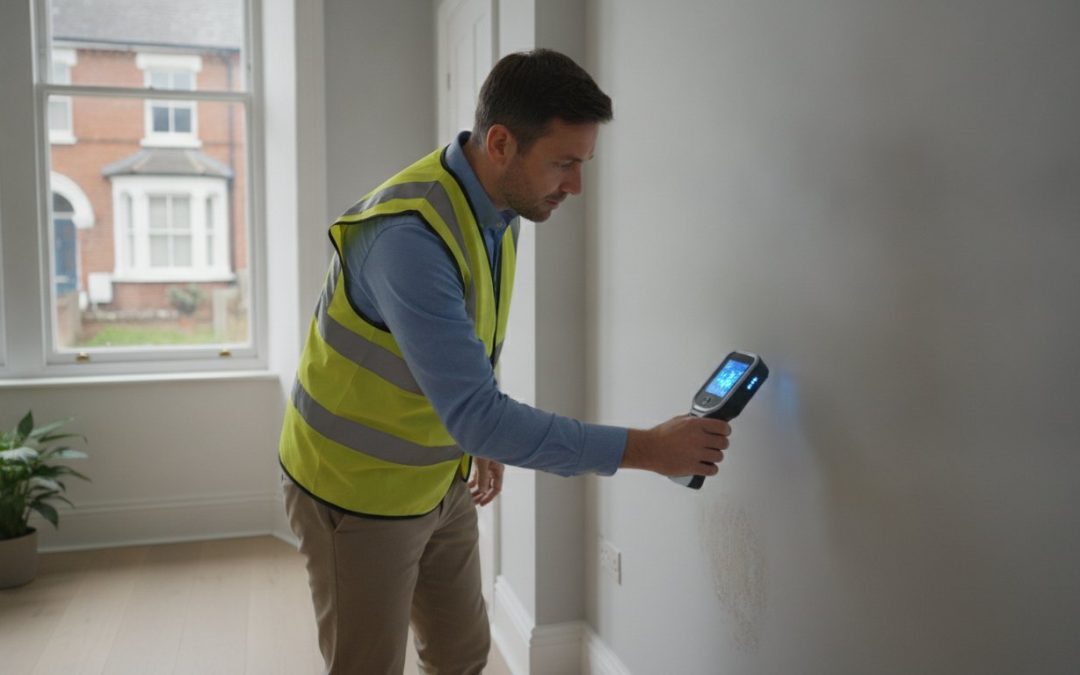
Government estimates suggest that up to 6.5 million homes in England are currently affected by damp and mould. If you’re a property owner, you’ve likely experienced the frustration of scrubbing away recurring black spots only to see them reappear weeks later. It’s exhausting to receive conflicting advice from general builders who suggest quick fixes that fail to address the technical cause. You deserve a clear answer that protects your property value and your family’s health.
Securing a professional damp and mould survey manchester provides the definitive diagnosis you need to stop the cycle of moisture damage. This guide will show you how a specialist investigation identifies the root cause of dampness, whether it’s a fault in the building fabric or defective materials within the wall cavity. We’ll preview the diagnostic process, explain the importance of a technical remedial plan, and demonstrate how a proactive approach ensures the long-term health of your property. By moving from surface-level observations to forensic structural analysis, you can achieve permanent peace of mind and restore a safe, dry environment to your home.
Key Takeaways
- Identify the critical difference between temporary surface cleaning and a technical forensic inspection that addresses deep-seated moisture profiles.
- Learn how defective or poorly installed cavity wall insulation compromises your property’s moisture barrier, leading to persistent damp through moisture bridging.
- Recognise the value of an independent damp and mould survey manchester for obtaining an unbiased diagnosis and a clear path toward structural restoration.
- Understand our non-disruptive investigation methodology, which uses precise moisture mapping to locate faults without causing unnecessary damage to your home.
- Discover how a professional remedial action plan serves as a vital investment in long-term asset health and ensures the permanent safety of your living environment.
Understanding the Importance of a Professional Damp and Mould Survey
A professional damp and mould survey manchester is far more than a visual check of black spots on a bedroom wall. It’s a technical forensic inspection that maps a property’s moisture profile to find exactly where water is entering or accumulating. While a general homebuyer’s report might flag dampness as a potential concern, it rarely identifies the specific mechanical failure responsible. Specialist investigations use precise equipment to look beneath the surface, moving beyond observation to provide a root-cause diagnosis. This approach is the only foundation for effective property preservation, ensuring you don’t waste money on temporary repairs that fail to address the underlying fault.
Surface-level observations are often misleading. A patch of mould in a corner might look like a simple ventilation issue, but it could actually be a sign of moisture bridging within a wall cavity or a failure in the external masonry. Without a deep-seated analysis, you’re merely treating the symptoms. A specialist survey provides the technical data needed to create an actionable remedial plan, protecting the structural integrity of your asset and restoring the comfort of your home.
Identifying the Three Main Types of Damp
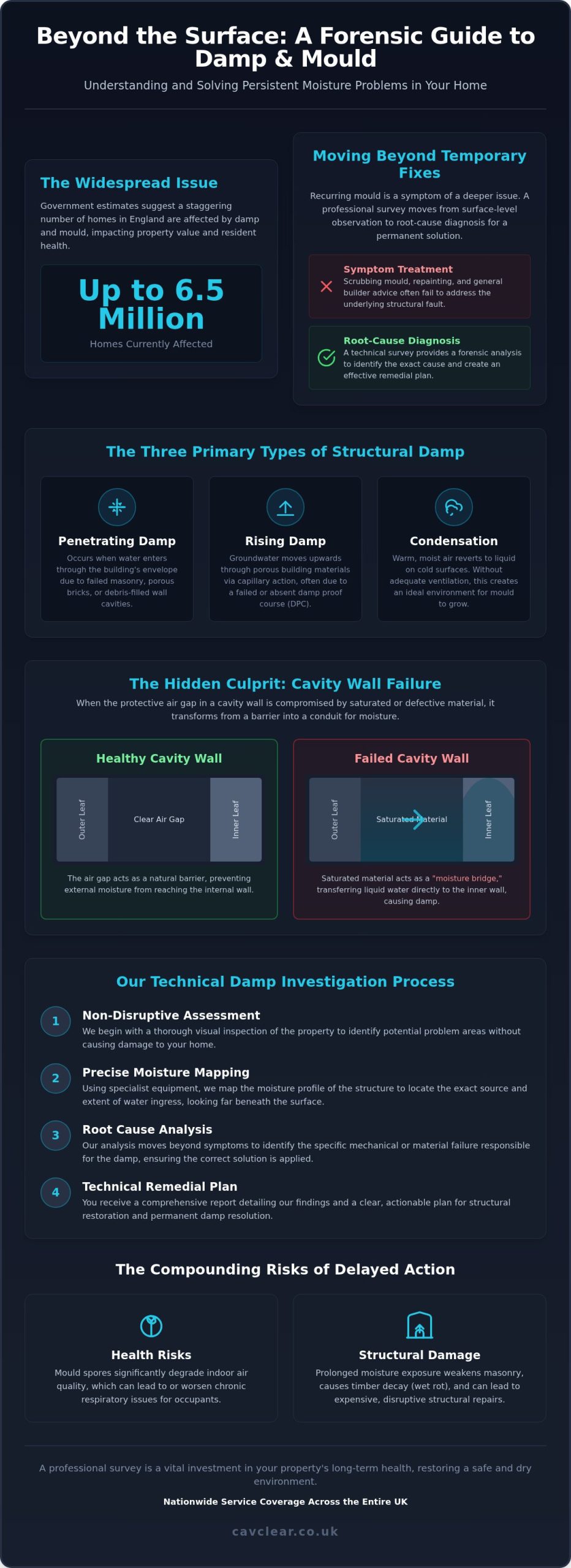
Understanding the specific mechanics of moisture ingress is vital for any effective repair. This Structural Dampness Overview highlights how different environmental factors interact with building materials to cause damage. There are three primary categories to consider:
- Penetrating Damp: This occurs when water enters through the building’s envelope. It’s often caused by failed masonry, porous bricks, or debris-filled cavities that allow moisture to bridge across to internal walls.
- Rising Damp: This involves ground water moving upwards through porous building materials via capillary action. It typically indicates a failure, bridge, or absence of a physical damp proof course (DPC).
- Condensation: When warm, moist air hits cold surfaces, it reverts to liquid. Without adequate ventilation, this creates the ideal environment for mould spores to germinate and spread rapidly.
The Health and Structural Risks of Delayed Action
Ignoring damp issues doesn’t just devalue your home; it actively compromises the safety of the living environment. Mould spores significantly degrade indoor air quality, which can lead to chronic respiratory issues for occupants. Beyond health, prolonged moisture exposure causes severe structural damage. It weakens masonry and leads to the decay of timber components. Wet rot can quickly take hold in floor joists and skirting boards, necessitating expensive and disruptive structural replacements. Taking proactive action through a specialist survey prevents these issues from escalating into a full-scale property crisis.
The Hidden Culprit: Why Cavity Wall Issues Cause Persistent Damp
The original design of a cavity wall serves a clear structural purpose. It creates an air gap that prevents external moisture from reaching the internal leaf of your property. This void acts as a natural barrier. However, when this space is filled with defective insulation that becomes saturated or slumps, the protective gap is lost. Instead of a barrier, the material becomes a conduit for liquid water. This failure often leads to recurring issues that surface-level cleaning cannot fix.
Property owners often notice internal damp patches or persistent mould growth in areas that feel unusually cold. These symptoms frequently indicate that the insulation within the cavity has failed. When we conduct a damp and mould survey manchester, we often find that the moisture source isn’t a simple leak; it’s a systemic failure of the wall’s internal environment. In these cases, cavity wall insulation removal is often the only way to restore the property’s structural integrity and stop the cycle of dampness.
How Failed Insulation Acts as a Moisture Bridge
Interstitial condensation occurs when warm air from inside the home penetrates the internal wall and meets the cold outer leaf within the cavity. If the cavity is filled with defective insulation, this moisture becomes trapped. Saturated insulation loses its thermal properties and transfers liquid water directly onto the inner masonry. Thermal bridging occurs when a specific part of the wall allows heat to escape more rapidly than the surrounding structure, creating cold spots that attract condensation and mould.
The Link Between Wall Ties and Dampness
Wall ties are essential components that secure the outer leaf of masonry to the inner structure. Over time, these metal ties can corrode, especially if they’re exposed to moisture from wet insulation. As they rust, they expand. This expansion causes significant cracking in the mortar joints, which allows even more water to enter the cavity and reach the internal plaster.
Debris often accumulates on these ties during original construction or through subsequent insulation work. This buildup creates a physical bridge that allows water to track across the cavity. Addressing these issues requires specialist knowledge of masonry stabilization. For more information on maintaining your property’s skeleton, refer to our wall tie replacement guide. If you suspect your cavity is compromised, arranging a technical cavity wall survey is a vital first step in your property’s preservation plan.
Independent Surveying vs. Sales-Led Quotes: Making an Informed Choice
When homeowners seek a damp and mould survey manchester, they’re often presented with “expert” quotes from general contractors. While attractive, these quotes are frequently sales-led exercises designed to promote specific products or generic building repairs. A professional survey is different. It’s a standalone technical service where the primary goal is diagnostic accuracy, not a sales conversion. Paying for a specialist’s time ensures that the investigation is exhaustive and the resulting recommendations are based purely on structural requirements. It’s a vital investment that prevents the wasted expense of ineffective treatments.
General builders often suggest “quick-fix” solutions like damp-proof paints or internal rendering. These methods frequently mask the symptoms while the underlying moisture continues to degrade the masonry and timber. A specialist investigation looks past the surface to identify the technical fault. By choosing an independent survey, you receive a forensic analysis of your property’s moisture profile, ensuring the proposed remedial plan addresses the root cause rather than just the visible mould.
What Makes a Survey Truly Independent?
True independence means the surveyor has no financial incentive to recommend one specific repair method over another. Our accredited technicians provide evidence-based reporting that prioritizes the long-term health of the building fabric. This reporting is backed by professional indemnity insurance; this offers a level of security that general builders cannot provide. It moves the focus from selling a service to providing a definitive diagnosis. The report serves as a transparent document that homeowners can use to secure accurate quotes for the necessary remedial work.
Avoiding the Pitfalls of Retrospective Insulation
A critical part of an independent survey is identifying when previous interventions have failed. We maintain a firm stance: installing new retrospective cavity wall insulation in a property already suffering from dampness is never a solution. This practice often exacerbates moisture traps and accelerates wall tie corrosion. It creates a bridge for water to cross the cavity, leading to persistent internal dampness. Our methodology focuses on the extraction of defective materials and the restoration of the original wall cavity. This proactive approach rectifies poor workmanship and prevents future structural decay, ensuring the property remains dry and safe for the long term.
The Step-by-Step Process of a Technical Damp Investigation
A technical damp and mould survey manchester follows a rigorous, methodical sequence to ensure no structural fault is overlooked. Unlike basic visual checks, our specialist contractors use a diagnostic framework that begins with the building’s exterior before moving inside. This non-disruptive approach allows us to gather critical data without damaging your property’s finishes or decor. We employ precision instruments like hygrometers to measure ambient humidity and electronic moisture meters to track water movement through masonry. The information collected during this process forms the foundation of a formal remedial action plan, providing a clear path to restoring your home’s structural health.
Our methodology prioritizes technical accuracy. By using advanced diagnostic tools, we eliminate guesswork and provide property owners with a transparent view of their building’s moisture profile. This forensic level of detail is what separates a professional survey from a standard builder’s estimate. It ensures that every recommendation is backed by physical evidence and technical standards. This data-led approach is vital for the long-term preservation of your property.
Step 1: External Structural Assessment
Our technicians start by examining the building’s envelope. We look for defects in the brickwork and pointing that could allow water ingress. A primary focus is the condition of the damp proof course (DPC) and checking for high ground levels that might bridge it. Blocked air bricks are a common finding; these restrict the airflow necessary to keep the cavity dry and well-ventilated. We also check for horizontal cracking in the mortar, which often signals that internal wall ties are corroding and expanding. Identifying these external failures is essential for stopping moisture at its source and preventing further masonry decay.
Step 2: Internal Moisture Mapping and Cavity Inspection
Inside the property, we use electronic moisture meters to map dampness hidden behind plaster or wallpaper. This mapping reveals the extent of the moisture spread and helps differentiate between condensation and structural leaks. To see what’s happening inside the wall cavity, we use high-definition borescope cameras inserted through small, discreet holes. This allows us to inspect the insulation and wall ties directly without the need for invasive wall removal. We also identify specific mould species, as their growth patterns often point to specific environmental triggers like poor ventilation or thermal bridging. If you’re concerned about the health of your home, you can book a technical survey to receive a comprehensive diagnostic report. Investing in a professional damp and mould survey manchester is the first step toward reclaiming a safe and structurally sound living space.
Restoring Property Health: From Survey Report to Remedial Action
A comprehensive damp and mould survey manchester concludes with a formal technical report. This document translates complex moisture mapping data into a clear, actionable remedial strategy. A professional report must contain detailed observations of the building fabric, empirical moisture readings, and photographic evidence from borescope inspections. For property owners, this document is a vital asset. It’s frequently used to satisfy insurance requirements or to provide mortgage lenders with proof of structural stability. Having a specialist report ensures that any identified faults are managed with technical precision rather than guesswork.
CavClear Ltd plays a critical role in executing the remedial works outlined in these reports. We specialize in the extraction of defective materials and the restoration of structural integrity through wall tie replacement and cavity cleaning. Resolving moisture issues is a vital investment in your property’s future value. It moves the home from a state of decay to a position of long-term health. By addressing the root cause, you’re ensuring that the living environment remains safe and that the building’s lifespan is extended through professional methodology.
Reviewing Your Remedial Action Plan
Once you receive your report, it’s essential to prioritize repairs based on structural urgency. Issues affecting wall ties or saturated insulation should be addressed first to prevent further masonry damage. A successful plan focuses on permanent fixes that restore the property’s original design intent. To help you select a qualified contractor, we’ve developed a checklist for choosing dampness specialists. This guide ensures you partner with technicians who understand the complexities of UK building structures and follow accredited technical standards.
Maintaining a Damp-no-obligation Home
Restoring property health doesn’t end with remedial work; it requires consistent environmental management. Maintaining adequate ventilation through trickle vents or extractor fans is necessary to prevent condensation from recurring. Consistent heating also helps keep internal surfaces above the dew point, which stops moisture from settling on cold walls. Externally, regular maintenance of gutters and masonry pointing prevents water from entering the building envelope. These proactive steps, combined with a professional damp and mould survey manchester, provide the long-term assurances you need. If you’ve noticed recurring moisture issues, arrange a professional inspection today to secure your property’s future.
Securing Your Property’s Structural Future
Addressing persistent moisture requires a shift from temporary surface cleaning to forensic structural analysis. A professional damp and mould survey manchester provides the technical data needed to identify failed insulation or compromised wall ties, ensuring your remedial plan is based on fact rather than guesswork. By focusing on the root cause of moisture ingress, you protect your property’s long-term asset health and restore the safety of your living environment. It’s an essential step for any homeowner who values structural integrity and permanent results.
Our methodology prioritizes non-disruptive, evidence-based reporting that serves as a vital investment in your home’s future. As specialists in structural cavity remediation with nationwide UK service coverage, we provide the expert solutions necessary to rectify poor workmanship and prevent future decay. Our accredited technical surveyors are committed to providing transparent, no-nonsense advice that puts your property’s health first.
Don’t let hidden moisture devalue your asset or compromise your family’s comfort. Book a professional damp and mould survey with the experts at CavClear today to secure a dry, structurally sound home for the long term.
Frequently Asked Questions
How much does a professional damp and mould survey cost in the UK?
Industry averages for a damp and mould survey manchester or elsewhere in the UK typically range from £150 to £400 for standard assessments. More comprehensive forensic inspections involving laboratory analysis can exceed £650 plus VAT. These figures reflect the technical expertise and equipment required to map a property’s moisture profile accurately. Investing in a professional report provides a definitive diagnosis, preventing the wasted expense of ineffective treatments that fail to address the root cause.
What happens during a damp survey and do I need to move furniture?
During the inspection, an accredited technician performs a methodical assessment of the building’s envelope and internal rooms. They use non-invasive tools like hygrometers and moisture meters to identify hidden water ingress. You generally don’t need to move heavy furniture unless it’s directly obstructing a suspected damp patch. The process is designed to be clean and non-disruptive; it focuses on gathering data for a formal remedial action plan without damaging your home’s decor or finishes.
Is a damp survey necessary for a mortgage application?
Mortgage lenders frequently require a specialist inspection if a general valuation report identifies high moisture readings or visible structural decay. This technical assessment confirms the property’s structural integrity and provides a clear breakdown of any necessary remedial works. Providing a formal report from a specialist contractor helps satisfy the lender’s requirements; it ensures the property is a sound investment and protects you from unforeseen repair costs after the purchase is complete across the UK.
Can a damp survey identify the cause of black mould permanently?
A technical damp and mould survey manchester is designed to move beyond surface symptoms to identify the structural triggers of mould growth. By using borescope cameras to inspect wall cavities and mapping internal moisture, surveyors determine if the issue stems from poor ventilation or defective insulation. This forensic approach allows for a targeted remedial plan that addresses the specific technical fault, ensuring the mould doesn’t return once specialist repairs are completed by a national provider.
How long does it take to receive the final damp and mould report?
You can typically expect to receive your formal documentation within three to five working days following the onsite inspection. This timeframe allows the accredited technician to analyze all gathered moisture data, review borescope footage, and compile a detailed remedial action plan. The resulting report provides a transparent overview of your property’s health, including photographic evidence and prioritized recommendations, which you can use for insurance purposes or to secure accurate quotes for specialist repairs.
Will the surveyor need to drill holes in my walls for the inspection?
To perform a thorough cavity wall survey, technicians often need to drill small, 12mm holes in the external mortar joints. These entry points allow high-definition borescope cameras to inspect the condition of wall ties and insulation without causing structural damage. Once the inspection is complete, these holes are professionally filled with matching mortar to ensure a clean and non-disruptive finish. This method is the only way to see hidden defects without removing sections of masonry.
Can defective cavity wall insulation be the cause of my damp issues?
Defective or poorly installed insulation often acts as a moisture bridge; it allows external water to track across the cavity to your internal walls. When the material becomes saturated, it loses its thermal properties and creates cold spots that attract condensation and mould. Identifying this failure through a technical inspection is the first step toward recovery. In many cases, specialist cavity wall insulation extraction is required to restore the property’s natural moisture barrier and ensure long-term structural safety.
What is the difference between a damp survey and a timber survey?
While a damp survey identifies the source and spread of moisture, a timber survey specifically examines the condition of wooden structures like floor joists and roof beams. Technicians look for signs of wood-boring insects or fungal decay, such as wet and dry rot, which often occur as a secondary consequence of prolonged dampness. These assessments are frequently performed together to provide a comprehensive overview of a property’s structural health, ensuring that both the masonry and the skeleton are protected.
Recent Comments