

Did you know that up to 6.5 million homes in England are currently affected by damp and mould? It’s a staggering figure that often leaves property owners feeling overwhelmed by technical jargon and the fear of hidden structural repair costs. You’re right to be cautious; choosing between a quick visual check and a specialist diagnostic can feel like a gamble when your home’s integrity is at stake.
Understanding how much does a damp survey cost uk is the first step in regaining control. Professional fees in 2026 are determined by the complexity of the property and the depth of the technical diagnostic required, such as the use of thermal imaging or borescopes. This article provides a clear breakdown of these investment levels and teaches you how to decode the moisture maps that act as a structural blueprint for your property. We’ll examine the specific data points that protect your asset, from identifying hidden moisture pathways to uncovering the cavity failures that standard surface meters often miss.
Key Takeaways
- Discover how much does a damp survey cost uk in 2026 and why professional fees vary based on property size and the use of advanced diagnostic tools like borescopes.
- Learn to differentiate between WME and REL scales to accurately interpret the moisture levels hidden within your masonry and structural cavities.
- Decode technical moisture maps using the traffic light system to pinpoint active ingress and distinguish between minor surface damp and serious structural failures.
- Identify how specific moisture patterns, such as large saturated blocks or grid-like readings, signal underlying issues with wet cavity wall insulation or failing wall ties.
- Use survey data to prioritize essential remedial works in ‘Red Zones,’ ensuring your investment focuses on long-term property preservation and structural health.
How Much Does a Professional Damp Survey Cost in the UK?
A professional damp survey is a vital diagnostic tool for any homeowner concerned about the structural health of their property. While some general contractors might offer a visual inspection, these often lack the technical depth required to identify the root cause of Structural dampness. When you’re trying to determine how much does a damp survey cost uk, you should expect a fee that reflects the technician’s expertise and the deployment of calibrated equipment. In 2026, these costs are tiered based on the size of the building and the complexity of the investigation required. It’s an investment in data that prevents the guesswork often associated with remedial repairs.
Think of a professional survey as a structural X-ray. It identifies hidden moisture trapped within the wall cavity that a standard visual inspection simply cannot see. The survey fee covers the use of specialist tools such as thermal imaging cameras, borescopes, and high-frequency moisture meters. The output of this process is a formal moisture map. This data-driven map serves as the technical foundation for a professional damp survey, providing a baseline that technicians use to recommend specific, targeted solutions for your property.
Factors Influencing Survey Pricing
Several variables impact the final cost of a professional assessment. Property type and the number of bedrooms are the primary drivers. A large detached house requires significantly more data points and time on-site than a small flat or mid-terrace property. The scope of the investigation also matters. If you require specialist structural checks, such as wall tie inspections or borescope investigations into the cavity, the fee will reflect this additional labor. Professional reports carry significant weight with insurers and mortgage lenders because they provide objective, technical evidence of the building’s current state rather than a subjective opinion.
The Value of Visual Mapping Over Basic Inspections
Visual mapping identifies the specific profile of moisture, helping technicians distinguish between rising damp and penetrating ingress. It reveals the “story” of the water movement through the structure. By mapping the data, we can track moisture levels over time to verify that remedial works are actually working. This technical rigor helps you avoid expensive, unnecessary treatments that only mask symptoms. Understanding how much does a damp survey cost uk involves looking beyond the initial fee and considering the long-term protection it provides. Instead of a quick fix that might fail, a mapped survey points toward a permanent resolution that preserves the long-term integrity of your home.
Understanding the Data: Moisture Meter Readings and Scales
Professional survey reports provide a technical breakdown that moves beyond simple visual observations. When assessing how much does a damp survey cost uk, you’re paying for the technician’s ability to interpret complex data from calibrated moisture meters. These devices typically operate in two distinct modes: Wood Moisture Equivalent (WME) and Relative (REL). Understanding these scales is essential for homeowners who want to verify the structural health of their property. A single high reading doesn’t confirm a structural failure; instead, surveyors look for consistent patterns that indicate active moisture ingress.
WME is a standardized scale that measures the theoretical moisture level in masonry as if it were wood. This allows for a uniform comparison across different building materials. Conversely, the REL mode is a non-invasive search setting. It compares the moisture level of a specific area against a known dry baseline within the same building. This comparative analysis is vital because masonry density and salt contamination can sometimes produce misleading results on a standard WME scale. If you suspect your home has hidden issues, a professional damp survey provides the technical clarity needed to plan effective repairs.
Deciphering WME Percentages
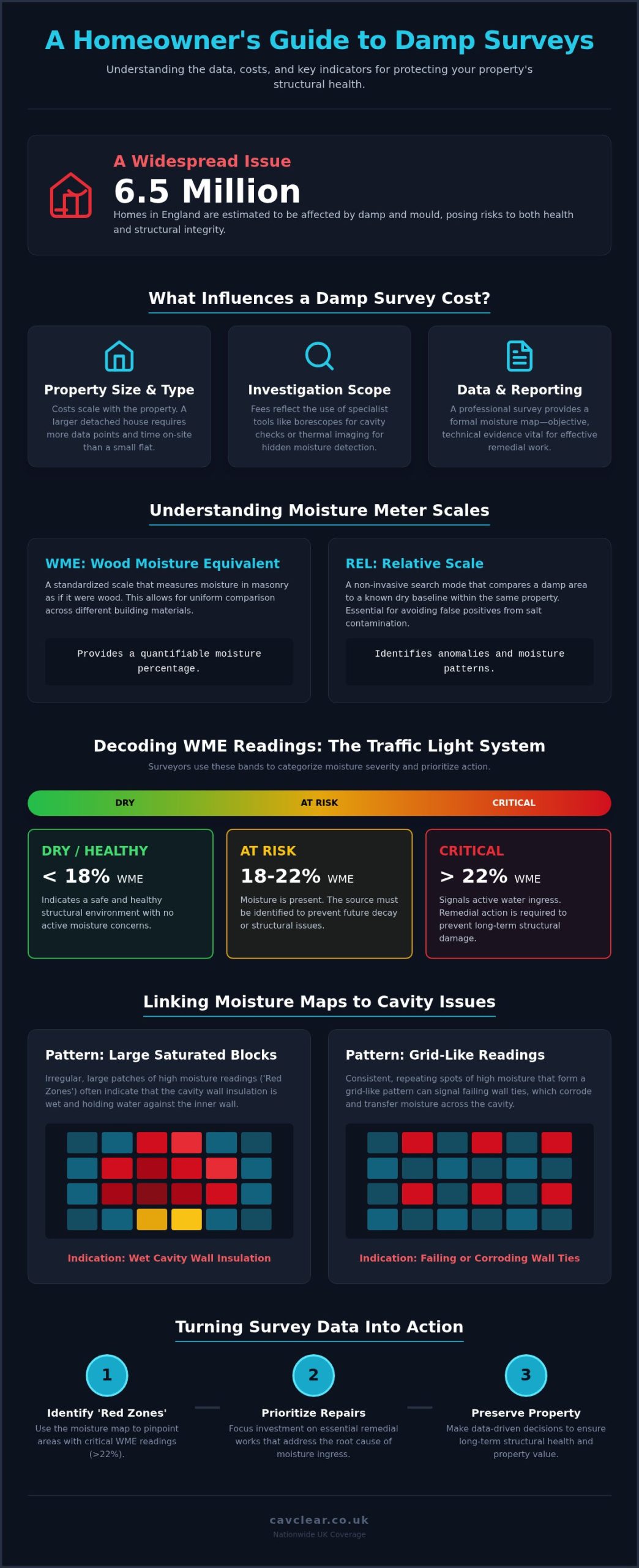
Surveyors categorize WME readings into three primary bands to determine the severity of the issue. Readings below 15% to 18% are generally considered dry and indicate a healthy structural environment. When readings climb into the 18% to 22% range, the area is flagged as “At Risk.” This mid-range suggests that moisture is present and could lead to decay if the source isn’t identified. Anything above 22% to 25% signals critical saturation. At these levels, the structural integrity of the masonry is compromised, and the risk of timber rot or internal damage increases significantly. Identifying these zones early allows for targeted inspections of the internal wall leaf for hidden faults.
Relative (REL) Scale Interpretation
The REL scale is particularly useful for brickwork where WME accuracy may vary due to the specific material composition. To use this scale effectively, the surveyor first establishes a reference point on a known dry internal partition. This baseline represents the “zero” for that specific building. By scanning outward from this point, the technician can pinpoint the peak of a moisture plume. This process identifies exactly where the water is entering the structure and how far it has spread. Using REL mode helps surveyors map the movement of moisture across a wall, providing the evidence needed to justify specific remedial actions like wall tie replacement or insulation extraction.
Deciphering the Visuals: Color-Coding and Moisture Map Patterns
A professional report transforms abstract moisture readings into a clear visual blueprint. While many property owners focus initially on how much does a damp survey cost uk, the true value of the investment becomes apparent when reviewing the moisture map. These maps utilize a standardized color-coding system to illustrate the exact distribution of moisture across your walls. Unlike a standard visual inspection, which only identifies surface damage, a technical map reveals the hidden story of water movement within the building structure. This clarity is essential for distinguishing between minor surface condensation and serious structural failures.
The visual patterns identified during a survey are directly influenced by the internal what is a cavity wall structure. Moisture often bridges the gap between the external and internal leaf via debris, failed wall ties, or saturated insulation. By mapping these patterns, technicians can pinpoint exactly where the cavity has been compromised. This precision ensures that any subsequent remedial work, such as cavity extraction, is targeted and effective. Understanding how much does a damp survey cost uk involves recognizing that you’re paying for this diagnostic precision, which prevents the high costs of misdiagnosed repairs.
The Traffic Light System Guide
Most professional moisture maps follow a “Traffic Light” system to categorize risk levels. Green zones represent normal moisture levels consistent with the UK climate. These areas are healthy and require no intervention. Yellow or amber zones indicate borderline readings. These often result from high atmospheric humidity or early-stage condensation issues that require monitoring rather than immediate repair. Red zones signal active moisture ingress. These areas represent a direct threat to the building’s structural integrity and require immediate remedial attention to prevent long-term decay of masonry and timber.
Common Moisture Distribution Patterns
The shape and orientation of damp patches provide critical clues about the source of the fault. Horizontal bands concentrated at floor level are the classic signature of rising damp, where moisture travels upward through the masonry. Conversely, isolated “clouds” or irregular clusters often indicate penetrating damp. These patterns frequently align with external faults like localized gutter leaks or cracked rendering. When dampness appears at ceiling height, it typically signals a failure in the roof-line or chimney stack. By analyzing these clusters, surveyors can determine if the moisture is falling from above or rising from the ground, allowing for a methodical repair strategy.
Interpreting Patterns: Linking Moisture Maps to Structural Cavity Issues
Technical mapping moves beyond surface aesthetics to reveal the internal state of the building. When you’re considering how much does a damp survey cost uk, you’re investing in the ability to distinguish between harmless surface condensation and deep-seated structural ingress. Surface moisture often fluctuates based on ventilation and heating, but structural ingress remains consistent regardless of internal airflow. Mapping these saturation levels allows technicians to see through the brickwork and identify faults within the cavity itself. This data-driven approach ensures that remedial work targets the cause rather than just the symptoms.
The difference between a visual check and a mapped survey is the identification of moisture profiles. A professional report differentiates between moisture sitting on the plaster and moisture held within the masonry leaf. This distinction is vital because treating structural dampness as a simple ventilation issue will result in continued decay. By identifying the depth and spread of moisture, surveyors can provide a clear roadmap for protecting your property’s long-term asset health.
The Signature of Wet Cavity Insulation
A moisture map showing consistent saturation across a large, rectangular block is a primary indicator of compromised insulation. When cavity materials become slumped or wet, they form “cold bridges” that transfer external moisture directly to the internal leaf. This often manifests as internal mould that mirrors the high-saturation zones identified on the map. To resolve this, cavity wall insulation removal is usually necessary. Extracting the saturated material restores the wall’s thermal properties and stops the continuous moisture transfer that damages internal finishes and structural integrity.
Wall Tie Corrosion and Moisture Profiles
High moisture readings that appear in a regular grid pattern often point to failing wall ties. These steel components are essential for structural stability, but persistent moisture ingress accelerates their oxidation. As ties corrode, they expand and pull moisture into the internal wall, often carrying hygroscopic salts that keep the area perpetually damp. Identifying these “spot” dampness patterns early is vital for property safety. In these high-moisture zones, professional wall tie replacement is the only way to ensure long-term stability and prevent wall leaf separation. If your survey reveals these critical patterns, our team provides expert cavity extraction and structural repairs to restore your home’s integrity.
Turning Survey Data into Action: Specialist Remedial Steps
Once you’ve determined how much does a damp survey cost uk and received your formal report, the focus must shift from diagnosis to resolution. A professional survey provides a data-driven blueprint that should dictate every subsequent repair. You must review any remedial recommendations specifically against the moisture map data provided in your report. If a contractor proposes a solution that doesn’t align with the high-saturation zones identified by the surveyor, it’s a sign that the repair might not address the root cause of the ingress. Technical data doesn’t lie; use it to hold contractors accountable for the results they promise.
Prioritizing ‘Red Zone’ repairs is the most effective way to prevent long-term structural decay. These areas represent active moisture pathways where the masonry leaf or internal cavity is compromised. Failure to address these zones leads to the proliferation of black mould and the eventual degradation of internal plasterwork and timber. Once the primary ‘Red Zone’ issues are resolved, you should request a follow-up check to verify a ‘dry’ map. This verification ensures that the moisture levels have returned to acceptable baseline percentages and that the structural environment is once again stable.
Vetting Remedial Recommendations
Effective remedial plans must be supported by quantitative map data rather than visual guesswork. Many property owners fall into the trap of ‘quick fixes,’ such as internal damp-proofing creams or waterproof renders. These methods often mask the symptoms while allowing moisture to continue building up within the cavity, leading to hidden wall tie corrosion. At CavClear, we emphasize the use of accredited technicians who specialize in structural repairs and insulation extraction. Specialist remedial contractors possess the calibrated equipment and technical training required to handle complex cavity issues that general builders might overlook. Choosing a specialist ensures that the extraction process is clean, non-disruptive, and addresses the specific faults identified in your survey.
Planning for Long-Term Property Health
Your moisture map serves as more than just a repair list; it’s a baseline for ongoing property maintenance. Keeping a record of these professional reports is vital for future property valuations and sales. Prospective buyers and mortgage lenders increasingly look for evidence of professional diagnosis and subsequent remedial success. By investing in a specialist survey and following through with accredited repairs, you frame the work as a vital investment in the property’s future rather than just a temporary fix. This methodical approach restores comfort and protects the building’s asset value for decades. For expert assistance in interpreting your data or executing professional repairs, Contact CavClear for expert remedial extraction and structural repairs across the UK.
Securing Your Property’s Structural Future
Understanding how much does a damp survey cost uk is the foundation of a successful remedial strategy. A professional survey moves beyond simple visual observations, providing you with a technical moisture map that acts as a structural blueprint for your home. This data-driven approach allows you to prioritize ‘Red Zone’ repairs, such as cavity extraction or wall tie replacement, based on quantitative evidence rather than guesswork. By identifying the exact moisture pathways within your masonry, you can prevent long-term decay and maintain your property’s asset value for decades.
CavClear operates as a nationwide specialist contractor, providing detailed technical reporting and the expertise of accredited extraction technicians. We focus on restoring structural integrity through precise, non-disruptive methodologies that address the root cause of dampness. Our team is committed to delivering long-term assurances that protect both your comfort and your property’s future. Don’t let hidden moisture compromise your home’s health. Book a Professional Remedial Survey with CavClear today to receive a clear diagnostic assessment and a low-pressure path toward a permanent resolution. Your home deserves the protection of expert structural care.
Frequently Asked Questions
Is a high moisture reading on the map always a sign of rising damp?
No, a high reading is not exclusive to rising damp. It can indicate penetrating damp or localized gutter leaks. When considering how much does a damp survey cost uk, remember that you’re paying for this diagnostic distinction. A surveyor analyzes the distribution to see if moisture is rising from the ground or falling from a roof-line failure. Identifying the specific ingress profile prevents the installation of unnecessary and expensive damp-proofing treatments that don’t address the root cause.
Can a moisture map detect damp hidden behind furniture or wallpaper?
Specialist moisture meters use non-invasive search modes to detect moisture up to 20mm behind surface finishes. This allows technicians to identify dampness trapped behind heavy wallpaper, tiling, or fixed furniture without causing structural damage. Mapping these hidden zones is a vital part of a professional survey. It ensures that the full extent of the ingress is documented, providing a clear blueprint for any required remedial works or insulation extraction.
What is the difference between a moisture map and a thermal imaging report?
A moisture map and a thermal imaging report serve different diagnostic purposes. The moisture map provides quantitative data by plotting specific moisture meter readings across a wall’s surface. Thermal imaging uses infrared cameras to visualize temperature differences, often highlighting cold bridges where insulation is missing or wet. Using both tools together allows a technician to cross-reference temperature drops with high moisture readings, confirming the presence of saturated cavity wall insulation.
How much moisture is considered ‘normal’ for a UK brick wall in winter?
In the UK, masonry is generally considered dry when moisture levels fall below 18% Wood Moisture Equivalent (WME). During winter, higher atmospheric humidity might cause surface readings to fluctuate slightly, but structural brickwork should remain within the Green Zone. If readings consistently exceed 20% in specific areas, it suggests active moisture ingress rather than seasonal variation. Professional surveys account for these environmental factors to provide an accurate assessment of your home’s structural health.
Do I need a moisture map if I can already see the mould?
Seeing mould only confirms that moisture is present on the surface. A moisture map is necessary to determine if that moisture is coming from internal condensation or deep structural ingress. If the map shows high saturation within the masonry, it indicates a failure in the cavity or external leaf. Understanding how much does a damp survey cost uk is an investment in this clarity, ensuring you don’t waste money on ventilation if the issue is actually structural.
Can wet cavity wall insulation cause high readings on an internal moisture map?
Wet cavity wall insulation is a frequent cause of high internal moisture readings. When insulation material becomes saturated, it loses its thermal properties and creates a continuous bridge for water to travel from the external leaf to the internal wall. This typically results in large, consistent blocks of Red Zone saturation on the moisture map. In these cases, specialist cavity wall insulation extraction is the only permanent solution to restore the building’s dry environment.
How long does it take for a moisture map to return to ‘green’ after repairs?
The drying process varies depending on the severity of the saturation and the thickness of the masonry. As a general rule, UK masonry dries at a rate of approximately 25mm per month once the source of ingress is removed. After completing structural repairs or insulation extraction, it may take several months for the moisture map to return to a Green status. We recommend a follow-up check after six months to confirm that the wall leaf is drying as expected.
Why do some surveyors use different colors on their moisture maps?
Surveyors use color-coding to make technical data accessible to property owners. While the Traffic Light system of Green, Yellow, and Red is the industry standard for risk levels, some maps use blue to represent total saturation. The specific colors are less important than the numerical WME or REL thresholds they represent. Every professional report should include a clear legend that defines what each color means for the structural integrity and moisture levels of your specific property.
Recent Comments