
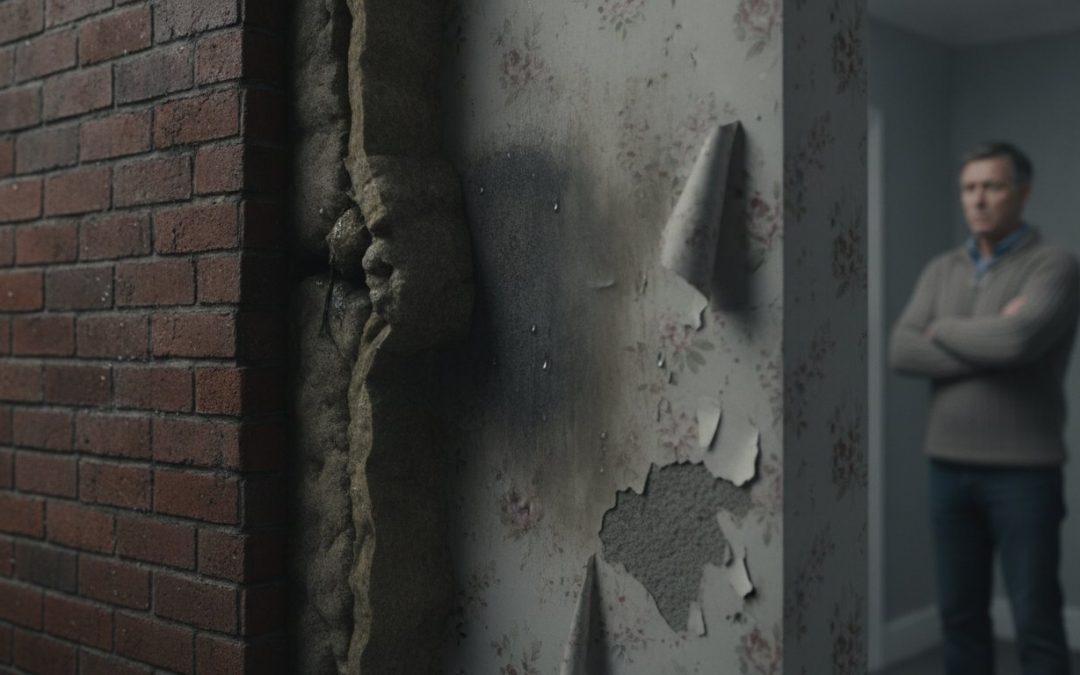
Your home insurance policy feels like a guarantee of security until you find a penetrating damp insurance claim rejected by your provider. It’s a common and deeply frustrating scenario for property owners across the UK. Most insurers categorise moisture ingress as a maintenance issue rather than an insurable event like a storm or a burst pipe. When you’re facing peeling wallpaper, persistent mould growth, and the fear of escalating repair costs, a standard rejection letter feels like a secondary disaster.
We understand that discovering a structural fault is stressful, especially when you’re left to manage the technical burden alone. This guide explains the specific reasons why insurance providers often refuse coverage and identifies the underlying structural failures they frequently cite as gradual deterioration. You’ll learn how to identify the true source of the moisture, such as defective cavity wall insulation or failing wall ties, and discover a clear, methodical plan to restore your property’s integrity. By addressing these technical faults at their source, you can stop the cycle of damage and secure the long-term health of your asset.
Key Takeaways
- Understand the technical reasons why a penetrating damp insurance claim rejected notification occurs and how providers distinguish between maintenance and structural failure.
- Identify hidden defects such as moisture bridging within cavity walls that are frequently misidentified as simple upkeep issues during initial inspections.
- Learn how to obtain a factual, technical understanding of property faults through professional cavity wall surveys and detailed reporting.
- Discover how specialist insulation extraction and wall tie replacement provide a permanent resolution to moisture ingress and protect long-term asset health.
- Gain a clear, methodical plan for restoring structural integrity and property comfort using nationwide, non-disruptive remediation techniques.
Why Insurance Coverage for Penetrating Damp is Often Refused
Receiving a rejection notice after discovering water damage in your home is a significant source of stress. Most property owners assume their buildings insurance provides a safety net for all structural moisture issues. However, the technical reality of how providers assess risk often leads to a penetrating damp insurance claim rejected. To understand this outcome, we must first define the problem. What is penetrating damp? In technical terms, it is the horizontal ingress of moisture through the external building envelope, such as walls, roofs, or window frames. Unlike rising damp, which moves vertically from the ground, penetrating damp is driven by external weather conditions and structural vulnerabilities.
The Wear and Tear Exclusion Explained
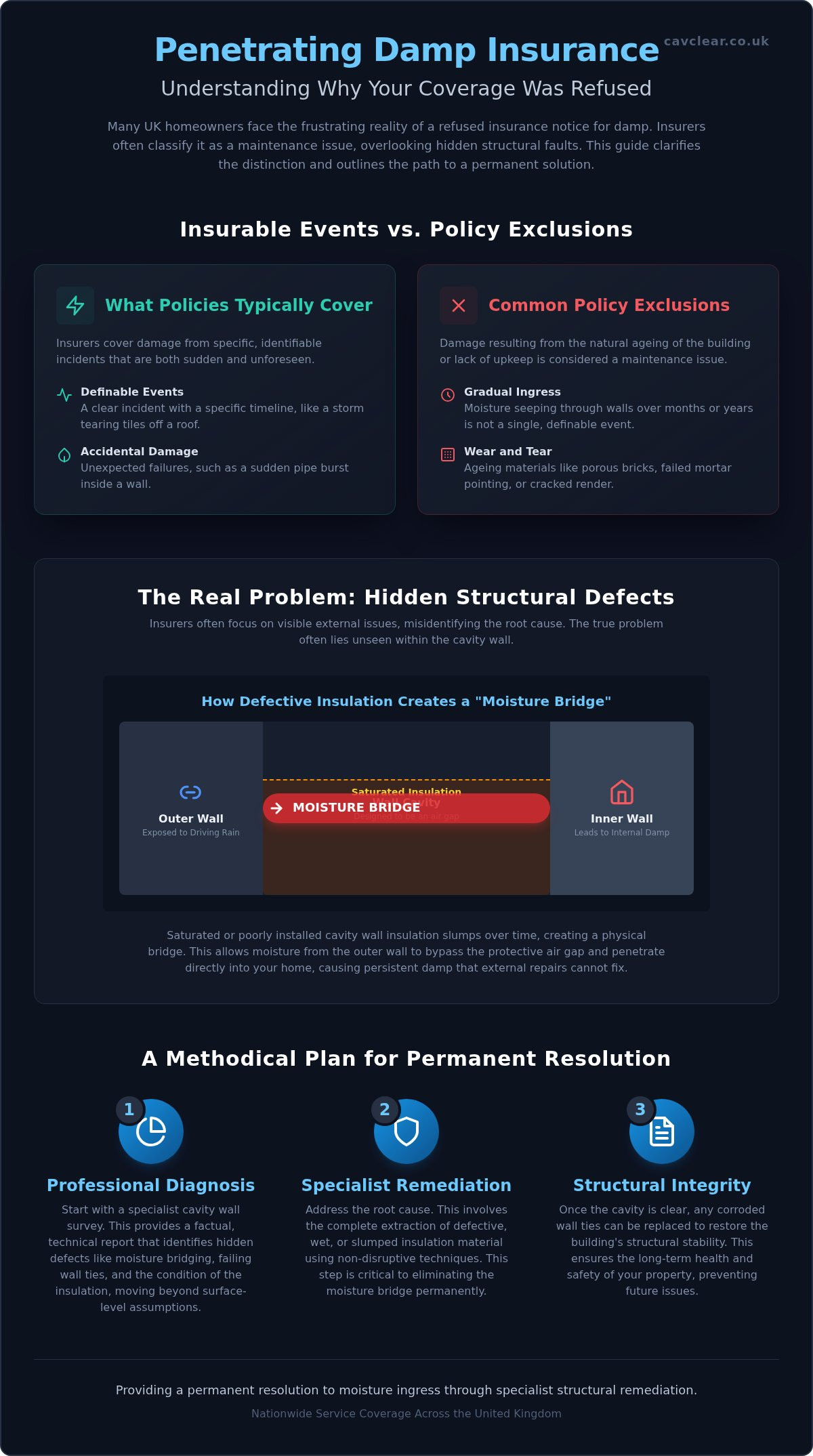
Insurance providers in the UK operate on the principle that they cover sudden and unforeseen events. They don’t cover the natural ageing process of a building. Most policies contain a specific wear and tear exclusion that applies to the external masonry, roof tiles, and guttering systems. If a surveyor identifies that moisture is entering because of porous bricks, cracked render, or failed mortar pointing, the insurer will likely classify the issue as a maintenance failure. They expect homeowners to perform regular inspections and repairs to ensure the building remains watertight. Gradual deterioration of the property’s facade is viewed as a predictable outcome of neglect rather than an insurable accident.
Definable Events vs. Gradual Ingress
For a claim to be successful, there must be a definable event that caused the damage. A sudden pipe burst or a storm that rips tiles from a roof provides a clear timeline for the insurer. Penetrating damp rarely follows this pattern; it’s often a slow, cumulative process where moisture seeps through the wall over months or years. When a loss adjuster visits your property, they look for evidence of a specific incident. If they find that the dampness is the result of long-term exposure to driving rain through existing structural gaps, they’ll attribute the fault to the building’s condition.
Even if a severe storm worsens the situation, a penetrating damp insurance claim rejected is likely if the underlying cause is a pre-existing technical fault. The insurer’s role is to restore the property to its state immediately before an event, not to rectify long-standing maintenance issues. This leaves the property owner with the urgent need for a clear, technical resolution to stop the damage at its source and restore the structural integrity of the home.
Structural Defects Misidentified as Maintenance Issues
When a property owner receives a notice that their penetrating damp insurance claim rejected, the justification often centres on visible external issues like failed pointing or porous masonry. While these are contributing factors, insurers frequently overlook internal structural failures that are invisible to the naked eye. One of the most common causes of persistent moisture ingress is the presence of a “moisture bridge” within the cavity itself. A cavity wall is designed to act as a barrier; the air gap prevents water from the outer leaf reaching the inner leaf. When this gap is compromised by defective materials or debris, moisture is given a direct path into the living space.
Loss adjusters often cite a lack of maintenance because they see damp patches and assume the external envelope hasn’t been cared for. However, the technical reality is often a failure of the property’s thermal envelope. This distinction is vital because a simple coat of water-repellent paint won’t fix a bridge inside the wall. Understanding why insurance claims for damp are rejected requires looking at how providers define “wear and tear” versus sudden damage. If the root cause is a structural defect, you need a specialist solution that addresses the void between your walls.
Defective Cavity Wall Insulation as a Moisture Bridge
Retrospective insulation materials, such as mineral wool or certain foams, can settle or “slump” over time. If the insulation becomes saturated due to driving rain, it holds water against the inner leaf of the wall. This creates a permanent moisture bridge that bypasses the cavity’s protective function. Because this happens inside the wall, it’s often misidentified as a maintenance issue by general surveyors. Resolving this requires specialist cavity wall insulation removal to clear the bridge and restore the air gap. This process is essential for the long-term health of the building and the comfort of its residents.
Wall Tie Corrosion and External Masonry Damage
Steel wall ties are essential for binding the two leaves of a cavity wall together. In many UK properties, these ties can corrode over time due to exposure to moisture and oxygen. As they rust, they expand to several times their original size. This physical expansion exerts immense pressure on the mortar joints, leading to horizontal cracking and spalling of the brickwork. These cracks then act as funnels for rainwater, accelerating the damp problem and compromising the property’s structural integrity. Because the damage appears as “cracked walls,” insurers often dismiss it as poor upkeep. In reality, it’s a technical failure that necessitates professional wall tie replacement. Identifying these faults early through a specialist survey at cavclear.co.uk ensures a permanent fix rather than a temporary patch.
Maintenance vs. Structural Failure: Understanding Policy Boundaries
Understanding where your responsibility ends and the insurer’s begins is essential for every property owner. A penetrating damp insurance claim rejected usually occurs because the fault falls on the maintenance side of the policy line. Insurers expect you to keep the external masonry, pointing, and roof in a state of good repair. If they determine the damp is a result of gradual deterioration over several years, they won’t provide coverage. This creates a clear boundary: the insurer covers the unexpected, while you are responsible for the inevitable. Maintaining the building’s envelope is a primary duty of ownership.
Technical evidence is your best tool when navigating these boundaries. Professional surveyors specialize in identifying structural defects causing damp, providing the clarity needed to distinguish between a simple leak and a systemic failure. It’s important to remember that even when an insurer accepts a case for resultant damage, such as ruined plasterboard, they often won’t pay to fix the actual source of the problem. You must be prepared to address the root cause independently to prevent the moisture from returning.
Covered Perils: What Insurers Typically Accept
Insurers generally cover “active” perils that are sudden and identifiable. This includes:
- Sudden impact damage, such as a falling tree hitting a wall and compromising the masonry.
- Severe storm-related failure where high winds visibly damage the structure or remove roof tiles.
- Damage to internal decorations caused directly by an insurable event.
If a storm is the primary cause of a leak, they may cover the cost of drying out the property and replacing internal decorations. You should note that while the damage to your interior is covered, the cost of the structural repair itself often remains your responsibility. The loss adjuster will look for a specific date of occurrence to validate the event.
Excluded Issues: Common Reasons for Denial
Facing a penetrating damp insurance claim rejected notice means you must pivot to a technical solution. Most policies exclude issues that develop over time or result from inherent defects. Common exclusions include:
- Rising damp, which is typically linked to a failed or missing damp proof course.
- Condensation resulting from poor ventilation or lifestyle factors.
- Penetrating damp caused by defective cavity wall insulation or moisture bridging.
Crucially, damp caused by defective cavity wall insulation is almost always excluded. Providers view the installation of retrospective materials as a modification, and any subsequent moisture bridging is seen as a technical fault rather than an insurable accident. This leaves the owner to fund the extraction and structural restoration to protect the long-term health of the property.
Practical Actions to Resolve Damp Issues After a Policy Refusal
Once you’ve had a penetrating damp insurance claim rejected, it’s time to pivot from administrative disputes to technical remediation. Many homeowners feel stuck after a refusal, but the primary goal must remain the protection of your property’s structural health. Quick cosmetic fixes, like repainting or using specialized plaster, only mask the symptoms while the underlying fault continues to degrade the masonry. Investing in a permanent solution is the only way to restore comfort and preserve the long-term value of your home. You need a clear path forward that addresses the physical failure of the building’s envelope.
Technical evidence is the most effective tool for moving past a rejection. A factual, technical understanding of the fault allows you to stop the moisture at its source rather than simply reacting to the damage. This transition requires a shift in mindset; you are no longer looking for a payout, but for a professional remedy that secures your property’s future. By focusing on asset protection, you ensure that the building remains a safe and dry environment for years to come.
Commissioning an Independent Technical Survey
The vital first step is obtaining a factual understanding of why moisture is entering the building. A professional damp survey moves beyond visual inspections to provide a diagnostic overview of the structure. Specialist technicians use borescopes to look inside the wall cavity, identifying hidden bridges such as slumped insulation or mortar debris. This level of detail is essential. A comprehensive report provides the evidence needed to plan precise repairs, ensuring you aren’t wasting money on unnecessary work. It shifts the focus from guesswork to a data-driven restoration strategy that targets the specific point of failure.
Creating a Targeted Remedial Action Plan
A targeted plan must prioritise fixing the source of ingress before any internal redecoration begins. If the survey reveals that moisture is crossing the cavity via defective materials, removing wet or contaminated insulation is a technical necessity. Saturated insulation acts as a reservoir, holding moisture against the inner leaf and preventing the wall from drying out naturally. You should always ensure that remedial work is carried out by accredited structural contractors who follow high-level standards for extraction and repair. Restoring a property to a dry, safe state requires a methodical approach that respects the building’s original design. For expert assistance in diagnosing these complex faults, you can book a specialist inspection at cavclear.co.uk to begin your property’s recovery.
Specialist Structural Remediation with CavClear
CavClear operates as a nationwide specialist dedicated to rectifying the root causes of moisture ingress. When you’ve had a penetrating damp insurance claim rejected, the next step shouldn’t be another superficial patch. Generic damp surveys often fail because they only confirm the presence of moisture without identifying the specific structural faults within the wall cavity. We provide a deeper level of diagnostic expertise, focusing on the restoration of your property’s original design and long-term health. Our approach is methodical and non-disruptive; we use specialist equipment to resolve faults without compromising the building’s facade.
We position our services as a vital investment in the future of your asset. By choosing a professional remedy, you move beyond the frustration of policy exclusions and toward a permanent fix. Our technicians are accredited and experienced in handling the complex environmental conditions found across the United Kingdom. We don’t just repair the damage; we restore the structural integrity and thermal efficiency of the building, providing you with the reassurance that the damp won’t return.
Methodical Cavity Wall Insulation Extraction
The extraction of defective or saturated insulation is a technical necessity for properties suffering from moisture bridging. Our process involves the precision removal of contaminated materials to clear the cavity void completely. A clear cavity is essential for preventing future damp because it restores the natural air barrier that protects the inner leaf of your home. This methodology ensures that moisture cannot track across the wall; it allows the masonry to dry out naturally and prevents the recurrence of mould. Protecting the structural integrity of the home begins with clearing these hidden obstructions and ensuring the wall can breathe as intended.
Expert Wall Tie Replacement and Masonry Repair
Corroding wall ties are a significant technical fault that insurers often dismiss as general wear. Our diagnostic process identifies the specific stage of tie failure, from early-stage oxidation to severe structural cracking. We install high-quality remedial ties to secure the two leaves of the cavity wall, followed by precision masonry repairs to seal the external envelope. It’s vital to consult dampness specialists who understand the relationship between wall tie health and penetrating moisture. This specialist intervention ensures a permanent resolution, effectively reversing the damage that led to your penetrating damp insurance claim rejected notice and securing the property for decades to come.
Securing Your Property’s Structural Future
Receiving a penetrating damp insurance claim rejected notice is a significant setback, but it shouldn’t leave your property’s health in jeopardy. Most rejections occur because insurers view moisture ingress as a maintenance responsibility rather than a sudden, insurable event. By identifying the true technical cause, such as defective cavity wall insulation or failing wall ties, you can move from a state of frustration to a clear, methodical plan for restoration. A specialist approach ensures that the root cause is eliminated, protecting your long-term asset health and restoring the comfort of your home.
Our nationwide team of accredited technicians provides the expertise needed to resolve these complex structural issues. We are specialists in structural wall repairs and insulation extraction, backed by detailed technical reporting that gives you a factual understanding of your property’s condition. This methodical, non-disruptive process is an investment in your home’s future. Don’t let persistent dampness compromise your building’s integrity. Book a Specialist Survey with CavClear Today and take the first step toward a dry, safe, and permanently protected property.
Frequently Asked Questions
Why did my insurance provider refuse to cover penetrating damp?
Your provider likely refused the claim because they classify penetrating damp as a result of gradual deterioration rather than a sudden, unforeseen event. Standard UK policies exclude damage caused by wear and tear or a lack of maintenance. If a surveyor identifies that moisture entered through porous masonry or failed pointing over a long period, it is considered a predictable outcome of ownership rather than an insurable accident. This is the primary reason for a penetrating damp insurance claim rejected notice.
Is penetrating damp considered a maintenance issue by most insurers?
Yes, insurers generally view the upkeep of the external building envelope as the homeowner’s responsibility. If moisture enters through porous bricks, failed mortar, or cracked render, providers classify the issue as a maintenance failure. Policies are designed to protect against unforeseen disasters like storms or floods, not the predictable outcomes of gradual structural deterioration. Keeping the property’s facade watertight is a condition of most standard insurance agreements.
Can I appeal a negative decision regarding damp coverage?
You can appeal if you have technical evidence that a specific, insured event caused the damage. For instance, if a severe storm damaged your roof tiles and led to immediate water ingress, you should provide dated photos and a professional report to support your case. However, if the underlying cause is an inherent structural defect or long-term neglect of the masonry, an appeal is unlikely to succeed under standard policy terms.
What are the most common causes of moisture ingress in cavity walls?
Moisture ingress is frequently caused by a moisture bridge within the cavity itself. This occurs when debris, slumped insulation, or corroded wall ties provide a direct path for water to travel from the external leaf to the internal leaf. While external faults like failed pointing contribute to the problem, the internal bridge is often the primary technical failure that prevents the wall from drying out naturally and leads to persistent damp patches.
How does defective insulation affect property insurance cases?
Defective retrospective insulation is often viewed as a technical failure of the material rather than an insurable event. If the insulation slumps or becomes saturated, it creates a permanent moisture bridge. Because this is a gradual process resulting from the material’s condition, insurers typically exclude it from coverage. This often leads to a penetrating damp insurance claim rejected, leaving the property owner responsible for the cost of extraction and structural restoration.
What should I do if my request for damp repairs is denied?
You should immediately commission a specialist structural survey to identify the root cause of the moisture. Once the technical fault is confirmed, prioritize remedial work such as insulation extraction or wall tie replacement. Focusing on fixing the source of the moisture is the only way to prevent ongoing damage and restore the structural integrity of your property. Masking the issue with cosmetic repairs will only lead to further deterioration and higher costs later.
Does home insurance cover the cost of insulation removal?
Standard home insurance policies almost never cover the cost of insulation removal. Extraction is considered a remedial maintenance task to fix a defective installation or a structural fault. While the policy might cover the resultant damage to internal plaster or decorations in very specific circumstances, the cost of clearing the cavity and restoring the air gap remains the financial responsibility of the property owner as part of essential building maintenance.
How can a technical survey help resolve a dispute with an insurer?
A technical survey provides factual evidence that clarifies the exact cause of the dampness. By using borescopes to inspect the cavity, a specialist can determine if the damage resulted from a sudden event or a long-term structural defect. While this doesn’t guarantee a reversal of an insurer’s decision, a detailed report ensures you have a professional diagnosis. This information is vital for planning correct repairs and protecting the long-term health of your property.
Recent Comments