

A single moisture reading can be the difference between a successful property acquisition and a decade of structural instability. For many UK homeowners, understanding the true damp survey cost is not just about the initial fee; it’s about avoiding the thousands of pounds required to rectify hidden wall tie corrosion or saturated masonry later.
It’s understandable to feel overwhelmed when mortgage lenders withhold funds or when different contractors provide conflicting advice about the health of your walls. You deserve a clear, expert diagnosis that prioritizes the safety of your home over a quick sales pitch. This guide provides the transparency you need to navigate 2026 market expectations while explaining how a technical inspection protects your property’s long-term structural integrity. We will examine the variables that influence professional pricing, the specific technical faults our nationwide specialists identify, and how a detailed formal report serves as your ultimate defense during property transactions.
Key Takeaways
- Learn why a professional technical inspection is a vital investment for identifying hidden structural faults that standard homebuyer reports often overlook.
- Review the 2026 industry averages for a professional damp survey cost, which varies based on your property’s size and the complexity of its cavity wall structure.
- Discover how independent surveys protect you from biased sales tactics by focusing on root causes rather than selling unnecessary remedial treatments.
- See how a specialist survey identifies critical issues like wall tie corrosion early, potentially saving you over £5,000 in major structural repairs.
- Secure the technical documentation needed to satisfy mortgage lenders and protect your property’s long-term asset health through a nationwide specialist network.
Understanding the Investment: What is a Damp Survey?
A damp survey is a methodical, technical assessment conducted by an accredited specialist to determine the presence, source, and extent of moisture ingress. Unlike a standard RICS Homebuyer’s Report, which provides a broad overview of a property’s condition, a specialist damp survey focuses on the intricate health of the building envelope. It involves a deep dive into structural dampness, specifically evaluating how moisture interacts with masonry, cavities, and internal finishes.
Many buyers are surprised when their general surveyor flags “potential damp” and recommends a specialist. This is because general surveys often lack the specialized tools needed to see behind the brickwork. When you evaluate the damp survey cost, it’s helpful to view it as a diagnostic investment. A professional report identifies the root cause of an issue rather than merely documenting surface symptoms. This distinction is vital; cleaning surface mould is a temporary fix, but identifying a failing damp proof course or a bridged cavity provides a permanent solution. Lenders and insurers rely on these professional documents to verify that a property is structurally sound before they commit to a mortgage or policy.
The Core Types of Damp Identified
A specialist survey categorizes moisture issues into three primary types to determine the correct remedial path. Rising damp occurs when groundwater moves upward through masonry via capillary action. This typically happens when a Damp Proof Course (DPC) is missing, damaged, or bridged by high ground levels. Penetrating damp involves water entering through external defects like cracked render or failing mortar. In properties with cavity walls, saturated insulation can bridge the gap, allowing moisture to travel from the outer leaf to the inner leaf. Finally, the survey assesses condensation, which is often a ventilation issue rather than a structural failure, though it can still cause significant damage if left unaddressed.
When is a Specialist Survey Required?
A specialist survey is usually triggered by specific “red flags” during a property transaction. Mortgage lenders often place a “retention” on funds if a general surveyor suspects moisture issues. This requires a professional document to release the capital. You should also consider a survey if you notice visible salt staining, peeling wallpaper, or crumbling plaster. For those buying older UK homes, pre-purchase due diligence is essential. Understanding the damp survey cost early in the process ensures you don’t inherit a property where wall tie corrosion or cavity wall failures remain hidden behind fresh paint. Our nationwide specialists provide the technical clarity needed to protect your investment and your family’s comfort.
Breakdown of Damp Survey Costs in the UK for 2026
In 2026, the professional damp survey cost is determined by the depth of technical investigation required to safeguard a property’s structural health. While a small flat requires less time for an external envelope check, a large detached family home demands a comprehensive assessment of multiple elevations. These price variations reflect the time an accredited technician spends on-site and the complexity of the final report. It’s important to distinguish between a ‘Survey Only’ fee and quotes that include remedial work. A professional survey provides an independent diagnosis, ensuring you don’t pay for unnecessary treatments that don’t address the root cause.
Complexity also dictates the final fee. Properties with solid walls offer straightforward moisture paths, but modern cavity wall structures require a more detailed approach. If a property has existing insulation or suspected wall tie failure, the surveyor must use specialized equipment to see inside the building envelope. This technical depth is why professional fees differ from basic visual checks. Because we operate as a nationwide specialist, we maintain consistent pricing standards across the UK. This ensures homeowners receive the same level of technical rigor regardless of their location. This rigorous approach aligns with the UK government’s damp and mould guidance, which highlights the severe health risks of living in moisture-compromised environments.
Factors That Influence the Final Quote
The total damp survey cost depends on several logistical factors. Property size is the most obvious variable; more external wall area means more points of inspection for our technicians. Access requirements also play a role. If a property has high-level elevations that require ladders or telescopic cameras to inspect, the quote will reflect this. Finally, the depth of reporting matters. A formal document suitable for mortgage lenders or insurance providers requires significant data analysis after the site visit is complete. To get a transparent view of your property’s health, you can request a fixed-price survey quote from our technical team.
Hidden Costs to Avoid
Homeowners should be wary of hidden charges that can inflate a standard quote. Many regional providers add travel surcharges if they have to travel long distances, which is why choosing a nationwide specialist is often more efficient. You should also avoid providers who offer a low initial fee only to bundle the survey with ‘compulsory’ product installations. A truly independent specialist focuses on diagnosis rather than sales. Finally, check if the quote includes follow-up support. Some firms charge extra for ‘re-inspections’ after remedial works are finished, while professional specialists include this as part of a long-term asset health plan.
no-obligation Damp Surveys vs. Professional Technical Inspections
It’s tempting to search for a expert survey when you’re already facing the high expenses of a property purchase. However, the reality of ‘expert’ assessments is that they often function as sales leads for contractors who profit from selling specific damp-proofing treatments. A professional damp survey cost ensures that the technician’s only priority is an accurate diagnosis. When a survey is expert, the provider has a vested interest in finding a problem that their products can solve. This often leads to biased advice that overlooks the underlying structural cause of moisture ingress in favor of profitable but unnecessary chemical injections or coatings.
At CavClear, we maintain that professional fees are essential for diagnostic integrity. Our technicians are focused on identifying technical faults, not meeting sales targets. By paying for a specialist inspection, you’re securing an independent advocate for your property’s health. This transparency is vital because it separates the diagnostic process from the remedial work. You receive a document based on technical standards and structural facts, which is exactly what mortgage lenders and insurance providers require to assess risk accurately.
The Risks of Sales-Led Recommendations
One of the most significant risks of sales-led assessments is the recommendation of retrospective cavity wall insulation. Some contractors suggest this as a way to fix damp, but this practice frequently exacerbates the problem. Retrospective insulation can bridge the cavity, allowing moisture to travel directly from the outer brickwork to the internal walls. This saturated environment accelerates the corrosion of wall ties, which compromises the building’s structural stability. You should never install retrospective cavity insulation to address damp issues. A truly independent specialist doesn’t benefit from selling you materials; they focus solely on identifying the technical fault, such as debris in the cavity or a failing damp proof course. Avoiding these biased assessments protects your property from the long-term damage caused by incorrect remedial advice.
What a Paid Technical Report Includes
A paid technical report provides a level of detail that sales-driven checks cannot match. It utilizes specialized tools to provide a complete picture of the building’s condition. A comprehensive report typically includes:
- Calibrated hygrometer readings to measure deep-seated moisture levels rather than just surface dampness.
- Endoscopic inspections of the wall cavity to identify hidden debris, mortar snots, or failing insulation.
- Thermal imaging to detect cold bridging and anomalies in the building envelope.
- Detailed remedial recommendations focused on restoring structural integrity.
Investing in the initial damp survey cost prevents the far higher price of repairing damage caused by incorrect, sales-driven advice. The resulting document is a professional structural remedial action plan that provides the technical clarity needed for successful property transactions.
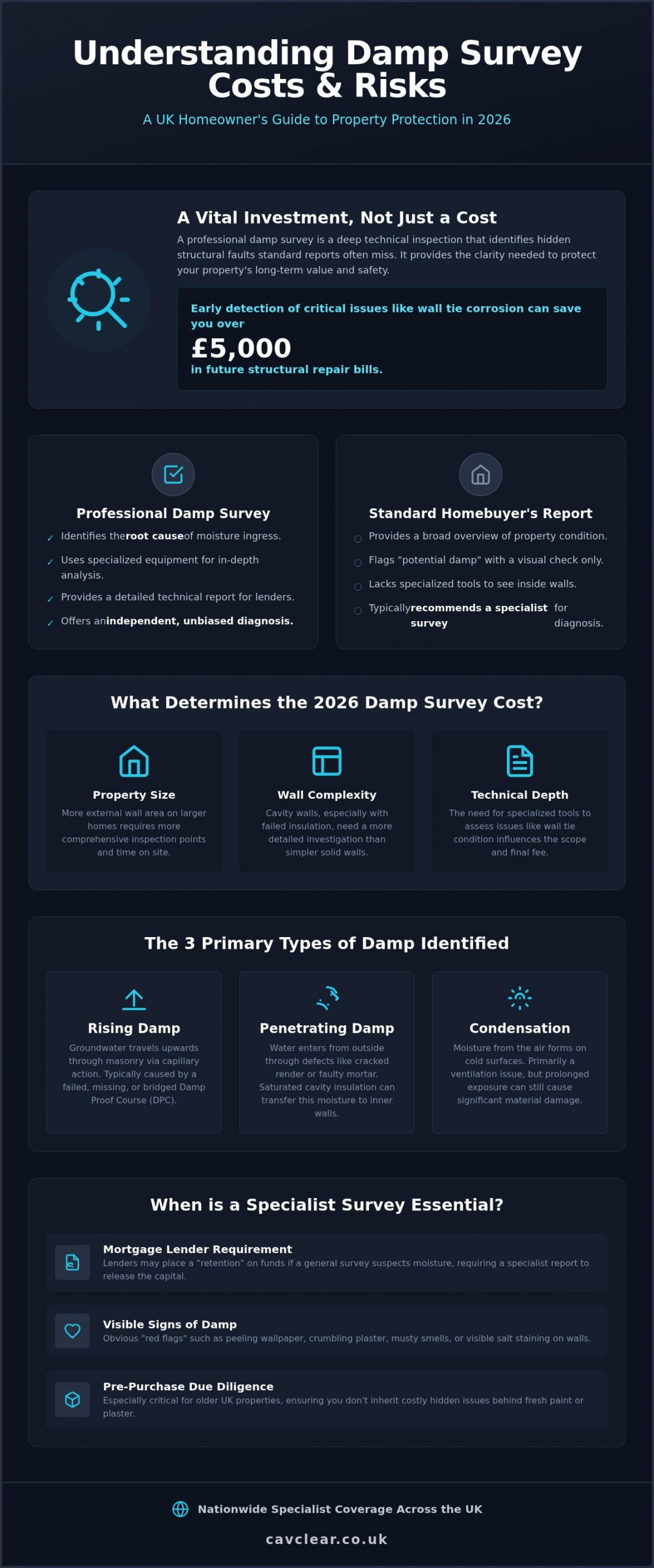
How a Specialist Survey Prevents Costly Structural Failures
A professional damp survey cost is a fraction of the expense required to rectify major structural failure. When moisture enters the cavity, it doesn’t just damage the wallpaper; it attacks the structural skeleton of the building. Identifying these faults early is the only way to protect your property’s market value and long-term stability. A specialist diagnostic report provides the evidence needed to stop degradation before it becomes a catastrophic financial burden.
While a specialist survey might range between £300 and £600 depending on the property size, failing to act can lead to structural wall repairs exceeding £5,000. This is especially true in homes with failing cavity wall insulation. Saturated insulation holds water against the inner and outer leaves, leading to permanent internal damage and accelerated masonry degradation. By evaluating the damp survey cost as a preventative measure, you ensure that hidden issues don’t evolve into unmanageable money pits.
Wall Tie Integrity and Damp
Damp walls are the primary cause of wall tie expansion, a process where the metal ties holding your walls together begin to fail. As the ties rust, they expand to several times their original size, forcing the mortar joints apart and causing visible horizontal cracking. Moisture acts as a catalyst for steel oxidation in wall ties. If left unaddressed, this corrosion compromises the stability of the entire external envelope. Professional wall tie replacement restores this stability, but it must be preceded by a technical survey to identify the extent of the corrosion and the moisture source.
The Cost of Ignoring Damp Signs
Delaying a survey allows manageable issues to escalate into severe health and structural risks. Persistent dampness often transitions from simple surface staining to toxic black mould, which presents significant respiratory hazards. Beyond the walls, moisture can migrate to timber elements, leading to the degradation of floor joists and the onset of wet rot. There is also a financial impact on daily living; damp walls are cold walls. Saturated masonry loses its thermal efficiency, which forces your heating system to work harder and increases your annual energy bills. Protect your investment by booking a technical cavity wall inspection today to ensure your home remains safe and efficient.
Securing Your Property with a CavClear Technical Survey
CavClear operates with a methodical diagnostic process that prioritizes structural facts over sales quotas. We understand that property owners face significant stress when moisture issues arise, which is why our approach is designed to provide maximum clarity. Our technicians follow a logical progression from initial visual observation to deep-level technical analysis. This ensures that every recommendation we make is rooted in the specific physical requirements of your building. By choosing a professional specialist, you ensure that the initial damp survey cost translates into a definitive roadmap for restoring your home’s comfort and safety. We focus on rectifying the poor workmanship of others and providing long-term assurances for your property’s future health.
Why Choose a CavClear Inspection?
Our expertise centers on the intricate maintenance of the building envelope, specifically focusing on cavity wall health and the extraction of failing materials. We utilize a non-disruptive methodology that relies on high-resolution technology to see inside your walls without causing cosmetic or structural damage. This technical precision allows us to identify debris, bridged cavities, and corroding ties that standard inspections miss. Our commitment to structural integrity means we don’t just identify a fault; we explain the underlying physics of the failure. This transparency empowers you to make informed decisions about your property’s future, ensuring that remedial actions are permanent fixes rather than temporary patches. Every inspection we conduct is performed by an accredited technician who understands the nuances of UK masonry and environmental factors.
Booking Your Nationwide Survey
Securing a professional assessment is a straightforward process designed to restore your peace of mind. We provide a transparent quote that accurately reflects the damp survey cost for your specific property type. Because we are a nationwide provider, we offer consistent professional standards across the United Kingdom, ensuring that every homeowner receives the same high-level expertise. During the visit, our surveyor will conduct a thorough external and internal audit, utilizing calibrated equipment to map moisture patterns and inspect the cavity. You will receive a detailed formal document that satisfies the requirements of mortgage lenders and insurance providers, providing a clear, low-pressure path toward structural resolution. Book your professional damp and structural survey with CavClear today.
Protecting Your Property’s Long-Term Structural Health
Choosing a professional technical inspection is an essential step in safeguarding your investment against hidden moisture damage. You now understand that the initial damp survey cost is a vital investment for preventing catastrophic failures like wall tie corrosion or saturated masonry. By prioritizing an independent diagnosis over biased sales pitches, you secure a document that satisfies mortgage lenders and provides a clear roadmap for permanent remedial action.
Our accredited technical specialists provide nationwide UK coverage, delivering detailed structural reports that identify root causes rather than surface symptoms. This methodical approach ensures your home remains a safe, dry, and efficient asset for years to come. Don’t leave your property’s integrity to chance with visual checks that miss what’s happening inside the cavity. We focus on restoring comfort through precise technical standards and proven methodology. Request a Professional Damp Survey Quote from our Nationwide Team and take the first step toward total structural peace of mind. Our team is ready to help you secure your property’s future.
Frequently Asked Questions
How much does a damp and timber survey cost in the UK?
The average industry price for a professional damp survey in 2026 varies based on property size and structural complexity. Small flats typically start at the lower end of the spectrum, while larger detached homes require more time and technical analysis. This fee covers the surveyor’s time on-site and the production of a formal technical report. It is a minor investment compared to the potential thousands spent on structural repairs later.
Who is responsible for paying for a damp survey when buying a house?
The buyer is typically responsible for paying for a damp survey during a property transaction. This serves as part of the buyer’s due diligence to ensure they aren’t purchasing a property with hidden structural faults. However, if a general survey has already flagged moisture issues, a seller might offer to cover the damp survey cost to provide transparency and keep the sale moving forward. The final report belongs to the person who commissioned it.
How long does a professional damp survey take to complete?
A professional damp survey usually takes between 1.5 and 2.5 hours to complete on-site for a standard property. The duration depends on the property’s size and the ease of access to external elevations. Our technicians use non-disruptive technology to inspect the building envelope, including the cavity. After the site visit, it typically takes 3 to 5 working days for the specialist to compile the technical data and issue a formal report.
What is the difference between a damp survey and a general home survey?
A specialist damp survey focuses exclusively on moisture ingress and structural integrity, whereas a general survey provides a broad overview. General homebuyer reports often rely on surface-level observations and basic moisture meters. In contrast, a technical survey uses specialized tools like endoscopes to look inside wall cavities. This allows for the identification of specific faults like bridged damp proof courses or wall tie corrosion that general surveyors often miss.
Will a damp survey include a quote for remedial works?
Yes, a specialist report from CavClear includes a detailed remedial action plan and a transparent quote for necessary works. We separate the diagnostic reporting from the project-based remedial fees. This ensures you receive a clear, low-pressure path toward a resolution. The report outlines the technical findings and specifies the required actions, such as cavity wall insulation extraction or wall tie replacement, to restore the property’s structural health and long-term asset value.
Can a damp survey help with my mortgage application?
A professional damp survey is often essential for satisfying mortgage lender requirements. If a valuation report flags moisture issues, lenders may place a retention on funds until a specialist provides a formal diagnosis. Our reports offer the technical clarity and accredited documentation lenders need to release these funds. Providing a professional structural assessment demonstrates that the property is a sound investment, which helps facilitate a smoother application process.
Is it worth paying for a damp survey if the house looks fine?
Investing in a survey is highly recommended even if a property appears fine on the surface. Many structural issues, such as wall tie corrosion or saturated cavity insulation, don’t show visible symptoms until the damage is advanced. A technical inspection identifies these hidden faults early, protecting you from inheriting a “money pit.” The damp survey cost is a small price to pay for the peace of mind that comes with knowing the building envelope is secure.
What happens if the survey identifies failing wall ties or insulation?
If the survey identifies failing wall ties or saturated insulation, we provide a structured remedial plan. These issues require specialist intervention to prevent further structural degradation. We focus on the physical extraction of defective insulation and the professional replacement of corroded wall ties. These actions stop moisture bridging and restore the stability of the external walls. Our nationwide team executes these repairs using clean, non-disruptive methodologies to ensure your property’s long-term safety and efficiency.
Recent Comments