
Could a few lines of technical jargon in a surveyor’s report be the only thing standing between you and your mortgage approval? If you’ve recently received a document filled with terms like “boroscope findings” or “rust heave”, it’s natural to feel a sudden sense of structural anxiety. Having your wall tie survey report explained shouldn’t require a degree in civil engineering. You likely believe that your home’s safety is paramount, but the path to fixing a fault often feels hidden behind complex industry terminology and confusing grading scales.
We’ll clarify every technical detail of your report, from the specific corrosion grading scales used in 2026 to the necessity of specialist boroscopic evidence. You’ll learn exactly how to interpret the severity of the findings and what they mean for your property’s long-term asset health. This guide provides a methodical breakdown of structural results. It moves from the diagnostic process to a clear resolution, giving you the confidence to protect your home with a professional, permanent remedy that ensures its future stability.
Key Takeaways
- Understand why general homebuyer surveys flag wall ties as a “further investigation” item and how a specialist report provides the definitive proof required by mortgage lenders.
- Get your wall tie survey report explained through the lens of boroscopic evidence and metal detection mapping to avoid unnecessary and costly masonry work.
- Learn to interpret the standard 1 to 4 or 1 to 9 corrosion grading scales used in 2026 reports to determine the true urgency of structural repairs.
- Discover the essential two-step remedial process that involves installing modern stainless steel ties before isolating old, corroded metal to prevent further brickwork damage.
- Identify why nationwide specialists are necessary to handle regional UK masonry styles using non-disruptive, accredited diagnostic methodologies.
What is a Wall Tie Survey Report and Why is it Necessary?
A wall tie survey report is a specialized technical document that provides a comprehensive assessment of the metal components connecting a property’s internal and external leaf. Having your wall tie survey report explained simply means moving beyond guesswork to obtain empirical data regarding the condition, density, and material of these hidden structural elements. While many homeowners only consider these ties when a structural problem arises, the report serves as a vital record of the building envelope’s integrity. It ensures that the structural stability of the property is documented through direct observation rather than surface level assumptions.
Standard homebuyer surveys often list wall ties as an item for “further investigation.” This occurs because a general surveyor can only observe the external symptoms of failure, such as horizontal cracking or bulging masonry. They can’t verify the internal state of the ties. The primary objective of a specialist report is to provide the definitive proof required to determine if a property is a safe investment or if it requires immediate remedial intervention. Because the report covers the entire building envelope, it offers a complete picture of structural health that goes far beyond a simple visual check of visible cracks.
General Survey vs. Specialist Wall Tie Report
There is a significant difference between a general property survey and a specialist inspection. A standard surveyor identifies symptoms. A specialist identifies the cause. We use high resolution boroscopes to perform intrusive inspections, allowing us to see exactly what a cavity wall tie is doing inside the dark environment of the wall cavity. This level of detail is essential for mortgage lenders. They often refuse to release funds until a specialist wall tie survey report explained by an expert confirms that the ties aren’t suffering from advanced corrosion that could lead to structural collapse.
When is a Report Mandatory?
Properties built between the 1920s and 1981 are at a higher risk of structural issues. During this period, mild steel or lightly galvanised ties were common. These materials are prone to “rust heave,” where the metal expands as it corrodes. If you notice horizontal cracks in mortar joints or bulging brickwork, a report becomes a safety necessity. For those buying or selling, a clear report is a powerful tool for negotiating property value. It transforms a vague structural concern into a documented fact, allowing all parties to proceed with confidence regarding the property’s future health.
Decoding the Technical Findings: Boroscopes and Metal Detection
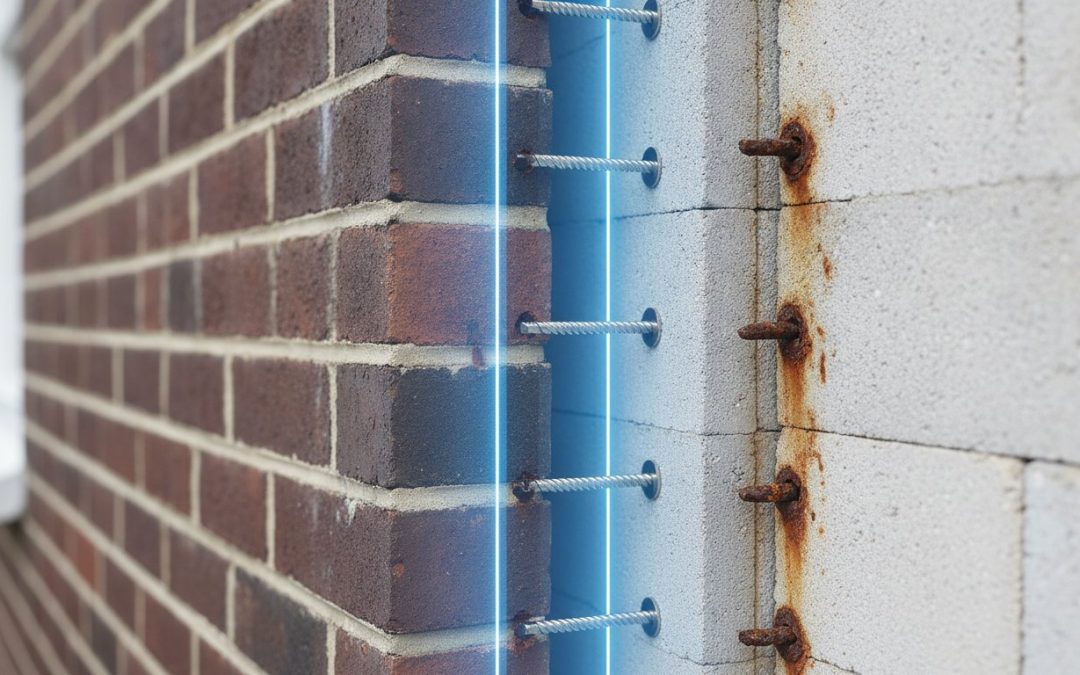
To get your wall tie survey report explained accurately, we must look where the eye cannot reach. External symptoms like cracking are often late-stage indicators of a much deeper problem. Instead, we use high-resolution boroscopes and metal detection to map the internal state of your walls. This process begins by drilling small, 10-12mm endoscopy holes into the mortar joints. These holes are discreet and easily filled after the inspection, ensuring your masonry remains undisturbed. Through these apertures, we identify specific tie types, such as the heavy fishtail ties common in older properties or the thinner butterfly wire ties. Each has a different failure rate and risk profile, which our technicians document with precision.
A specialist inspection goes beyond the surface to look inside the wall cavity. We don’t just guess at the condition of the metal based on external brickwork. By using specialist equipment, we provide the empirical evidence that mortgage lenders and structural engineers require. This methodical approach ensures that any recommended remedial work is based on the actual condition of the ties rather than a generic assumption about the building’s age.
Boroscope Imagery: The Evidence Base
Imagery is the foundation of a reliable structural report. Our technicians look for specific markers of decay, such as red rust or the white oxide that appears when galvanised coatings fail. It’s vital to differentiate between surface “flash” rust, which may be superficial, and structural corrosion that thins the metal and compromises its strength. The Building Research Establishment (BRE) provides the framework for these observations, ensuring every finding aligns with national safety standards. We include clear photographic evidence in every report because transparency is essential when making decisions about structural repairs.
Mapping Tie Density and Patterns
Metal detection allows us to see through the brickwork to map the density of existing ties. Modern UK building standards typically require a density of 2.5 ties per square metre, usually spaced at 900mm horizontally and 450mm vertically. Even if your walls show no visible cracks, a survey might reveal “missing” ties or incorrect patterns that compromise the lateral restraint of the structure. If you’ve been advised to seek further investigation, booking a specialist wall tie survey is the only way to confirm if your home meets these critical safety benchmarks. Incorrect tie patterns can lead to wall instability during high winds or temperature shifts, making this data a vital part of your property’s long-term asset health.
Understanding the Corrosion Grading System in Your Report
To have your wall tie survey report explained correctly, you must understand the standardised grading system used to categorise metal decay. Surveyors typically use a scale ranging from 1 to 4, or sometimes 1 to 9, based on established industry benchmarks. This numerical value isn’t just a score; it’s a structural risk assessment that dictates the timeline for any necessary intervention. Grade 1 represents a pristine condition where the original protective coating is intact and the metal remains bright. This is the “clean bill of health” every homeowner hopes for, indicating that no action is required. A professional wall tie survey report explained by a specialist will always clarify the difference between surface oxidation and deep structural pitting.
Grades 2 and 3 signal progressive corrosion. At Grade 2, you might see the early stages of white oxide formation, which suggests the galvanised coating is beginning to deplete. By Grade 3, red rust and pitting are visible on the surface of the tie. This stage represents a critical decision point. While the wall may still be stable, the protective layers have failed, and the structural integrity is actively declining. Grade 4 indicates advanced structural failure. At this stage, the tie has often lost significant cross-sectional area, or it has expanded enough to cause visible distress to the masonry. This usually necessitates immediate wall tie replacement to prevent further damage or potential collapse.
What is Rust Heave?
Rust heave is the physical expansion of iron oxide that occurs as a metal tie corrodes and increases in volume by up to seven times its original thickness. This expansion exerts immense pressure within the mortar joint, eventually lifting the masonry above it. Your report will often link these internal findings to external symptoms like horizontal cracking along the bed joints. Ignoring Grade 3 corrosion is a significant financial risk. The cost of replacing ties while the brickwork is still intact is far lower than the expense of rebuilding sections of a wall that has been displaced by advanced rust heave.
Material Analysis: Galvanised vs. Stainless Steel
The material of the existing ties is a primary focus of the analysis. Older properties built before the 1980s almost exclusively used galvanised steel ties, which have a finite lifespan and are the most common subjects of failure reports. If your report identifies stainless steel ties, it usually indicates that remedial work has been performed previously or the property is of modern construction. A professional survey assesses the “expected life” of these components. While galvanised ties might only have a few years of viability left once corrosion starts, stainless steel is considered a permanent fix that ensures long-term asset health.
Interpreting the Remedial Action Plan and Recommendations
A structural report doesn’t just list faults; it provides a methodical path toward restoration. When you have your wall tie survey report explained, the remedial action plan is the most critical component for your property’s future health. This plan follows a specific four-step sequence designed to restore structural integrity without causing further disruption to your daily life.
- Step 1: Installation of remedial stainless steel ties. We use high-grade materials to ensure a permanent fix. These are typically mechanical, resin, or helical, depending on the masonry type identified in the survey.
- Step 2: The Isolation phase. We disconnect the old, corroded ties to stop them from damaging the wall. This prevents the continued expansion of metal within the mortar joints.
- Step 3: Making good. Our technicians prioritise a non-disruptive methodology. We match the mortar colour to your existing brickwork and seal the 10-12mm boroscope inspection holes. This ensures the repair is virtually invisible and the weatherproofing of the building envelope is maintained.
- Step 4: Certification. Upon completion, you receive a formal certificate and a long-term guarantee. This document is a vital investment in your property’s future, as it provides the definitive proof required by mortgage lenders and surveyors during any future sale.
Why Isolation is Critical
Simply adding new ties to a wall doesn’t solve the underlying problem of rust heave. The old, corroded ties remain in the cavity and will continue to expand as they oxidise. To prevent this, the report will specify “isolation,” which involves disconnecting the tie from the outer leaf. We often use techniques like “sleeving” or specialized foaming to ensure the old metal no longer exerts pressure on the masonry. This process ensures that the structural repair is permanent. Proper isolation prevents future “stepped” cracking in the brickwork, protecting the long-term asset health of your home.
Selecting the Right Remedial Tie
The choice of remedial tie depends entirely on the building materials identified during the survey. Mechanical expansion ties are often the best choice for properties with solid brick or concrete inner leaves, as they provide a secure grip through expansion. However, for fragile or perforated brickwork, resin-bonded ties are necessary to avoid putting extra stress on weak masonry. Your report justifies the specific tie selection based on the exact masonry type found during the boroscopic phase. If you need a professional assessment of your property’s needs, you can book a comprehensive wall tie survey with our nationwide team.
Choosing a Nationwide Specialist for Your Wall Tie Survey
Selecting the right professional to assess your property is as important as the repairs themselves. General builders often lack the high-resolution boroscopic equipment and metal detection tools required for an accurate diagnostic report. They frequently rely on external symptoms alone, which can lead to over-specifying work or missing hidden structural faults. Having your wall tie survey report explained by a specialist ensures that the data is rooted in technical standards rather than visual guesswork. A specialist understands that regional masonry styles across the United Kingdom, from traditional brickwork in the south to stone-faced cavities in the north, require different diagnostic approaches to ensure structural integrity.
When reviewing a quote, check if the provider offers a deductible survey fee. Many reputable specialists will subtract the cost of the initial inspection from the final bill if remedial work is required. This practice makes the diagnostic process a cost-effective first step. A professional report is a vital investment in your property’s future. It protects the long-term resale value by providing the definitive proof that mortgage lenders and surveyors demand during a property transaction. Without this accredited documentation, you may face significant delays or price renegotiations when you decide to sell.
Vetting the Survey Report
A high-quality structural report must meet specific criteria to be considered valid by financial institutions. You should ensure the document includes clear, dated photographs of the internal cavity taken during the boroscopic phase. It’s also essential that the report features a scaled plan of your property. This plan should clearly mark where ties were tested, the specific locations of any failures, and the density of the existing ties. Finally, look for a fixed-price remedial plan. Avoid “estimates” that could fluctuate; a professional specialist provides a transparent, set cost based on the empirical evidence gathered during the survey.
The CavClear Standard
We provide a professional and deeply reassuring authority for homeowners facing structural uncertainty. Our commitment to detailed, non-alarmist reporting ensures you understand the exact state of your property without unnecessary stress. We often find that wall tie corrosion is accelerated by environmental factors within the cavity. Our expertise allows us to combine structural surveys with cavity wall insulation removal when wet or poorly installed material is found to be compromising the ties. This holistic approach ensures the restoration of comfort and the long-term health of your building envelope. Book your professional wall tie survey with CavClear today to secure a permanent fix for your home.
Securing Your Property’s Long-Term Structural Health
Understanding the difference between surface oxidation and advanced structural decay is essential for any property owner. Having your wall tie survey report explained by an expert ensures you can distinguish between minor maintenance and urgent structural needs. We’ve covered how boroscopic evidence provides the definitive proof required for mortgage approvals; additionally, we’ve seen how the isolation of old ties is the only way to prevent future masonry damage. This technical clarity transforms a complex structural concern into a manageable, professional resolution.
As nationwide UK structural specialists, we focus on providing accredited technical boroscope reports that eliminate guesswork. Our methodology ensures that every recommendation is backed by empirical data, allowing us to provide fixed-price remedial action plans that protect both your home and your budget. You don’t have to manage structural anxiety alone. Taking a proactive approach today ensures your property remains a safe, stable, and valuable asset for years to come.
Secure your property’s structural integrity with a CavClear Survey
Frequently Asked Questions
Is a wall tie survey report covered by my standard home insurance?
Standard home insurance policies typically don’t cover the cost of a survey or the subsequent remedial work. Most UK insurers categorise wall tie corrosion as “gradual deterioration” or “wear and tear” rather than sudden, accidental damage. You should review your specific policy documents; however, structural maintenance is generally the responsibility of the property owner rather than the insurer.
How long does a specialist wall tie survey take to complete?
A specialist survey usually takes between one and three hours to complete. The exact duration depends on the size of your property and the number of inspection points required to get your wall tie survey report explained with full accuracy. A standard three-bedroom semi-detached home typically requires about two hours for a technician to map the tie density and perform boroscopic checks on all elevations.
Can I sell my house if the report shows wall tie corrosion?
You can sell a property with wall tie corrosion, but it’ll likely impact the buyer’s mortgage approval. Most lenders require a specialist report if a general surveyor identifies potential structural issues. If the report confirms corrosion, the buyer may request a price reduction or ask that the remedial work is completed and certified before the sale proceeds to protect their investment.
Do I need to leave the house while the surveyor is working?
You don’t need to leave your home during the inspection. The survey is an external process that involves working from the outside of the building. Our technicians use ladders or small platforms to access the inspection points, so there’s no need to enter your living spaces. You can continue your daily routine without any significant disruption to your comfort.
How much does a professional wall tie survey report cost in 2026?
The cost of a structural report varies depending on the property’s size, height, and the number of elevations that require testing. Property owners should look for specialists who provide a comprehensive, boroscope-led diagnostic rather than a simple visual check. Many nationwide specialists offer a deductible fee structure, where the initial cost of the survey is subtracted from the final price of any required remedial work.
Will the surveyor need to drill into my walls?
Yes, the surveyor must drill small endoscopy holes to view the internal cavity. These holes are typically 10-12mm in diameter and are drilled specifically into the mortar joints to avoid damaging the bricks. Once the boroscopic evidence is gathered, the holes are sealed with colour-matched mortar. This ensures the process is non-disruptive and the final finish is virtually invisible.
What is the difference between a boroscope survey and a visual inspection?
A visual inspection only identifies external symptoms like cracks, while a boroscope survey provides direct evidence of the internal metal condition. Relying on a visual check is risky because ties can be severely corroded without showing any external signs. A boroscope allows the technician to see the actual stage of decay, ensuring the wall tie survey report explained to you is based on fact rather than speculation.
How long is a wall tie survey report valid for mortgage purposes?
Most UK mortgage lenders and surveyors consider a report valid for six to twelve months. Because corrosion is a progressive issue, the structural state of the ties can change over time. If you’re selling a property and your report is older than a year, a lender might request a fresh inspection to confirm the property’s continued structural integrity before releasing funds.
Recent Comments