
What if the “lack of maintenance” label on your rejection letter isn’t a final verdict, but a technical misunderstanding of your property’s structural health? It’s incredibly frustrating when an insurer dismisses significant damp as simple wear and tear, especially when you are trying to figure out how to appeal a rejected damp insurance claim UK after insurers paid out a record £6.1 billion in property insurance cases during 2025, according to the Association of British Insurers. You likely feel overwhelmed by technical policy wording while facing the high cost of repairs, but you don’t have to accept a flawed assessment. Our specialist perspective ensures that structural faults, such as debris in the cavity or failing wall ties, are identified as the true structural root cause.
This article provides the technical steps and evidence required to challenge a rejected property insurance decision and prove the structural root cause of dampness. You’ll learn the specific process to dispute a decision, including how to use the mandatory eight-week internal complaint window and when to escalate to the Financial Ombudsman Service for expert. We provide a clear plan to restore your home’s integrity through specialist cavity inspections and expert reporting that moves beyond a simple visual check to secure your property’s long-term health.
Key Takeaways
- Identify the specific exclusion clause in your decision letter to challenge the common “wear and tear” assumption used by insurers.
- Follow our technical guide on how to appeal a rejected damp insurance claim UK to ensure your case is backed by structural evidence.
- Deploy specialist tools like endoscopes to uncover hidden cavity debris or wall tie corrosion that acts as the true source of moisture.
- Understand the process for escalating your dispute to the Financial Ombudsman Service if an internal resolution isn’t reached within eight weeks.
Analyzing the Grounds for a Rejected Damp Insurance Case
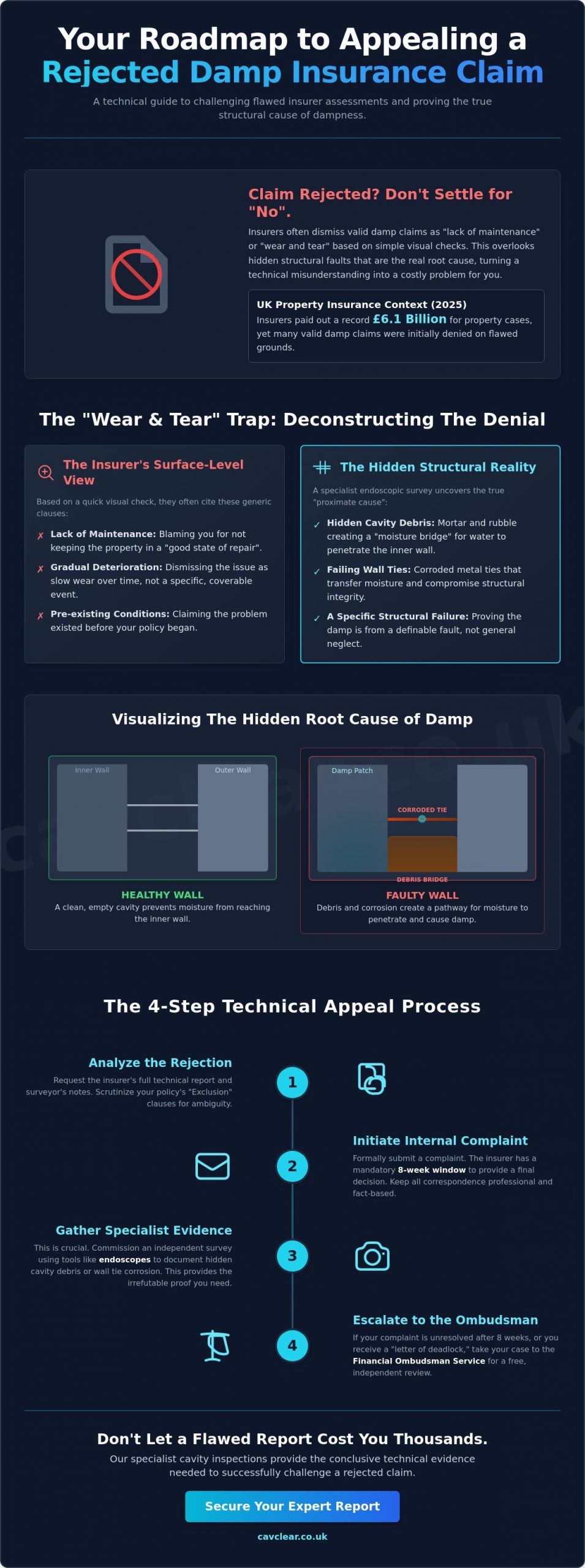
Receiving a rejection letter from your insurer is a setback, but it’s rarely the final word on the matter. Most homeowners feel a sense of defeat when they see terms like “gradual deterioration” or “lack of maintenance” cited as the reason for a denial. Understanding how to appeal a rejected damp insurance claim UK requires a technical breakdown of these specific exclusion clauses. In 2025, UK insurers paid out £6.1 billion for property cases, yet many valid disputes are initially turned down because the insurer’s surveyor only performed a surface-level visual check. You don’t have to accept a generic assessment when structural evidence suggests otherwise.
The “Wear and Tear” trap is a common hurdle. Insurers often default to this rejection when they can’t immediately identify a sudden event, like a burst pipe. However, structural dampness is frequently caused by a specific failure within the building’s envelope. Debris within a cavity wall creates a bridge for moisture, which leads to penetrating damp that insurers incorrectly label as rising damp. In insurance terms, we look for the “proximate cause.” This is the primary event that sets a chain of damage in motion. If a storm damaged your external masonry three months ago, leading to water ingress that now appears as internal mold, the storm is the proximate cause. The damage isn’t the result of your “failure to maintain” the wall; it’s the result of an external force.
Common Rejection Reasons for Dampness
The most frequent obstacle for UK homeowners is the “lack of maintenance” clause. Insurers expect you to keep your property in a good state of repair. They distinguish between “gradual damp,” which they view as a maintenance issue, and “sudden structural failure,” which is often covered. If your case was rejected due to “pre-existing conditions,” the insurer is suggesting you didn’t provide a fair presentation of risk when you took out the policy. We often find that what an insurer calls “gradual” is actually the result of a specific, hidden defect like failing wall ties. Learning how to appeal a rejected damp insurance claim UK involves proving that the issue was neither visible nor preventable through standard homeowner maintenance.
Reviewing Your Policy Documentation
Your first step is to locate your “Summary of Cover” and “Exclusions” sections. Look for ambiguous wording. If a policy doesn’t explicitly define “maintenance,” there’s room for interpretation in your favor. You should also check if the insurer provided a detailed surveyor’s report. If they didn’t, you’ve the right to request the full technical findings. Comparing their report against a specialist cavity survey often reveals gaps in their logic. Standard inspectors often miss issues hidden behind the brickwork, such as wall tie corrosion or insulation blockages, which are the real drivers of the damage.
Steps to Challenge a Decision Regarding Property Damage
Challenging an insurer’s decision requires a methodical approach that prioritizes technical evidence over emotional appeal. If your initial case is rejected, you must formalize your disagreement through the insurer’s internal complaints procedure. This isn’t just a formality; it’s a mandatory legal step before you can escalate the matter elsewhere. Understanding how to appeal a rejected damp insurance claim UK starts with demanding transparency. You should immediately request the full technical report from the insurer’s initial inspection. Most homeowners only see the final rejection letter, but the underlying report often reveals whether the inspector actually used borescope cameras or simply relied on a visual guess.
Initiating the Internal Complaint
Insurers are required to acknowledge your formal complaint within 5 business days. They then have a maximum of 8 weeks to provide a final decision. During this period, keep your correspondence professional and focused on structural facts rather than the stress of the situation. If the insurer fails to resolve the matter within this 8-week window, or if they issue a final rejection, you can request a “letter of deadlock.” This document confirms that the internal process is exhausted, allowing you to move your case to the Financial Ombudsman Service for an independent review.
While waiting for a response, you shouldn’t remain passive. Commissioning an independent specialist survey provides a vital counter-opinion that can highlight missing data in the insurer’s assessment. If you suspect hidden debris or wall tie failure, a specialist cavity wall survey provides the definitive data needed for your rebuttal. We often find that once an insurer is presented with high-resolution photographic evidence of a blocked cavity, they’re more likely to reconsider their “lack of maintenance” stance.
Organizing Your Evidence File
A successful dispute relies on a comprehensive rebuttal file. You should compile chronological photo evidence that shows the progression of the dampness, especially if it worsened after a specific weather event. Between 2021 and 2024, the average cost of a home insurance payout increased by 50%, leading insurers to be more rigorous with their inspections. To counter this, gather all records of previous maintenance, such as gutter cleaning or repointing, to prove the property was well-kept. This documentation is a vital component in how to appeal a rejected damp insurance claim UK effectively. For more details on the types of reports that carry weight during a dispute, refer to our Professional Damp Survey Guide. Ensure you maintain a strict log of all communication, including dates, names of representatives, and reference numbers, to build a clear timeline for the Ombudsman.
The Role of Specialist Surveys in Providing Technical Evidence
A visual inspection by an insurance loss adjuster often fails to identify the physical reality hidden within your walls. These standard assessments typically rely on surface observations, which frequently lead to the incorrect conclusion that dampness is caused by homeowner lifestyle or lack of ventilation. To understand how to appeal a rejected damp insurance claim UK, you must shift the focus from surface symptoms to structural causes. A specialist survey uses non-invasive technology to look where a standard inspector cannot. This technical data is vital when presenting a case to the Financial Ombudsman Service, as they require objective proof that the insurer’s decision was unfair or based on incomplete information.
Advanced Diagnostic Techniques
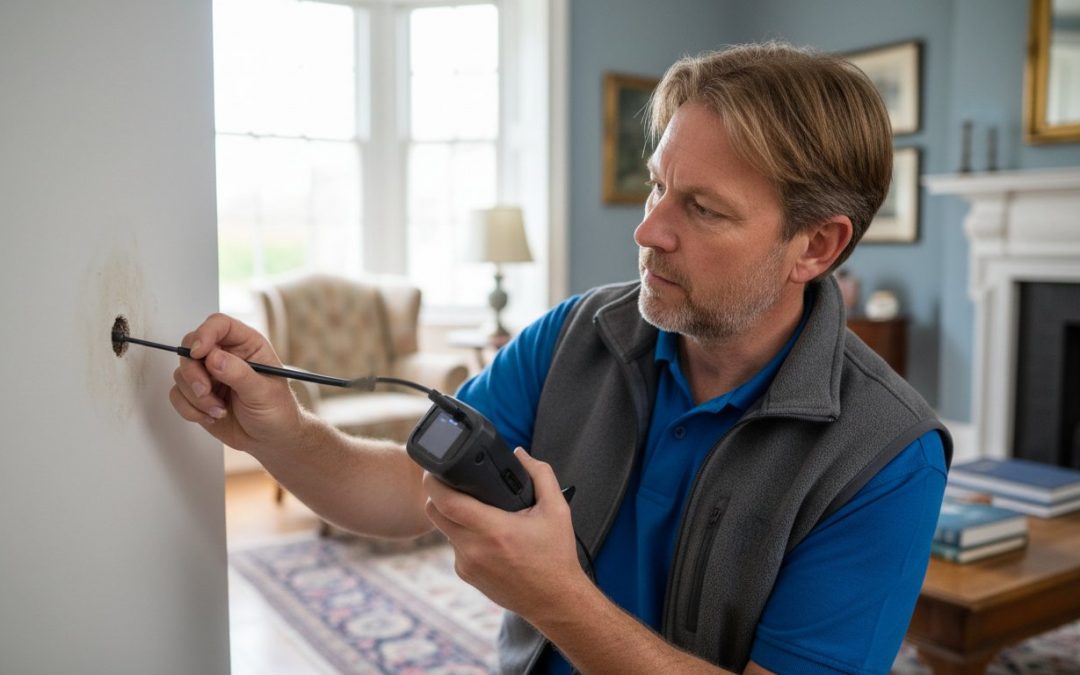
Specialists employ high-resolution endoscopes to perform internal cavity inspections. By inserting a small camera through a 12mm hole in the mortar joint, we can identify debris, mortar snots, or failing insulation that bridges the cavity and transfers moisture. This is the evidence insurers miss. While a handheld moisture meter only confirms that a wall is wet, electronic moisture profiling maps the exact path of water ingress. This distinguishes between rising damp and penetrating damp caused by structural faults. We also conduct structural integrity assessments of wall ties. Corrosion in these ties can cause the outer leaf to shift, creating cracks that allow water to bypass the cavity entirely. These findings turn a subjective argument into a factual dispute based on construction standards.
What a Specialist Report Should Include
Your appeal’s success depends on the quality of the reporting. A professional document must clearly identify the structural root cause, such as defective insulation or blocked cavities, rather than using vague terms. It should include high-definition imagery from the endoscopic survey and a detailed remedial action plan. This plan outlines the necessary cavity wall insulation extraction or wall tie replacement required to restore the property. When you’re learning how to appeal a rejected damp insurance claim UK, having a report from an accredited technician provides a level of authority that insurers find difficult to dismiss. For guidance on selecting a qualified professional, see our checklist on Choosing the Right Dampness Specialists. A comprehensive report doesn’t just point out the problem; it provides the technical roadmap for a permanent fix, ensuring your home’s long-term health and thermal efficiency.
Identifying Root Causes: From Cavity Debris to Structural Faults
Proving the physical origin of moisture is the most critical stage in learning how to appeal a rejected damp insurance claim UK. Insurers frequently misdiagnose internal mould as a “lifestyle issue,” suggesting that poor ventilation or drying clothes indoors created the problem. This assessment is often a surface-level assumption that ignores the building’s thermal envelope. In reality, internal dampness is frequently a symptom of a structural failure within the wall itself. When the external leaf of a property fails to prevent water ingress, or the cavity is compromised, the resulting cold spots and moisture transfer make mould growth inevitable regardless of how often you open your windows.
Defective or saturated cavity wall insulation is a primary culprit in these disputes. While insulation is intended to improve thermal efficiency, it can act as a physical bridge for moisture when it becomes wet. This “penetrating damp” occurs because the insulation allows water to travel from the wet outer leaf to the dry inner leaf. If your insurer has rejected your case based on “gradual deterioration,” you must demonstrate that the insulation’s failure is a specific structural fault that requires professional intervention to restore the property’s integrity.
Hidden Cavity Wall Issues
A functional cavity wall relies on a clear air space to prevent moisture transfer. However, construction debris often accumulates at the base of the wall, bridging the damp proof course (DPC). This allows ground moisture to bypass the protective barrier, leading to symptoms that look like rising damp but are actually caused by “cavity bridging.” When debris or failing insulation is present, cavity wall insulation extraction is often the only permanent solution to stop the moisture path. Without removing the saturated material, the wall will never fully dry out, leading to long-term structural decay and persistent health risks from spores.
Wall Tie Failure and Dampness
The stability of your home’s outer leaf depends on the integrity of its wall ties. These metal connectors can corrode over time, especially in coastal areas or where the cavity is filled with moisture-retaining material. Recognizing the signs of failure is essential for a successful appeal. Horizontal cracking indicates wall tie expansion as the metal oxidises and forces the mortar joints apart. These cracks create direct pathways for rainwater to enter the cavity. If your insurer has overlooked these structural signals, a detailed Wall Tie Replacement Guide can help you understand the necessary remedial steps. Proving that the dampness is a direct result of these failing components shifts the responsibility back to the structural cause rather than homeowner maintenance.
If you need to verify the condition of your property’s internal structure to support your appeal, we provide nationwide coverage for professional cavity wall surveys that identify these hidden faults with precision.
Escalating the Dispute to the Financial Ombudsman Service
When your insurer issues a final decision letter or fails to resolve your complaint within eight weeks, the next step is escalation. You have exactly six months from the date of the final response to refer your case to the Financial Ombudsman Service (FOS). This service is expert for consumers and provides an independent assessment of whether your insurer acted fairly. In April 2025, the FOS case fee for financial firms was set at £650, which often encourages insurers to settle valid disputes before they reach this stage. Understanding how to appeal a rejected damp insurance claim UK involves knowing that the Ombudsman prioritizes “fair and reasonable” outcomes over narrow policy interpretations.
The FOS frequently overrules insurers who incorrectly apply “wear and tear” exclusions to damage caused by hidden structural faults. If your specialist survey identifies debris bridging the cavity or wall tie corrosion, this technical data becomes the foundation of your case. The Ombudsman expects insurers to have conducted a thorough investigation. If the insurer’s surveyor only performed a visual check and missed the structural root cause, the FOS is likely to view their decision as unreasonable. Learning how to appeal a rejected damp insurance claim UK effectively means being prepared to present high-resolution endoscopic evidence that proves the physical state of the building.
Preparing Your FOS Submission
Your submission should clearly summarize the technical failure of the insurer’s initial investigation. You must highlight where the insurer failed to follow construction standards or ignored physical evidence of moisture paths. Your independent specialist report serves as the primary evidence in this phase. It demonstrates that the dampness is a structural symptom, not a maintenance failure. By presenting facts about cavity blockages or insulation saturation, you move the conversation away from subjective lifestyle arguments. This methodical approach ensures that the adjudicator understands the technical necessity of remedial actions like cavity wall insulation extraction.
What to Expect from the Ombudsman Process
Property disputes often follow a two-stage resolution process. Initially, an adjudicator reviews the facts and provides an informal view on the matter. If you or the insurer disagrees with this assessment, you can request a final decision from an Ombudsman. This final ruling is legally binding on the insurer if you choose to accept it. Most cases are resolved within several months, though complex structural disputes may take longer. Following the Ombudsman’s recommendations ensures the long-term health of your home. By securing a professional remedy, you restore the property’s thermal efficiency and protect its structural integrity. Our commitment to the “right way” of performing extractions ensures that your home receives a permanent fix, backed by a specialist guarantee.
Restoring Your Home’s Structural Integrity
A rejection letter doesn’t mean your property is beyond repair or that the dampness is your fault. By identifying the technical root cause, such as debris in the cavity or wall tie expansion, you can move past the “wear and tear” label. We’ve provided the essential steps on how to appeal a rejected damp insurance claim UK, emphasizing that physical evidence is your strongest tool. Standard visual checks often miss the saturated insulation or structural faults that professional diagnostic tools reveal. In 2025, insurers paid out £6.1 billion for property cases; this proves that successful outcomes are possible when you present the right data.
Our accredited technicians provide nationwide UK coverage, delivering the detailed technical reports required to challenge an insurer’s assessment. We specialize in cavity wall and structural damp diagnostics, ensuring you have the evidence needed for a successful escalation to the Financial Ombudsman Service. Taking proactive steps today prevents further structural decay and restores your home’s thermal efficiency. You deserve a property that’s dry, safe, and structurally sound for the long term.
Book a Specialist Technical Survey to Support Your Appeal
Frequently Asked Questions
What is the most common reason damp insurance cases are rejected in the UK?
The most common reason for rejection is the “wear and tear” or “lack of maintenance” clause. Insurers often use this as a default position when they can’t identify a single, sudden event that caused the damage. They argue that the dampness is a result of gradual deterioration over time, which is typically excluded from standard policies. Proving a structural root cause is the only way to overturn this assessment.
Can I challenge an insurer who says my damp is caused by condensation?
You can challenge a condensation diagnosis by providing technical evidence of a structural fault. Insurers often misinterpret the presence of internal mould as a lifestyle issue caused by the homeowner. Using borescope inspections to identify debris in the cavity or saturated insulation proves that the moisture is penetrating from the outside. This constitutes a structural failure rather than a lack of ventilation.
How much does a specialist damp survey cost for an insurance appeal?
Costs for specialist surveys vary based on property size and the diagnostic tools required for a thorough investigation. While we don’t provide fixed pricing here, these inspections are a necessary investment to determine how to appeal a rejected damp insurance claim UK effectively. As a nationwide company, we provide these technical reports to homeowners across the country to counter an insurer’s visual assessment with hard data.
What happens if the Financial Ombudsman Service agrees with the insurer?
If the Financial Ombudsman Service (FOS) agrees with the insurer, their decision is final regarding the ombudsman process. You still have the right to take the matter to court, though this involves significant legal costs and risk. Most homeowners use the FOS findings to understand technical gaps in their case and then proceed with necessary remedial work like cavity extraction to protect their property’s future health.
Is there a time limit for appealing a rejected property insurance decision?
There are two critical time limits to remember when disputing a decision. You have six months from the date of the insurer’s final decision letter to refer your case to the Financial Ombudsman Service. Internally, insurers have eight weeks to provide a final response to your formal complaint. Missing these deadlines can significantly weaken your ability to dispute the decision or have it reviewed by an independent body.
Do I need a solicitor to appeal a rejected damp case?
You don’t need a solicitor to appeal a rejected damp case through the insurer’s internal process or the Financial Ombudsman Service. The FOS is a expert, independent service designed to be accessible to homeowners without legal representation. Focus your resources on obtaining a specialist technical report instead. The Ombudsman prioritizes structural facts and building standards over complex legal arguments in property damage disputes.
How can thermal imaging help my insurance dispute?
Thermal imaging identifies “cold spots” on internal walls that are invisible to the naked eye. These cold spots often correlate with areas where cavity insulation is wet or missing, creating a thermal bridge. By mapping these temperature variations, you can prove the exact path of moisture ingress. This evidence is vital for how to appeal a rejected damp insurance claim UK because it demonstrates a physical defect in the building’s envelope.
What should I do if my insurer ignores my formal complaint?
If your insurer ignores your formal complaint for eight weeks, you can escalate the matter directly to the Financial Ombudsman Service without their final response. This is known as the “eight-week rule” under Financial Conduct Authority regulations. You don’t need their permission to move forward if they fail to meet this deadline. Keep a log of all sent correspondence as proof that you attempted to resolve the matter internally.
Recent Comments