
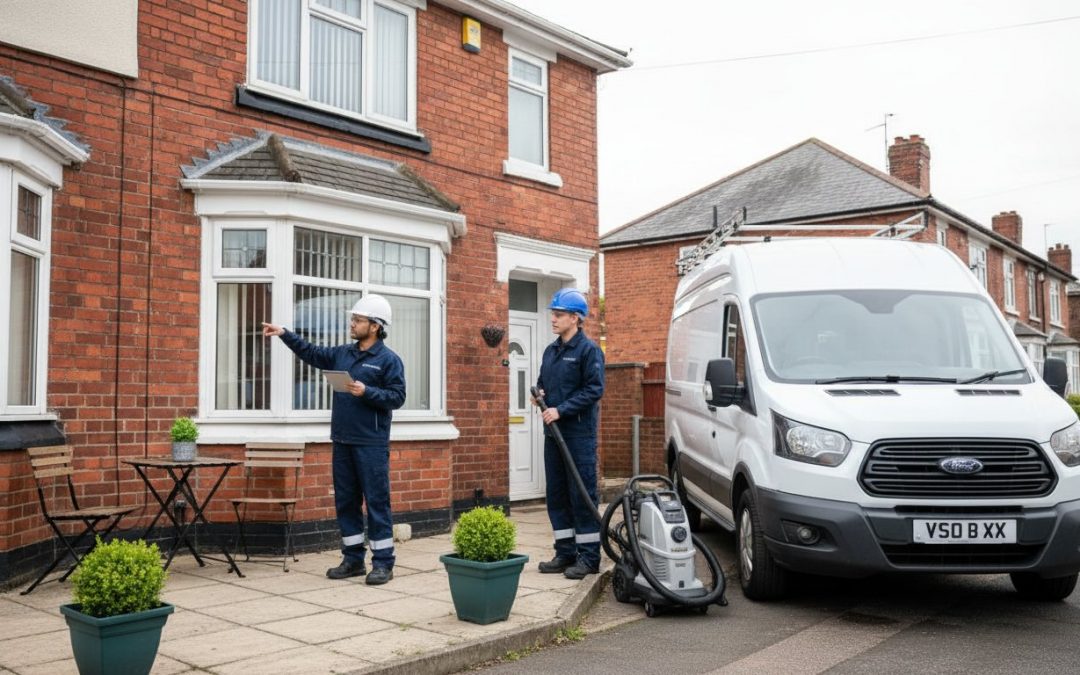
What if the most critical step in restoring your home’s structural health didn’t involve any internal mess or disruption to your daily life? Most homeowners feel a deep sense of anxiety when they discover their cavity wall insulation is failing, fearing that the extraction process will involve clouds of dust and potential damage to their masonry. It’s a valid concern, as the integrity of your property depends on a precise, professional approach. This guide focuses on the essential steps for preparing a house for insulation removal to ensure the process remains safe, efficient, and entirely non-invasive.
We understand that you want to protect your investment and restore your home’s comfort. You’ll discover exactly how to get your property ready for our specialists, ensuring a smooth transition to a dry and healthy environment. This article provides a comprehensive preparation checklist that builds your confidence in the extraction process. We’ll walk you through the necessary external clearances and the technical safety measures we implement across the United Kingdom. Following these professional standards, updated as of May 2026, ensures your project avoids common pitfalls and guarantees a permanent fix for your property.
Key Takeaways
- Clear the perimeter of your property by moving garden furniture, potted plants, and vehicles to ensure specialists have unobstructed access to all external elevations.
- Protect your living space by identifying internal air vents and covering sensitive electronics located against external-facing walls before the extraction team arrives.
- Understand how preparing a house for insulation removal involves setting up industrial vacuum units and compressed air systems to extract debris without creating internal mess.
- Learn why a structured “drying out” period and a follow-up professional damp survey are essential for restoring your home’s structural integrity and long-term thermal efficiency.
Why Preparing Your Property for Insulation Extraction is Essential
Insulation removal is the systematic extraction of defective, saturated, or degraded materials from within a building’s external walls. When we discuss preparing a house for insulation removal, we are focusing on a vital phase that ensures the safety of our technicians and the efficiency of the extraction. Many properties across the United Kingdom suffer from failed cavity fill that has become a liability rather than an asset. This material often acts as a reservoir for moisture, leading to persistent penetrating damp and toxic mould growth. Our primary objective is to restore your property to its original, breathable state, allowing the structure to function as it was designed. Proper site preparation prevents unnecessary delays, allowing us to focus on the technical precision required for a clean extraction.
The Consequences of Neglecting Cavity Health
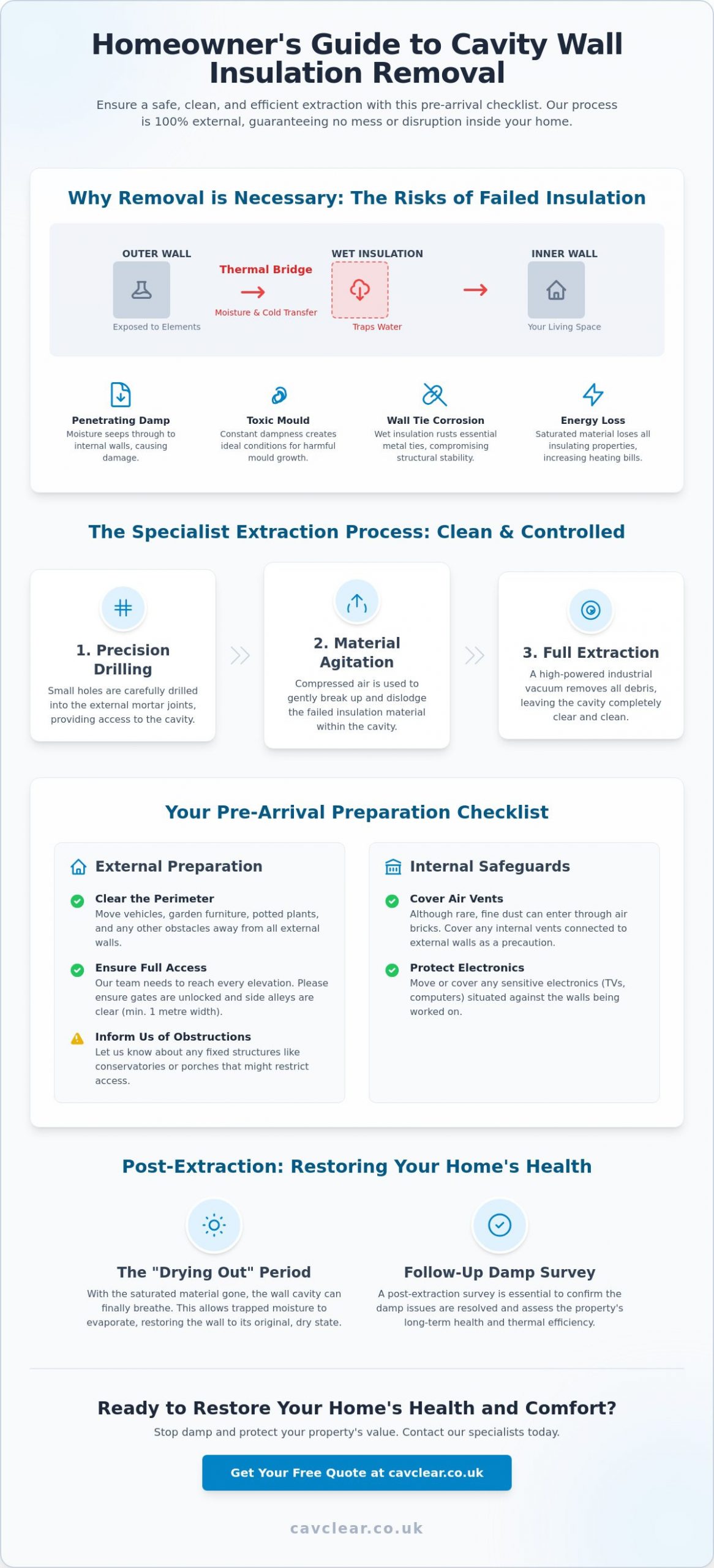
Saturated insulation creates a permanent thermal bridge. This bridge draws cold and moisture directly from the outer leaf to the inner leaf of your home. If wet insulation remains in contact with metal wall ties, it significantly increases the risk of wall tie corrosion, which can compromise the structural stability of the masonry. Understanding what is a cavity wall is the first step in recognizing why this space must remain clear. A blocked cavity traps water, prevents airflow, and eventually causes internal damage that is far more expensive to repair than the cost of a timely extraction. We see properties every day where neglected cavities have led to significant internal plaster damage and compromised air quality.
Setting Realistic Expectations for the Process
Homeowners often fear that removing insulation involves heavy demolition or extreme mess. In reality, professional extraction is a controlled, technical procedure that utilizes specialized industrial equipment. While the process is less intensive than asbestos abatement procedures, it requires a similar level of specialist rigor to ensure no debris remains. We use high-powered vacuum units and compressed air to agitate and remove every trace of the failed material through small, strategically drilled holes in the mortar joints.
- Timeline: Most standard residential projects are completed within 1 to 2 days, depending on the property size.
- Non-Invasive: All work is performed from the exterior, meaning your internal living space remains undisturbed.
- Specialist Gear: We employ industrial-grade extraction machinery designed specifically for the UK’s unique housing stock.
When you are preparing a house for insulation removal, you are setting the stage for a seamless restoration. By clearing the work area and understanding the technical nature of the task, you help us ensure your home returns to a dry, healthy condition as quickly as possible. This proactive approach is the most effective way to protect your property’s long-term value and structural integrity.
External Site Preparation: Access and Structural Safety
Successful extraction starts with unobstructed access to the property’s facade. When preparing a house for insulation removal, homeowners must recognize that our teams operate heavy, industrial-grade equipment requiring a clear radius around the building. This isn’t just about convenience; it’s a safety requirement that ensures high-pressure hoses and extraction units function without hindrance. We conduct a thorough assessment of your masonry before any work begins. It’s essential that the external brickwork is stable enough to accommodate our precision drilling patterns. While the ultimate goal is a home that is properly insulated from the roof down, the removal of failing cavity fill is the immediate priority to halt moisture ingress and structural decay.
As a nationwide specialist serving the entire United Kingdom, we encounter various property layouts, from detached homes to tight terraced streets. Technicians need to reach every external elevation where insulation exists. If your home has restrictive access points, such as narrow side alleyways less than one metre wide or overhanging conservatories, please inform us during the initial consultation. Identifying these challenges early prevents delays on the day of extraction. If you’re unsure about specific access requirements, a professional site assessment can clarify these details before the team arrives.
Clearing the Perimeter for Extraction Equipment
Our technicians utilize large-scale industrial vacuum units that typically remain stationed on a vehicle or at a central point on your driveway. From here, heavy-duty hoses extend to the work area. You should move any vehicles, trailers, or caravans to provide at least three metres of clearance for the machinery. Additionally, please clear the base of the walls by moving:
- Garden Furniture: Tables, chairs, and benches should be moved to a safe distance.
- Potted Plants: Delicate ornaments or heavy planters can block the drilling path.
- Waste Bins: Relocate wheelie bins to ensure technicians can move expertly with hoses.
We also require access to an external power point in most cases. If your property lacks an outdoor socket, we may need to run a protected lead to an internal source, which we will discuss upon arrival.
Scaffolding and High-Level Access Requirements
For multi-storey properties, standard ladders are often insufficient for a safe and thorough extraction. We determine if high-level access, such as mobile towers or fixed scaffolding, is necessary during the pre-work survey. Our specialists usually coordinate the logistics of this equipment to ensure it meets safety standards for working at height. The drilling process itself is remarkably non-invasive. We make small, 22mm to 25mm holes directly into the mortar joints rather than the bricks. This technique preserves the aesthetic and structural integrity of your masonry while providing the necessary entry points for our agitation tools and vacuum nozzles.
Internal Safeguards to Protect Your Living Space
While the actual extraction of material occurs from the exterior of your property, the internal living environment requires specific safeguards. When preparing a house for insulation removal, homeowners often worry about dust or debris migrating into their rooms. Our specialists use a non-invasive approach that focuses on maintaining the pressure balance of the building. We require all windows and doors to remain securely closed during the high-pressure extraction phase. This simple step ensures that the vacuum created by our industrial machinery remains concentrated within the wall cavity, preventing the escape of fine particles into your home. Technicians also utilize internal pressure monitoring to verify that the extraction process is contained and controlled at all times.
Move any sensitive electronics, such as televisions or computer equipment, away from external-facing walls. While we don’t drill through the internal leaf, the vibrations from the extraction tools can occasionally dislodge minor dust from existing hairline cracks in older plaster. Covering furniture with lightweight dust sheets provides an extra layer of security and peace of mind during the project. Our nationwide team has refined these protocols across thousands of UK properties to ensure your internal space remains pristine.
Managing Internal Air Vents and Flues
One of the most critical aspects of preparing a house for insulation removal is the management of ventilation points. You must locate all sub-floor and room-level vents that penetrate the cavity. These vents are direct pathways between the work zone and your living space. Our specialists temporarily seal these openings to prevent insulation beads or dust from entering. We perform a rigorous safety check on all gas flues. It is vital that these remain unobstructed throughout the process to ensure the safe operation of heating systems. We never compromise on these safety standards, as property integrity and resident health are our primary concerns.
Protecting Floor Coverings and Entry Points
Our technicians primarily work from the outside, but they may need to enter the property to inspect internal vents or perform borescope checks on the cavity’s internal leaf. We recommend using temporary floor protection, such as adhesive plastic or heavy-duty runners, in hallways and rooms adjacent to external walls. This proactive measure prevents any accidental transfer of debris from technician footwear. Our teams strive for a completely clean finish, ensuring that your daily routine remains as undisturbed as possible while we restore your home’s structural health.
The Specialist Removal Process: What to Expect On-Site
Once the external site is staged and internal safeguards are active, the technical extraction phase begins. By effectively preparing a house for insulation removal, you allow our technicians to deploy industrial-grade equipment immediately upon arrival. This phase is a methodical engineering process designed to evacuate every trace of failed material from your property’s structure. We utilize high-powered, vehicle-mounted vacuum units that create a continuous negative pressure environment within the cavity. This vacuum-sealed approach is the only way to ensure 100% of the debris is captured and contained, preventing environmental contamination around your home. This level of precision is essential for a successful cavity wall insulation removal project.
Industrial Extraction vs. Manual Methods
Standard household or commercial vacuums are entirely insufficient for the cubic volume of material found in a typical UK property. A standard semi-detached home often contains over 50 large bags of saturated fibre or bonded beads. Our industrial extraction units are designed to handle these high volumes without losing suction or allowing dust to escape. While some general contractors might suggest manual removal or basic tools, these methods often leave significant pockets of wet material behind. We use specialized directional nozzles and compressed air to agitate the insulation. This agitation breaks down bonded materials and dislodges stubborn fibres, ensuring they flow expertly into the extraction hose. Whether your home contains loose-fill mineral wool, urea-formaldehyde foam, or expanded polystyrene beads, our specialist machinery adapts to the specific density of the material.
Verification and Quality Control
The extraction process isn’t complete until we verify the cavity is entirely empty. We use high-definition boroscope cameras to inspect the internal void, paying particular attention to “dead spots” that are notoriously difficult to clear. These areas include the masonry under window sills, around door frames, and at the corners of the property. We also ensure the base of the cavity, specifically at the damp proof course (DPC) level, is cleared of all rubble and accumulated debris. If these areas remain blocked, moisture will continue to bridge across to your internal walls.
- Visual Proof: Technicians provide boroscope footage to confirm the cavity is clear from top to bottom.
- Debris Disposal: All extracted material is bagged and removed from the site in accordance with waste management standards.
- Restoration: We finish the project by sealing the 22mm injection holes with mortar that is professionally colour-matched to your existing masonry.
This technical rigor ensures your home’s breathability is fully restored, halting the cycle of damp and structural decay. If you’re ready to secure your property’s future, book a specialist extraction survey with our nationwide team today.
Post-Removal Care: Restoring Your Home’s Breathability
Successful extraction marks the beginning of your property’s recovery. While preparing a house for insulation removal ensures a smooth technical process, the post-extraction phase is where structural health is truly restored. The primary goal is breathability. Saturated masonry doesn’t dry overnight. It can take several months for the structure to reach a stable, dry state. This timeline depends on the thickness of your walls and prevailing weather conditions. You must allow the building to shed its moisture naturally. While the initial focus is often on preparing a house for insulation removal, understanding the subsequent drying process is equally vital for long-term property health.
Masonry needs time. We recommend increasing internal ventilation to help moisture escape from the inner leaf of the masonry. This proactive step prevents stagnant air from trapping dampness inside your living space. Our nationwide team has observed that properties following a structured drying plan see a much faster return to optimal thermal efficiency. It’s a vital investment in your home’s future.
Monitoring Moisture Levels and Drying Times
Several factors influence how quickly your home returns to its original state. Properties with south-facing walls often dry faster due to solar gain. Shaded or sheltered elevations may require more time. You should monitor your internal walls closely during the first winter after removal. Look for a gradual reduction in salt staining or damp patches. To ensure the process is moving in the right direction, we advise scheduling a professional damp survey approximately six months post-extraction. This allows us to use calibrated moisture meters to verify that the structural drying is complete. We check for any hidden “debris bridges” that could cause recurring issues.
Structural Integrity and Remedial Repairs
Removing wet insulation often reveals the true extent of structural damage caused by years of moisture retention. This is a common discovery. One of the most significant issues we identify is the degradation of the metal ties that hold your property’s inner and outer leaves together. When these ties are subjected to prolonged contact with wet mineral wool or foam, they begin to rust and expand. This expansion can cause horizontal cracking in your mortar joints. In such cases, wall tie replacement is necessary to ensure the building remains structurally sound. We handle these repairs with the same specialist rigor as our extractions.
A clear, dry cavity is the only way to guarantee a healthy living environment. Our nationwide team provides a comprehensive guarantee on all extractions. This gives you the peace of mind that your property has been restored the right way. Following these professional standards ensures your home remains dry, warm, and structurally secure for decades to come.
Secure Your Property’s Structural Health
Restoring the breathability of your home’s structure is a vital investment in its long-term integrity. By following the essential steps for preparing a house for insulation removal, you ensure a non-invasive and efficient extraction that halts the cycle of damp and decay. Our process relies on precision industrial equipment and technical verification through boroscope inspections to guarantee a 100% clear cavity. This methodical approach protects your masonry and internal living space from the risks associated with wet, failing insulation.
As a nationwide specialist with service coverage across the entire United Kingdom, we provide the expertise needed to rectify poor workmanship and restore comfort. Our accredited specialist technicians conduct comprehensive technical property inspections to identify any underlying issues, such as wall tie corrosion or debris bridges. Taking these proactive steps today prevents costly structural repairs in the future. Book your specialist cavity wall survey with CavClear today to begin the journey toward a dry, healthy home. We’re here to provide a permanent, guaranteed fix for your property.
Frequently Asked Questions
Do I need to leave the house during insulation removal?
You don’t need to vacate your property while the extraction is underway. Since our specialists perform all work from the exterior, your internal living space remains largely unaffected and fully habitable. We only ask that you keep windows and doors closed to help maintain the necessary pressure balance within the wall cavity. This non-invasive approach ensures your daily routine continues without significant disruption while we restore your home’s structural health.
Will removing cavity wall insulation make my house colder?
Removing saturated or defective insulation actually improves your home’s comfort by allowing the structure to dry. Wet material acts as a thermal bridge, drawing heat away from your internal walls rather than retaining it. Once the cavity is clear and the masonry has dried, the natural air space provides a much more effective barrier against moisture. This prevents the damp-induced chill that often plagues properties with failed or slumped insulation.
Is the extraction process very noisy for neighbours?
The extraction process involves industrial vacuum units and compressors that generate a level of noise comparable to a large diesel engine. We strictly adhere to standard working hours, typically between 8:00 AM and 5:00 PM, to minimize any disturbance to your neighborhood. Because the machinery is vehicle-mounted and stays outside, the sound is consistent but controlled. We recommend informing your neighbors in advance as part of preparing a house for insulation removal.
What happens to the old insulation material after it is removed?
Every kilogram of extracted material is vacuum-sealed into industrial waste bags and removed from your property for professional disposal. We handle all logistics of waste management in accordance with UK environmental standards. This ensures that no debris, dust, or saturated fibres are left behind on your driveway or in your garden. Our goal is to leave the exterior of your property as clean as it was before our technicians arrived.
Can I remove cavity wall insulation myself to save money?
DIY extraction is not possible because it requires industrial-grade vacuum units and compressed air systems that aren’t available for domestic hire. Attempting to remove material manually often leads to “debris bridges” and blocked sub-floor vents, which significantly worsen damp issues. Professional extraction includes boroscope verification to ensure the cavity is 100% clear. This specialist intervention is the only way to guarantee a permanent fix and restore your home’s breathability.
How do I know if my insulation actually needs removing?
Persistent damp patches, mould growth on internal walls, or an unexplained increase in heating costs are primary indicators of failed insulation. If you notice “cold spots” on your masonry, it often suggests the material has slumped or become waterlogged. We use high-definition boroscope cameras during our technical inspections to provide visual proof of the insulation’s condition. This diagnostic approach confirms whether an extraction is the necessary solution for your property’s long-term health.
Will the drilling damage my external render or brickwork?
Our technicians use precision 22mm to 25mm drill bits designed to minimize the impact on your property’s facade. We drill into the mortar joints whenever possible to preserve the integrity of the bricks. If your home has a rendered finish, we employ specialized techniques to prevent surface cracking. After the extraction, every hole is filled with a professionally colour-matched mortar to ensure the repair is virtually invisible and the masonry remains watertight.
How much space do the technicians need for their equipment?
Technicians require enough space to park a large transit-style van on your driveway or directly outside the property. When preparing a house for insulation removal, you should ensure there is at least a three-metre radius of clear space around the vehicle for hose deployment. Additionally, all external walls must be accessible, which means moving garden furniture and potted plants. This allows our team to move expertly and operate the high-pressure extraction system safely.
Recent Comments