
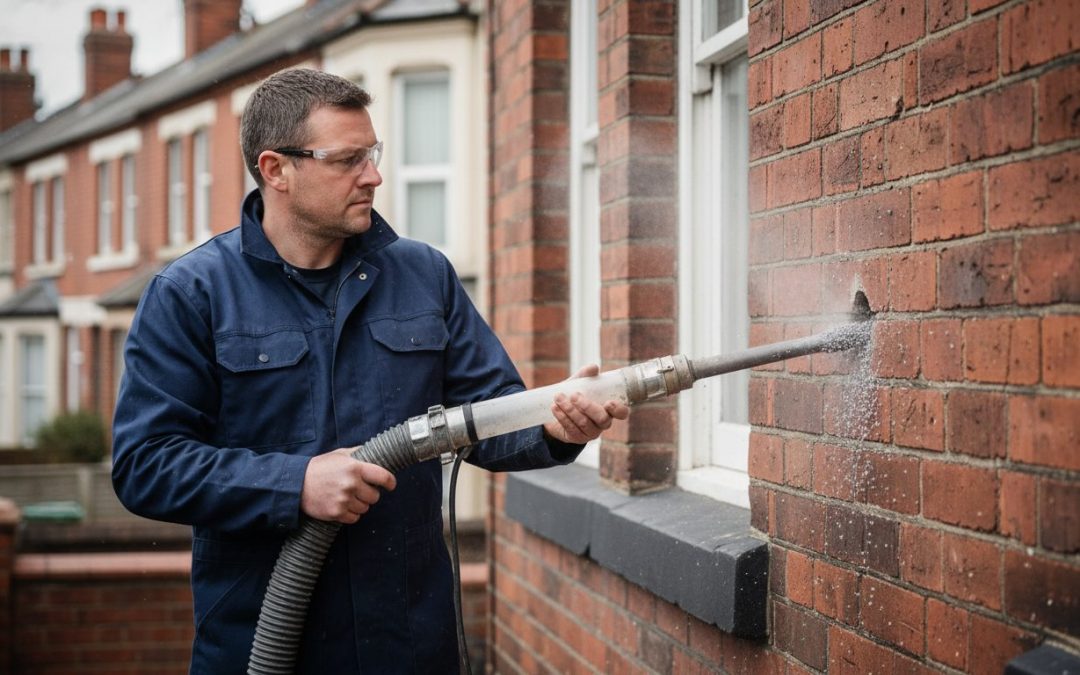
Your home’s cavity wall was designed to breathe, but saturated bonded beads are effectively suffocating your property’s structural integrity from the inside out. You likely believe that your home should be a safe, dry sanctuary, yet persistent damp and rising energy costs suggest otherwise. It’s stressful to realize that the material meant to insulate your walls is now holding moisture against your masonry and threatening your wall ties. We believe every homeowner deserves a clear path to restoring their property’s health without the fear of hidden structural decay.
This 2026 guide details the professional cost to extract bonded bead insulation and the technical variables that influence pricing for a specialist removal. You’ll learn how our nationwide teams achieve a 100% complete extraction to eliminate mold and protect your home’s long term value. We’ll examine the equipment required, the importance of debris removal, and how this investment ensures a dry, healthy living environment for years to come.
Key Takeaways
- Identify the technical reasons behind bonding agent failure and how these breakdowns compromise your home’s thermal efficiency.
- Evaluate the specific variables, including property scale and accessibility challenges, that influence the overall cost to extract bonded bead insulation.
- Understand the rigorous extraction methodology required to ensure total debris removal from difficult areas like corners and window reveals.
- Learn how a specialist extraction protects structural health by arresting wall tie corrosion and facilitating a necessary drying-out period.
- Discover the long-term benefits of restoring your property’s cavity, providing peace of mind and securing the building’s future value.
Understanding Bonded Bead Insulation and Why Extraction Becomes Necessary
Bonded bead insulation consists of small expanded polystyrene (EPS) spheres injected into a wall cavity alongside a liquid adhesive. This bonding agent is designed to glue the beads together, creating a solid but breathable mass. While it remains one of the more common building insulation materials, its performance relies entirely on the integrity of the adhesive. When this glue fails, the insulation loses its structural stability and begins to compromise the property’s health.
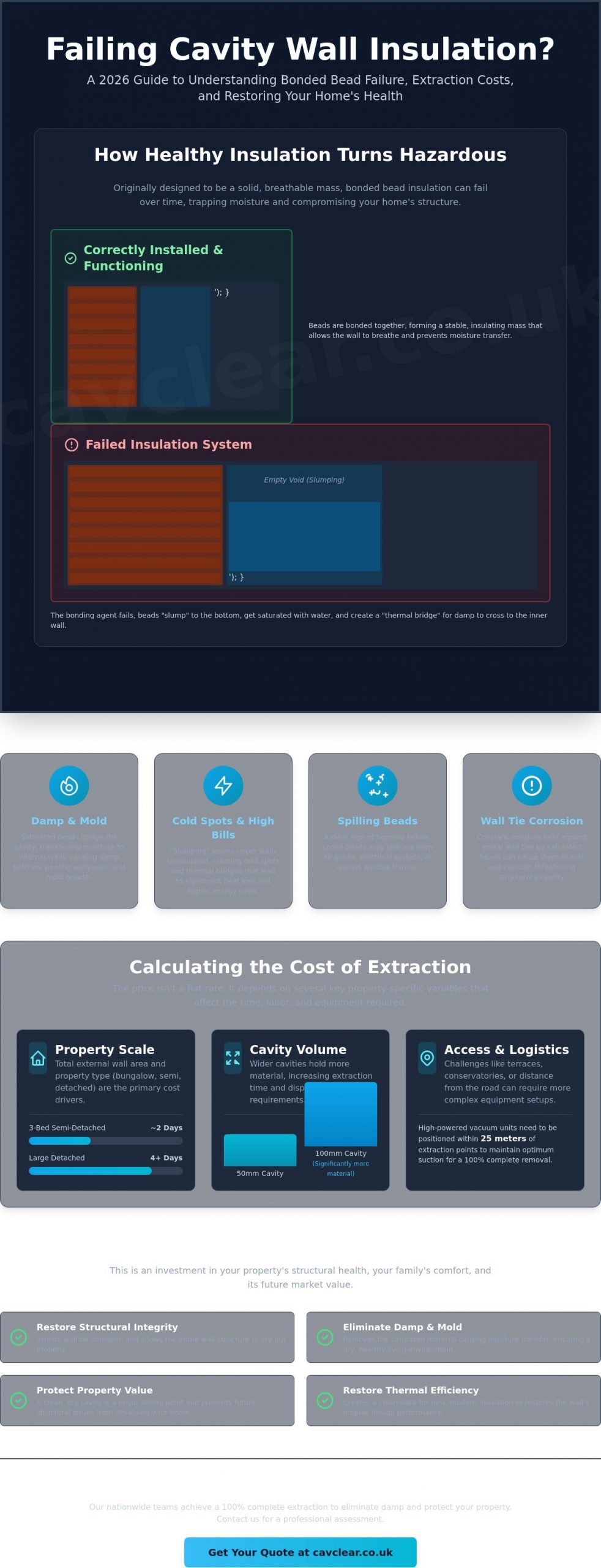
Understanding the cost to extract bonded bead insulation starts with recognizing why these systems fail after years of exposure to the UK climate. The primary causes of failure involve the breakdown of the bonding agent or insufficient glue coverage during the initial installation. When the adhesive fails, gravity pulls the loose beads toward the base of the wall. This process, known as slumping, leaves the upper sections of the property entirely uninsulated. These voids create cold spots where internal moisture condenses, often leading to localized mold growth at the top of walls and around window reveals.
As a nationwide specialist, CavClear identifies these failures in properties across the United Kingdom, where coastal winds and high rainfall accelerate the breakdown of original installations. The relationship between saturated beads and penetrating damp is a significant concern for homeowners. When the material is no longer a bonded mass, it can trap water against the inner leaf of the building, leading to expensive internal damage.
The Failure of Bonding Agents in Cavity Walls
Moisture ingress is the primary catalyst for adhesive degradation. In many UK properties, driving rain penetrates the outer leaf of brickwork and attacks the bonding agent over time. If the original installer used an insufficient glue-to-bead ratio, the material becomes brittle and eventually disintegrates. You’ll often see the “loose bead” symptom, where insulation spills out of air bricks, electrical sockets, or gaps around pipework. This indicates the system has transitioned from a stable mass to a loose fill material that no longer provides a reliable thermal barrier. Professional extraction is the only way to clear these debris-filled cavities and restore the wall’s breathing space.
Identifying Damp and Thermal Bridging Issues
Failing beads do more than just lose heat; they often facilitate moisture transfer. Saturated beads can act as a bridge, allowing water to travel from the wet external brickwork directly to the dry internal plasterboard. Homeowners frequently report “ghosting” on internal wallpaper, which appears as dark, damp patterns tracing the shape of the mortar joints. Thermal bridging is the path of least resistance for heat loss through saturated material. This compromise to the building fabric makes the cost to extract bonded bead insulation a necessary investment to protect the long-term structural integrity of the home and ensure a dry, healthy living environment.
Factors Influencing the Cost to Extract Bonded Bead Insulation
Every property presents a unique set of structural challenges that dictate the final quote for remedial work. The cost to extract bonded bead insulation isn’t a flat rate; it’s a calculation based on the time, equipment, and technical expertise required to return your wall cavities to a clean, breathable state. Specialists evaluate several critical variables during a site survey to ensure the extraction is performed safely and effectively.
Property Scale and Cavity Volume
The total surface area of your external walls serves as the primary baseline for pricing. A standard three-bedroom semi-detached house typically requires 2 days of onsite labor, whereas a large detached property with expansive elevations may take 4 days or more. Beyond the external dimensions, the width of the cavity itself plays a major role. Homes built with 100mm cavities contain significantly more material than older properties with 50mm gaps. This increased volume extends the vacuuming time and requires more frequent disposal cycles. Bungalows often present a unique scenario where the cost per square meter is higher because the footprint-to-wall ratio requires the extraction team to reposition heavy machinery more frequently to reach every corner of the property.
Access Requirements and Site Logistics
Physical access to the perimeter of your home determines the type of equipment a specialist team must deploy. High-powered vacuum units require a stable position within 25 meters of the extraction points to maintain optimum suction levels. If your property has restricted access, such as narrow alleyways or a large conservatory blocking a rear elevation, technicians must use specialized slimline hoses or extended reach systems. Height is another significant factor. While most extractions are managed from ground level using ladders, any work exceeding 5 meters that cannot be safely reached may require scaffolding. According to industry data from MyJobQuote, the cost of removing cavity wall insulation increases when these logistical hurdles necessitate additional safety structures or specialized machinery.
Bead Condition and Internal Obstructions
The physical state of the insulation inside your walls directly impacts the speed of the project. Ideally, bonded beads should remain somewhat pliable, but moisture ingress or the use of low-quality adhesives can cause the beads to solidify into hard clumps. These “logs” of insulation don’t flow expertly and require mechanical agitation to break them down before they can be vacuumed out. Construction debris, often referred to as mortar “snots,” also complicates the process. These hardened mortar drops bridge the cavity and trap beads, creating pockets of damp insulation that are difficult to reach. Specialists use borescope cameras to locate these blockages, ensuring no material is left behind to cause future damp issues. If you suspect your insulation has failed, booking a professional cavity wall inspection is the most reliable way to identify these hidden obstructions before work begins.
By addressing these factors during the initial assessment, a specialist ensures that the cost to extract bonded bead insulation reflects the actual requirements of your home. This transparent approach prevents unexpected mid-project price hikes and guarantees that your property’s structural health is the priority.
Analysing the Investment: Bead Extraction vs. Other Insulation Types
Extracting bonded bead insulation is a significantly more technical process than removing loose-fill materials like mineral wool. Bonded beads are installed with a PVA-based adhesive designed to hold the Expanded Polystyrene (EPS) spheres in a stable matrix. Over time, this adhesive can fail or, more commonly, the beads can become saturated with water due to driving rain or structural defects. When assessing the cost to extract bonded bead insulation, homeowners must consider that this material requires higher-grade machinery to overcome the structural integrity of the bonded clumps.
Achieving 100% clearance is a precise engineering task. EPS beads are lightweight and prone to static, meaning they often cling to wall ties or become trapped in tight corners and under window lintels. If even a small percentage of these beads remain, they can form a bridge for moisture to travel from the outer brickwork to your internal walls. We use high-resolution borescope inspections throughout the process to verify that every square inch of the cavity is clear. This visual confirmation is the only way to ensure the property’s thermal envelope is restored to its original, healthy state.
Specialist Suction Equipment and Technical Expertise
Standard industrial vacuums are insufficient for this task. They lack the torque required to pull heavy, wet beads from the base of a cavity. Our teams utilize high-volume suction rigs paired with specialized compressed air tools. These tools safely agitate and break down the bonded clumps without damaging the delicate wall ties that hold your home together. It’s a delicate balance that requires significant technical training. A technician must understand how to maneuver extraction hoses around internal obstructions to prevent leaving “dead zones” of material behind. This level of expertise directly affects the final cost to extract bonded bead insulation, as it guarantees a level of thoroughness that basic contractors cannot match.
The Hidden Costs of Incomplete Extraction
A “cheap” quote often indicates a contractor who lacks the necessary extraction rigs or the patience to perform a full clearance. Many low-cost operators use a “drill and fill” approach, which is entirely unsuitable for extraction. They might remove the easy-to-reach material but leave significant debris in hard-to-access areas. This is a false economy. Remaining beads continue to trap moisture, leading to persistent damp and mold growth that will eventually require a second, more expensive intervention. It’s vital to remember that cavity wall insulation removal is a one-time investment if executed correctly by specialists. Choosing a specialist service ensures the structural integrity of your home is protected for the long term, preventing the recurring repair bills associated with poor workmanship.
The Professional Extraction Process: What Your Quote Covers
When you evaluate the cost to extract bonded bead insulation, you aren’t just paying for a vacuum service. You’re investing in a multi-stage structural recovery process designed to restore your home’s thermal integrity. A professional extraction is a methodical operation that requires specialized equipment and technical expertise to ensure the cavity is 100% clear of debris and failed adhesive.
Borescope Inspections and Pre-Extraction Mapping
The process starts with a technical survey using high-definition borescope cameras. Our specialists use these tools to look inside the cavity, identifying “voids” where beads have settled and “wet zones” where saturated insulation is causing internal damp. During this survey, it’s vital to assess the condition of wall ties because corrosion can often mirror or accompany insulation failure. Surveyors also map out internal obstacles such as fire socks to ensure the extraction doesn’t compromise your home’s fire safety barriers. This mapping phase ensures that the extraction is targeted and leaves no pockets of material behind.
Once the survey is complete, technicians follow a strategic drilling pattern on the exterior of the property. These holes are positioned to maximize airflow and ensure every corner of the cavity is accessible. We don’t use a “one size fits all” approach; instead, we adapt the pattern to the specific architecture of your home. To release the bonded material, we use oscillating air whips. These specialized tools enter the cavity and vibrate at high frequencies to agitate and break the bond between the EPS beads and the masonry walls without causing any structural damage.
High-Powered Vacuum Extraction and Site Clearance
To keep your property and the surrounding area clean, we utilize a closed-loop vacuum system. This high-powered equipment pulls the beads directly from the wall into a sealed unit, preventing thousands of lightweight beads from blowing across the neighbourhood. The extracted EPS material is then bagged and transported to authorized facilities for ethical disposal and recycling. This ensures that the environmental impact of the failure is managed responsibly.
A critical but often overlooked part of the quote is the restoration of natural ventilation. We manually clean all air bricks that were previously blocked by the bead insulation, allowing the cavity to breathe again. Finally, our team performs a mortar colour-match on all drill holes. By using pigments that match your existing masonry, we ensure the exterior finish is seamless and the work is virtually invisible once dry. This attention to detail protects your property’s kerb appeal while securing its long-term health.
If you’re concerned about damp or failing insulation, contact our specialists today for a professional assessment of your property.
Protecting Property Value and Restoring Structural Integrity
Removing compromised insulation is a vital step in safeguarding a building’s future. Once the extraction process is complete, the property enters a critical drying-out period. This phase typically lasts between 4 and 6 months, though it can take longer if the saturation levels were extreme. During this time, the residual moisture trapped within the masonry evaporates, allowing the thermal properties of the brickwork to return to their natural state. Skipping this period or failing to ensure a total extraction prevents the walls from reaching the equilibrium required for a healthy living environment.
The Link Between Wet Beads and Wall Tie Failure
Metal wall ties are the structural anchors that hold the inner and outer leaves of a cavity wall together. When bonded beads become saturated, they hold moisture directly against these metal components for years. This constant contact accelerates the oxidation process, leading to severe rusting. As the metal corrodes, it undergoes “wall tie expansion,” where the rust occupies a significantly larger volume than the original steel. This pressure is enough to lift mortar courses and cause visible horizontal cracking across the external brickwork. To identify if your property’s skeleton is at risk, a professional damp survey is the most effective diagnostic tool. It provides a technical overview of the cavity’s condition before structural damage becomes irreversible.
Long-Term Benefits of a Clear Cavity
A clear cavity allows a house to breathe as its original architects intended. By removing the barrier of wet beads, you eliminate the bridge that allows liquid moisture to track from the outside in. This process also halts the migration of hygroscopic salts. These salts are responsible for approximately 85% of internal plaster damage in damp homes, as they attract moisture from the air even on dry days. Restoring the air gap ensures that any water penetrating the outer leaf simply drops to the bottom and escapes through weep holes. While the cost to extract bonded bead insulation is a primary consideration for homeowners, the long-term energy savings and the removal of recurring repair bills make it a financially sound decision. You’re not just fixing a wall; you’re restoring the thermal efficiency of the entire envelope.
In the 2026 property market, transparency is paramount. Lenders and surveyors now scrutinize cavity history more than ever before. Choosing a specialist with nationwide UK coverage ensures that the work meets high technical standards. Upon completion, a professional certificate of removal is issued. This document is essential for future property sales, as it provides “peace of mind” to buyers and confirms that the structural integrity of the building has been restored. It transforms a potential liability into a verified asset, ensuring the home remains mortgageable and safe for decades to come.
Securing Your Property’s Future and Structural Health
Addressing failing cavity fill is a critical step in preventing moisture ingress and long-term damp issues. The cost to extract bonded bead insulation is a necessary investment that restores your home’s natural breathability and thermal performance. By clearing the cavity of debris and compromised materials, you protect your masonry from the significant risks associated with poorly installed or degraded bead systems. This proactive measure ensures your external walls function as intended, preserving the building’s structural integrity for decades.
CavClear provides national UK coverage for all property types, deploying accredited specialist technicians to handle even the most complex extractions. Our process is non-invasive and relies on comprehensive HD borescope reporting to guarantee a completely clear cavity. We focus on delivering a permanent resolution that eliminates the stress of mold and cold spots. You’ll gain peace of mind knowing your property is in the hands of experts dedicated to high standards of maintenance and safety.
Book your specialist cavity survey with CavClear today
Your home deserves a professional solution that stands the test of time.
Frequently Asked Questions
How long does it typically take to extract bonded bead insulation from a whole house?
Most extractions for a standard three-bedroom semi-detached home take between 1 and 2 days to complete. Larger detached properties or homes with complex layouts might require up to 3 days of onsite work. Our specialists use high-powered vacuum systems to ensure the process remains efficient. This timeline includes the initial setup, the extraction itself, and a final borescope inspection to verify the cavity is entirely clear.
Will the extraction process create a lot of mess in my garden or driveway?
The extraction process is designed to be self-contained and clean. We use industrial-grade suction equipment that pulls the beads directly from the wall into a sealed collection unit on our vehicle. While we drill small 22mm holes in the mortar joints, our team clears any minor dust immediately. We guarantee your property’s exterior will be left in the same condition we found it.
Can I stay in the house while the bonded beads are being removed?
You can remain inside your home throughout the entire procedure. All work is performed from the exterior of the property, so there’s no need for us to enter your living spaces. The noise levels are comparable to a standard industrial vacuum. Since we don’t use chemicals, there aren’t any fumes or health risks to occupants during the extraction process.
What happens if some beads are left behind in the cavity?
Leaving debris in the cavity can create bridges that allow moisture to transfer to your internal walls. This often results in localized damp spots or mold growth. To prevent this, we perform a 100% borescope inspection across the entire wall surface. Ensuring a completely clear cavity is essential to restoring the structural integrity and breathability of your home’s external envelope.
Is it possible to remove bonded bead insulation myself to save on costs?
Homeowners shouldn’t attempt DIY extraction because it requires specialized industrial machinery and technical expertise. Without the correct vacuum pressure, the bonded adhesive makes the beads difficult to dislodge. Attempting this without professional equipment often leads to incomplete removal and damaged wall ties. The professional cost to extract bonded bead insulation ensures the job meets 2026 safety standards and prevents future structural issues.
Do I need to re-insulate the cavity after the beads have been extracted?
We strongly advise against installing retrospective cavity wall insulation after an extraction. Filling the cavity again often leads to the same damp and condensation problems that required the extraction in the first place. Instead, we recommend focusing on internal thermal solutions or external wall insulation. Maintaining a clear, ventilated cavity is the best way to protect your property from long-term water ingress.
How soon after extraction will the damp patches on my walls start to dry out?
Internal walls typically begin to dry within 4 to 6 weeks, though thick masonry can take up to 4 months to fully shed retained moisture. This timeline depends on the 10% to 15% humidity levels in your home and the local weather conditions. Using a dehumidifier can accelerate this natural evaporation process once the source of the moisture bridge is removed.
Will removing the insulation make my home significantly colder?
You might notice a slight change in temperature, but the impact is often less than expected because wet insulation actually draws heat out of a building. Wet beads act as a thermal bridge rather than a barrier. By removing the damp material, you’re eliminating the source of cold spots and mold. The cost to extract bonded bead insulation is an investment in a healthier, more breathable living environment.
Recent Comments