
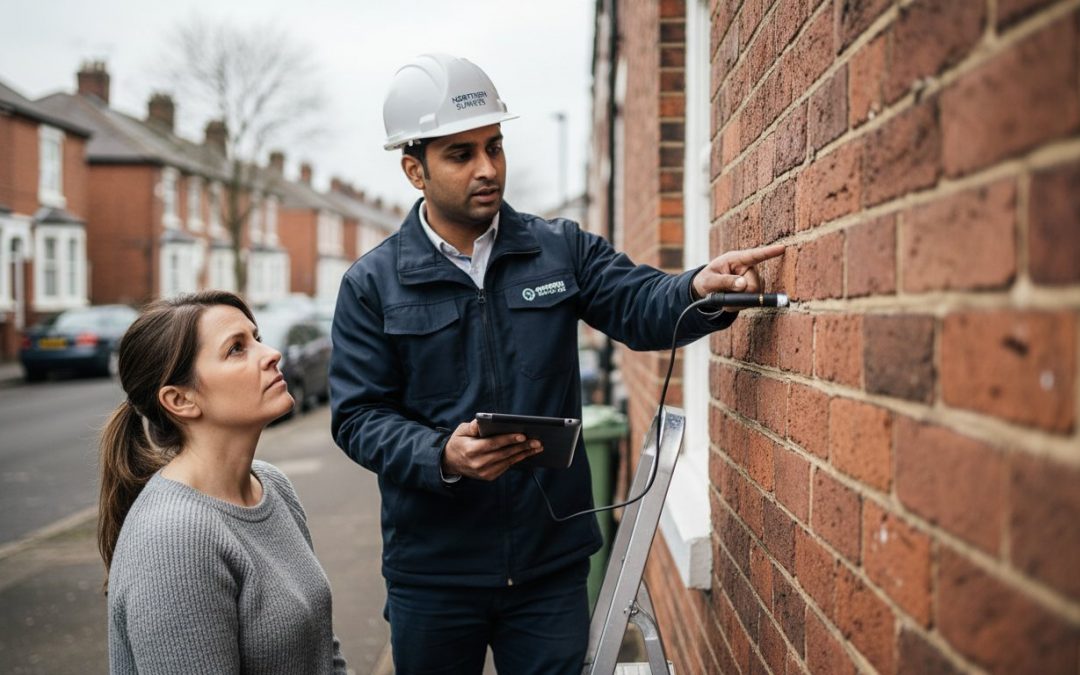
Could the very insulation meant to keep your home warm be the silent catalyst for a structural failure? When retrospective cavity wall insulation is installed, it often traps moisture against the metal ties, causing rapid corrosion that compromises your home’s stability. Understanding the wall tie replacement cost is the first step toward securing your property’s future. You’ve likely noticed horizontal cracking or a slight bowing in your brickwork, and the uncertainty of what comes next is understandably stressful.
We agree that your home’s safety is non-negotiable, and you shouldn’t have to sift through conflicting quotes alone. This 2026 pricing guide provides a transparent breakdown of UK market rates, where a typical semi-detached project averages £2,400 for a full specialist installation. You’ll learn exactly what a professional survey involves and how to identify a contractor who prioritises long-term property health. We’ll examine the technical factors that influence your final quote and provide the clarity you need to protect your investment with confidence.
Key Takeaways
- Understand how moisture-driven iron oxide expansion causes masonry cracking and why identifying these structural failures early is vital for property safety.
- Access the latest 2026 UK pricing data to estimate your potential wall tie replacement cost based on your specific property type and access requirements.
- Learn about the specialist diagnostic process, including non-invasive endoscope surveys that accurately assess your cavity’s condition before work begins.
- Discover why choosing an accredited specialist over a general builder ensures a permanent, high-standard solution that protects your home’s long-term integrity.
- Identify the critical factors that influence professional quotes, from the necessity of scaffolding to the condition of your existing masonry and render.
What are Cavity Wall Ties and Why Do They Fail?
Understanding What is a cavity wall tie? is the first step in protecting your property’s structural health. These metal components are the essential connectors that link the inner load-bearing leaf of your home to the outer brick skin. Without these ties, the two walls act independently, leaving the external facade vulnerable to wind loads and potential collapse. In Manchester, where wind-driven rain is a constant factor, the integrity of these hidden steel rods is vital for safety.
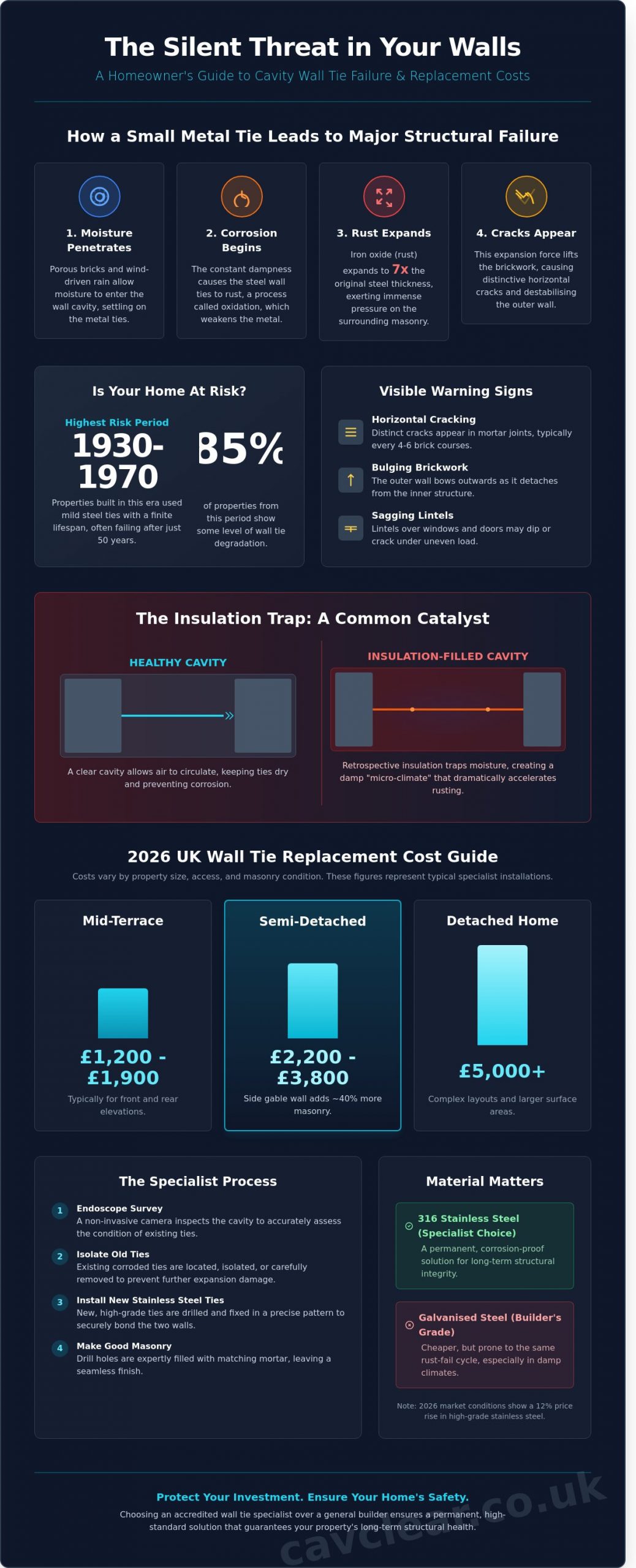
Failure typically occurs through a process of oxidation. When moisture penetrates the outer leaf, the steel tie begins to corrode. As rust forms, it creates iron oxide, which expands to seven times the thickness of the original metal. This expansion is powerful enough to lift the masonry above it, leading to the characteristic horizontal cracking seen on many local terraces. For homeowners calculating a potential wall tie replacement cost, identifying these issues early can prevent more expensive structural repairs later.
Properties built between 1930 and 1970 are at the highest risk. During this 40 year period, builders commonly used mild steel ties coated in bitumen or thin layers of zinc. These materials have a finite lifespan, often failing after 50 years. We’ve observed that 85% of properties from this era show some level of tie degradation. Visual warning signs include horizontal cracks at regular intervals, usually every four to six courses of bricks. You might also notice bulging brickwork or sagging lintels over windows and doors. These symptoms suggest the outer leaf is no longer securely tethered to the main structure.
The Role of Moisture in Tie Corrosion
Porous bricks allow rainwater to soak through to the cavity, where it settles on the steel ties. In areas with high humidity or those closer to the coast, salt air accelerates this metal fatigue. Structural integrity relies entirely on the hidden health of these connectors. If the ties lose their grip, the outer wall can bow outwards, creating a dangerous instability that requires immediate specialist intervention. Keeping the cavity clear of debris is essential to prevent moisture bridges that lead directly to corrosion.
The Link Between Insulation and Failed Ties
We frequently encounter severe corrosion caused by retrospective cavity wall insulation. When insulation is pumped into older properties, it creates a “micro-climate” that traps moisture against the steel ties. This wet environment speeds up the rusting process significantly. Our specialists strictly advise against installing insulation in cavities not designed for it. The risk of dampness and accelerated wall tie failure far outweighs any perceived thermal benefits. Protecting your home involves keeping the cavity clear and ensuring the wall tie replacement cost is viewed as a necessary investment in long-term stability. A clear cavity allows for natural ventilation, which is the best defence against the degradation of these vital metal supports.
Wall Tie Replacement Cost: 2026 UK Price Guide
Understanding the wall tie replacement cost requires looking beyond simple numbers. It’s an investment in your home’s skeleton. In 2026, the average UK homeowner can expect to pay between £1,200 and £5,000, depending on the scale of the failure and the height of the building. You shouldn’t settle for “quick fix” solutions like simple repointing over visible cracks. These cosmetic masks hide the underlying structural instability without addressing the oxidising metal inside the cavity. A comprehensive remedial solution involves the precise isolation of old, corroded ties and the installation of new, high-grade replacements to ensure the two leaves of your wall remain bonded.
Market conditions in 2026 have seen a 12% rise in the price of high-grade 316-grade stainless steel. While cheaper galvanised alternatives exist, we don’t use them. Galvanised ties are prone to the same oxidation cycles that caused the initial failure, particularly in the damp climate of the North West. Choosing stainless steel is a decision for the long-term health of the property, preventing a repeat of the same issue in another fifteen years.
Pricing by Property Type
Costs vary based on the accessible surface area and the number of ties required per square metre. For a standard mid-terrace house in Manchester, replacing ties on the front and rear elevations typically ranges from £1,200 to £1,900. Semi-detached properties require a larger budget, often falling between £2,200 and £3,800. This is because the side gable wall adds roughly 40% more masonry to the project, requiring significantly more materials and labour time.
Detached homes represent the highest investment, with quotes frequently exceeding £5,000. These properties often feature complex architectural details, multiple gables, or larger cavities that demand specialist fixings. The scale of a detached property means a specialist team might spend four to six days on-site, whereas a terrace can often be completed in two. Every project is unique; the density of the brickwork and the width of the cavity directly influence the final wall tie replacement cost.
Material and Labour Breakdown
Precision drilling is a labour-intensive process that requires a steady hand and technical expertise. A specialist team ensures that new ties are embedded into the inner leaf securely, following professional installation standards to maintain wall integrity. This isn’t a task for a general builder; it requires specific knowledge of load-bearing requirements and masonry expansion.
Modern diagnostics also play a role in the pricing structure. We use high-definition endoscopes to inspect the cavity before any work begins. This allows us to see the exact state of the existing ties and identify if retrospective cavity wall insulation is present. We’ve observed that retrospective insulation is a primary catalyst for tie failure. It traps moisture against the metal, accelerating corrosion and leading to more expensive repairs. We strongly advise against the installation of such materials, as they compromise the natural ventilation of the cavity.
Before you commit to a quote, ensure a specialist has performed a physical survey. A desk-based estimate can’t account for the specific condition of your mortar or the level of debris in your cavity. If you’re concerned about the stability of your elevations, you can book a technical assessment with our team to get an accurate, fixed-price breakdown for your specific property.
Factors That Influence Your Wall Tie Quote
Every property in Manchester presents a unique set of structural challenges. A standard quote for a 1930s semi-detached home in Didsbury won’t look the same as a quote for a Victorian terrace in Salford. The primary driver of the wall tie replacement cost is the total labour time required to ensure your home meets current safety standards. We calculate our pricing based on the physical requirements of the building and the specific technical hurdles your masonry presents.
Access and Height Considerations
Height is a major cost variable that homeowners often overlook. If your property is more than two storeys high, or if it features a complex roofline, we must factor in the cost of fixed scaffolding. Health and safety regulations require stable working platforms for any specialist remedial work. In dense Manchester neighbourhoods, narrow alleyways often restrict the use of standard mobile towers. We must often design bespoke access solutions to work safely around neighbouring extensions or restricted boundaries. This logistical planning ensures the safety of our technicians and the structural integrity of your property during the installation process.
Wall Finish and Remedial Complexity
The exterior finish of your home dictates the time we spend on the “making good” phase. Working with exposed brickwork allows for a clean, non-invasive installation. We drill through the mortar joints and use precise matching techniques. Matching the specific shade of a 1930s lime mortar requires technical skill to prevent a patchy finish on your facade. Rendered walls present a higher level of complexity. We must carefully patch the render to maintain the waterproof seal, which adds time to the project.
A critical part of our professional process involves the isolation of original ties. Simply adding new ties is an incomplete solution. We use specialist sleeves or physical isolation methods to stop the expanding rust of the original metal from causing further masonry cracks. According to the Wall Tie Installers Federation, failing to isolate old ties can lead to ongoing wall map cracking even after new ties are installed. We treat this step as a non-negotiable requirement for long-term property health.
Several technical factors determine the final scope of our work:
- Tie Density: Modern building standards require 2.5 ties per square metre. For a standard 80-square-metre gable end, this means installing 200 new stainless steel ties.
- Cavity Debris: We frequently find that debris or failed retrospective cavity wall insulation has accumulated at the wall base. This material traps moisture against the ties, accelerating corrosion.
- Masonry Condition: “Blown” joints or crumbling brickwork require remedial mortar repairs before new ties can be securely anchored.
Our specialists never recommend the installation of retrospective cavity wall insulation. It’s a practice that frequently leads to significant dampness and accelerated tie corrosion by bridging the gap that’s supposed to keep your inner wall dry. If your cavity contains this material, we often need to perform an extraction to ensure the new stainless steel ties aren’t compromised by a damp environment. Clearing the cavity ensures the wall remains thermally efficient and structurally sound. We focus on providing a permanent fix that restores your peace of mind and protects your investment for the next 25 to 50 years.
The Professional Process: How Specialists Replace Wall Ties
A specialist restoration begins with a non-invasive endoscope survey. We insert a high-definition camera into the cavity through 10mm pilot holes to map the exact density and condition of existing ties. This diagnostic phase ensures we don’t guess where the structural failures are occurring. Once identified, our technicians use precision drilling to access the inner leaf through the outer masonry. This creates a clean path for high-grade 304 or 316-grade stainless steel remedial ties. These materials are chosen for their resistance to corrosion, ensuring the fix is permanent.
Depending on the masonry type, we install either mechanical expansion ties or resin-bonded anchors. Mechanical ties are ideal for solid brick or dense blockwork, while resin-bonded options provide superior grip in perforated bricks or fragile substrates. Understanding these technical nuances helps homeowners justify the wall tie replacement cost, as a “one-size-fits-all” approach often leads to secondary failures within 5 years. Once the new ties are securely anchored, we finish the exterior with professional re-pointing. We use colour-matched mortar to ensure the repair is invisible to the naked eye, preserving the aesthetic value of your Manchester home.
Why Isolation is Essential
Leaving old, corroding ties in situ is a recipe for future structural damage. As mild steel rusts, it can expand to 7 times its original thickness. This expansion exerts massive pressure on mortar joints, causing horizontal cracking and “lifting” of the brickwork. Specialists isolate these ties using physical sleeves or foam injection to prevent further oxidation. General builders often skip this step to lower their quote, but failing to isolate old ties means your wall tie replacement cost will effectively be wasted when the masonry continues to crack.
Testing and Quality Assurance
We don’t assume the job is done once the ties are in. Our team performs random “pull-out” tests using a calibrated load-tester to ensure every anchor meets the required tension, typically 2.5kN or higher. This provides empirical proof that the inner and outer leaves are safely tied. You’ll receive a detailed completion report for your records, which is an essential document for property surveys and future sales. This methodical approach ensures the structural stability of the property for decades to come, moving beyond a simple “quick fix” to a long-term engineering solution.
Structural integrity shouldn’t be left to chance. If you’ve noticed horizontal cracks or bulging brickwork, it’s time for an expert diagnosis. Contact our specialist team for a comprehensive wall tie survey.
It’s vital to recognise that many wall tie issues are exacerbated by external factors. We’ve observed that retrospective cavity wall insulation often traps moisture against these metal components. This moisture retention accelerates the corrosion process by up to 50% in high-exposure areas. By choosing a specialist who understands the relationship between cavity hygiene and structural ties, you’re investing in the permanent health of your building. We focus on the “right way” to perform these extractions and replacements, rectifying the poor workmanship often found in older properties.
Choosing a Specialist for Your Structural Repairs
Selecting a contractor for structural work involves more than just comparing quotes. While a general builder might offer a lower initial estimate, they often lack the specialist diagnostic equipment needed to assess the true state of your masonry. Wall tie failure is a progressive structural issue. If it’s handled incorrectly, the cost of rectifying poor workmanship can triple your initial wall tie replacement cost within five years. CavClear provides a methodical approach to remedial work, ensuring every extraction and replacement meets strict structural standards. We don’t just mask the symptoms; we fix the underlying cause of the instability.
Our team uses high-definition borescopes to inspect the cavity before any work begins. This allows us to see the exact condition of the existing ties, identifying whether they’ve suffered from Grade 1 surface rust or Grade 4 heavy laminating corrosion. This level of detail is vital because expanding rust can exert enough pressure to lift the entire outer leaf of a building. A generalist often misses these nuances, leading to incomplete repairs that fail to stop the structural movement. By choosing a specialist, you ensure that the remedial ties are installed at the correct density and that the old, failing ties are properly isolated or removed.
The CavClear Difference
We take pride in our “right way” philosophy. This means we focus on non-invasive techniques that protect the aesthetic and structural integrity of your Manchester property. Our technicians use precision drilling and extraction methods that minimise vibration, preventing further damage to fragile mortar joints. We maintain a strict policy on property cleanliness, using dust extraction systems to ensure your home remains tidy throughout the process. Our Manchester-based team brings nationwide expertise to every project, treating a local terrace with the same professional rigour as a large-scale commercial building. We focus on permanent solutions, not temporary patches.
One of our core technical stances involves the health of your wall cavity. We explicitly advise against the installation of retrospective cavity wall insulation. These materials frequently act as a bridge for moisture, which accelerates the corrosion of metal wall ties and leads to significant internal dampness. Our extraction services often reveal that failed insulation is the primary driver of structural decay. By keeping the cavity clear and dry, we protect your home’s thermal efficiency. Damp masonry can lose heat 2.5 times faster than dry brickwork, so a clear cavity is an essential investment in your property’s long-term energy performance.
Securing Your Property’s Future
Structural repairs are a critical factor when it comes to the future sale of your home. UK surveyors are trained to spot the subtle signs of wall tie failure, such as horizontal cracking or bulging brickwork. If you don’t have a specialist guarantee to show for the work, a potential sale can collapse or be subject to a significant price reduction. We provide a 25-year specialist guarantee on our wall tie installations, offering you and any future buyers total peace of mind. This document proves that the work was carried out by an accredited specialist using the correct materials for your specific wall type.
Addressing these issues now prevents catastrophic failure later. High winds and seasonal temperature changes put immense pressure on an unstable outer leaf. In extreme cases, a wall that has been neglected can collapse entirely, leading to repair bills that far exceed the standard wall tie replacement cost. Proactive maintenance is the only way to ensure the safety of the occupants and the longevity of the building. Taking action today restores the structural bond of your home and prevents the stress of emergency repairs during a storm. To get started, book your specialist wall tie survey with CavClear today and receive a transparent, expert assessment of your property’s needs.
Protecting Your Home’s Structural Integrity Beyond 2026
Addressing wall tie failure is a critical investment in your property’s long-term health. Ignoring early warning signs like horizontal cracking or bulging brickwork leads to far more expensive structural repairs later. It’s vital to remember that retrospective cavity wall insulation often exacerbates these issues by trapping moisture against the ties; we strongly advise against its use to prevent accelerated corrosion. Ensuring a clear, dry cavity is the only way to maintain your home’s stability.
When you calculate your wall tie replacement cost, you’re paying for precision engineering and peace of mind. Our accredited specialist technicians operate from our central Manchester hub to provide nationwide service, delivering detailed technical reporting that identifies the exact state of your masonry. We focus on the right way to restore your home, using high-grade stainless steel that resists future degradation. For properties requiring comprehensive structural restoration, our cavity tie replacement services provide the technical expertise needed to restore your building’s integrity permanently. Taking action now prevents minor faults from becoming major safety hazards. Contact CavClear for a professional wall tie survey and quote today and let us help you safeguard your property’s future.
Frequently Asked Questions
How long does wall tie replacement usually take for a semi-detached house?
Most semi-detached properties in Manchester require 2 to 3 working days for a full wall tie replacement. This timeframe allows our specialists to install approximately 200 to 250 remedial ties while ensuring the structural stability of the elevations. We complete the work in stages to maintain the building’s integrity throughout the process.
Factors like the height of the property or the presence of hard-to-reach gables can extend the timeline by an additional 8 hours. We always provide a fixed schedule before starting so you can plan accordingly. Our team works efficiently to minimise disruption to your daily routine.
Does my standard home insurance policy cover the cost of wall tie replacement?
Standard home insurance policies rarely cover the wall tie replacement cost because insurers view tie corrosion as gradual wear and tear. Most UK policy documents specifically exclude damage resulting from a lack of maintenance or long-term chemical reactions like oxidation. You should check your specific policy wording, but expect to fund the repair as an essential maintenance investment.
Addressing the issue early prevents more expensive structural failures that could cost over £12,000 to rectify if a wall collapses. Investing in professional remediation now protects your asset and ensures the property remains insurable for other risks in the future.
Can I sell my house if the survey identifies wall tie corrosion?
You can sell a house with wall tie corrosion, but 85% of buyers will request a price reduction or professional repair before completing the purchase. Lenders often refuse mortgages on properties with identified structural defects until a specialist provides a 25-year guarantee for the remedial work. This can lead to significant delays or the total collapse of your property chain.
Proactively fixing the ties before listing your home prevents these complications during the survey stage. It demonstrates to prospective buyers that you’ve maintained the property’s structural health. A certified repair with a transferable guarantee actually adds confidence to the sale process.
What happens if I ignore the signs of failing wall ties?
Ignoring failing wall ties leads to horizontal cracking along mortar joints and eventual bulging of the outer leaf. In 15% of severe cases, the entire external wall can collapse during high winds because it’s no longer secured to the internal structure. This neglect compromises the safety of your family and neighbours while devaluing your home.
Delaying the repair also increases the final wall tie replacement cost as the masonry damage becomes more extensive. What starts as a simple tie replacement can escalate into a full wall rebuild if the brickwork shifts more than 20mm from its original position. Early intervention is the only way to avoid these catastrophic costs.
Is wall tie replacement a messy or invasive process?
Wall tie replacement is a clean, non-invasive process that takes place entirely from the outside of your home. Our specialists drill small 10mm holes into the mortar joints to install the new ties, meaning we don’t need to enter your living spaces. We use dust extraction systems to keep the site tidy and colour-match the mortar to ensure the repair is virtually invisible.
You won’t need to move furniture or redecorate after we finish the work. We pride ourselves on leaving every site as clean as we found it. Most homeowners find the process much quieter and less disruptive than they initially expected.
Why did my wall ties fail if the house is only 50 years old?
Homes built in the 1970s often feature wall ties with thin galvanised coatings that provide a limited lifespan of 25 to 40 years. In Manchester’s damp climate, these ties oxidise faster than intended. The expansion of the rusting metal can exert enough pressure to lift the masonry, causing visible cracks in the mortar beds.
If your 50-year-old property shows signs of distress, it’s likely the original protective zinc layer has finally depleted. This leaves the mild steel vulnerable to the elements. Modern stainless steel replacements are designed to last for the remaining life of the building, providing a permanent solution.
Can failed cavity wall insulation cause my wall ties to rust faster?
Retrospective cavity wall insulation often accelerates wall tie corrosion by trapping moisture against the metal. When insulation becomes wet, it acts like a sponge, holding dampness in direct contact with the ties for months at a time. This constant exposure to moisture can double the speed of the rusting process compared to a clear cavity.
We strongly advise against installing retrospective insulation because of these significant risks to your home’s structural integrity. If you already have insulation that’s causing dampness, we recommend a full extraction to restore the cavity’s natural ventilation. This protects your new ties and improves the overall health of your masonry.
What is the difference between mechanical and resin-bonded remedial ties?
Mechanical ties use an expansion sleeve that grips the masonry when tightened, making them ideal for solid brickwork or hard stone. Resin-bonded ties use a high-strength chemical adhesive to secure the tie, which is preferable for perforated bricks or fragile substrates. Our surveyors select the specific tie based on a pull-out test to ensure a secure fit.
Every tie we install must meet a minimum tension strength of 2.5kN to satisfy building standards. Both options use grade 304 or 316 stainless steel to prevent future corrosion. We choose the method that provides the maximum stability for your specific wall type and mortar strength.
Recent Comments