

What if the cracks appearing in your external masonry aren’t a sign of imminent collapse, but a manageable technical fault that can be permanently resolved without demolishing your home? It’s completely natural to feel a sense of dread when you spot horizontal cracking or bulging brickwork, especially when conflicting advice leaves you feeling uncertain about the safety of your property. This guide provides essential reassurance for homeowners with wall tie issues by explaining why these structural concerns are solvable through precise, non-disruptive engineering.
We’ll explore how a professional survey identifies the exact condition of your ties and why a logical, standards-based plan of action is the key to restoring both your home’s integrity and your own peace of mind. By moving from observation to expert recommendation, you can secure your property’s future as a long-term asset without the stress of hidden costs or unnecessary disruption. Understanding the actual risk level is the first step toward a permanent fix that preserves your property’s value and safety for years to come.
Key Takeaways
- Understand how wall ties act as the essential structural backbone of your property, providing the lateral stability required for safety.
- Learn to distinguish between minor cosmetic issues and critical signs of failure, such as horizontal mortar joint cracking or bulging masonry.
- Discover how specialist diagnostic tools like borescopes provide vital reassurance for homeowners with wall tie issues by identifying faults without invasive work.
- Explore the modern “drill and fix” methodology using high-grade stainless steel ties to restore structural integrity with minimal disruption.
- Find out how professional documentation and certified repairs protect your home’s market value and ensure long-term asset health.
Understanding the Role of Wall Ties in UK Properties
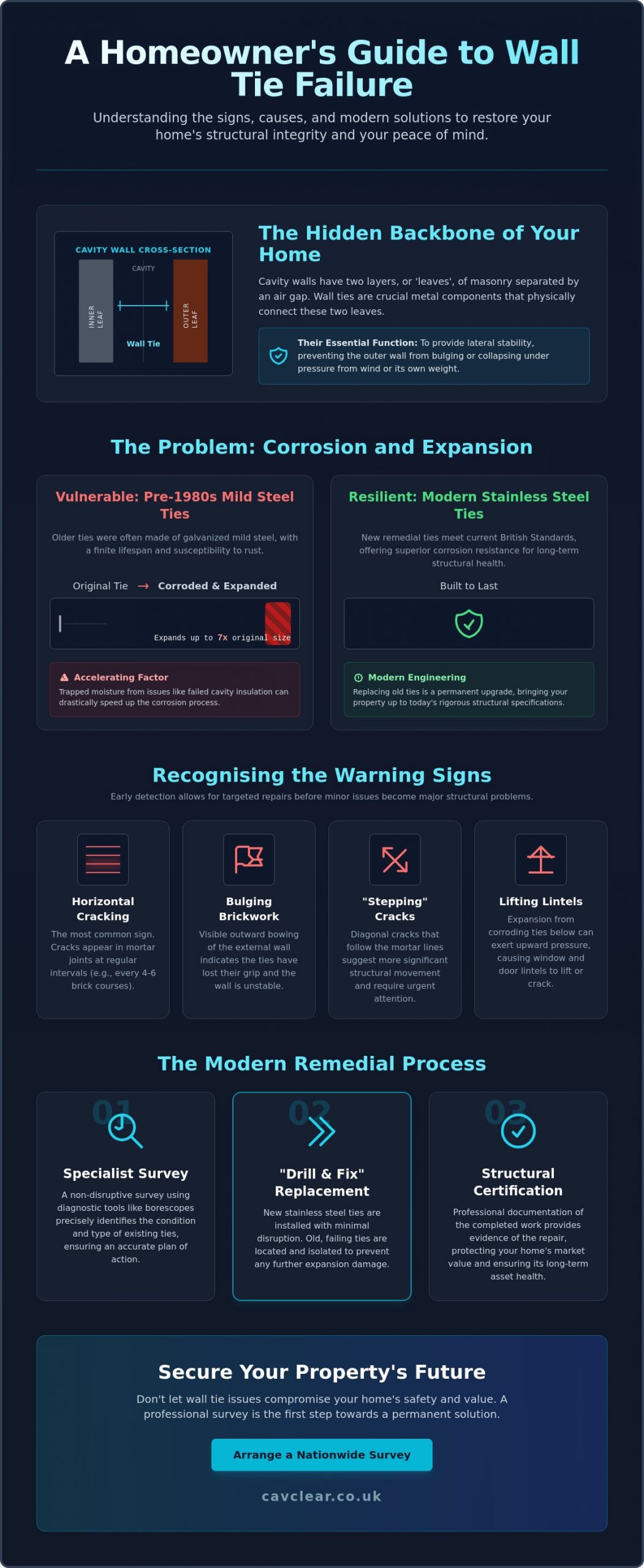
Most British homes constructed over the last century rely on a cavity wall system. This architectural design consists of two separate masonry layers, known as leaves, with an air gap between them. This gap serves as a vital barrier against moisture penetration and provides thermal insulation. However, for a cavity wall to remain structurally sound, these two leaves must be securely connected. This is where wall ties perform their essential function. These components act as the hidden backbone of your home, providing the lateral stability necessary to prevent the outer leaf from bowing or collapsing under wind pressure or the weight of the structure. Understanding this fundamental system provides the first level of reassurance for homeowners with wall tie issues, as it highlights that these faults are technical in nature rather than signs of a fundamentally flawed building.
If you’re wondering, what is a cavity wall tie? it is essentially a metal connector embedded in the mortar joints during construction. While they are invisible from the outside, their role is critical. Properties built before the mid-1980s are particularly susceptible to tie-related concerns. During this era, many builders used galvanized mild steel ties. While effective for a time, these materials have a finite lifespan compared to the modern stainless steel alternatives used today. Identifying a fault isn’t a reason for panic; instead, it’s the first step toward a permanent engineering fix that secures your property’s future.
Why Do Wall Ties Fail?
The transition from mild steel to modern stainless steel standards occurred because of a natural chemical process called oxidation. When moisture enters the cavity, it reacts with the zinc coating on older ties. Once this protective layer wears thin, the steel core begins to rust. As iron turns to iron oxide, it expands significantly, often reaching several times its original thickness. This expansion exerts immense pressure on the surrounding mortar, leading to the characteristic horizontal cracks often seen on external walls. Moisture retention is frequently exacerbated by poorly installed or degraded retrospective cavity insulation, which can trap dampness against the metal and accelerate the corrosion process.
The Evolution of Structural Standards
Historical building regulations were significantly less rigorous than today’s technical requirements. Modern engineering demands a high degree of precision to ensure the wall cavity remains clear and stable. A clear cavity prevents the transfer of water from the outer leaf to the inner leaf, protecting your interior living space from dampness. Remedial wall ties are now considered a standard property upgrade rather than a temporary patch-up. By installing high-grade stainless steel ties that comply with current British Standards, you’re not just repairing a fault. You’re bringing an older property up to modern structural specifications, ensuring it remains a safe and valuable asset for decades.
Recognising the Real Signs of Wall Tie Failure
Identifying structural faults early prevents minor issues from becoming major repairs. The most common indicator of failure is horizontal cracking in the mortar joints. These cracks usually appear at regular intervals, often every four to six courses of brickwork. This pattern occurs because the horizontal “fishtail” ties used in older properties are bedded into these specific joints. Recognising the signs of wall tie failure early provides the best reassurance for homeowners with wall tie issues, as it allows for targeted remedial work before the masonry becomes unstable.
While horizontal lines are the primary warning, other symptoms require more urgent attention. “Stepping” cracks that follow the mortar lines diagonally or visible bulging in the external leaf suggest that the ties have already lost their structural grip. In extreme cases, you might notice window lintels lifting or internal damp patches where corroded ties have allowed water to bridge the cavity. If you spot these signs, arranging a professional wall tie survey is the most logical next step to determine the extent of the movement and restore safety.
The Expansion Effect: Why Cracks Appear
Rust is a powerful physical force. When a galvanized steel tie oxidizes, the resulting rust can expand to seven times the thickness of the original metal. This expansion forces the mortar joints apart, literally jacking the brickwork up. It’s important to differentiate this from subsidence. Subsidence typically causes vertical or diagonal cracks that cut through the bricks themselves, whereas wall tie failure is almost always confined to the mortar joints. Because the expansion is gradual, the damage is often caught long before it poses a risk of collapse.
Visible vs. Hidden Corrosion
Not all failure is visible to the naked eye. Older properties often used thick “fishtail” ties which cause obvious cracking when they rust. However, many homes built between the 1960s and 1980s used thinner wire ties. These ties can corrode away completely until they snap, leaving the outer wall detached without ever showing a single crack on the surface. Because of this hidden risk, a specialist inspection using borescopes is the only way to confirm the safety of your home’s structure.
- Check for horizontal cracks every 4-6 brick courses on gable ends or long walls.
- Look for cracks that are wider at the top of the house than at the bottom.
- Inspect window sills and lintels for signs of lifting or “heaving.”
- Examine the property from a distance to spot visible bulging or bowing in the masonry.
- Check if window frames appear to be separating from the surrounding brickwork.
Why a Specialist Survey is Your Best Source of Reassurance
A specialist survey acts as a technical health check for your property’s structure. Instead of relying on visual guesswork from the street, a specialist uses precision tools to see exactly what is happening inside the cavity. This provides the ultimate reassurance for homeowners with wall tie issues because it replaces anxiety with hard evidence. A survey often confirms that problems are localized to specific elevations rather than the entire building, which can significantly reduce the scope of necessary work. By understanding the true state of your home, you can move away from fear and toward a logical, manageable solution.
The diagnostic process begins with high-sensitivity metal detectors to map the exact location of existing ties. Once identified, the surveyor targets specific areas for visual inspection. This data-driven approach ensures that no part of the wall is left to chance. By commissioning a specialist survey for wall tie issues, you receive a comprehensive assessment that distinguishes between superficial mortar cracks and genuine structural instability. This level of detail is essential for making informed decisions about your property’s maintenance.
The Borescope Inspection Process
Surveyors use borescopes to perform a non-invasive internal examination. We drill small, discreet holes into the mortar joints, usually no larger than 10mm in diameter. An optical camera is then inserted into the cavity to inspect the condition of the ties. The surveyor grades each tie based on a standard scale of corrosion, ranging from a bright, clean finish to advanced flaking and metal loss. This process is clean and efficient. It provides you with clear visual proof of your home’s internal condition without causing any structural damage or significant mess.
Interpreting the Specialist Report
Your final report serves as a logical roadmap for the future health of your home. It includes a detailed remedial action plan that outlines exactly where replacement ties are needed and which existing ties require isolation. This document is vital for mortgage lenders and insurance providers; it proves that structural concerns are being managed by a professional. In many cases, a damp survey is recommended alongside this inspection. This helps to determine if trapped moisture or debris in the cavity is accelerating the corrosion process, ensuring that the root cause is addressed alongside the structural fix.
The Modern Process of Remedial Wall Tie Replacement
Precision is the hallmark of a professional installation. Once the new ties are securely bedded into both the inner and outer leaves, the small entry points are repointed using mortar that is carefully color-matched to your existing walls. This attention to detail ensures that the finished work is virtually invisible to the naked eye. By the time the technicians leave, your home’s structural integrity is restored, yet the aesthetic appearance remains unchanged. If you are concerned about the stability of your masonry, you can book a professional wall tie survey and replacement consultation to secure your home’s future.
Types of Remedial Ties
Selecting the correct hardware is essential for a permanent fix. Specialists typically choose between three main types of remedial ties based on the specific masonry of your home. Mechanical expander ties work well in solid brick, while resin-fixed ties provide a chemical bond that is ideal for softer or perforated materials. Helical ties are often preferred for their ability to be driven into position without excessive vibration. Regardless of the mechanism, stainless steel remains the industry standard. Its resistance to corrosion ensures that the new ties won’t suffer from the same oxidation issues that plagued the original galvanized steel components.
Isolation: Stopping the “Rust Bloom”
Installing new ties is only half of the solution. If the old, corroding ties are left active within the wall, they will continue to oxidize and expand. This ongoing expansion, often called a “rust bloom,” can still cause masonry to crack even after new ties are installed. A professional wall tie replacement strategy must include a plan to neutralize the old steel. This is achieved by either physically extracting the old tie or using foam sleeves to isolate it from the surrounding mortar. This critical step prevents further “jacking” of the brickwork and ensures the long-term health of your property’s structure.
Long-Term Structural Health and Property Value
A certified wall tie repair is more than a structural necessity; it’s a critical safeguard for your property’s market value. When you address these issues correctly, you transform a potential liability into a verified asset. This proactive approach provides significant reassurance for homeowners with wall tie issues, as it ensures the building’s “envelope” remains secure and efficient. Once the original mild steel is replaced with modern stainless steel connectors, the structural fault is effectively resolved for the remainder of the building’s lifetime. You aren’t just fixing a crack; you’re future-proofing the structure against further deterioration.
Professional documentation acts as a bridge between technical work and financial security. Future buyers and their surveyors look for evidence of correct methodology and high-grade materials. By keeping detailed records of your specialist survey and subsequent remedial work, you demonstrate that the property has been maintained to modern standards. This transparency removes the uncertainty that often stalls property transactions, allowing for a smoother sale and protecting your equity. A home with a clean bill of structural health is always more marketable than one with unaddressed or poorly documented faults.
Preparing for a Survey or Sale
Presenting a comprehensive structural report to mortgage lenders is the best way to avoid delays during a sale. Lenders prioritize stability. They want to see that any movement has been professionally diagnosed and rectified. Proactive maintenance is always more cost-effective than emergency structural repairs, which often carry a premium and cause significant stress. Additionally, a stable wall structure is a mandatory prerequisite for other essential maintenance, such as cavity wall insulation removal. If your property requires insulation extraction due to dampness, ensuring the wall ties are sound first prevents structural compromise during the extraction process.
The Peace of Mind of Professional Accreditation
The value of using nationwide specialists for remedial works cannot be overstated. High-level standards and correct methodology are what separate a permanent fix from a temporary patch-up. Specialist contractors provide long-term guarantees that offer additional reassurance for homeowners with wall tie issues, ensuring that the structural integrity of the home is backed by professional accountability. UK properties are remarkably resilient when managed with technical rigor. By investing in professional-grade repairs, you restore the comfort and safety of your home, ensuring it remains a robust and reliable asset for decades to come.
Securing Your Property’s Future with Professional Expertise
Finding a specialist who provides clear data and transparent reports is the ultimate reassurance for homeowners with wall tie issues. Our accredited specialist technicians offer nationwide coverage, providing the detailed technical reports required by both homeowners and insurers. We focus on non-disruptive, permanent structural solutions that prioritize the health of your building. To take the first step toward total peace of mind, Book a Professional Wall Tie Survey with CavClear today. Your home’s stability is a vital investment in its future; let’s ensure it remains secure for years to come.
Frequently Asked Questions
Is my house at immediate risk of collapse if I have wall tie issues?
No, a house rarely faces immediate collapse from wall tie failure. This is a gradual engineering fault that typically shows visible warning signs, such as horizontal cracking or masonry bulging, long before the structure becomes unsafe. Identifying these signs early provides essential reassurance for homeowners with wall tie issues. It allows for a controlled, professional intervention that restores structural integrity before the situation reaches a critical stage.
How much does a professional wall tie survey typically cost?
You should consult a specialist to obtain a quote based on your property’s specific size and location. While we don’t provide specific pricing here, a professional survey is a necessary investment that replaces uncertainty with a detailed technical report. The process involve using borescopes and metal detectors to map the condition of your ties. This diagnostic data ensures you only pay for the repairs your home actually requires.
Can I replace wall ties myself or do I need a specialist?
You must hire a specialist for this type of structural work. Replacing wall ties requires technical precision, including the correct staggered placement of new ties and the isolation of old, corroding steel. Incorrect DIY installation can cause further masonry damage and will not comply with UK Building Regulations. A professional ensures the work is certified, which is vital for maintaining the property’s market value and long-term safety.
Will wall tie replacement work be visible on the outside of my house?
The finished work is virtually invisible to the naked eye. Technicians drill small, discreet holes into the mortar joints to install the new stainless steel ties. Once the ties are secured, these holes are repointed using mortar that is carefully color-matched to your existing masonry. This methodology preserves the aesthetic appearance of your home while providing a permanent structural fix that meets modern engineering standards.
How long does the remedial wall tie replacement process take?
A typical residential project is usually completed within one to two working days. The exact duration depends on the size of the elevations being treated and the condition of the brickwork. This fast turnaround is a key part of the reassurance for homeowners with wall tie issues, as it demonstrates that structural repairs don’t have to be long, drawn-out construction projects. The work is efficient, clean, and highly targeted.
Does my buildings insurance cover wall tie replacement?
Most standard buildings insurance policies do not cover wall tie replacement because it is classified as a maintenance issue. Insurers generally view the gradual corrosion of metal ties as wear and tear rather than sudden accidental damage. It’s always best to check your specific policy wording. However, completing a professional repair and keeping the documentation is essential for ensuring your property remains insurable and attractive to future buyers.
Why is stainless steel used for remedial wall ties?
Stainless steel is the industry standard because it offers permanent resistance to corrosion. Unlike the galvanized mild steel ties used in the past, stainless steel will not oxidize or expand when exposed to moisture within the cavity. This prevents the “rust bloom” effect that causes horizontal cracking in masonry. By using high-grade stainless steel, we ensure that the structural connection between your wall leaves remains secure for the building’s lifetime.
Do I need to move out of my home while the work is being done?
You don’t need to leave your home or even move your furniture while the work is performed. All remedial activities take place on the exterior of the property. The process is non-disruptive and creates no mess or structural vibration inside your living spaces. You can continue your daily routine as normal while our technicians restore the structural backbone of your home with professional precision and care.
Recent Comments