
Could your property be restored to a dry, thermally efficient state in less time than it takes to complete a standard boiler installation? If you’re dealing with the persistent damp and mould caused by failing insulation, you likely feel a sense of urgency to fix the issue. However, the fear of your home being “out of action” for weeks often leads to unnecessary delays. You want a solution that prioritises your family’s health but don’t want your driveway to become a permanent construction site. A common question homeowners ask our specialist team is: how long does cavity insulation extraction take?
For a standard three-bedroom semi-detached house in the UK, the extraction process typically requires between one and two days of on-site work. This specialist guide provides the realistic timelines you can expect and details the technical factors, such as property height and material type, that influence the project duration. We’ll show you how our non-invasive techniques provide a clear schedule for restoring your home’s structural integrity while ensuring minimal disruption to your exterior. By the end of this article, you’ll understand exactly how we return your property to a safe, damp-expert environment with total peace of mind.
Key Takeaways
- Understand why a standard UK semi-detached property typically requires one to three days for a professional extraction team to complete the work.
- Learn how property height and the condition of the material influence how long does cavity insulation extraction take, ensuring you can plan for a safe and efficient project.
- Discover the importance of using high-volume industrial vacuums to protect your home’s structural integrity and ensure a complete removal of all debris.
- Recognise that the extraction is only the first step, as saturated brickwork may require several weeks or months to dry out fully and restore your home’s health.
- Identify the critical differences between nationwide specialists and general builders to avoid the risks associated with inadequate machinery and poor workmanship.
Understanding the Typical Timeline for Cavity Insulation Extraction
Determining how long does cavity insulation extraction take is a primary concern for homeowners dealing with damp or failing insulation. For a standard UK semi-detached property, the extraction process typically requires between 1 and 3 days of onsite labor. This timeframe ensures the structural integrity of the building remains protected while every trace of compromised material is removed. It is vital to distinguish between the physical time our specialists spend on your property and the longer recovery period required for the walls to fully dry out once the debris is gone.
Some contractors may offer a 24-hour turnaround, yet this “quick fix” approach is rarely professional or thorough. Rushing the process often results in residual debris settling at the base of the wall or snagging on wall ties. These remnants create bridges that allow moisture to travel from the outer leaf to the inner leaf of the building. Understanding What is a Cavity Wall? helps clarify why this clear air space is so critical. Any shortcut that leaves material behind will inevitably lead to recurring damp issues and potential timber rot within the property floorboards or joists.
The Standard 3-Day Schedule Breakdown
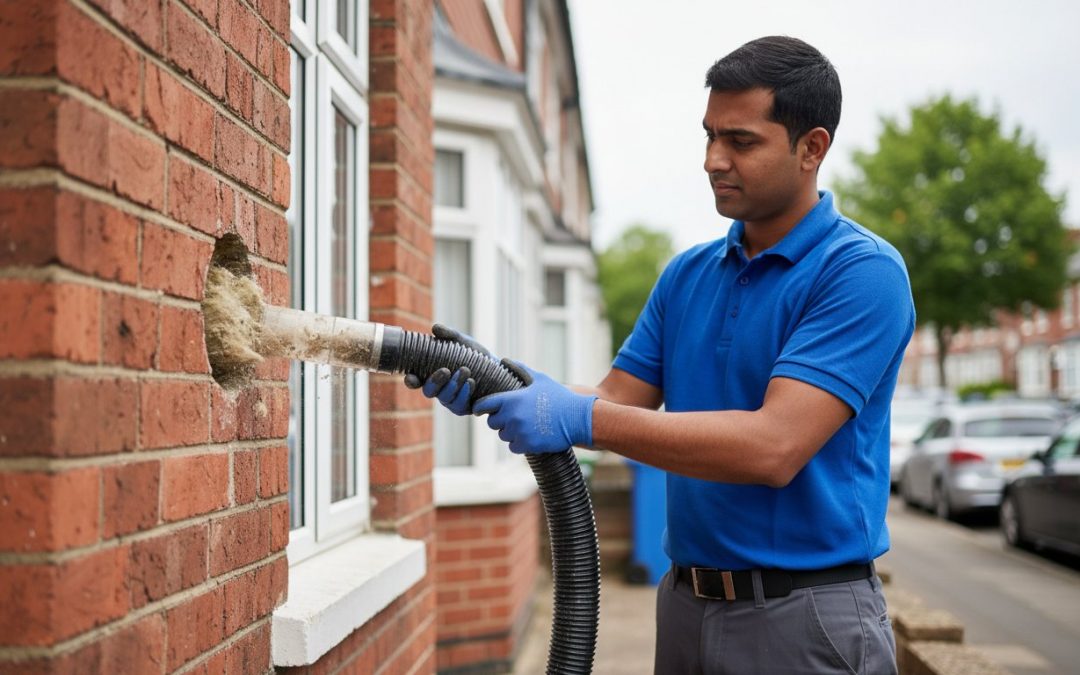
- Day 1: Site Setup and Preparation. Our team establishes safety barriers and protects the surrounding area. We then drill a specific, calculated pattern of small holes into the mortar joints to access the cavity without damaging the brickwork.
- Day 2: Core Extraction. Specialists use industrial-grade vacuums and high-pressure compressed air to dislodge and remove the insulation. This is the most intensive phase of the project, requiring constant monitoring to ensure a steady flow of material.
- Day 3: Inspection and Reinstatement. We conduct a final cavity inspection using high-definition borescopes to guarantee no debris remains. Once the cavity is confirmed clear, we remove all waste from the site and seal the injection holes with mortar that matches your existing masonry.
Why Initial Surveys Are the Starting Point
A professional survey is the only way to accurately predict how long does cavity insulation extraction take for your specific home. This diagnostic stage allows a specialist to identify the exact volume of material and the type of insulation present, whether it’s mineral wool, urea-formaldehyde foam, or bonded beads. Using a borescope during the survey reveals internal obstructions or slumped material that could complicate the removal.
Skipping this step often leads to unexpected delays during the physical work. For instance, if a survey reveals that the insulation is saturated with water or has hardened into a solid mass, we can adjust our equipment and staffing levels accordingly. This transparency ensures that once we arrive on site, the project proceeds at a steady, methodical pace toward a permanent resolution for your home’s thermal efficiency.
Key Factors That Dictate the Speed of Insulation Removal
Every property presents a unique set of challenges that influence the project timeline. When homeowners ask how long does cavity insulation extraction take, the answer depends on the physical characteristics of the building and the condition of the material inside the walls. A standard three-bedroom semi-detached house typically requires a full working day, but certain variables can extend this to 48 hours or more. For instance, three-storey homes require significant additional time for the safe erection of scaffolding. Accessing higher elevations isn’t just about reach; it involves meticulous safety protocols that can add 4 to 5 hours to the total setup time.
Access constraints around the ground floor also play a major role. If your home has a conservatory, a narrow side-alley, or a recent extension, our specialists must navigate these obstacles to position the industrial extraction units. These constraints often mean we have to use longer suction hoses, which can slightly reduce the vacuum pressure and extend the extraction phase by 15% to 20%. Our team focuses on a non-invasive approach, ensuring your property remains protected throughout the process. If you are concerned about specific obstacles at your property, you can book a specialist survey to get a precise time estimate.
Material Type: Mineral Wool vs. Foam
The specific substance inside your walls is the primary driver of labor time. Mineral wool and white wool are loose-fill materials that usually move quickly through our equipment. However, Urea-Formaldehyde Foam (UFF) is far more labor-intensive. Because this foam hardens into a solid block, it must be mechanically broken down into smaller fragments before suction can begin. This process often doubles the duration of the work compared to wool. Expanded Polystyrene (EPS) beads are highly mobile and extract quickly, but they require 100% containment. We use specialist bead-capture technology to ensure these plastic spheres don’t escape into your garden or the wider environment.
The Impact of Saturation and Debris
The condition of the insulation is just as important as the type. When insulation becomes wet due to driving rain or structural faults, it clumps together and its weight increases by up to 350%. These heavy, sodden clumps resist standard vacuum pressure and require our high-performance extraction units to work at maximum capacity. Following Energy Saving Trust guidance on the proper assessment of wall cavities helps us identify these saturation zones before we begin.
We also encounter internal obstructions such as “mortar snots” — excess mortar left behind during the original house construction. These hardened deposits trap insulation in the corners of the cavity, making it difficult to clear. Removing these blockages is essential for restoring the structural integrity of your home, even if it adds 2 to 3 hours to the project. Understanding these variables is key to answering how long does cavity insulation extraction take for your specific property, ensuring the job is done the right way rather than the fast way.
The Professional Extraction Process: A Step-by-Step Breakdown
A specialist extraction involves more than just pulling material out of a wall. It requires a methodical approach to maintain the property’s structural integrity. We use high-volume industrial vacuums because domestic-grade equipment lacks the static lift required to pull heavy, wet debris from the depths of a cavity wall. This technical choice directly impacts how long does cavity insulation extraction take, as efficient machinery speeds up the recovery of defective materials. Using underpowered tools often leaves residue behind, which continues to bridge dampness across the cavity.
The Drilling and Air-Injection Phase
Technicians begin by mapping a precise drill pattern across the external masonry. This prevents “blind spots” where damp insulation might otherwise remain trapped. A 2019 Welsh Government statement on insulation problems highlighted that poor workmanship during installation often leads to these failures. The air-injection process serves as the primary catalyst for debris movement. By introducing compressed air at specific intervals, we agitate the material, forcing it toward the extraction points without damaging the brick ties. This phase is critical for dislodging compressed mineral wool or bonded beads that have settled over time.
Industrial Vacuuming and Containment
The material flows through a sealed system into reinforced bags for eco-friendly disposal. This containment prevents dust from entering the living space or the local environment. Technicians monitor the extraction rate constantly. If the flow slows, it indicates a blockage or a change in material density. A specialist manually checks the “clearance” using borescope cameras to confirm that 100% of the debris is gone from the base of the wall. This visual verification is non-negotiable for ensuring the cavity is fully ventilated and ready to dry out.
The process concludes with a thorough site restoration. We patch the drill holes using mortar that matches the existing brickwork. Technicians mix the mortar on-site to ensure the aesthetic finish of the property remains intact. A professional team ensures the property is as clean as they found it, removing all traces of the old insulation. Understanding these technical steps helps homeowners grasp how long does cavity insulation extraction take, as a thorough job usually requires one to two full working days for a standard semi-detached house. We don’t take shortcuts, as the goal is a permanent restoration of your home’s health.
Why the Drying Out Period is Essential After Extraction
A common misconception among homeowners is that the restoration process finishes the moment the extraction van leaves the driveway. The reality is that physical removal is only the first stage of property recovery. Saturated mineral wool or damp bonded bead insulation acts like a heavy, wet sponge held against your internal walls. Even after this material is gone, the surrounding brickwork remains saturated. When considering how long does cavity insulation extraction take, you must factor in the secondary phase: the drying out period.
Saturated bricks can take weeks or even months to fully release trapped moisture. A single damp brick can hold significant amounts of water, and in a typical UK semi-detached home, the total volume of water trapped within the masonry can reach hundreds of litres. Once the cavity is clear, the wall can finally function as a rain barrier again. This allows the internal leaf to dry toward the inside of the house while the external leaf dries toward the outside air.
The Timeline for Moisture Evaporation
The time required for a wall to dry completely depends on several environmental factors. Seasonality plays a major role; a property extracted in July will dry significantly faster than one serviced in December due to higher ambient temperatures and lower external humidity. The orientation of the wall also matters. North-facing walls receive less direct sunlight and usually take longer to shed moisture than south-facing elevations. Local weather patterns, particularly driving rain, can also influence the pace of evaporation.
We recommend a minimum of 4 to 6 weeks of clear air circulation before you begin any internal redecoration. Rushing to paint or wallpaper can trap residual moisture behind the new finish, leading to bubbling, peeling, or the return of surface mould. You can monitor this progress by using a digital hygrometer to track internal humidity levels. As the structure dries, you will notice these readings stabilize toward a healthy range of 40% to 60%.
Structural Benefits of an Empty Cavity
Restoring a clear, empty space is the most effective way to manage moisture in UK homes. This gap prevents the direct transfer of water from the outer leaf to the inner leaf, which is the primary cause of penetrating damp. By removing the bridge created by wet insulation, you protect the structural integrity of the building. The air within an empty wall cavity circulates naturally, ensuring that any moisture that does enter is evaporated quickly.
Another critical benefit involves the protection of wall ties. In properties built between 1930 and 1980, these metal ties are vulnerable to accelerated corrosion when they are constantly encased in damp insulation. Removing the wet material halts this corrosive process, potentially saving you thousands of pounds in future structural repairs. When you understand how long does cavity insulation extraction take, it’s clear that the short-term removal process is a vital investment in the long-term health of your home.
If you are concerned about damp walls or failing insulation, our specialists can provide a full diagnostic survey. Contact CavClear today for expert advice.

Choosing a Specialist for Efficient and Safe Extraction
Selecting a specialist contractor like CavClear ensures that your home is treated with the technical precision required for a permanent solution. Cavity extraction is a complex engineering process that requires more than just basic tools. While homeowners often ask how long does cavity insulation extraction take, the more critical question is whether the job will be done correctly the first time. Using general builders who lack specialized extraction machinery often leads to incomplete work, leaving pockets of wet material that continue to cause damp and structural decay.
Our team utilizes high-velocity suction units and industrial-grade compressed air systems designed specifically for the UK’s unique building stock. These tools allow us to clear debris from tight corners and around window openings that standard vacuums cannot reach. By choosing an accredited specialist, you receive a detailed post-extraction report and borescope evidence showing a clean cavity. This transparency restores the value of your property and provides the peace of mind that your home’s thermal integrity is protected for the long term.
Nationwide Service and Professional Standards
CavClear operates a nationwide service, bringing consistent, high-quality standards to every corner of the United Kingdom. We understand that local weather conditions and construction styles vary, which is why our technicians are trained to handle diverse property types. Our specialist status means we don’t just remove insulation; we diagnose the health of the entire wall cavity. If we identify structural weaknesses during the process, we provide integrated solutions like wall tie replacement to ensure your home remains stable and safe. This comprehensive approach is why our projects typically finish within the estimated one to two day timeframe, as we have the right equipment to handle complications immediately.
Your Next Steps to a Damp-no-obligation Home
Restoring your property begins with a professional technical survey. This diagnostic stage is vital to determine the exact state of your cavity and the extent of the saturation. Following the survey, you’ll receive a detailed remedial action plan tailored to your home’s specific needs, outlining exactly how we will achieve a 100% clear cavity. When considering how long does cavity insulation extraction take, remember that a survey is the fastest way to get a definitive timeline for your specific property. Don’t let failing insulation compromise your living conditions any longer. Book your specialist survey today to protect your home from further damage and begin the journey toward a dry, healthy environment.
Securing Your Property’s Future Health
Understanding how long does cavity insulation extraction take is the first step toward reclaiming a dry, healthy living environment. While most standard semi-detached properties require approximately two days of onsite work, the specific timeline depends on factors like the type of material and the volume of debris present. Our accredited specialist technicians follow a methodical process to ensure every section of the cavity is clear, allowing the structure to begin its essential drying out period. This phase is vital for preventing long-term damp issues and protecting your wall ties from corrosion.
As a nationwide provider, we deliver detailed technical reporting and structural recommendations for homeowners across the UK. You don’t have to live with the stress of failing insulation or property damage. Professional intervention restores your home’s thermal efficiency and provides lasting peace of mind. Our team focuses on a clean, non-invasive approach that prioritizes the long-term health of your building. Taking action now prevents further structural deterioration and ensures your property remains a comfortable, safe investment for years to come.
Request a Professional Cavity Extraction Survey
Frequently Asked Questions
How long does it take to remove cavity wall insulation from a 3-bedroom house?
Cavity insulation extraction for a three-bedroom house typically takes 1 to 2 days to complete. A standard semi-detached property usually requires between 8 and 16 working hours. The exact time depends on the type of material, such as bonded bead or mineral wool, and the ease of access to all elevations. Our specialists use industrial vacuum machinery to ensure every piece of debris is removed from the cavity.
Is the extraction process noisy or disruptive to the neighbors?
There is some noise from the industrial vacuum and compressed air equipment, but we keep disruption to a minimum. The extraction process involves a powerful vacuum unit located outside the property. While the machinery is audible, the noise is limited to standard working hours, typically between 08:00 and 17:00. We inform neighbors of our presence to maintain professional standards and ensure a smooth workflow.
Do I need to be inside the house while the extraction takes place?
You don’t need to be present inside the house while we work. All extraction activities take place from the exterior of the building. Our technicians drill small, 22mm holes in the mortar joints to access the cavity. As long as we have clear access to the external walls and a power supply, you can continue your daily routine elsewhere. We’ll provide a full briefing before we start.
Will the extraction process cause damage to my external brickwork?
No, the extraction process is designed to protect your property’s structural integrity. We use a precision drilling pattern that targets the mortar joints rather than the bricks themselves. Once the redundant insulation is cleared, we refill these holes with a matching mortar color. This ensures the aesthetic of your home remains intact. Our specialist approach prioritizes the long-term health of your masonry and prevents future moisture ingress.
How soon after extraction will the dampness in my home disappear?
Drying times vary, but you’ll usually see a reduction in surface moisture within 4 to 6 weeks. The actual duration depends on the volume of water held within the walls and the time of year. Saturated bricks can take several months to dry out completely. In 90% of cases, improving airflow within the cavity immediately stops the transfer of moisture to the inner leaf, which is vital for a healthy home environment.
Can I remove the cavity wall insulation myself to save time?
You shouldn’t attempt to remove cavity wall insulation yourself. Professional extraction requires specialized industrial vacuums and borescope cameras to ensure the cavity is 100% clear. Incomplete DIY removal often leaves pockets of wet material that continue to cause damp and wall tie corrosion. Our accredited specialists follow strict safety protocols to handle hazardous debris correctly. Attempting this without the right gear can lead to structural damage.
What happens to the waste material once it is extracted?
We collect all extracted material into sealed bags and remove it from your site immediately. The debris is transported to a licensed waste management facility for responsible disposal. We ensure your driveway and garden remain clean throughout the project. By removing 100% of the old insulation, we eliminate the source of dampness and prepare your home for a more stable thermal future. This process is a key part of our nationwide service commitment.
Is the extraction process affected by rain or bad weather?
Light rain doesn’t stop the process, but heavy storms can cause delays. When considering how long does cavity insulation extraction take, you must account for environmental conditions. We can’t work in torrential rain because moisture can enter the open drill holes during the vacuuming phase. Our team monitors local UK weather forecasts to schedule work during safe windows, ensuring we don’t introduce new moisture into your wall structure.
Recent Comments