
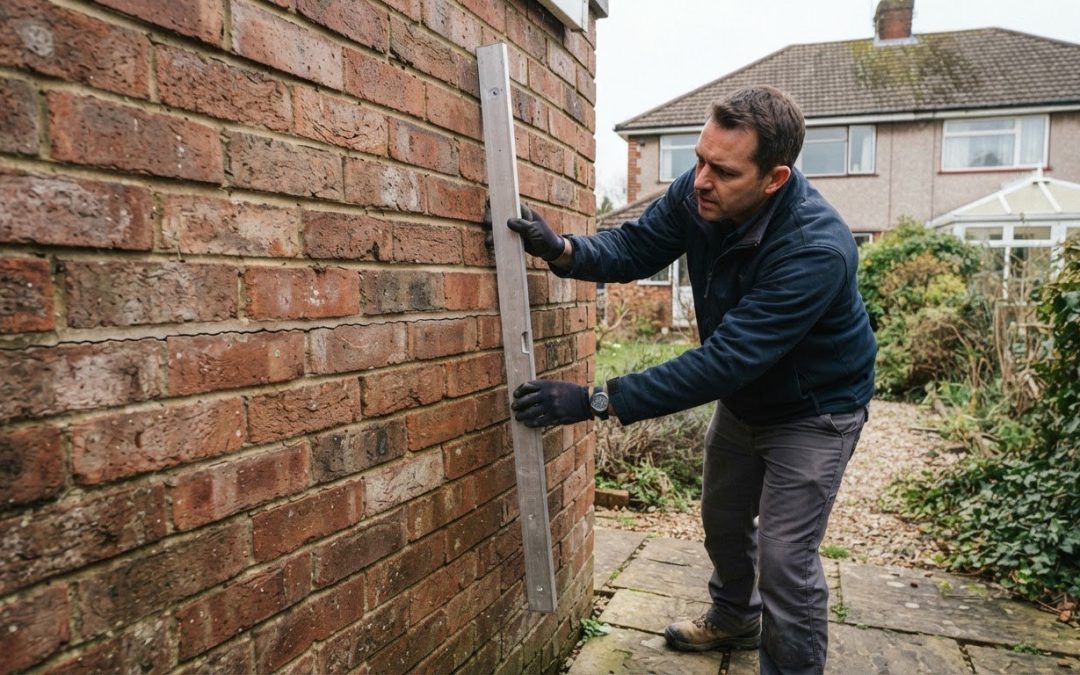
Could wall ties be corroding even if there’s no obvious crack? Yes. Horizontal cracks along mortar joints, or bulging and bowing brickwork, can be warning signs, but ties can also fail without visible damage. Knowing how to spot possible wall tie corrosion means looking at the overall pattern, not relying on one mark or crack.
It’s understandable to want a clear answer from what you can see outside. These signs may point to a problem, but they cannot confirm corrosion or show the condition of ties hidden inside the cavity. A specialist assessment examines the ties and surrounding brickwork before recommending what to do next.
This guide explains what cavity wall ties do, which signs may indicate corrosion, and how BRE 401 grading helps describe the level of corrosion and inform recommendations. It also outlines when a wall tie survey or inspection is appropriate, so you can make a measured decision about your property.
Key Takeaways
- Look for patterns in the brickwork, not just a single crack or patch of discolouration.
- Understand how photographs from an internal tie inspection can help document visible corrosion.
- Learn why wall bowing may indicate movement between the inner and outer leaves.
- See how BRE 401 grading helps describe corrosion and guide recommendations.
- Know when visible signs call for a specialist wall tie survey rather than guesswork.
When is a wall tie corroded?
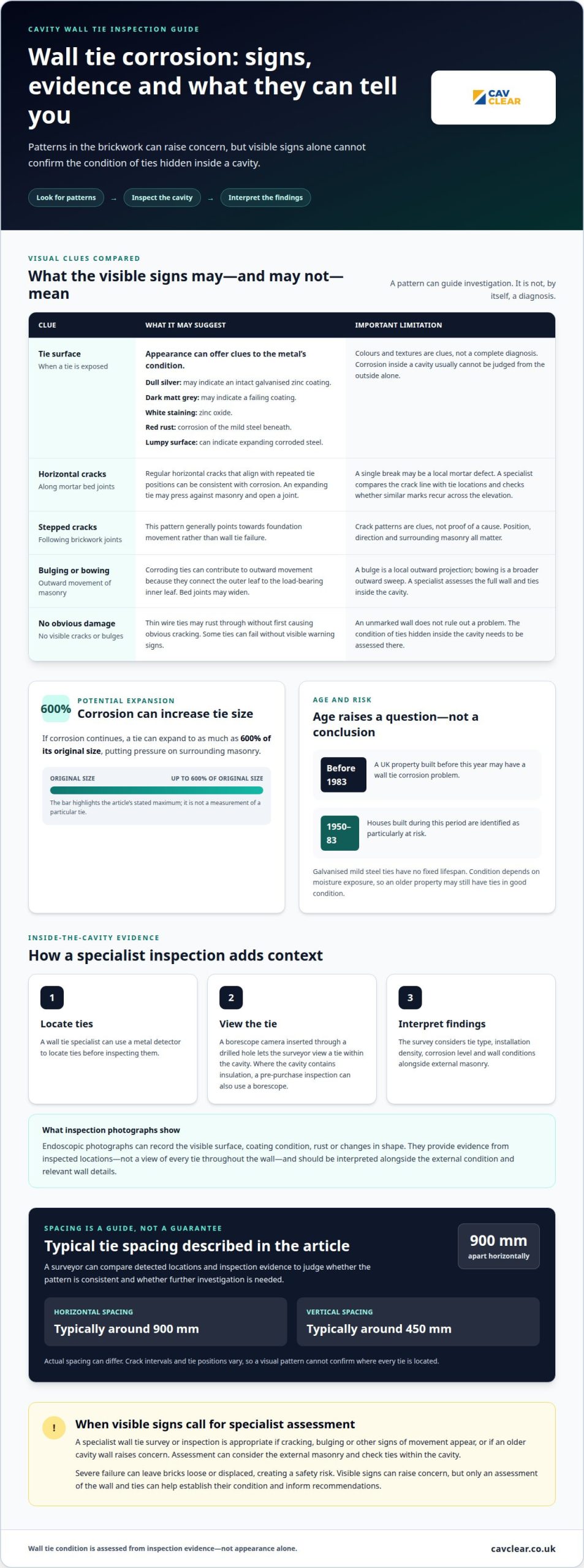
A wall tie is corroded when moisture causes its metal to deteriorate, but visible signs vary. On an exposed tie, dull silver can indicate an intact galvanised zinc coating. Dark matt grey may indicate a failing coating; white staining is zinc oxide; and red rust indicates corrosion of the mild steel beneath. A lumpy surface can also indicate that the steel is expanding as it corrodes.
Those colours and textures are clues, not a complete diagnosis. Corrosion inside a cavity wall can’t usually be judged from the outside alone, and thin wire ties may rust through without first causing obvious cracking. If corrosion continues, a tie can expand to as much as 600% of its original size, putting pressure on surrounding masonry.
Age helps establish risk, but doesn’t prove the condition of a tie. In the UK, a property built before 1983 may have a wall tie corrosion problem, with houses built during 1950-83 identified as particularly at risk. Galvanised mild steel ties have no fixed lifespan: their condition depends on moisture exposure, so an older property may still have ties in good condition.
A wall tie specialist can locate ties with a metal detector, then inspect them through a borescope camera inserted into a drilled hole. This lets the surveyor view a tie inside the cavity rather than relying only on exposed brickwork. Where the cavity contains insulation, a pre-purchase inspection can also use a borescope camera to examine tie condition.
Endoscopic photographs record what the camera reveals inside the cavity. Images can show a tie’s visible surface, including its coating condition, rust or changes in shape, and support the surveyor’s written findings. They provide evidence from the inspected locations, not a view of every tie throughout the wall. The report should interpret the images alongside the external condition and relevant wall details.
A wall tie survey also assesses tie type, installation density, corrosion level and wall conditions. Ties are typically around 900mm apart horizontally and 450mm vertically, but actual spacing can differ. A surveyor can use the detected locations and inspection evidence to judge whether the pattern is consistent and whether further investigation is needed.
A structural engineer or wall tie specialist should inspect a property if cracking, bulging or other signs of movement appear, or if an older cavity wall raises concern. A specialist inspection can assess the external masonry and check ties within the cavity.
If corroded ties are left untreated, deterioration and movement may progress, potentially causing bulging or bowing. Severe failure can leave bricks loose or displaced, creating a safety risk. Thin ties may also fail without obvious warning cracks.
What are the signs of wall tie failure inside?
Wall tie failure can sometimes cause cracks inside a property, but this is less common than external mortar damage. The location and direction of cracking help a specialist assess whether ties could be involved.
Cracking Along Mortar Bed Joints
Regular horizontal cracks in external mortar bed joints can follow the line of corroding wall ties. They may appear where ties are embedded, often at intervals of 450mm. The pattern matters: a horizontal crack aligned with repeated tie positions is more suggestive than an isolated break in mortar.
Corrosion can make a tie expand and press against the surrounding masonry, opening the joint. A surveyor compares the crack line with tie locations and checks whether similar marks recur across the elevation. This relationship can help distinguish tie-related damage from a local defect in one mortar joint.
Cracking inside the property is possible, but less common. If it appears, note whether it is horizontal and close to the corresponding external elevation. Internal cracks alone don’t establish wall tie failure; a specialist considers their position alongside the outer brickwork and evidence from the cavity.
Visible cracking is not essential for tie failure. Badly corroded fishtail ties can fail without obvious cracks, so an unmarked wall does not rule out a problem. Mortar joints can provide useful clues, but the tie’s condition needs to be assessed within the wall.
Recognising Crack Patterns
Crack patterns describe the direction and route of breaks through mortar or brickwork. Horizontal cracks along bed joints can be consistent with wall tie corrosion, while stepped cracking generally points towards foundation movement rather than tie failure. These patterns are clues, not proof of a cause.
Other signs can include vertical cracks, sagging lintels, upward cambering of window sills, lifting roof edges, separated window reveals or uneven floors. Each can have causes beyond wall ties. A specialist considers the full pattern, its position and the surrounding masonry before drawing conclusions.
For example, a recurring horizontal line along mortar joints may correspond with tie positions. A stepped crack following the brickwork joints suggests a different movement pattern. Cracks can also occur where there are no ties at the affected points, so their alignment and distribution matter more than appearance alone.
Wall tie installation density and actual tie locations can vary, which is why a visual crack pattern cannot confirm every tie’s position. A specialist survey combines external inspection with investigation of ties inside the cavity. If cracking is present, a wall tie survey can help establish whether tie corrosion is a likely cause and what assessment is appropriate.
Bulging or bowing of the outer leaf
A bulge is an outward curve or local projection in the external masonry, while bowing describes a broader outward sweep across a section of wall. In cavity walls, corroding ties can contribute to this movement because they connect the outer leaf to the load-bearing inner leaf. The change may be easier to see along a long, unsupported wall.
As a tie corrodes, expansion can press against the surrounding mortar and brickwork. Bed joints may widen, and the outer leaf can move upwards or outwards. This movement creates tension in the inner leaf and bending movement across the wall. The effect may appear as a local bulge or a more gradual bow across a wider area.
Bulging is a common result of wall tie corrosion, but it does not reveal the full condition of the ties. Where a wall has begun to bulge, ties are normally still intact to some degree. The movement needs to be assessed alongside the ties themselves, rather than treated as proof that every tie has failed.
Look at the shape and location of the change, not just one uneven brick. For example, a section projecting from an otherwise flatter elevation differs from a wall that appears consistently bowed. Cracks, widened mortar joints or displaced bricks in the same area add important context for a structural inspection.
Severe wall tie failure can leave bricks loose or displaced, creating a safety risk. If masonry appears unstable, keep clear of the affected area and arrange a prompt professional assessment. A surveyor can examine the external wall and investigate ties within the cavity to help establish whether corrosion is contributing to the movement.
The inner leaf may also be pulled outwards as the outer leaf moves. This means a visible bulge can reflect movement across the cavity, not just a surface defect in one brick. A structural assessment considers both leaves, the wall’s overall profile, and whether cracks or joint changes align with the affected section.
Galvanised mild steel ties can corrode when moisture damages their protective coating, but a bulge alone cannot identify a tie’s material or condition. Evidence from inside the cavity helps distinguish tie corrosion from other causes of uneven masonry. The assessment should relate the observed movement to tie locations and the condition of the surrounding brickwork.
For a long wall with visible bowing, or a local section with loose bricks and widening joints, a specialist wall tie inspection can assess the extent and likely cause. Early investigation provides a clearer basis for deciding whether monitoring or remedial work is appropriate, without relying on appearance alone.
BRE 401 corrosion grading and recommendations
BRE 401 helps describe the observed corrosion in cavity wall ties and inform recommendations. According to the Building Research Establishment, Digest 401, titled “Replacing Wall Ties”, was published in 1995. Its grading should be read as part of an inspection report, alongside evidence about the ties and the surrounding masonry.
A grade communicates the surveyor’s assessment of corrosion severity; it isn’t a visible sign you can reliably assign from outside. The report should explain the inspection evidence supporting the grade, which areas were examined and how the findings affect next steps. One corroded tie cannot automatically establish the condition of every tie across an elevation.
The practical response depends on the recorded condition. Slight early-stage corrosion may require monitoring, while confirmed corrosion alongside horizontal cracking calls for remedial wall tie replacement as soon as practically possible. A report should connect the recommendation to the observed corrosion and cracking, rather than treating the grade as a standalone instruction.
For replacement, the recommendation should make clear which areas need remedial work and how the proposed ties address the wall’s condition. Replacement ties are recommended at a density of 2.5 ties per square metre, with approximately 50mm-70mm embedment into the internal masonry leaf. These figures describe the stated recommendation, not a substitute for assessing the property and its wall construction.
BRE 401 is the relevant technical publication for wall tie replacement, but its grading is not a guarantee of workmanship or future performance. A grade should not be treated as a certificate. The report and any separate written assurance serve different purposes, so readers should understand what each document actually covers.
Corroded ties are repaired or replaced by installing replacement ties to stabilise the cavity wall. The method and extent depend on the wall and inspection findings; the report should identify the remedial recommendation. BRE 401 also informs the approach to checking completed installation, including random tension testing of replacement ties.
Pull-testing applies a controlled tensile load to selected ties. Results are recorded and assessed against acceptance criteria to provide evidence about the ties’ resistance under tension and installation performance. This does not replace the initial survey or explain corrosion elsewhere in the wall. A specialist interprets the results alongside the locations examined and recommended work, so the report links installation evidence to the relevant wall sections.
For example, a report describing slight corrosion without horizontal cracking may recommend monitoring, while confirmed corrosion with cracking may support timely replacement. The grade, photographs, test results and remedial recommendation should form a consistent record. This distinguishes an observation from a repair decision and keeps the next step tied to the wall’s actual condition.
For UK properties, BRE 401 provides a technical framework for describing corrosion and considering remedial work. The inspection findings and replacement specification explain how the recommendations apply to the wall under assessment.
Horizontal cracks in brickwork from corroding wall ties
Cracks associated with corroding wall ties often run horizontally along mortar courses in an external brick wall. They may follow joints where ties are embedded, forming a line that continues across part of the elevation. Knowing how to spot possible wall tie corrosion starts with noticing this pattern, while remembering that a crack alone cannot confirm its cause.
In some cases, horizontal cracking splits the external brickwork into panels only a few hundred millimetres tall. The crack may follow a bed joint rather than cut diagonally through individual bricks. Check whether the line continues across several bricks and whether similar horizontal cracks appear at other levels.
A repeated pattern is more informative than one isolated crack. During an inspection, the surveyor compares the crack’s position with suspected tie locations and checks adjacent mortar joints. Cracking that aligns with tie positions can support further investigation, but appearance alone cannot establish corrosion or show how many ties are affected.
Corrosion can make a metal tie expand against the surrounding masonry. That pressure may widen a bed joint and produce a horizontal split along the mortar. The visible break can vary in width and continuity, so both a fine line and an open joint need to be considered alongside the wall’s wider condition.
Horizontal cracks alone cannot diagnose wall tie corrosion. Badly corroded fishtail ties may fail without visible cracking, while other structural issues can also cause cracks. A wall without obvious horizontal lines cannot be assumed to have sound ties, and a crack does not by itself prove tie failure.
Check the crack’s route and position, and how it relates to the surrounding brickwork. For example, a horizontal line following one bed joint differs from stepped cracking that follows the edges of bricks. A surveyor also considers whether the same pattern occurs elsewhere and whether the outer leaf shows movement or bulging.
Crack evidence is only one part of an assessment. A specialist wall tie survey can combine an external inspection with an investigation of ties inside the cavity, then document the findings and recommend next steps. This helps distinguish visible symptoms from the underlying condition of the wall and its ties.
If you’re considering how to spot possible wall tie corrosion after seeing recurring cracks or other movement, a specialist assessment can investigate whether ties are involved. Arrange a wall tie assessment to examine the brickwork and cavity evidence.
CavClear
CavClear helps property owners investigate suspected wall tie corrosion through Wall Tie Surveys & Reports, Cavity Wall Insulation Surveys and Specialist Cavity Wall Inspections. These assessments consider visible masonry signs alongside the condition of ties within the cavity, helping clarify whether cracking or movement may be related to corrosion.
Where survey findings identify failed or corroded ties, the report can recommend remedial steps, including Wall Tie Replacement where appropriate. If cavity wall insulation is also a concern, CavClear provides Cavity Wall Insulation Removal when a professional survey confirms it is needed. The appropriate next step depends on the inspection findings and the wall’s condition.
If you’ve noticed cracks, bulging brickwork or other signs of movement, contact CavClear to discuss a specialist assessment.
Choose a clear next step for your property
Knowing how to spot possible wall tie corrosion gives you a reason to investigate, not a diagnosis to make alone. The useful next step is to have the wall assessed as a whole, rather than deciding on remedial work from one visible sign. This keeps the decision grounded in the property’s actual condition.
When arranging an assessment, describe what you’ve noticed and where it appears. Note whether the concern is limited to one elevation or occurs in several areas. These details give the specialist a practical starting point for examining the wall and explaining how the findings relate to your concerns.
A clear report can help you understand the recommended next step and plan work carefully. If remedial action is advised, use the findings to understand its purpose and the areas involved before deciding how to proceed. This turns a worrying observation into a manageable property-maintenance decision.
For a measured next step, contact CavClear about wall tie concerns. A specialist assessment can help bring clarity to the condition of your property and give you a practical way forward.
Frequently Asked Questions
What Are Cavity Wall Ties?
Cavity wall ties are metal connectors linking a wall’s inner and outer leaves, helping the masonry act as a stable structure. Builders embed them in mortar joints during construction. If you’re looking at a property, the ties are usually hidden inside the cavity, so their type and condition can’t be established from the brick face alone. An inspection can identify the tie arrangement and assess whether further investigation is needed.
Which houses are most at risk?
UK cavity-walled homes built before 1983 may be at risk, particularly properties constructed during 1950-83. Age is a useful indicator, not proof of corrosion: moisture exposure and the tie’s condition also matter. For example, two homes from the same period can have different findings after inspection. A property’s construction history can help a specialist decide where to focus checks, but it cannot replace evidence from the wall itself.
What are the common signs of wall tie corrosion in UK cavity walls?
Possible signs include recurring horizontal cracks in mortar joints, bulging masonry, widened bed joints and displaced bricks. Internal cracking can occur, though it’s less common. These features can have other causes, and some ties can fail without clear cracking. If you notice a pattern across an elevation, record its location and appearance for the surveyor. The combination of visible changes and inspection evidence is more useful than one symptom alone.
How can bulging or fretting brickwork indicate wall tie failure?
Bulging suggests that part of the outer masonry has moved outwards, while fretting describes mortar or brick edges breaking down. Either may appear alongside tie-related movement, but neither confirms the cause on its own. For instance, local mortar wear at one joint differs from a broader wall section bowing outward. An inspection compares the affected area with nearby brickwork and examines the cavity ties before recommending remedial work.
How can you distinguish wall tie corrosion from other causes of cracks in masonry?
Crack direction and location offer clues, but they don’t prove the cause. Horizontal cracks following mortar bed joints may be associated with wall ties; stepped cracks generally point towards foundation movement. A surveyor also considers whether cracks recur across an elevation, whether the wall has moved and what the cavity inspection reveals. This joined-up assessment helps distinguish a possible tie issue from other masonry movement.
How does a wall tie corrosion inspection or borescope survey work?
A survey starts with an external visual inspection, followed by locating ties with a metal detector. The specialist then inserts a borescope camera through a drilled opening to view ties inside the cavity. Endoscopes can record images of visible evidence, and optional alternative inspection methods may suit insulated or hard-to-reach cavities. The findings are recorded in a detailed report linking the inspected locations and observed tie condition with recommended next steps.
Recent Comments